Prop and Predator
Galerie Noah Klink, Berlin
27.04. – 23.06.2024
in conversation with Ben Broome
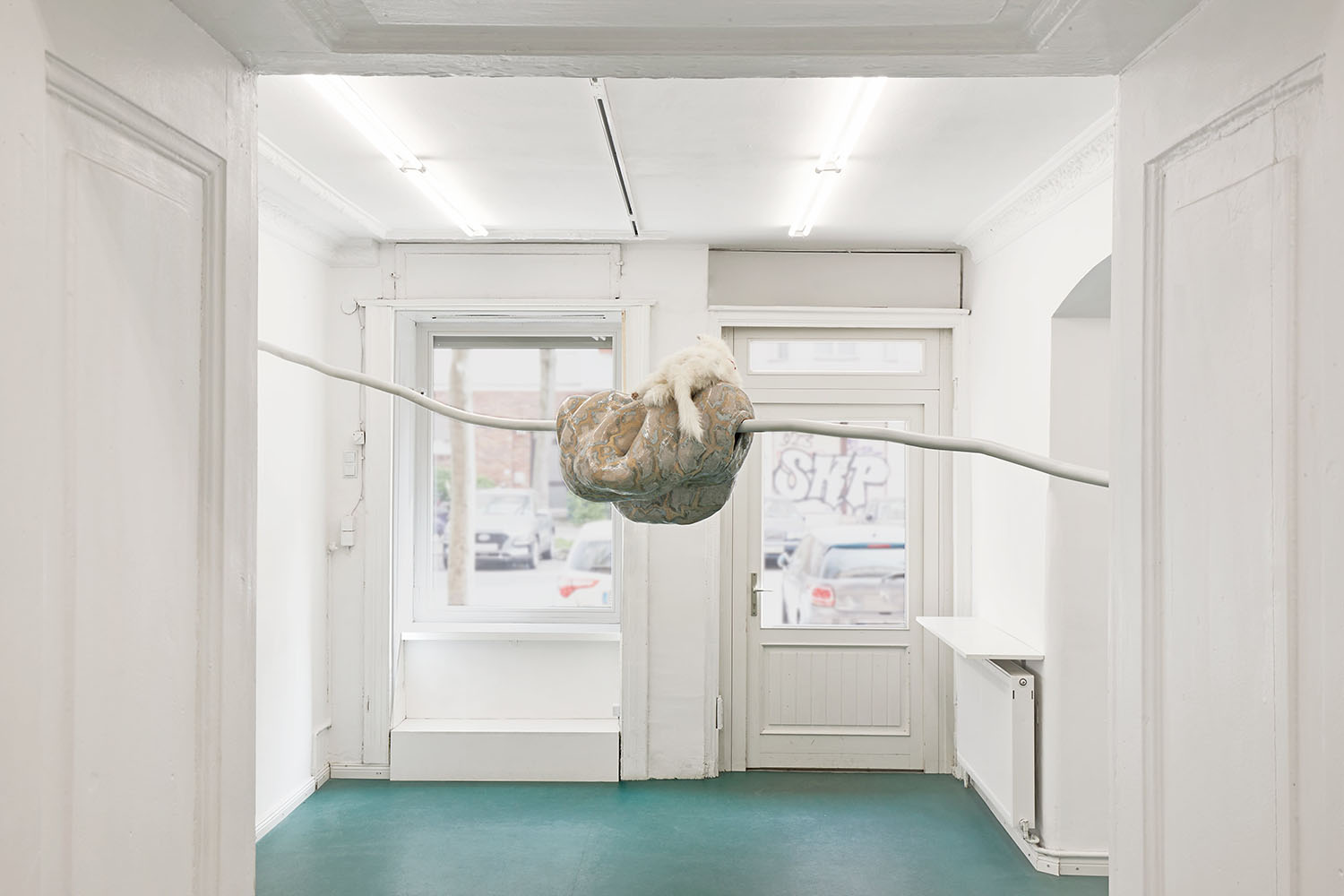
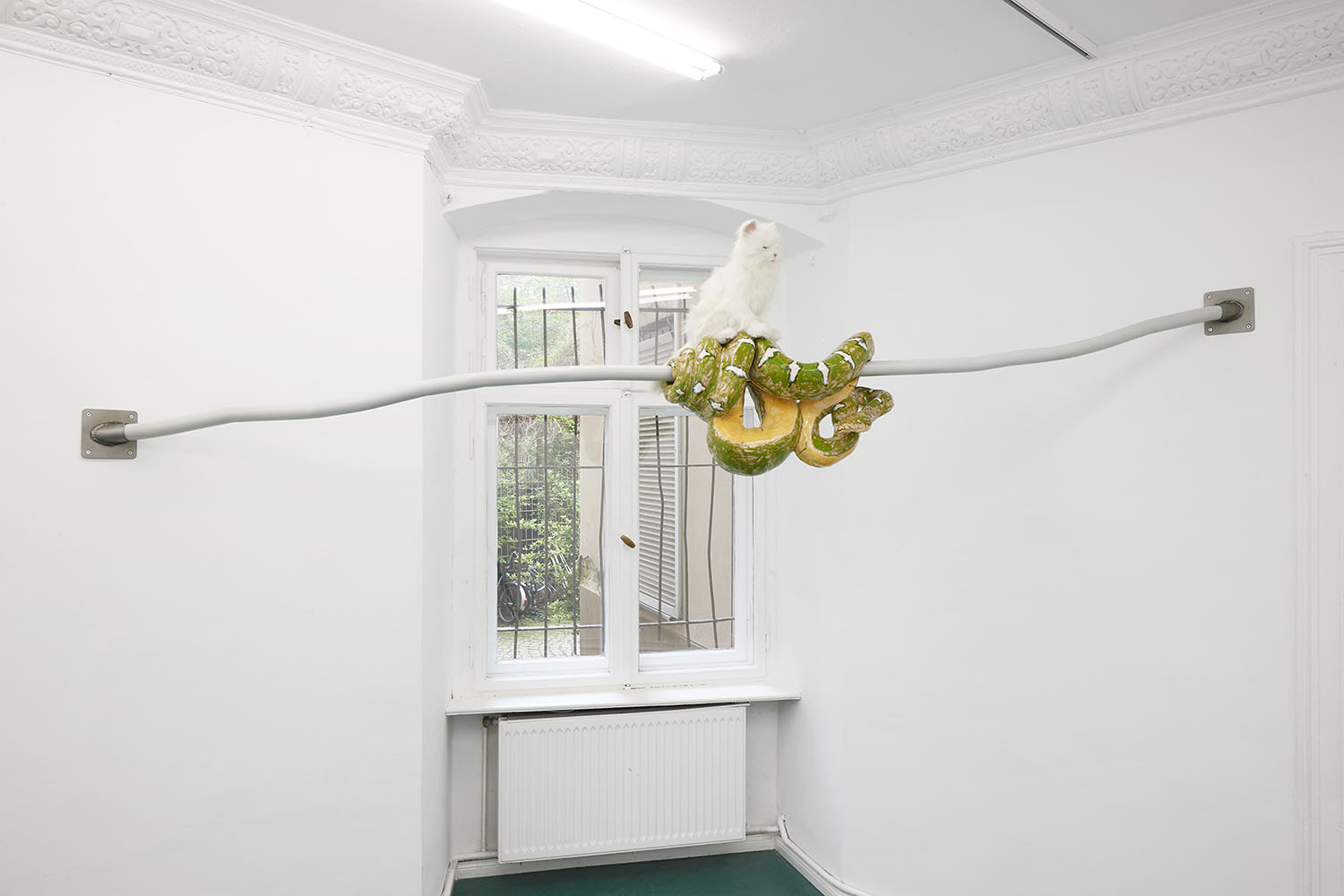
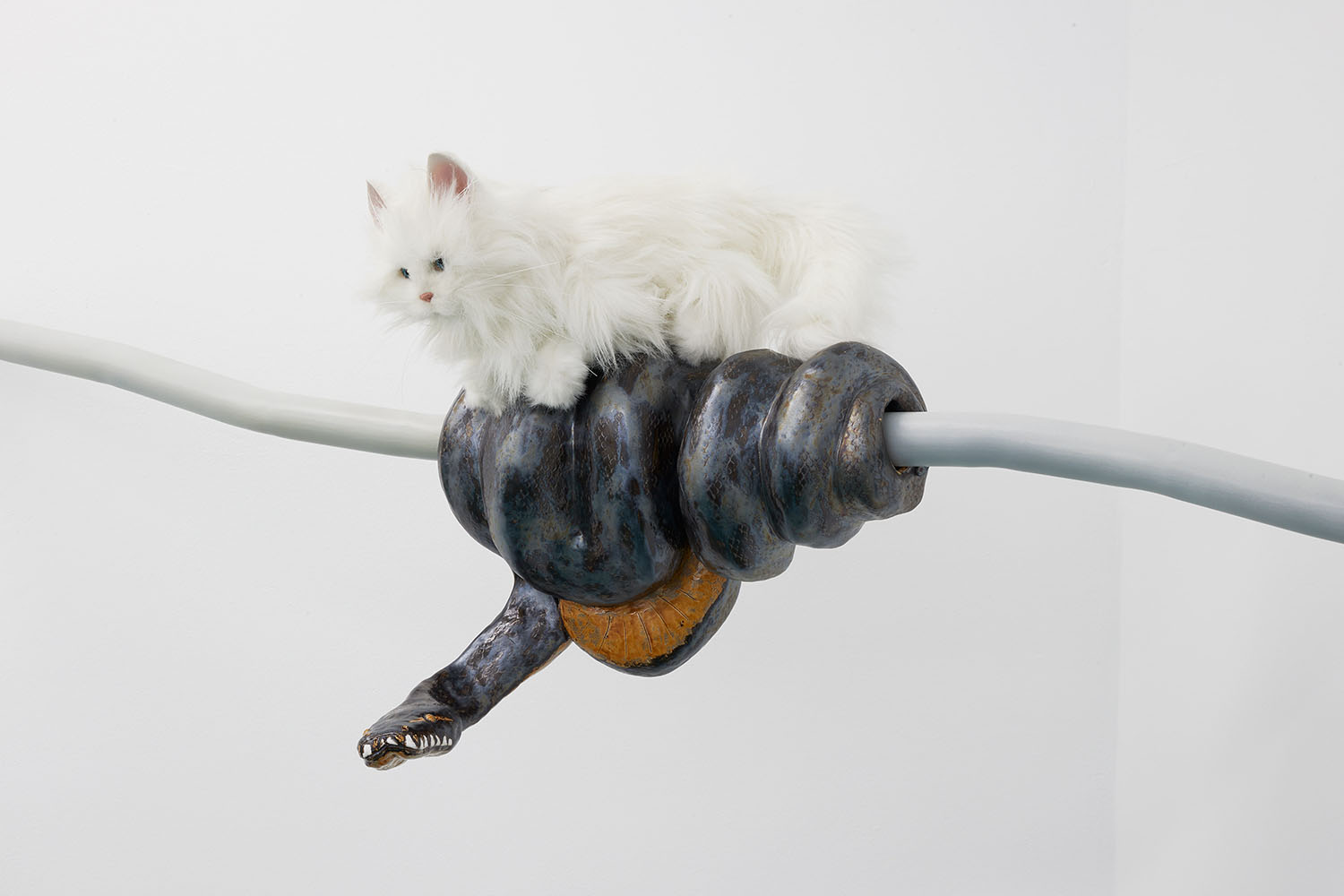
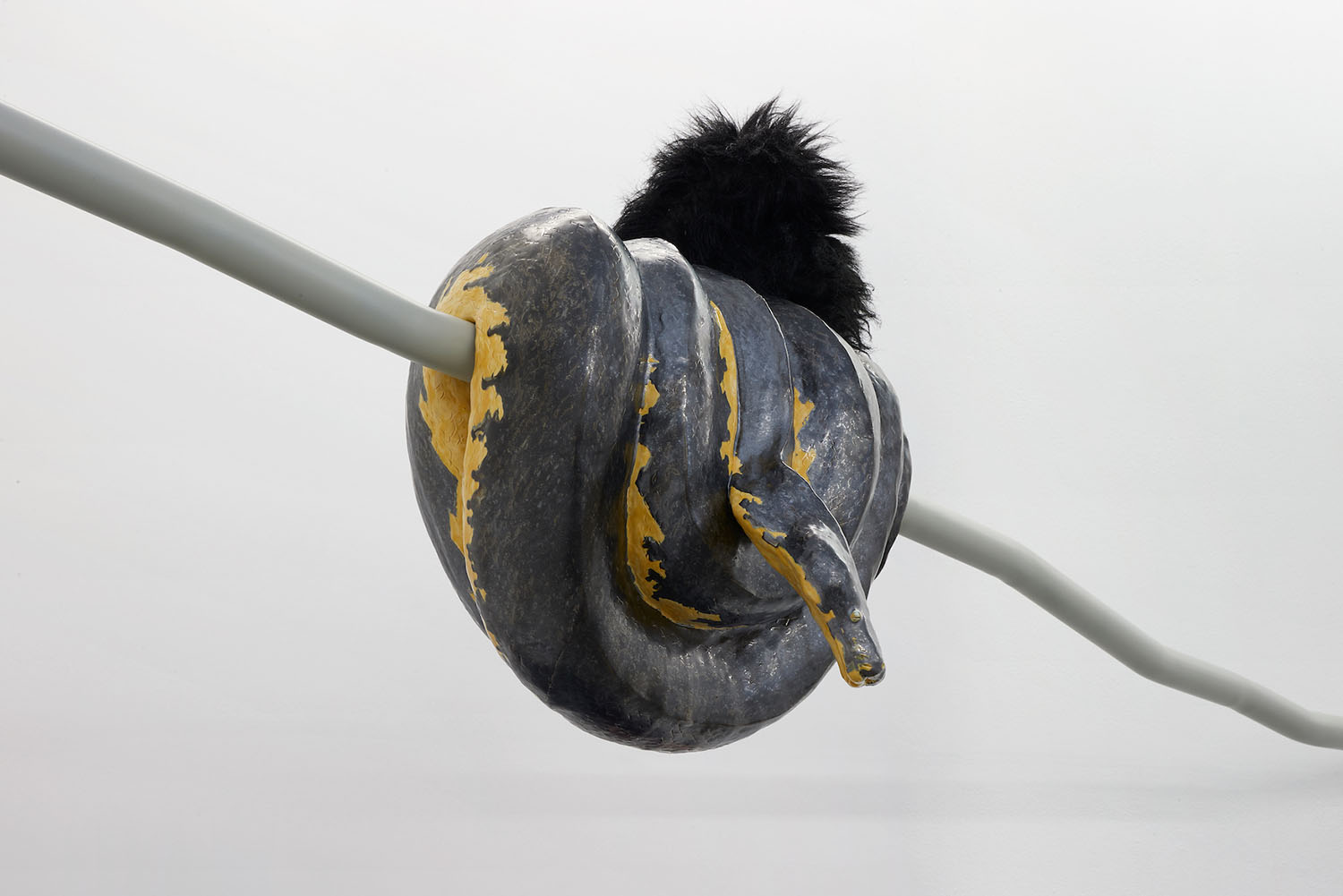
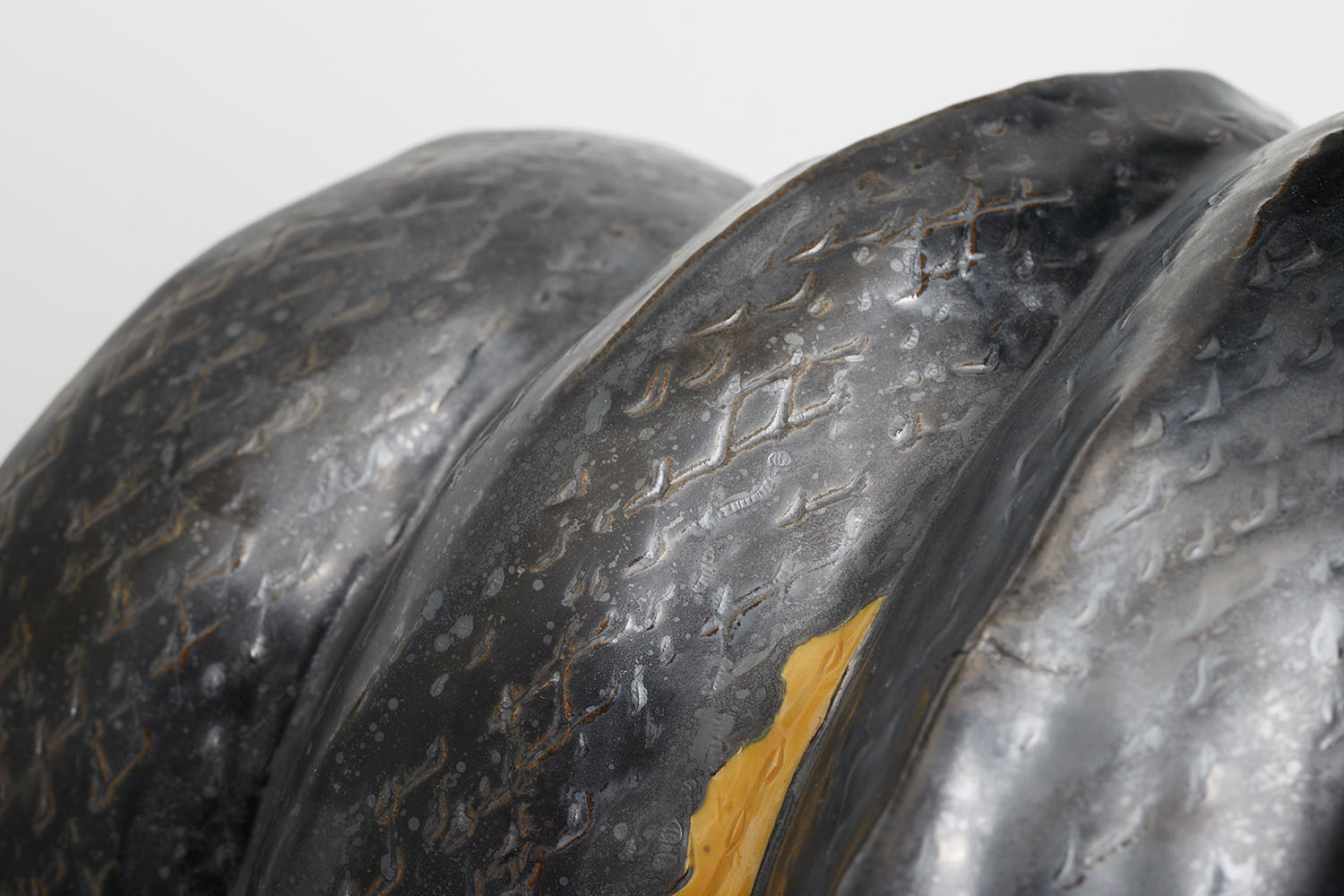
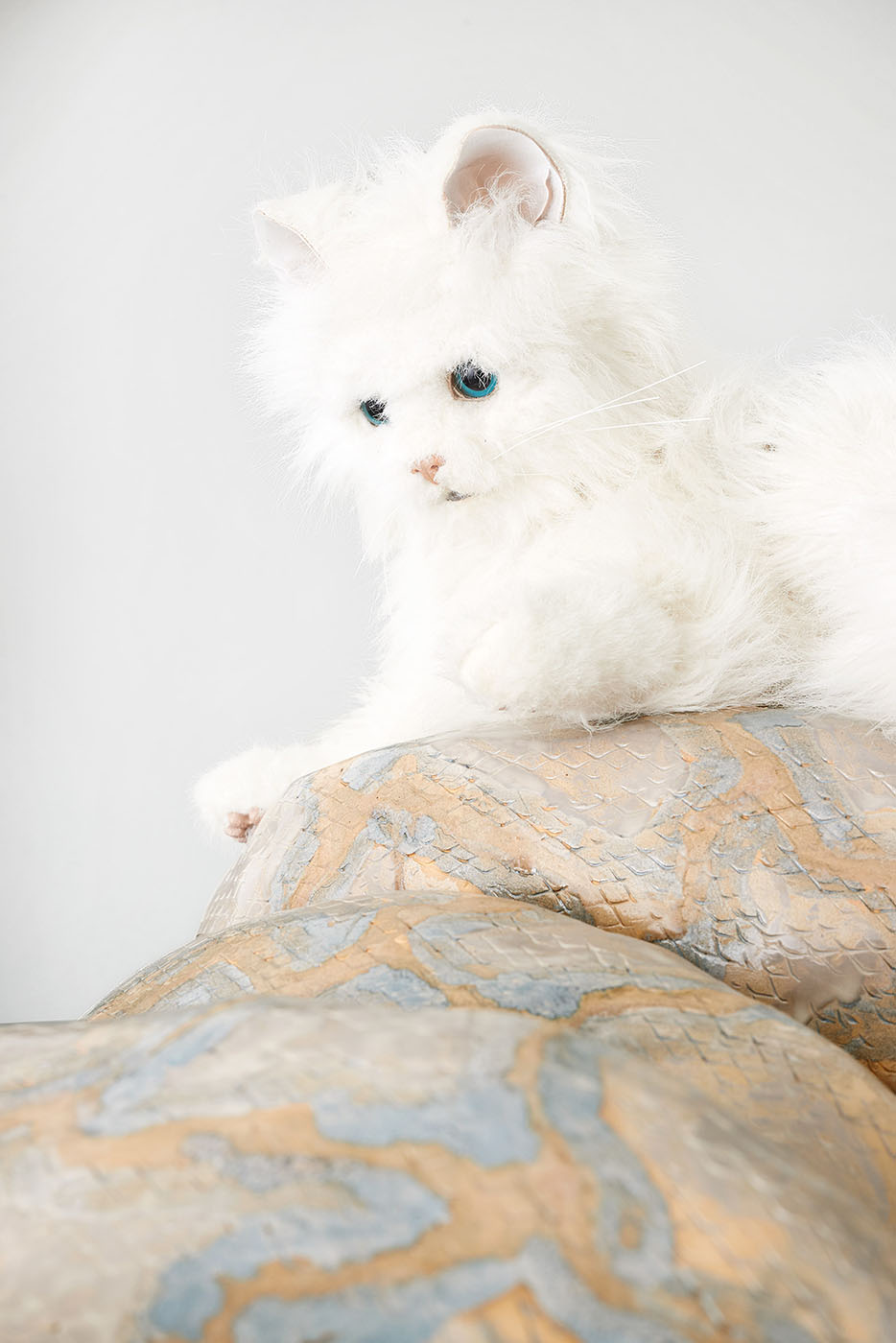
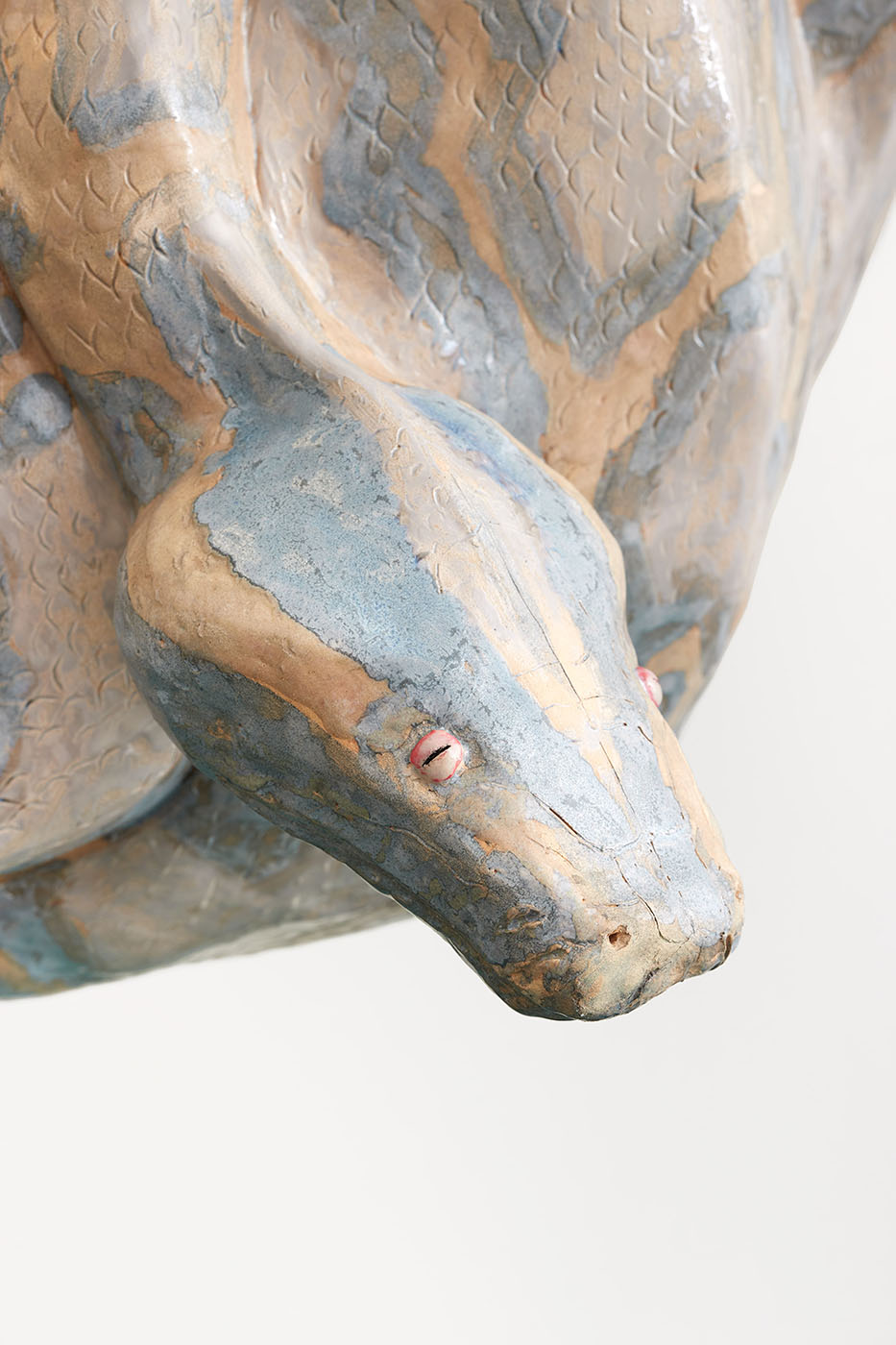
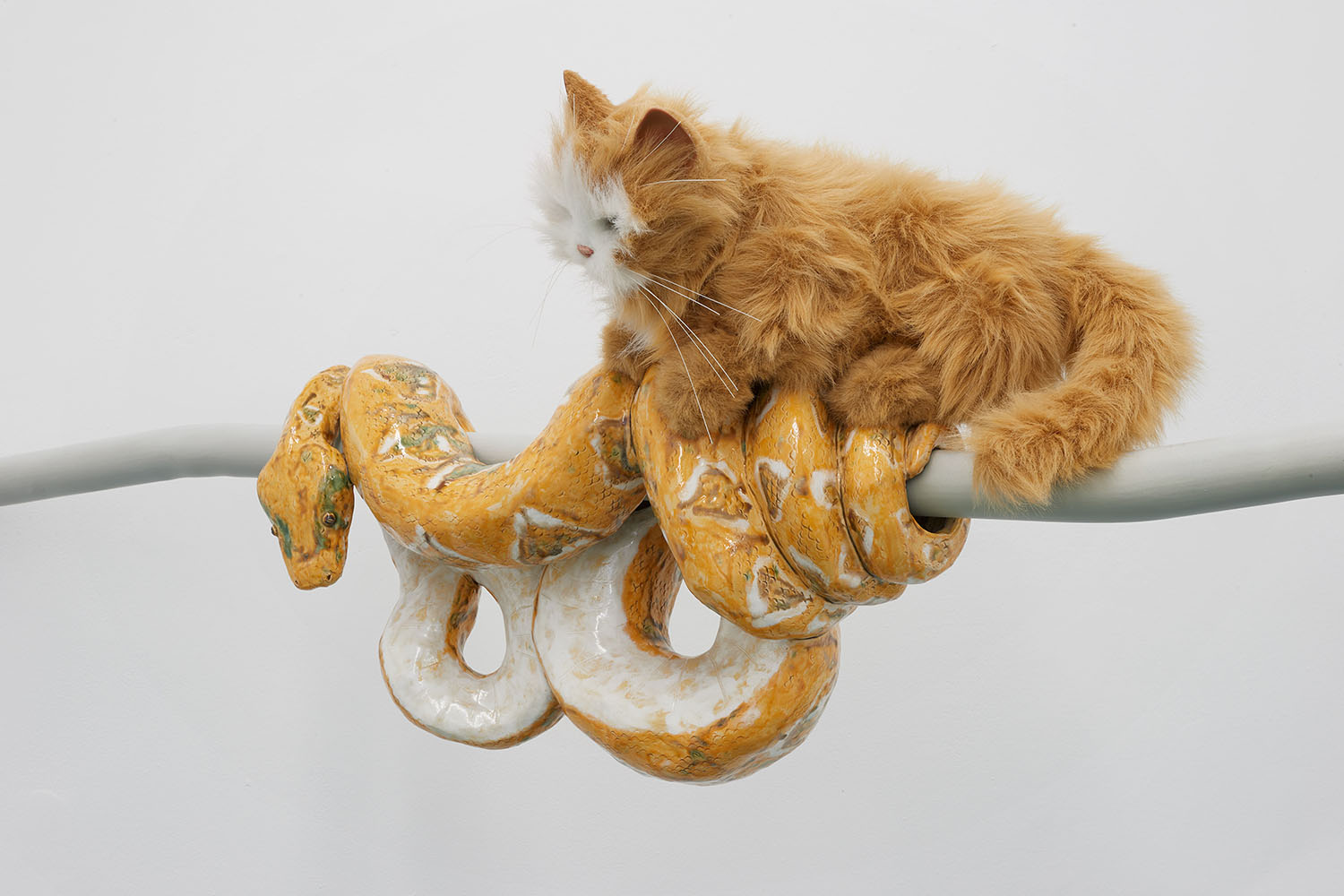
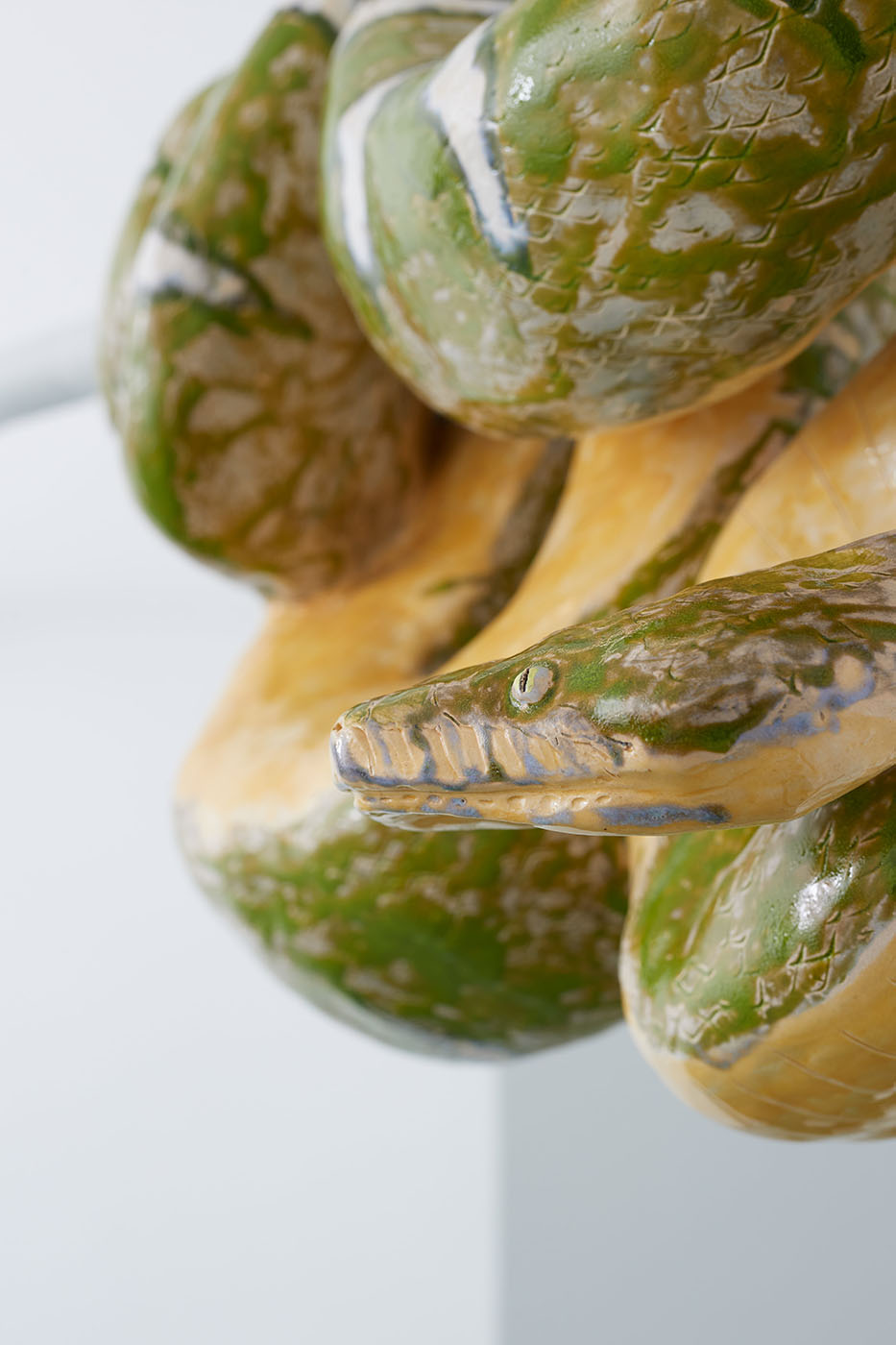
Entering Prop and Predator, Gerrit Frohne-Brinkmann’s exhibition at Galerie Noah Klink, viewers are met by steel bars criss-crossing the Berlin gallery at eye level. From each bar hangs life-size, and meticulously crafted, ceramic pythons accompanied by antiquated (and sometimes grubby) animatronic cats perched atop their serpentine companions. Frohne-Brinkmann’s latest offering encourages a rethinking of the traditional positions these often-domesticated animals hold in mass-media, continuing the artist’s investigation into consumerism, spectatorship and the collision between the natural and synthetic. Speaking over zoom the week following my visit the Hamburg based artist expands:
Your work concerns technology that may be obsolete: this notion of technological archaeology runs throughout. What part does obsolete technology play in your practice?
The moment technological elements came into my work was when I started working on the Dirty Parrots (2018). It continued with the ILOVEYOU (2021) work that utilised computer towers that had been infected by the Love Bug computer worm. It was a famous millennial catastrophe, a worldwide infection that made companies collapse and cost billions in damages. I remembered this from my childhood as a big event that no one could really understand; suddenly my parents would warn me about things happening on the internet that they couldn't control. Remembering this catastrophe I wondered if there were computer towers still with this virus inside them, a sent or received love letter (that's how the virus spread)...I was touched by the idea of this lovesick technological entity. My starting point was to question how we see technological entities, investigating the ways we find to relate to technology. I like this idea of displaying objects that are useless in our contemporary reality but still could be seen as an ancestor of some technological development.
There's a parallel between those lovesick computer towers and the animatronic cats in your current Noah Klink exhibition Prop and Predator in the sense that love is lost for both. The cats and computers were perhaps much loved at one point.
Yes, they were loved, they were maybe part of a family, a substitute for a pet. They have a different function now versus when they were new…now they embody a discarded memory. One of the main questions I attempt to ask in my work is ‘when does something become an object or a thing worthy of being collected or exhibited?’. The robots that I use for my work resemble the animal they were modelled after (a parrot or a cat), but at the same time resemble a robot. They’re a marker of consumer behaviour and the history of consumption for this specific time: the early 2000s. They possess an aesthetic that signifies the integration of technology into our personal lives, into toys or into consumer goods. The animatronic objects outlive the natural age of a cat, I find it astonishing that they’re still working, that they’re still here.
You speak about the two entities present in these new works—the snake and the cat—within the context of prop and predator, prey and protagonist. How do you differentiate between these classifications?
These four words evoke nature’s food chain and also connotations of theatre or staging. I wanted to find a way to combine the animatronic found objects with my naturalistic ceramics, a way to make sculptural collage that questions the hierarchies between the snake and cat but also the hierarchical connotations of the pairs of titling words. The cat is animated and the snake is still but the snake has the quality of a handmade sculpture—it has a certain worth in terms of craftsmanship. One animal is considered wild, whereas the other is domesticated but they both could be considered prop, predator, prey or protagonist depending on how they’re viewed and the context in which they exist.
I saw them both within the context of domesticity and the keeping of pets. They're both creatures that have become tamed in the work.
The keeping of plants and animals at home merges natural science and entertainment culture. I really like how, for example, if you had an enclosure for a snake at home, you might also make a certain staging for it, you might create your own exhibit.
Staging and theatre imply entertainment. Do you consider entertainment value in the exhibition of these works?
The simple effects in my work, the movements and noises the cats make, exhibit a kind of limitation: you see the movements and hear the sounds but these can only repeat so the entertainment value diminishes with time. Disappointment begins to grow as you see the repetition of the few pre-programmed actions— then it's stuck there, they freeze, they become dysfunctional. I guess at that point it becomes quite useful for me to kind of ask the question “what does a viewer expect to get from seeing the work?”. You immediately described the cats as something technological but other visitors reacted as though they were cute pets or were even repulsed by the snakes. They elicit a response on a variety of levels depending on the viewer. I quite like that.
The notion of prop / predator, there’s a pairing there. A conflicting pairing but also a harmonious one. I was thinking about some of your other works: your Earmouse (in seashell) series (2022) or Bugs I & II (2022). There is a conflict and symbiosis in those works too, how do you view this clash?
There is a harmony in these works but I’d describe it more as a dependency. Who's dependent on who or which structure is supporting which? The Earmouse (in seashell) series was born from another famous internet phenomenon in the nineties: a research programme by a group of scientists around Charles A. Vacanti that grew a human ear structure on a mouse's back. This image of the mouse and human ear spread around the world and, in doing so, lost its context. Opponents of genetic engineering would use it as an example of science getting out of hand but, at the same time, there was no genetics involved at all. I felt a conflict in myself: I was moved by the tragic life of this mouse but I liked the combination of this animal with a technological or human element. I let this mouse appear in my work but I didn't really know where to place them or why they existed. I thought that, by building larger than life sea shells around them, I’d give them a stage and make them appear almost as if they were a pearl. In German we say Ohrmuschel which translates as ‘ear shell’ so there's this semantic or associative repetition of the ear. I was thinking of Botticelli’s Venus as a symbol of perfection appearing as a pearl inside the scallop shell. The seashell is close to perfection in nature, I liked the challenge of attempting to recreate that perfection in a ceramic structure. This is an intrinsic part of artistic production: If you do a lot of things by hand, then of course you are limited by your own abilities. A question that I often ask myself is “how good does it have to look to be a snake or to become a seashell?”
The animatronic cats in Prop and Predator were originally fabricated to be as lifelike, as close to nature as possible. Do you consider the ‘real’ natural world when making ceramic forms?
My goal was to make the ceramics look as close to a real snake as the robotic cat would look to a real cat; I wanted the ceramics and the animatronics to possess a similar level of natural realness. I’m fascinated by the very basic phenomena from the natural world: you put a seed into the soil and then something grows. The way we learn how our world works is very much informed by the museum exhibition. You might go to a museum to see the skeleton of a whale or drawers of pressed flowers. The mixing and questioning of these methods of learning and viewing is something that can happen in an artistic field. I like to copy ways of presentation that could be associated with a science museum or a zoo but then exhibit these objects where it's unclear to the viewer what they’re actually being shown or how one might relate to them.
A viewer could see your work through the lens of the natural sciences or within the context of conceptual arts. Natural science has a very defined point of entry. Conceptual art is, of course, much more abstract and open. Does one inform the other for you?
In my studies I was fascinated by conceptual art, I liked to think about the strategies and ideas behind artworks and exhibitions. With time it became obvious to me that I wanted to make things from a very basic idea of expression. At that point the concept lost some importance; to me it’s not necessary to consider my work as very conceptual or intuitive and figurative. I enjoy that, working as an artist, you can just do stuff or collect stuff…I’ll find a black and white cat on eBay that I haven't found before and get really excited about it!
Gerrit Frohne-Brinkmann
Prop and Predator
Galerie Noah Klink, Berlin
27.04. – 23.06.2024
All images courtesy of the artist and Galerie Noah Klink
Photos by Volker Renner