Text by Philippa Snow
CURA.45
The Blackout Issue
Essay
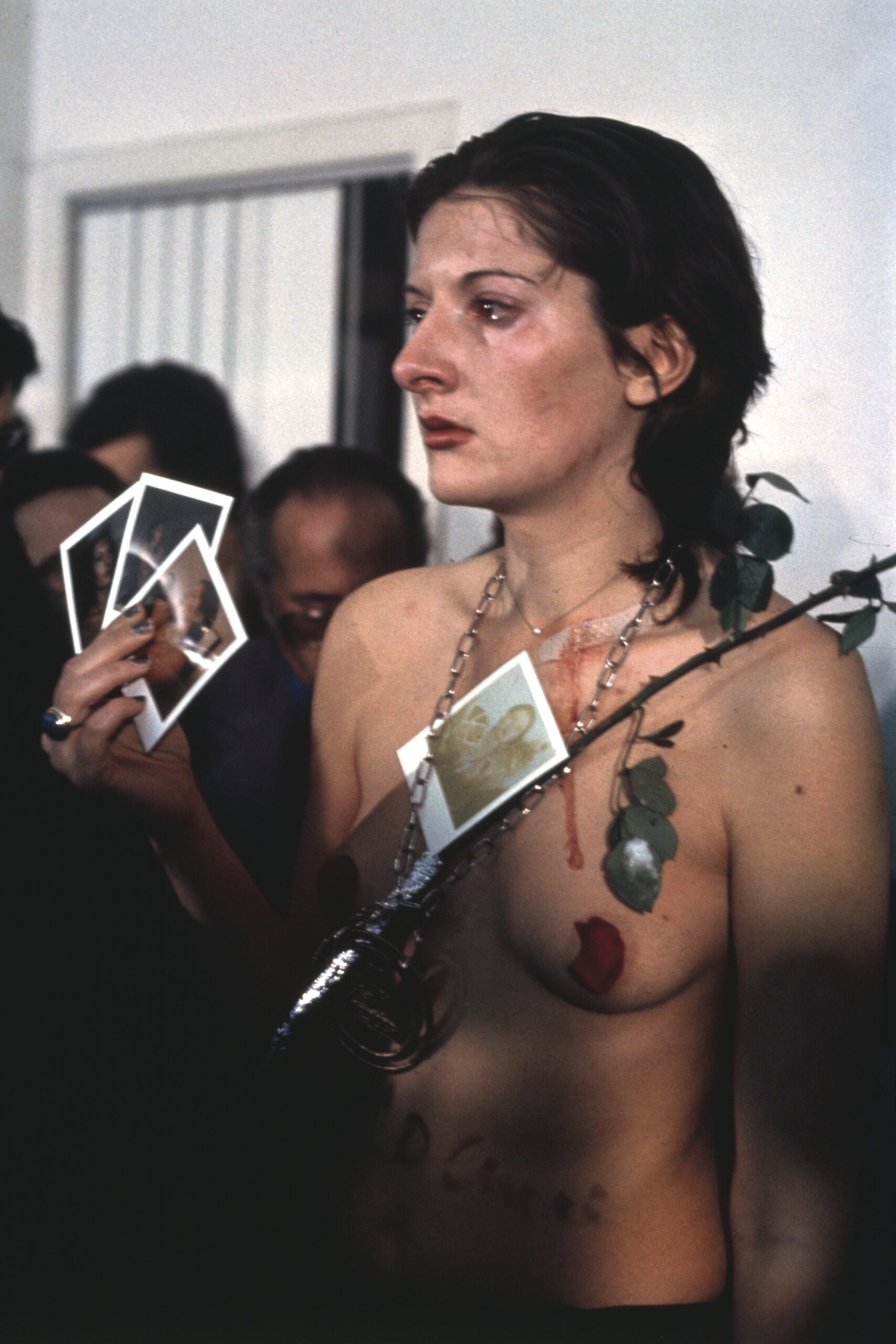
Marina Abramović, Rhythm 0, performance (6 hours) Studio Morra, Naples, 1974
Photo: Donatelli Sbarra © Marina Abramović Courtesy: Marina Abramović Archives
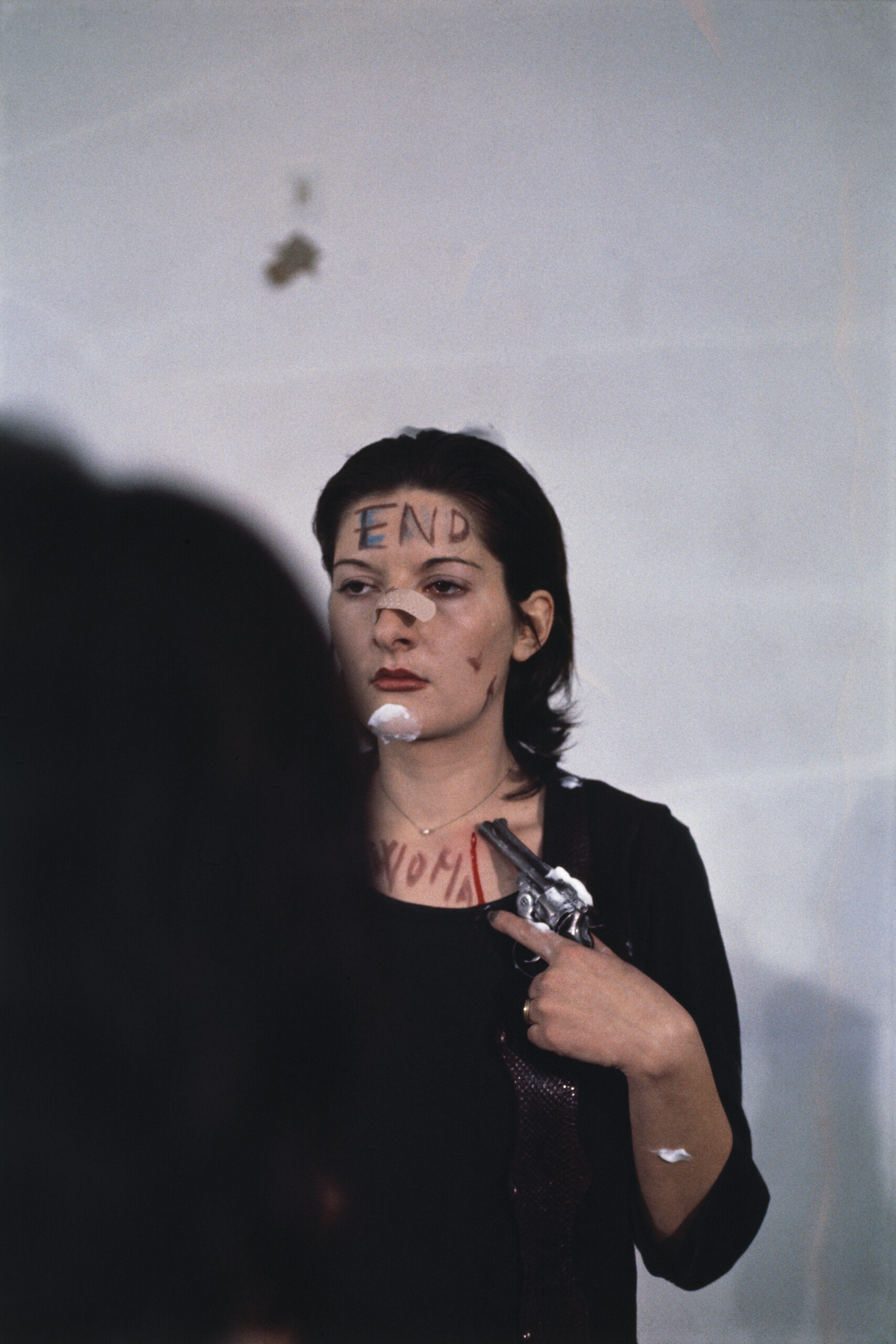
Marina Abramović, Rhythm 0, performance (6 hours) Studio Morra, Naples, 1974
Photo: Donatelli Sbarra © Marina Abramović Courtesy: Marina Abramović Archives
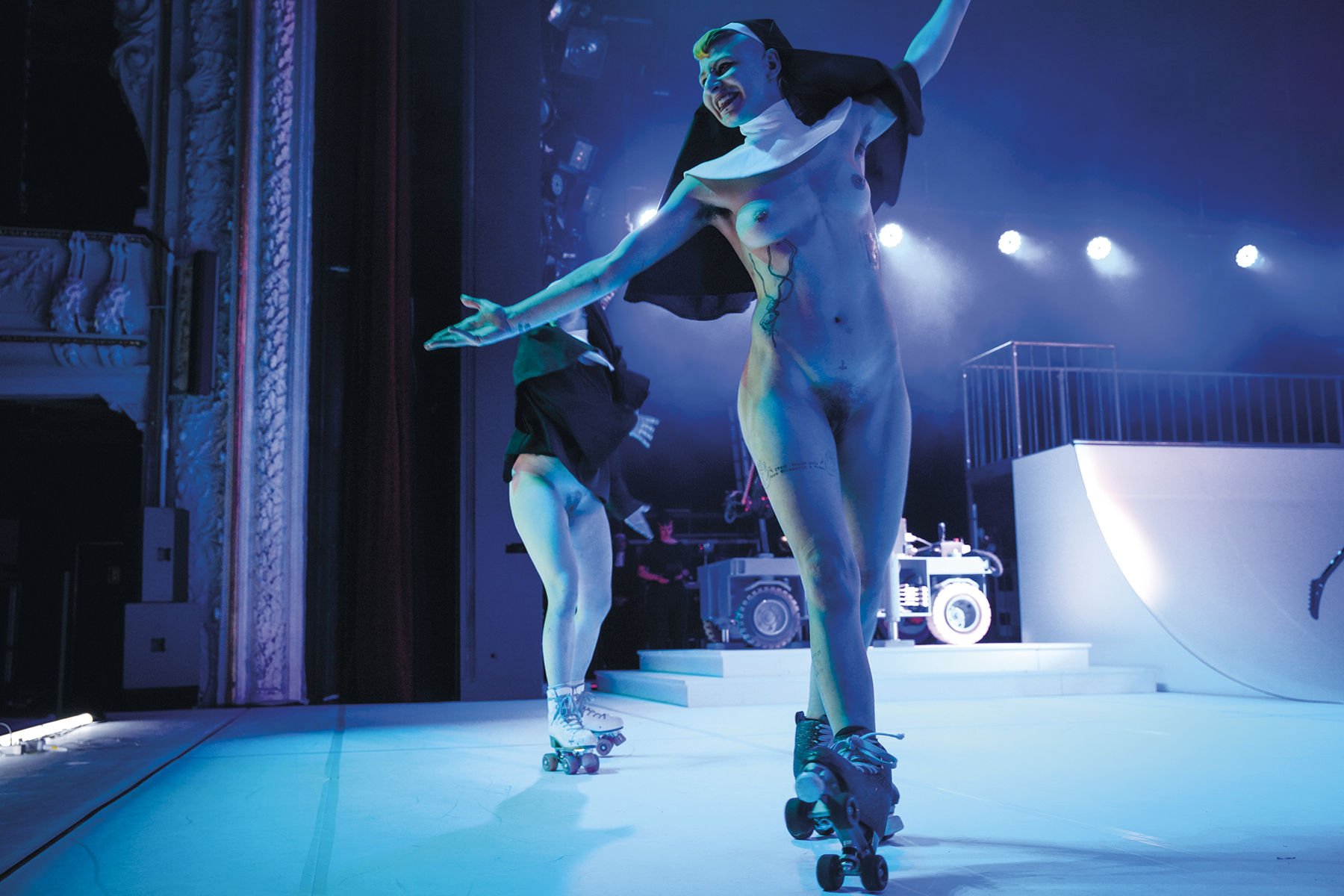
Florentina Holzinger, SANCTA, 2024 Photo: Nicole Marianna Wytyczak
Courtesy: the artist and neon lobster

Florentina Holzinger, SANCTA, 2024 Photo: Matthias Baus
Courtesy: the artist and neon lobster

Jordan Wolfson, Female figure, installation views, David Zwirner, New York, 2014
Photo: John Smith © the artist Courtesy: the artist and David Zwirner

Jordan Wolfson, Female figure, installation views, David Zwirner, New York, 2014
Photo: John Smith © the artist Courtesy: the artist and David Zwirner
As someone who has spent a significant amount of time over the past few years thinking and writing about body-based, extreme performance art, I must confess that lately, I have kept returning in my mind to the subject of the British adult star, Bonnie Blue. Best known for a penetrative stunt in which she allegedly had sex with 1,057 men, Blue is fascinating for two reasons, the first being the scale-and-endurance-focused nature of her video content, and the second being her affect—one that is not simply flat, but so thoroughly devoid of emotion that it almost resembles a Zen state. “If I was an athlete and did loads of marathons, nobody would care,” she remarked in a recent documentary. “But because I’m trying to push my body in a sex perspective, everyone’s like whoah, you’ve gone too far.” If it’s true that her feats of bodily excess would be more readily embraced by society if she were an athlete, it is also true that they might be deemed acceptable—at least by a rarefied group—if she were positioning them as performance art. I am hardly the first to hear about Blue and immediately think of Marina Abramović. A writer from The Times, in fact, directly referenced Abramović’s 1974 Rhythm 0 in an interview with Blue this summer, making a direct comparison between that work, and an act that the adult performer was planning with the piquant working title Bonnie Blue’s Petting Zoo. Abramović’s piece saw her presenting her audience with 72 objects on a table, including razorblades and a gun, and allowing them to use them on her body as they pleased. Blue, in a performance intended for streaming on the website OnlyFans, was to be trapped in a glass box and left open to all manner of sexual violations. “[But Abramović] gave them all these horrible sharp things,” she pointed out in The Times, “and I was just going to have dildos and lube.”
“In essence,” Georges Bataille wrote in Erotism: Death and Sensuality, “the domain of eroticism is the domain of violence, of violation.”
In Blue’s unintentional homage to Abramović, the gun would have been substituted for the humble phallus, or rather for many humble phalluses—funny, if not necessarily funny ha-ha, since symbolically speaking, it is usually the other way around. What makes me think of Blue and Abramović as funhouse mirrors for each other is not merely the obvious similarity of these two performances, but also their mutual ability to greet the potential for violence with an ice-cool hauteur. Both women have about them an air of spooky, superhuman tolerance for abnegation, and while one uses this tolerance to create material that is meant to be hot, and the other employs it for more high-minded means, both are ultimately interesting subjects for study, regardless of mitigating factors like morality and taste. On the subject of producing Rhythm 0, Abramović said that the piece “pushed [her] body to the limits” (foreshadowing, albeit accidentally, Blue’s use of the same phrase). Still, it could not be denied that, even when a member of the audience held a gun to her head, she appeared to be capable of keeping her mind calm and steady, even clear. The violence that erupted from her viewers was the very outcome she’d desired, and it was integral to the piece that there was a sexual element to it, too, as certain members of her audience delighted in exploiting her extreme vulnerability: she was, in the age-old parlance of both rapists, asking for it from the start, and her doing so was (broadly) agreed to be art.
It makes sense that sex and violence would be twinned in performances by women, given that the female body is often the subject of violence that is itself sexualized, but reactions to women who take physical risks are often—to use an ironic term—hysterical in comparison to those facing men who deliberately sustain pain or injury. Consider the exhilarating work of the Austrian-born choreographer and artist, Florentina Holzinger, whose recent opera Sancta was met with a flurry of outraged press following its premiere in 2024: “18 audience members required medical treatment,” NBC breathlessly reported, “after watching recent performances featuring explicit lesbian sex scenes, piercing, and lots of blood.” As in other works by Holzinger, the dancers appear almost entirely nude; some wear the wimples of nuns. Per Florian Malzacher at Spike magazine, that aforementioned blood flows in “torrents” on the stage. He is also quick to point out that the bluntness of Sancta is as necessary a part of its design as its cast’s femininity—it is, in essence, the hard, focused bluntness of a crucifixionist’s hammer driving in a holy nail. “Pain, pathos, and… silly punchline[s] coincide,” he concludes. “Perhaps this is true self-empowerment.” Here, there are no phalluses involved, and there are no guns either, but it remains another transgressive, specifically female show of endurance. “Suffering,” the Polish mystic and Saint Faustina Kowalska once said, “is a great grace.” It can also be, provided it is self-inflicted for this purpose, a great artistic tool. Works that utilize extreme (or perhaps simply authentic) sex and violence in this manner are able to offer us a release that feels both dangerous and ecstatic. An especially beautiful review of Sancta came from an unexpected place: the social media account of Christian Hermes, the city dean for the Stuttgart catholic church, who posted an image of himself standing side-by-side with Holzinger on Instagram, with a caption that acknowledged the media furore around the opera, but also presented a moving defense of its “artistic radicalism,” which he recognized as a feminist correction to the systemic, patriarchal violence of the Church. “Isn’t there [also] a scandal… where bodies and souls are punished in the madness of perfection, where power and charisma are abused?” he wrote—adding, in a presumable reference to Christ’s stigmata, that also added a faint note of perversion,
“Holzinger literally puts her finger in the wound.”
Even when it is men producing art around the topic of violence, I confess to having something of a bias towards those that focus on the bodies or experiences of women. I did not have the dubious pleasure of taking in Real Violence, the 2017 piece by Jordan Wolfson in which viewers, through the use of VR, were forced to watch the artist physically attack another man—an effect achieved with the use of a dummy, but reportedly still vivid and bloody enough that the artwork caused a stir when it showed at that year’s Whitney Biennial. “What I feel about this is,” Wolfson told ARTnews at the time, “the human body is a sculpture, and this is like a body sculpture.” For years, I have thought of an earlier “body sculpture” of Wolfson’s as one of my favorite works of art of the still-young century—2014’s (Female figure), an animatronic made to resemble the body of a gyrating sex worker, fitted with a lizard-like mask that suggested a witch from a cartoon. I can so easily picture its queasily realistic movements; more easily still, I can picture the gleaming and sterile-looking rod through its torso, pinning it as if it were an insect on a board, and the scuffs on its body which suggested that some terrible, mysterious struggle had occurred. Even the broad, generic nature of the title (Female figure) feels, in retrospect, wonderfully provocative: like a suggestion, perhaps, that this mechanoid starlet—highly-sexed, trapped in place, subject to injury, and doomed to repeat herself endlessly in her uncanny erotic display—might be a kind of everywoman, a manifestation of the contemporary feminine id. One might say that she was “push[ing] her body [from] a sex perspective,” until almost nothing else of her remained. Technically, there is nothing real about Wolfson’s sexily opaque and robotic creation, and yet there is something about her darting eyes that suggests a desire for retributive violence. You wish that you could set her free, if only to see if she reached first for a phallus, or a gun.
Perhaps This is True Self-Empowerment
Text by Philippa Snow
CURA. 45
The Blackuout Issue
Cover Story
PHILIPPA SNOW is a critic and essayist, based in Norfolk, England. Her work has appeared in publications including Bookforum, The Los Angeles Review of Books, Spike magazine, Tate Etc., ArtReview, frieze, The White Review, Vogue, The Nation, Texte Zur Kunst, The New Statesman, Artforum, The TLS and The New Republic.