The weather is dry, and so are things
CURA.36 SS2021
FUTURITY
Tired of making artist statements, Guan Xiao has recently begun writing episodic poetry, akin to nursery rhymes, that accompany her sculptures and link them to the narrative structure of her moving image practice. The following is a fragment of our dialogue, hopping over liquid grounds, alongside cracks, touching upon atmosphere, response-ability, and simulated environments.

Documentary: From National Geographic to BBC, 2015
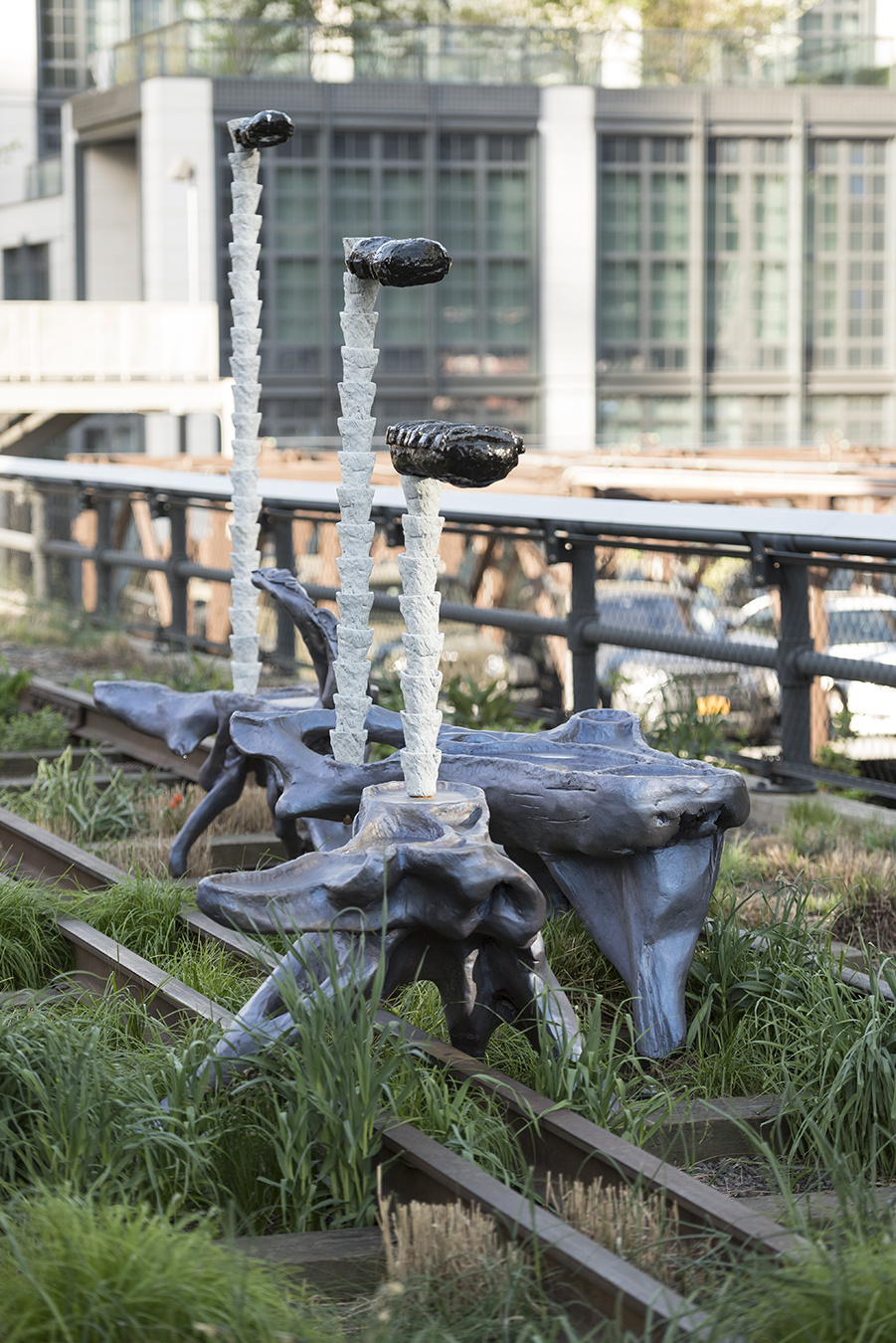
A crack is something forthcoming, a change that has already begun. You don’t know the result, but you can know it is inevitably coming. Like a shadow, a crack can separate and melt things together. The Catcher: Dewdrops slide down, silently, and leaves waver. Fluffy grasses also quiver gently. Dust starts to fly up from the ground. Pollens are everywhere. Plants try very hard to launch their seeds high up into the sky. Hairs and spores float around in the air… Butterflies flap their wings. Crustaceans and arthropod insects waggle their tentacles. Rattlesnakes rattle their tails. Frogs swiftly wind up their legs. Antelopes stretch out their muscular legs to run and leap… Under the backdrop of a microworld, body movements seem rough and even a bit clumsy. Like a spoon churning in the sea of molecules, it constantly cuts the world apart. It is as dense as the bullets shot from a heavy machine gun into a serene lake. The irresistible sense of beauty is instantly shielded, like sound to be devoured by the water: a passivated single-channel tranquility, leaving a world teeming with clues. However, the catcher hops within the field so skillfully that it perfectly avoids each and every crack. As a matter of fact, rather than hopping, it’s more like a ball hit back and forth, attached to a moving surface and trying its best to cooperate as if for the sake of soothing them… It fluctuates along with the wavy lines, vibrates the polylines, drops, and rises along the parabola… Beyond the moving part, it’s absolute stillness. In other words, it moves in a static manner. Its body becomes a bag to collect smells. It will work as long as it’s open.[1]
You describe the Catcher’s body as a carrier bag[2] collecting smells. Can you explain that?
I see life and/or narratives as made of pieces that we pick up. All the memories in the bag need each other, and they stick together and they become a bunch. They meet each other and in that way they become each other’s metaphor. In the studio, I work in accordance with this concept. I take everything from the bag, everything I picked up or collected. Then I try to construct those memory-images with the matter from my bag. Often the things we contain in ourselves are phenomena such as smells—atmospheres of a present that might not be our present moment. We think this is our reality but once we have them in our bag, how can they still exist by themselves? They exist always in relation to their container. For many years I have learnt Buddhism from two different gurus and it influenced my life and my work greatly. I learned that life is much richer than any life we wish for or imagine. Our horizon is so narrow. Our imagination is limited and limiting.
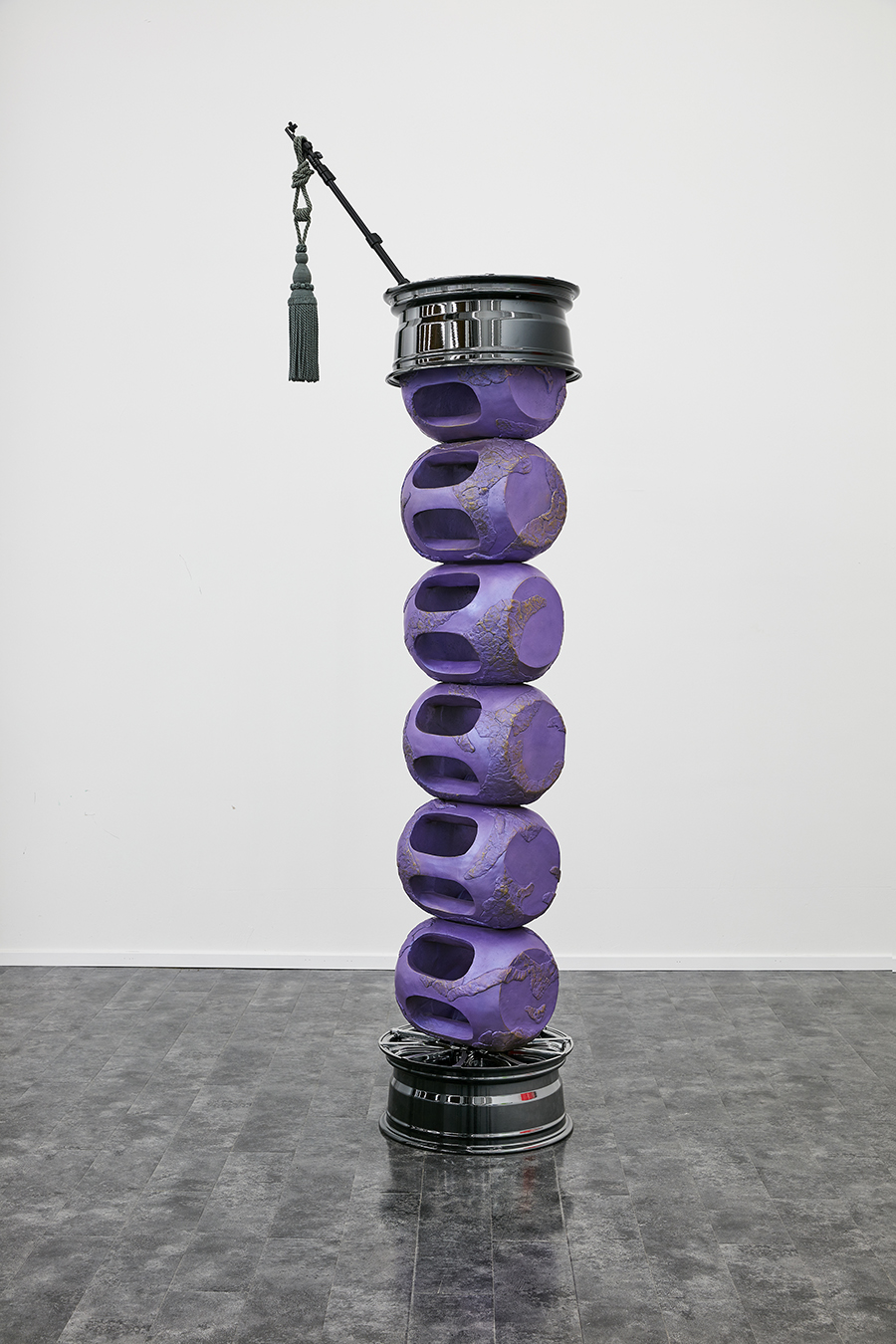
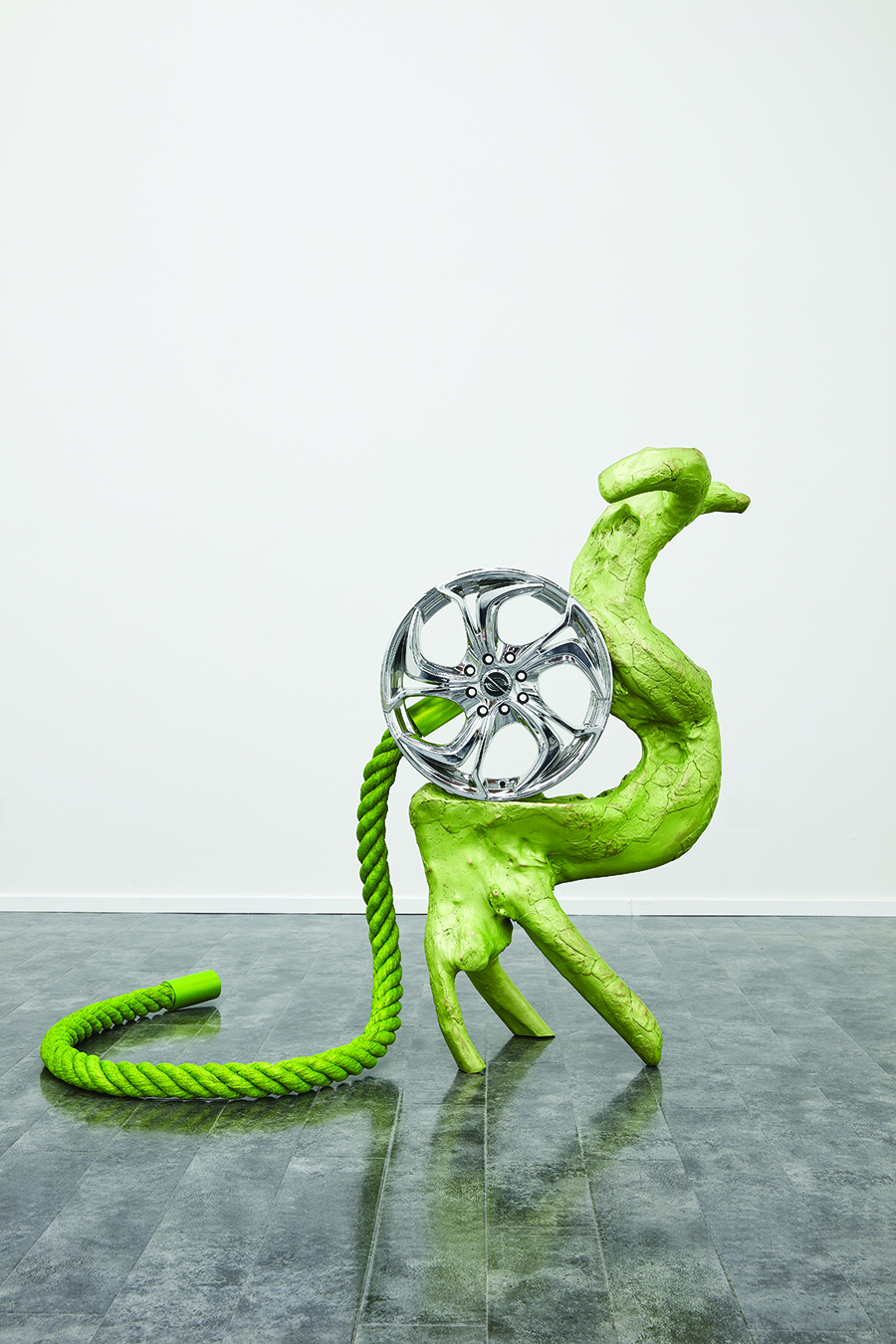
Din Din Jaarhh Courtesy: the artist and Antenna Space, Shanghai
This process of reshaping something pre-existing by over-imposing a symbolic form from your imagination, is it reminiscent of practices like topiary gardening?
I try to show the process of constructing those images. In the last series of sculptures, I used rope to tether everything together; and so it became part of the body of the sculpture, like how a spider’s web is somehow part of the spider and vice versa. In other cases the sculptures are constructed as stacks—in a more linear, or sequential structure. Coming back to my refusal to make statements, I don’t want you to see the sculpture as a final object, or an end product.
And your narratives, whether video or writing, act as a sort of psychological landscape film in which the sculptures appear as characters—or rather, events?
I am not so happy with the idea of ‘landscape,’ as a landscape has to be defined. Nature has acted as a foil for culture far too often. I prefer to think in terms of the environment, it’s more open. It can correspond with you.
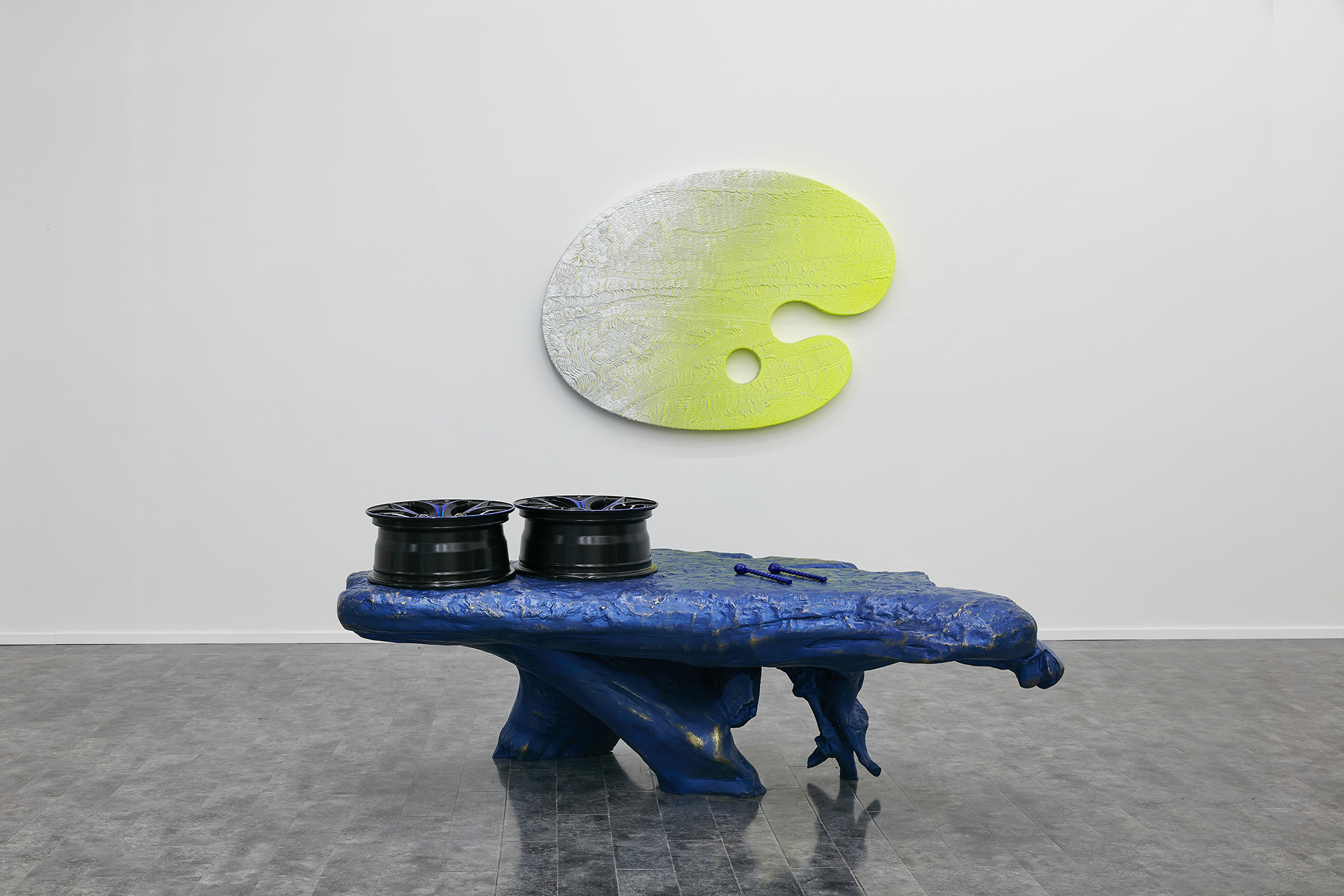
Blue Frog, 2015
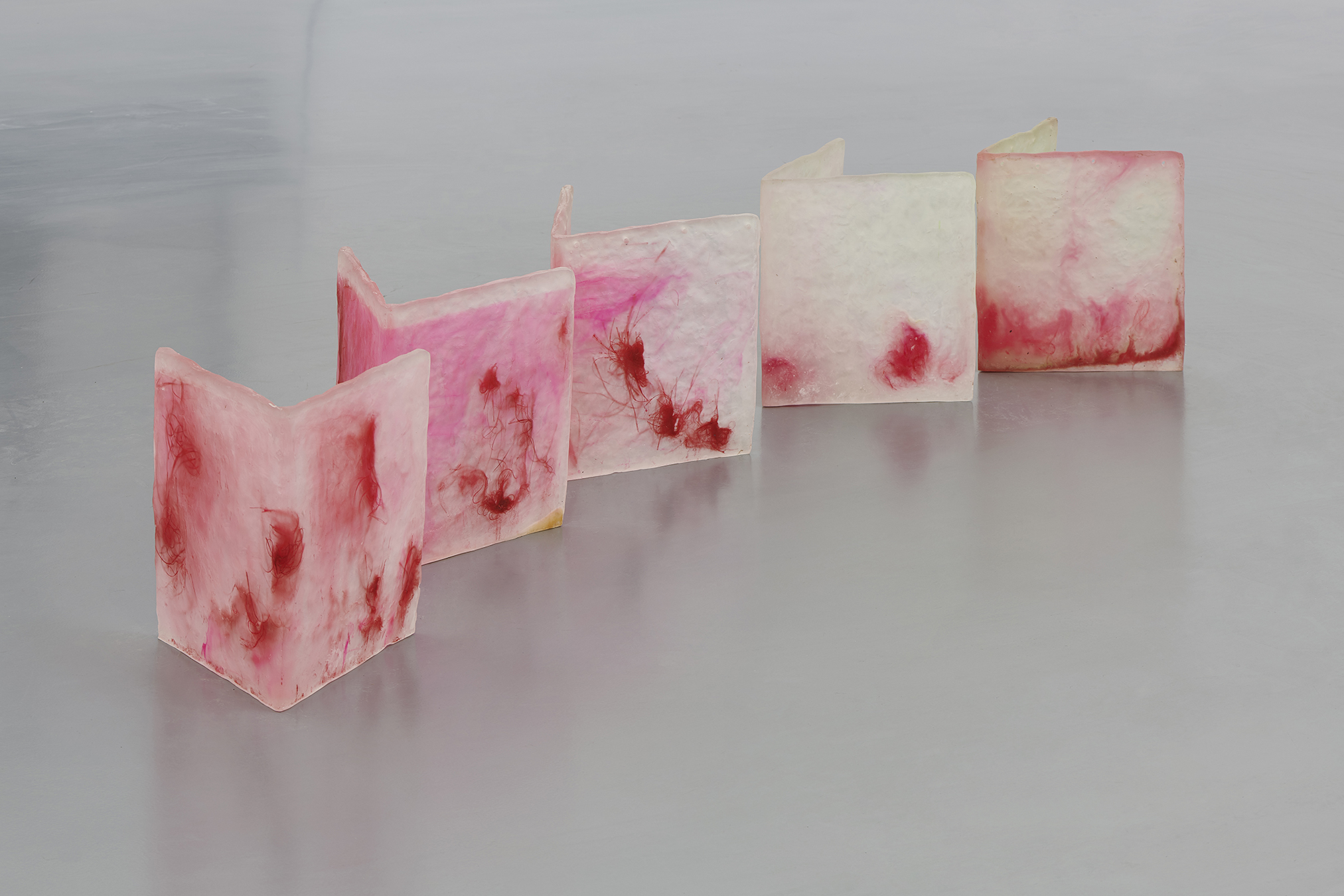
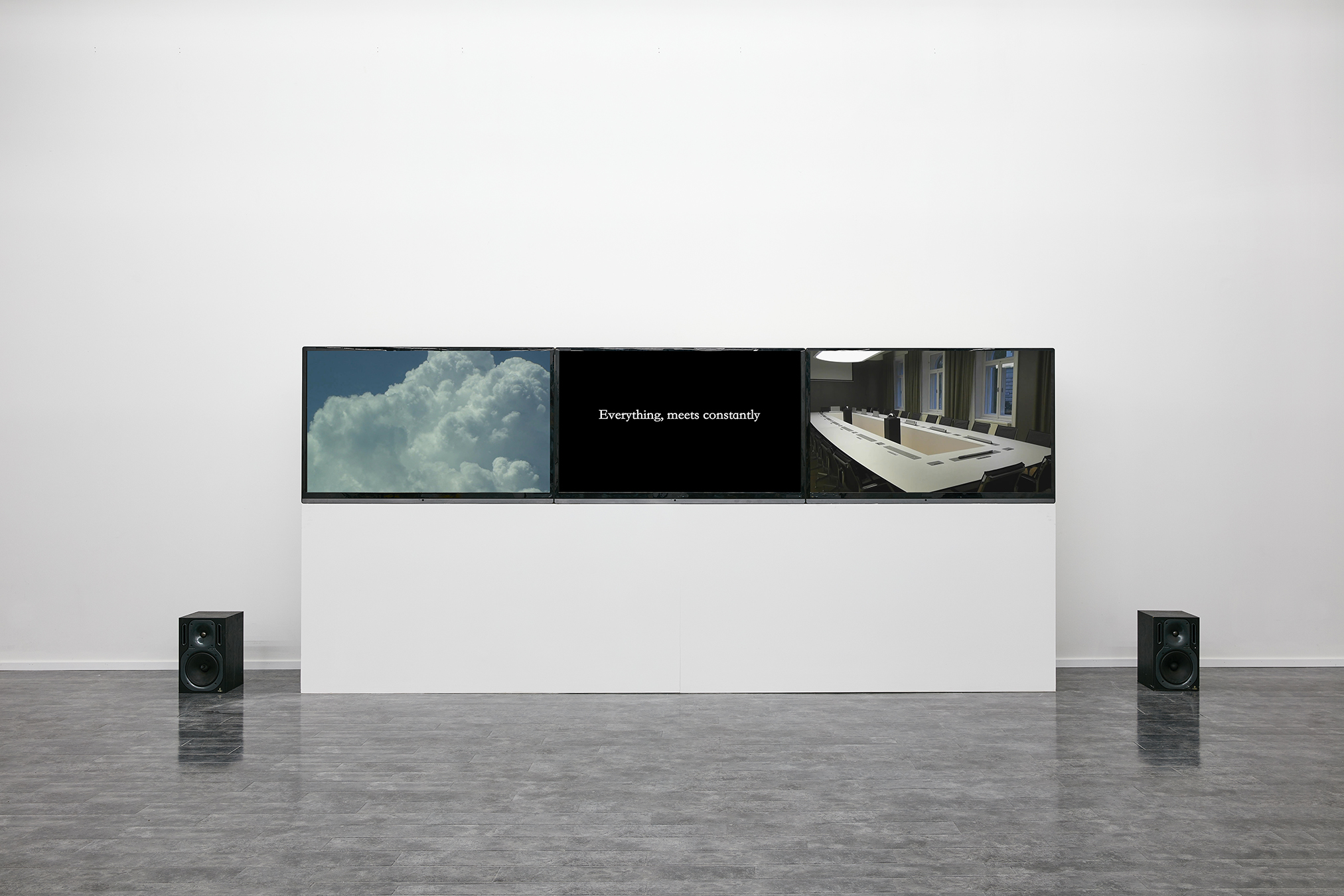
Your most recent video Just a Normal Day[3] is a flood of images, intersected with plain text that reads like a package insert for over-the-counter drugs. The three channels juxtapose wildly different footage to an effect that I can best describe by quoting from that same video: “the flying flies buzz.” Do you seek to simulate a certain experience or environment?
Most images come to me through screens. When I assemble footage, or make metaphors, the body’s sensation helps me: sound, smell, and touch build up images in my head. When you stick your head out through the window, you can feel the temperature and the humidity of the air; your body resonates with the environment. Similarly, when you watch the same thing through your screen, your brain will trigger the same feelings, generating the same image in your imagination.
So in a way your sculptures operate as surrogates for living beings?
Yes, when I make sculpture, I follow a similar process. Several images form a moment, a bunch of fragments glued together. The backdrops that often appear in my installations display the environment where I find all other matter. In the sculpture Documentary of Agriculture: Gathering (2019) I used a pattern made from a layer scan of a city, I don’t know which one. It stands in as an abstracted simulation, a metaphor, of the idea of a contemporary urban life, where the day-to-day overshadows the underlying structures, assumptions, pre-dispositions and potential cracks. The sculptures’ characters are—like us—shaped by what they are exposed to through visual and auditory experience.
Their being is in response to their environment. Donna Haraway speaks of a practice of response-ability.[4] How do you understand that notion?
It does not only mean we are taking responsibility for what the world is right now, but it also enables a response to the experience of the world. Contrary to what science makes us believe, most phenomena tend to be unpredictable, unexplainable, uncategorizable. We are not in control of the variables that define us. Our ability to adapt is perhaps our sole, but very transformative power.
How do we or the sculptures adapt to the world? Could music play a role in this? I am asking because I know it often appears in your work as a cultural artefact. I am thinking of Just a Normal Day blurting Dionne Warwick’s evergreen What the World Needs Now Is Love, for example.
Yes, although it is not about a general love for someone or something, it is about the relationships and differences as something multilateral. If matter constantly converses and changes, there are no total opposites, so in a way metaphor is the only way for us humans to understand or grasp the world. I think love can be an attractor of response-able relationships between all entities.
Which makes me think of your repeated reference to the seminal Japanese animation Neon Genesis Evangelion.[5] In your video, we see the main character’s feet tentatively wading in a translucent liquid. In the series plot, immersing oneself into the liquid allows the human pilot to mentally sync with their machine, the Eva. In another story, you quote from the same anime “The blue neon lights adorn his room as fancy as the sea.” Why are you invoking these liquid grounds?[6]
Before I go to sleep, I often read comics on my phone. It gets completely dark in the room, and when I try to move my eyes from the screen, I lose orientation for a brief second. The screen sucks me in, and spits me out again. There is always this gap, a pause, it cannot be a smooth flux. So you see, embodiment is related to our environment, it is an ecological question. For example, Just a Normal Day features all these recordings of nanotechnology trying to fix something in a micro-world. Through the lens of the microscopic camera it looks like a huge world. If we change the dimension, what’s big and obvious and important could be nonexistent. For the little bug, the Himalaya is not existent because it’s too big. Big could mean important, but it could also mean non-existent. There is this tradition in Zen culture where the master trains the students by suddenly hitting them and it makes them snap out of their current reality. The main goal of this practice is to make the student break out. Of course, it does not have to be a punch in the face, it can also be a joke, or a sound.
Action, 2014
1
Guan Xiao, The Catcher, 2020.
2
See Astrida Neimanis reading of Ursula Le Guin’s seminal “Carrier Bag Theory of Fiction” in Thinking with Water (Montreal: McGill-Queen‘s University Press, 2013).
3
Guan Xiao, Just a Normal Day, 2019, commissioned by Susanne Pfeffer for Tai Kwun Contemporary, Hong Kong.
4
See Donna Haraway, Staying with the Trouble. Making Kin in the Chthulucene (Durham: Duke University Press, 2016), p. 28
5
Neon Genesis Evangelion is an anime TV series from 1995, written and directed by Hideaki Anno and produced by Gainax and Tatsunoko Production.
6
The French philosopher Luce Irigaray describes water as “liquid ground,” somewhat paradoxically, both essential to life and always shifting. See Luce Irigaray, Marine Lover of Friedrich Nietzsche, translated by Gillian C. Gill (New York: Columbia University Press, 1991), p. 37.
CURA.36
Spring Summer 2021
THE FUTURITY ISSUE
CREDITS:
All images Courtesy: the artist, Kraupa-Tuskany Zeidler, Berlin and Antenna Space, Shanghai
GUAN XIAO (b. 1983, Chongqing Province, China) lives and works in Beijing. Her practice focuses on sculpture, video, and installations. Guan Xiao assimilates her own identity, history, and geographical background into virtual characters or species, and imbues them with a hybridized identity. Through her highly amalgamated practice, she emphasizes the importance of difference by creating contradictions between materials and concepts.
SARAH JOHANNA THEURER is a critical practitioner of techno-social techniques and theories. She is Associate Curator at Haus der Kunst in Munich and a radio host on Cashmere Radio Berlin.