The apple has never been a particularly sensual fruit: it is only (an understatement!) the biblical tradition that associates it with sin. The apple is sensual in Eve’s hands, when she offers it, when one imagines the rotation of her wrist that allows her to show off, to tempt… otherwise the apple in itself, smooth-skinned and compact, does not offer great cues for seduction. Things are a bit different with a peach, especially regarding its white or yellow paste with a slightly fuzzy skin. Touch, juice, chromatic contrast between the pulp and the corrugated stone, and probably also its association with summer, the season in which the peach ripens, are all joyfully provocative elements. “Elio” Chalamet recently celebrated the peach in Call Me By Your Name.
Nevine Mahmoud’s fruit does not lose an ounce of this sensuality, but shifts it all to the visual dimension and to the tactile contradiction. Her peaches, watermelon slices and big cherries are very compact, concentrated.
They are made of marble, or alabaster, and the finish of their surfaces is calibrated to irresistibly entice one to touch them. One of the peaches has a slice cut out of it, shamelessly revealing its stone of another color; on another of these fruits a big tear is rolling down; on the sides of a watermelon slice there are droplets of sweat/condensation, while another slice has been bitten… From an Italian point of view, these slick pieces bring to mind the Memphis style, the ’80s, a world of interior design in which hot and cold are useless antinomies in the face of the chromatic and graphic vitality that always emanates from the object. “Yes, why not? I am attracted to Italy, and in particular to Milan,”(1) the artist says.
Mahmoud also uses blown glass, mainly turning it into parts of the female body: flabby breasts on soft bellies, or single breasts or legs, always one at a time, always featuring an opalescent quality of the material—more aimed at exploring the opaque liquidity of glass than its mineral transparency. With these works, one may be tempted to think of a more decadent, or even painful take on form by an artist who chooses to face and focus on solid materials and finished forms.
The peach, like other Mahmoud subjects, comes in different versions. Probably the best known is the one entitled Cleave and Spread, in orange calcite with its stone fragment in pink alabaster clearly visible: a gentle yet unmistakable allusion. I happened to see it in one of the European venues of the group show Seven Sisters, curated by Martha Kirszenbaum and featuring works by female artists focused on female physicality, as part of the theme of control over one’s body and one’s intimacy. By Mahmoud there were also a lily and a mouth, and her role in the exhibition was to confirm the possible softness of marble, deconstructing the tradition of macho-carving.
In a 2016 article,(2) Andrew Berardini outlined the poetic-sculptural genealogy of Mahmoud’s practice, placing it at a point where Eva Hesse and Alina Szapocznikow’s concerns and materials absorb the Californian fetish dimension of a McCracken. Mahmoud moved to Los Angeles in 2014 where she obtained an MFA at the University of Southern California, and it was there that her obsession for sculpture took hold, with the beginning of her quest for sculptors-mentors who could teach her sculpture. Her tension in appropriating a masculine and muscular technique vanishes, a few years later, when Mahmoud no longer doubts dominating it; she also works with glass, excited by the changes in state that the material undergoes, from solid to viscous and boiling, in order to take shape. Aside from the glass pieces, the rest of her sculptures are produced, with the help at the most of one assistant at a time, in her studio in East Los Angeles.
If her materials of choice, as relentlessly repeated when talking about her, are marble—different types of marble in different colors and finishes—alabaster, and glass, it must be said that Nevine works with space in an equally wise manner. The erotic power of the individual elements is alluded to, playful and dense; when the artist arranges them for an exhibition, rather than occupying the space, she draws it. When one looks at one of her exhibitions, or enters her studio, the eyes follow a movement that certainly draws strength from the fact that it is provoked by individual, mocking and seductive entities. But a big part in this game is also played by the stands: the soft blue donut, an ass-hole-donut, is placed on a fluorescent Plexiglas base; the tongue (sometimes with a round hole in the middle) exists because it sticks out directly from the wall; cherries are characters, with disproportionate linear petioles that thrust themselves into space; the soft busts protrude from the wall held by a solid curved metal pipe, far from seductive or discreet; the glass leg rests on small wooden pillars; other pieces are on transparent glass plinths… it’s a visual score.
There is something of Mahmoud’s own physicality as a young woman in this way of being in space—energetic and concentrated, with a precise desire to know how to occupy all the space. She is long-limbed, and since she is in Los Angeles her limbs are often naked. In an interview asking her what her work robes are, Mahmoud replies “Leggings and shorts in the summer—although I have some pretty gnarly burns on my hands and legs just from the grinders, so I should be wearing long pants all the time.”(3) Instead, she leaves her skin exposed to space, to her materials, her techniques.
I am preparing an exhibition in which she will take part together with Derek MF Di Fabio and Margherita Raso;(4) Derek says that Nevine’s works are a bit like black holes for their material and non-material density.
While working on this project we passed around Ottessa Moshfegh’s stories, both the participants and I completely taken by the existential darkness void of drama of her narration. In Moshfegh’s latest novel, the main character looks carefully in the mirror and detects a small dark shadow inside his pupil, saying “Someone said once that pupils were just empty space, black holes, twin caves of infinite nothingness. ‘When something disappears, that’s usually where it disappears—into the black holes in our eyes.’ […]”(5)
1. In conversation with me, in her studio in Los Angeles, July 2019.
2. Andrew Berardini, “Playtime,” in Mousse, no. 52, February 2016.
3. Christine Whitney, “The Sculptor Bringing Back the Craft of Stone Carving,” in New York Magazine, 27 March 2017.
4. Project Room #13: Derek MF Di Fabio, Nevine Mahmoud, Margherita Raso, Fondazione Arnaldo Pomodoro, Milan; 14 April-26 June 2020.
5. Ottessa Moshfegh, My Year of Rest and Relaxation.
NEVINE MAHMOUD (b. 1988, London, UK) received her BA from Goldsmiths, University of London and MFA from the University of Southern California, Los Angeles. Her work was recently on view in The Artist is Present, curated by Maurizio Cattelan, at the Yuz Museum in Shanghai. Recent group exhibitions include: Dreamers Awake: Women Artists After Surrealism, White Cube, London; The Poet, the Critic and the Missing, the Museum of Contemporary Art, Los Angeles.
EVA FABBRIS is Exhibition Curator at Fondazione Prada, Milan. She is also active as an independent curator and art historian; in this capacity, she is curating the next cycle of the Fondazione Pomodoro’s Project Rooms and the solo show Alessandro Pessoli. Testa Cristiana in the Chiostri di S. Eustorgio, both in Milan in 2020. She curated exhibitions at the Nouveau Musée National de Monaco in Montecarlo, la galerie de l’erg in Brussels, Triennale di Milano, Fondazione Morra in Naples.
All images Courtesy: the artist and M+B, Los Angeles
NEVINE MAHMOUD
Text by Eva Fabbris
“Audience participation” in performance art is often perceived as a threat. Undoubtedly, it prevents a certain public from attending any performance where it is seen as even a remote possibility. While audience members can assert their own passivity by staring down at their feet or their program in order to avoid eye contact with those on stage, it is futile; to be a viewer of a performance is automatically to become a participant. The audience sets the tone, allowing the performer to react to perceived energies. Audiences have agency— they can boo, try to quietly sneak out the back, go as far as to get on stage and confront the performers if they like. (As a performance curator, I’ve seen it all.) The sense of power can flip in a matter of seconds. In her ongoing performance work Sanity TV (2016-present), Autumn Knight puts these dynamics at the forefront, skillfully navigating rooms comprised of a handful of people to hundreds in cities internationally. For the 2019 Whitney Biennial, Knight traversed the building and tailored the performance to create intimate moments in glassed-in conference rooms, the Trustee Room at a moment when the museum leadership was being scrutinized and protested against, and eventually landed in the museum’s theater. Playing the host of a television talk show, she zeroes in on her “guests” within the audience with incisive humor and distinct authority; it is evident that she is not merely the host, but also the director. As a respondent, the pressure is on to keep up with her improvisation, which proves impossible. Knight’s role as interrogator implicates you in something, no matter what character you inhabit. In your attempts to be clever, play by Knight’s rules, or go for authenticity, you have likely revealed a latent bias or an unseemly desire to assimilate to the groupthink.
Knight’s persona never cracks, even if the audience’s emotions (veering wildly from levity to tense anxiety) are right on the surface.
Somehow, in this situation where the power should lie within both performer and audience, you leave unsettled, far more self-conscious, and absolutely in awe of Knight’s capacity to read human behavior.
Sanity TV may be the clearest demonstration of Knight’s academic background in both theater and drama therapy, yet she never allows her work to settle into any predictable space of discomfort. Creating a prolific body of work in her native Houston before relocating to New York in 2016, Knight’s projects in theaters, galleries and beyond question the institutions that seek to regulate and violate black female subjectivity. The pervasiveness of this institutional control means Knight’s work can remain malleable and far-reaching, lending itself to a wide-range of forms and approaches. On the occasion of Knight’s WALL (2014-2016) being acquired by the Studio Museum in Harlem—the first ever performance to be added to their venerable collection—it was performed at Danspace in October 2019, which is located in the sanctuary of the church of Saint Mark’s Church in-the-Bowery. It is a charged space that is the oldest site of continuous worship in New York City, while being a locus of experimental performance since the 1960s. Ten femme, black-identified performers embodied concepts of the wall, with an initial departure point from Jerusalem’s Western Wall, as it is known in Hebrew, or the Buraq Wall in Arabic. The site is one of reverence and prayer, and also one of deep conflict resulting in riots and death. Using local performers in each iteration of the work, the walls that are conjured by these performers are myriad: physical borders meld into psychological barriers and systemic limitations. Sharing this stage is Knight and collaborator Natasha L. Turner; while they interact with each other, they do not interfere with the ensemble, who are seated and perform in a line facing the audience. The ensemble may be unified by their blue costumes, but refuse to recede into a single body. Knight ensures that they retain their individual rituals and strategies that carry multitudes of lived experience. The audience members of WALL are not the direct participants as enacted in Sanity TV; we become more aware of the divergences amongst the ensemble and amongst ourselves, as receivers and witnesses. The wall created by the ensemble’s positioning is not a confrontation of the audience, nor one that flattens subjectivity and reception. Rather, it is a reminder of theorist Édouard Glissant’s concept of relation as put forth in his 1990 book Poetics of Relation; relation must be acknowledged through difference. To highlight the difference between one side of the wall and the other, insiders and outsiders, performer and audience, is not a divisive procedure. It is one which advocates for more demanding articulations of who holds power and how.
This extends to Knight’s video work, where she still maintains a performative command over her audience, often through a canny use of language. While performance and video have long been entangled, Knight eschews any one-to-one relationship between the two. For instance, Knight describes her video Pong! (2019) as “mixture of intervention, performance, installation, and documentary work.” Here, the camera is fixated on the determined face of a white woman adeptly playing ping-pong; her opponent is never shown. The percussive and particular sound of the ball creates a constant rhythm with which to read the overlaid text, which establishes the historical context before moving into a first-person narrative about the shock of a white childhood girlfriend’s casual racism. At first, the historical details seem relatively “objective,” listing facts about the price of milk and popular culture. The historical references which follow the story, however, now appear far more loaded, citing Jesse Jackson, Benjamin Carlson, and Prozac. Still, they remain facts of the same year; even if the camera has not moved off its subject, our viewpoint has shifted. Knight extends these moments of exposure and encounter to a creature not typically recast as a subject of empathy: the cockroach, which has held a role as a specter of fear in Knight’s work since 2013. Videos such as Roaches Aren’t the Easiest Creatures to Milk (2017)—a riff on the absurdity of pharmaceutical commercials which announce themselves with sunny images of an unencumbered life, and conclude with an increasingly dismal list of harmful side effects— use the cockroach as a vehicle to speak of survival, prejudice, and shame. The camera is cropped tightly to Knight’s mouth, as she drinks (cockroach) milk, pure white and luscious. While persuasion is a primary quality of a powerful performer, Knight correspondingly employs doubt as a generative tool.
AUTUMN KNIGHT is an interdisciplinary artist working with performance, installation, video and text. Her performance work has been on view at various institutions including Krannert Art Museum (IL), The Institute for Contemporary Art (VCU), Human Resources Los Angeles (HRLA) and Akademie der Kunste (Berlin). Her performance and video work is held in the permanent collection of the Studio Museum in Harlem. Knight participated in the 2019 Whitney Biennial as a performance and video artist.
LUMI TAN is Curator at The Kitchen in New York, where she has organized exhibitions and produced performances with artists across disciplines and generations since 2010. She will be working with Autumn Knight on an upcoming residency and performance project in May 2020.
CREDITS:
Cover: Lament, 2017, Krannert Art Museum, IL Photo by Paula Court.
Video by Daniel Carroll Courtesy: the artist and Whitney Museum of American Art
All images Courtesy: the artist
AUTUMN KNIGHT
Text by Lumi Tan
https://curamagazine.com/wp-content/uploads/2020/06/portrait-option-4.jpg,https://curamagazine.com/wp-content/uploads/2020/06/02_KNIGHT.jpg,https://curamagazine.com/wp-content/uploads/2020/06/2017-06-03-OpticaAKnight-006.jpg,https://curamagazine.com/wp-content/uploads/2020/06/2017-06-03-OpticaAKnight-008.jpg,https://curamagazine.com/wp-content/uploads/2020/06/IMG_1381.jpg,https://curamagazine.com/wp-content/uploads/2020/06/IMG_1396.jpg,https://curamagazine.com/wp-content/uploads/2020/06/IMG_1892.jpg,https://curamagazine.com/wp-content/uploads/2020/06/IMG_2393.jpg,https://curamagazine.com/wp-content/uploads/2020/06/s2017_AKnightLament_p4.jpg,https://curamagazine.com/wp-content/uploads/2020/06/s2017_AKnightU17_v3.00_14_16_12.Still003-copia.jpg
This text investigates the path of the Danish artist Jesper Just, who represented Denmark in 2013 at the Venice Biennale. Using a selection of his films, exhibitions and performances, it examines some of the main themes of the artist’s practice. It focuses specifically upon the relationship between video and the traditions of cinema and the cultural industry, together with the way in which Just explores—via the exhibition—a possible renewal of the relationship between viewer and art piece, towards a kind of total art which, thanks to the themes and devices chosen, places the individual rather than the work at the center of the artist’s practice.
Jesper Just’s films feature refined images and slow times that could be found in cinema, but their unusual rhythms and soundtracks functioning as dialogues definitely move them away from the seventh art. The more attentive viewers will not have missed the fact that the spaces of Just’s films outline actual film settings and that the image is only one of the languages that make up a more complex system that ends up enveloping the viewer. When Richard Wagner took on the romantic myth of the Gesamtkunstwerk, the total work of art theorized by the German painter Philipp Otto Runge, he proposed expressing the unity of life in the communion of the arts at the service of the artistic experience. If Jesper Just’s work initially appears more fragmented and less dramatic than Wagner’s, such a notion of total art is perhaps not so far from his conception of art and even less from his films, his performances and his settings.
Jesper Just clearly deconstructs the language of cinema and the distribution of roles by creating a new balance between subject, project, actors and viewer. This overturning of values partly explains the language he uses in his films, but also the device he sets up and the balance he establishes between story and experience.
As a director, Just does not impose a strict direction on his actors but instead gives them a certain acting autonomy. However, he investigates the stereotypes of cinema: “it’s more the action or lack of action of the films that then breaks these clichés rather than any radical performance on the part of the actor(1). The consequence of this is that the actors must accept becoming part of a mechanism destined to obstruct the cinema device and thus allow the film to become an art piece. The characters, for example, seem to be more sensitive to the environment in which they are placed, and their personality expresses itself in the relation with architecture. When asked how he builds a new story, Just does not necessarily speak of an anecdote but more often of a place, an atmosphere or an environment that become the basis of his reflections and on which he develops a form of “architectural performance.” This often implies the absence of dialogues allowing for a transposition of the spectator’s experience who intuitively shares the actor’s experience. The body, the movement and the gaze constantly relate to the environment in which the film is shot and to the exhibition space. This performative function of architecture is expressed in particular in films such as intercourse, premiered in 2013 at the Danish Pavilion of the Venice Biennale. Individuals dwell in a Chinese reconstruction of the city of Paris, a sort of odd and cannibal tribute to the French capital. The characters roam the city, and it is through the incongruity of the place that the question of the individual is placed at the center of the film. To Gauguin’s formula “Where do we come from? What are we? Where are we going?” one may add the question of the environment, of what architecture reflects about us or, to a certain extent, the questioning of the information provided by that environment. A reference to the idea of meeting, the word ‘intercourse’ embodies this relationship because it conveys the idea of an individual’s communion with the environment, in particular through architecture. This architecture, which ends up resembling a Potemkin village designed to conceal misery, questions the value of the idea of reproducing models of life and society. A film set, in short, which Just aims at deconstructing.
The fact that Jesper Just was playing with the codes of cinema became clear early on. His education in the fields of painting, drawing and photography, prior to video, might have allowed him to spontaneously free himself of the rules of cinema. It is no coincidence that the film No Man is an Island (2002)—which portrays a man improvising a dance in slow motion watched by the actor Johannes Lilleøre, moved to tears—looks more like the footage of a happening or an experimental film. The artist uses these codes nonchalantly to better crack them, in particular through rhythm, the apparent absence of progression, the centrality of emotion versus narration. The artist shows that he knows that the story is built from images that are not seen, from what can be inferred and supposed. In most cases, Just refuses to write an identifiable and linear story. If some may detect a connection here with David Lynch, the cryptic or esoteric absurd is not found in Just. Above all, the artist aims to introduce an ambiguity, intended to maintain a confusion and contradiction that open up fields of interpretation which allow the viewer to project and shape a personal experience. Among the technical devices used by the artist, we immediately note the presence of overlapping points of view, in particular in This Nameless Spectacle, produced in 2011 by the Val-de-Marne contemporary art museum (MAC VAL). With a wink to the history of cinema, the film is inspired by a technique used in 1927 by Abel Gance, based on the superposition of different points of view of the same scene. The division into two horizontal screens forces the viewers to concentrate and choose how to follow the story, because the concurrent movement of the two screens prevents them from perceiving it in its entirety, causing a frustrating feeling. The proliferation of screens in Just’s exhibitions, often combined with a destructured, interrupted and fragmented writing, makes simultaneous access to the whole narrative impossible. In this film in particular, the artist questions the political and social dimensions of the landscape, both from the point of view of the film and its object, i.e. in this case the disabled body, the healthy body and the way in which cinema reinforces such perceptions. Jesper Just chooses devices that he renews constantly and, as we will see further ahead, going beyond the experience that the viewer has with his own body, he focuses on architecture by creating powerful installations and ecosystems that in the end overwhelm the viewer.
Jesper Just’s practice constantly challenges art categories. Since taking up the challenge launched by RoseLee Goldberg in 2005 to produce a piece, True Love is Yet To Come, for Performa 05 in New York, the artist has turned the deconstruction of art genres into a central element of his research. In this sense, Interpassivities is a piece representative of the attempt to shatter the typical principle of the ‘viewer/art piece’ relationship. In this choreographic work, premiered in 2018 as part of the Next Wave Festival at the Brooklyn Museum, the viewer becomes a performer himself. Entering a large room, he senses the beginning of the work thanks to a few musical notes and the movement of a female dancer, who starts making gestures. After a few minutes, a group of workers arrive to disrupt the space, moving the pallets that make up the floor and conditioning the gestures and movements of the dancers as well as those of the viewers. The sound arises from the floor and viewers can feel its vibrations, while the presence of a mechanical piano is revealed through the removal of the pallets and videos are projected on the walls. The space of this performance-ballet-concert-projection is built to destabilize, divert, deconstruct the automatisms of the use of cultural and artistic objects, and thus produce a change in the behavior and status of viewers and performers. A landscape is projected into the exhibition space. In this video, Kim Gordon, the iconic Sonic Youth bass player, makes music by beating on the border between the United States and Mexico with a stick, while the floor of the exhibition keeps moving and changing, giving new meaning to the unpredictability of the border imposed on all those taking part in the exhibition. This exhibition project symbolizes the performative fluidity explored by Jesper Just exhibition after exhibition, in his quest for a union between body and mind, between the self and the other. The work entitled Cadavre Exquis, created and hosted for the first time in Copenhagen in 2019 by the Teater Revolver with CPH: DOX, takes this experience even further, since the viewers are inside the scene—the spectators become the actors. They realize that they must act out a role and/or think about the personality they play in everyday life(2), thus extending the experience of art into their lives and systematically involving and mixing bodies.
Whether queer, belonging to a certain race, subject to physical and aesthetic standards, the body is often placed at the center of Just’s works, aiming in particular to decipher normativity and reflect on discrimination against disability. If some aspects of the video that gave the title to the exhibition Servitudes at the Palais de Tokyo in 2015 raised issues related to the condition of disability, by destructuring the exhibition space with the use of several screens, Just made it impossible to fully and thoroughly perceive the piece from a temporal point of view, hindering an ideal and integral perception and allowing the viewers, according to their intentions, to make their own montage of the film. Jesper Just also challenged the spectators physically, by making sure that the exhibition could only be accessed using a sloping wheelchair ramp. In the film, a woman tries to eat a corn cob with her hands bridled by rehabilitation devices. Are her hands hindered, assisted or replaced in their action? In any case, it is clear that the relationship between body and technology has become a topic of increasing importance in Just’s latest works.
In the film Corporealities, recently shown at the Emmanuel Perrotin gallery in New York, the relationship between body and technology seems to become the focus of Just’s research. The film is an extension of Circuits (Interpassivité), premiered at the Brooklyn Museum in 2018, and again produced with the American Ballet Theater, but projected onto five fragmented LED screens. The image is exploded, fragmented in an apocalyptic atmosphere of devastation or deconstruction which emphasizes the incongruity of the athletic bodies. Using an electric medical device intended to stimulate muscle contraction, the supernatural, idealized and oversized bodies of classical ballet dancers are reduced to passivity and move only under the impulse of the stimuli of an electric current synced with a composition by Gabriel Fauré, Pavane op. 50 in F-sharp minor. This particularly moving piece, both romantic and modern, is played here electronically and without feeling, in the form of a MIDI (Musical Instrument Digital Interface) file. The body, undergoing several transformations, moves like a robot both to compensate for injuries or deficiencies, but also to adapt to the ideal of physical power, perfect body or eternal youth, with ever higher standards. What happens when there is no longer intention, and movement is controlled by the machine? The artistic direction is here reduced to a computer program that dehumanizes will.
This exhibition expresses one of the central focuses of Just’s work, that of the body’s ability, its potential but also its limitations. When dancers are not dancing, actors are not speaking, when gestures are hampered by muscle rehabilitation devices, Just is reflecting on functionality, utilitarianism and productivity, themes that also concern the viewer in first person. This explains why most of the artist’s films and environments give the impression of sending messages much stronger than their actual experiencing, because they introduce and foster doubt. If Just does not go so far as to speak of sabotage, he claims to be interested in “what is left behind in the wake or what falls between the cracks, co-existing between different spheres.” “Because,” he continues, “perhaps it’s encouraging a form of failure in traditional use or intent, in order to expose other mechanisms at play.”
If it has often been said that Jesper Just’s videos are based on a non-narrative principle, it is because the artist systematically replaces verbal speech with emotional speech, thus endlessly multiplying the effect of the story. The fundamental principle of the use of emotions in Just’s work is based on the idea that “emotions are constructs, developed and emerging from previous personal experience, in an interaction between the brain, the body and one’s culture.” All the logic of the relationship with the body and with the construction of an environment that favors a catharsis also derives from such relationship between individual and emotion: “Your brain will investigate if what it is encountering is something you have experienced before, in order to best prepare your body how to react.” In this way the artist rejects the idea of the universality of the work of art, because the emotion is primarily individual: that is why the whole device around the film and the film itself rely heavily on participation, interpretation but also appropriation.
For Jesper Just, “the films are not just projections, but almost become embodied, like a sculpture, or an architectural element.” It is by using immersion, narrative cutting, ellipse, silence, fragmentation, physical participation, interval, that the artist conceives actual installations that challenge the visitor’s body and mind. If Richard Wagner’s total art was able to reach—through a huge image, the negation of technique, the disappearance of the orchestra and the plunge into darkness—what could have become cinema, on the contrary Just’s ambition is to move away from it and, perhaps, to reach total art by allowing the visitor to fully take part in both a physical and mental experience.
NOTE:
1. All Jesper Just quotations are from a conversation with the author (2-3 February 2020).
2. Irene Campolmi, Folding the outside inside, performance, in Jesper Just’s Artistic practice (2005-2019), in Jesper Just. Servitudes. Circuits. Interpassivities (Milan: Mousse Publishing, 2019), p. 27.
JESPER JUST (b. 1974, Copenhagen, Denmark) lives and works in New York, NY, USA. Jesper Just uses the language of cinema to confront and divert the stereotypical Hollywood constructs of masculinity and femininity, as well as the biased representation of minorities and people with disabilities in mainstream culture. His short films and multi-projection video installations question the mechanisms of cinematic identification and break viewers’ expectations of narrative closure by unfolding surrealist, emotionally ambiguous, open-ended, and often silent situations or encounters.
MATTHIEU LELIÈVRE is an art historian and independent curator, and an art adviser and curator at the Musée d’Art Contemporain in Lyon. He has worked with several public and private institutions, including the Musée des Arts Décoratifs in Paris, the Galerie Thaddaeus Ropac and the Palais de Tokyo in the context of the 15th Biennale de Lyon.
JESPER JUST
by Matthieu Lelièvre
https://curamagazine.com/wp-content/uploads/2020/05/JJU_A039369_004.autoxauto.jpg,https://curamagazine.com/wp-content/uploads/2020/05/A005C001_170110_R0Y0.mov.00_44_40_15.Still002-copia.jpg,https://curamagazine.com/wp-content/uploads/2020/05/3.jpg,https://curamagazine.com/wp-content/uploads/2020/05/8.jpg,https://curamagazine.com/wp-content/uploads/2020/05/9.jpg,https://curamagazine.com/wp-content/uploads/2020/05/A001C001_170110_R0Y0.mov.00_24_10_17.Still001-copia.jpg,https://curamagazine.com/wp-content/uploads/2020/05/A004C004_170110_R0Y0.mov.00_09_30_03.Still004-copia.jpg,https://curamagazine.com/wp-content/uploads/2020/05/E002199_004.4500xmax.jpg,https://curamagazine.com/wp-content/uploads/2020/05/E002199_008.4500xmax.jpg,https://curamagazine.com/wp-content/uploads/2020/05/E002199_012.4500xmax.jpg,https://curamagazine.com/wp-content/uploads/2020/05/JJU_A039369_003.autoxauto.jpg,https://curamagazine.com/wp-content/uploads/2020/05/JJU_A039369_005.autoxauto.jpg
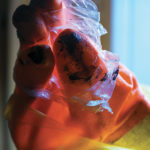
This looks like a melting tool. A drill bit has caught fire in a failed attempt to bore into a seemingly impenetrable disc. Any builder’s deepest worry, that the tool will buckle under stress. Undue strain on the tool borne of misuse—the shameful error of the amateur. Closer inspection suggests that the tool bit is unfurling, exhaling into curlicues like a tightly wound roll of ribbon unbound or a paper roll coming undone as it smolders. The drill bit is a twirl of soft copper becoming limber in a bath of burning napalm; the unyielding disc is soft wax. The material referents peel away; a physiognomy of stress remains.1
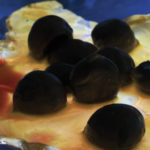
Mechanically speaking, stress is a measure of direction. It is the force that keeps the form of the object and is not to be confused—nor correlated—with strain. Napalm is a common material in Diane Severin Nguyen’s photographic stagings: a mixture of gasoline and styrofoam, napalm is like jelly—it holds together via elastic stress. Burning napalm causes the gasoline to combust, leaving the residue of caramelized plastic behind. Any delicate structure is filled with stress; disrupt a fragile object and strain occurs.
Stress in objects may signal pain within human bodies. Co-dependent exile depicts five colorful half-sucked lifesaver candies hanging from twine. The stress of torsion gives the twine its shape; torsion in medical science is synonymous with nauseating agony. Nguyen carefully selects the innards of each image to create a body that combines mechanical and sensual stress in equal measurements. In this sense, each photograph has organs whose shared physiological purpose is to decode one another as freely as possible.
If Nguyen’s images involve language, it is one spoken at the bottom of a deep well in the dark. Far from the logocentric surface, language becomes primordial and sensuous. Dug roots, slime molds and pools of grime are seen as if they were felt. As if the optic nerve has leached away from the eyes and absorbed into the flesh, the cognitive becomes the haptic.
By working in photography, Nguyen inverts the cognitive instinct to metabolize these foreign bodies via touch, smell, or taste.
The viewer must inscribe upon the image his or her own sense-memory. As if all other valves have been shut off, the multiple flows of nonverbal, uncoded data must be rubbernecked through the human visual apparatus. This is the cruelty of Nguyen’s art.
The artist abhors binaries, especially those designating the organic from the inorganic. The content of the photograph is, of course, a crystallization of the artist’s accumulated sense-memories and personal history. Any familiarity I have with her material choices is anecdotal and irrelevant. They were, of course, chosen, staged and lighted—and lighted often quite perfunctorily, either with a phone’s flashlight or whatever incidental studio light was available.
Human psychological stress is an interesting discussion here because it is, too, the result of many different flows of intensity in the human body and in the brain. The Cartesian notion of the brain is a sort of “cooling station” for the sensations experienced in the body: a cerebral thought (or cerebral crystallization) is the end result of bodily happenings. The aching of joints and the pangs of hunger may bond with language to create a grandiose existential longing. When the body experiences stress, it comes to resemble an assembly of cooperating life-machines and much more a locus of tension and difference.
Like a river which is just a long thread of water under stress in a certain direction, the stress of the body—of blood flow, of neural communication, of the tension holding liver tissue together—is what brings life to this assemblage of different smaller bodies with different intensities. There cerebral cortex (the site of language in humans) is where these different intensities are named, indexed and given the imprimatur of “human experience”.
As Nguyen points out, the language of photography and of psychology follow very similar contours of history, which makes sense: never has humanity had such an efficient reinforcer of human hierarchies as it does with photography. Unlike traditional modes of making, the photograph can represent humans and human activity at a feverish rate. Modern psychology classifies a theory of mind to be essential for healthy social behavior. Possession of healthy theory of mind, in turn, causes sane humans to anthropomorphize non-human entities such as animals and objects. That is, we assume that non-human objects (including animals) are rational agents with beliefs and intentions. Most photographers seek to create an image upon which the viewer can inscribe his or her theory of mind.
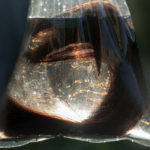
Nguyen’s photography is schizophrenic in the sense that the material signifiers tend to be out of joint with one another. The elements therein are typically deterritorialized. Liquid Isolation is a good example: a clear plastic bag contains a large section of chopped human hair suspended in water.2 The vessel should really contain some aquatic specimen or a goldfish won at a carnival. The large lock of hair is stressed in every direction by the water via a slight tweak in pressure that gives the severed lock an uncanny animism which repels interpretation.
The schizophrenia of Nguyen’s practice emanates from her chosen position somewhere in between objective and non-objective photographic traditions. The chosen materials are meant to decode themselves, and the environment into which they are introduced further strips them of any comfortable, intentional stance they may have originally had.
The photographer creates a machine of his or her own body, and the resulting photograph cements this bond. One could also argue that the subject of a photograph forms an assemblage with the photographic process itself. Like mind and body, the content of the photograph is composed of the cleavage between what the photographer witnessed and what has been finally inscribed upon the print.
The artist thinks of photography as a “liquid language” wherein hierarchies and value can move more freely than in more “plastic” arts. The physical surface of the photograph is a smooth space, made up solely of different energy levels manifested as color and density. It is conceptually weightless and has no plasticity. It is, however, traditionally borne of wetness: the darkroom print gains its features through various immersions in aqueous solutions. The end result of photographic development, however, is to chemically congeal a scrutable image. A uniform surface of undeveloped paper gains its definition merely through differentiation—chemicals put under strain, coaxed into a new energy state.
Stress in animals—unlike the indulgent and long-term use of it by humans—is the rapid accumulation of potential energy immediately preceding an act of survival. Like the elasticity of a drawn archery bow, stress is what gives an object its shape. In some ways, it is what keeps the material world together.
Napalm hangs in the atmosphere of Nguyen’s photography: a glob of unfired napalm keeps its shape through viscous stress; a small napalm fire stays where it belongs because of the material’s stickiness. A solid object may carry the wounds of prior and unseen napalm burns. It is a schizophrenic substance: protean, moldable, workable, volatile. Such is the artwork of Diane Severin Nguyen.
NOTE
1. Diane Severin Nguyen, Wilting Helix, 2019, LightJet chromogenic print, artist frame, 15 × 10 inches (38 × 25.4 cm), Ed. of 3 + AP.
2. Diane Severin Nguyen, Liquid Isolation, 2019, LightJet chromogenic print, artist frame, 15 × 22.5 inches (38 × 57.15 cm), Ed. of 3 + AP .
DIANE SEVERIN NGUYEN (b. 1990, Carson, CA, USA) is an artist who lives and works between Los Angeles and New York. Most recently, Nguyen exhibited a solo show in Los Angeles at Bad Reputation, and was part of two-person exhibitions at Bureau, New York, and Exo Exo, Paris. She will complete her MFA at Bard College at the end of 2019.
TODD VON AMMON is a gallerist, writer and curator based in Washington DC. He recently opened von ammon co – contemporary art, a project space in Washington’s Georgetown neighborhood.
CREDITS:
All images Courtesy: the Artist, Bad Reputation, Los Angeles and Bureau, New York
DIANE SEVERIN NGUYEN
Text by Todd von Ammon
CURA.31
GRRRL POWER
https://curamagazine.com/wp-content/uploads/2020/05/Liquid_Isolation_2019_NGUYEN_CURA_28cm-copia.jpg,https://curamagazine.com/wp-content/uploads/2020/05/Colonizing_Hearts_2019_NGUYEN_CURA_28cm-copia.jpg,https://curamagazine.com/wp-content/uploads/2020/05/Between_Two_Solitudes_2019_NGUYEN_CURA_28cm-copia.jpg,https://curamagazine.com/wp-content/uploads/2020/05/Breakthrough_Sunrise_NGUYEN_2019_CURA_28cm-copia.jpg,https://curamagazine.com/wp-content/uploads/2020/05/Co-dependent_exile_2019_NGUYEN_CURA_28cm-copia.jpg,https://curamagazine.com/wp-content/uploads/2020/05/Wilting_Helix_2019_NGUYEN_CURA_28cm.jpg