Tiramisù for Two
L’Ascensore, Palermo
10 July – 10 August 2021
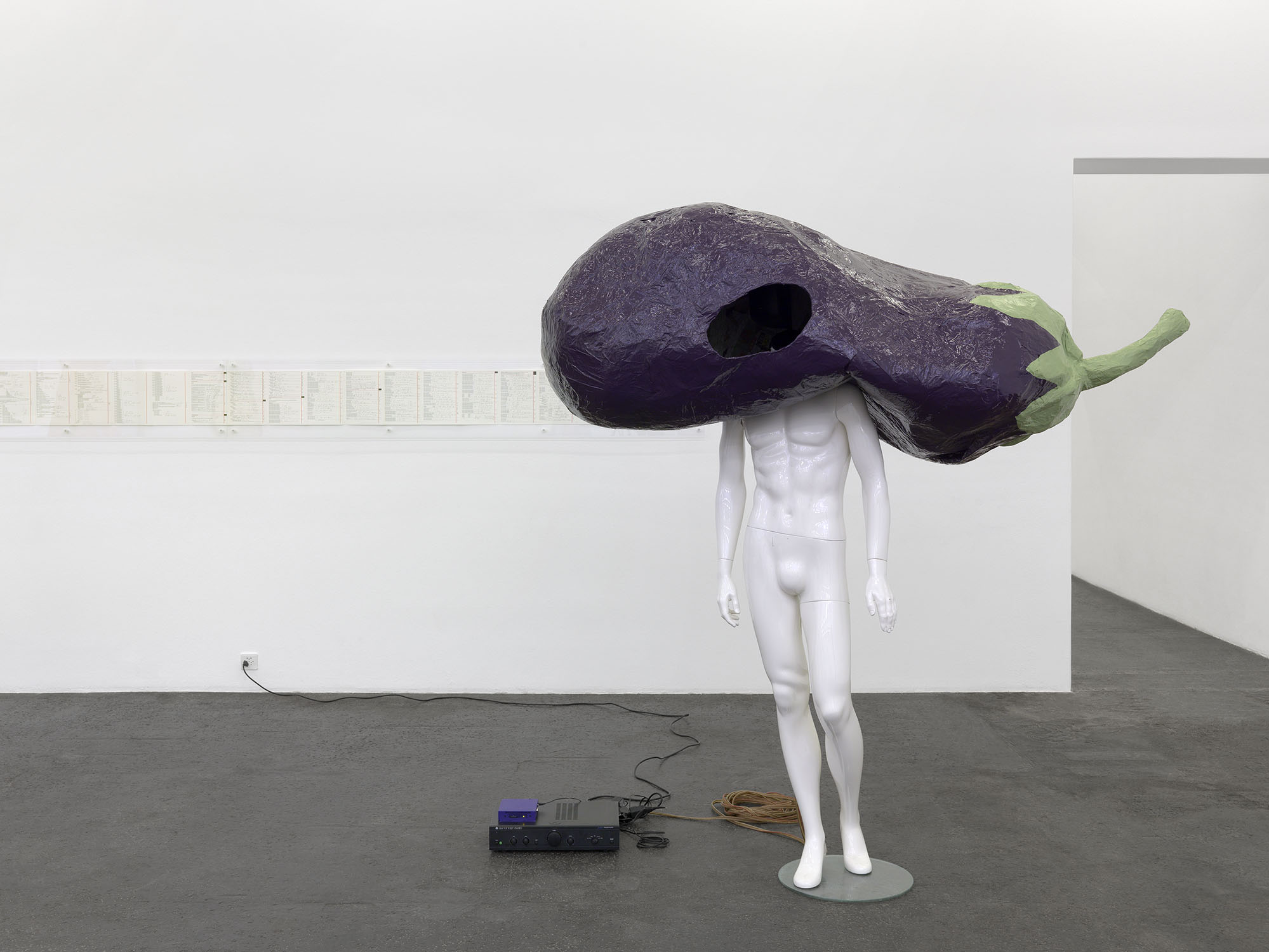
Jam, 2021. Photo Annik Wetter, Courtesy the artist and Kunst Halle Sankt Gallen
Following the finissage of the exhibition Tiramisù for Two at L’Ascensore, Palermo, artist Alfredo Aceto engages in conversation with CURA. New Media Special Projects Coordinator Giulia Colletti. Echoing layered imaginaries and unexpected associations not necessarily linearly revealed within the exhibition, the dialogue expands on Aceto’s latest production and his transitional objects.
In your latest exhibition, floating and unstable dramaturgies merge with fictional universes in an exquisite forced cohabitation of artworks and sceneries.
Tiramisù for Two is a non-canonical exhibition to me. I do not paint; nonetheless this is a show with and around painting, as the main purpose is to investigate the pictorial medium. What does it mean to paint nowadays? In Quadri Politici Svizzeri, I take the cue from the cover of a publication Enzo Cucchi made for an exhibition in Switzerland, back in 2009. In this case, what interests me the most is the attribution of two qualitative adjectives to the pictorial object. “Political” is often conceived as a substantial adjective to the artwork. “Swiss” refers to geographic coordinates while often alluding to institutional efficiency.
It seems your attempt is to produce a work which could paradoxically void itself through signifiers.
Correct. In fact, the work Screen involves a different perspective on the process of voiding. It is a painting of an automobile LCD screen. A screen applied to a “screen” – which is the pictorial surface – on which I then created silk-screened bands imitating an industry scotch tape. This work takes its cue from earlier watercolors, in which car interiors blend with the landscape. The latter becomes a fragmentation of scotch, which serves to unite something. Once again, it comes to my mind the notion of combining different forms to produce a void – the juxtaposition of such different screens seems to allude to something when in fact says nothing. In both cases, visitors are dealing with two paintings without any substantial pictorial language.
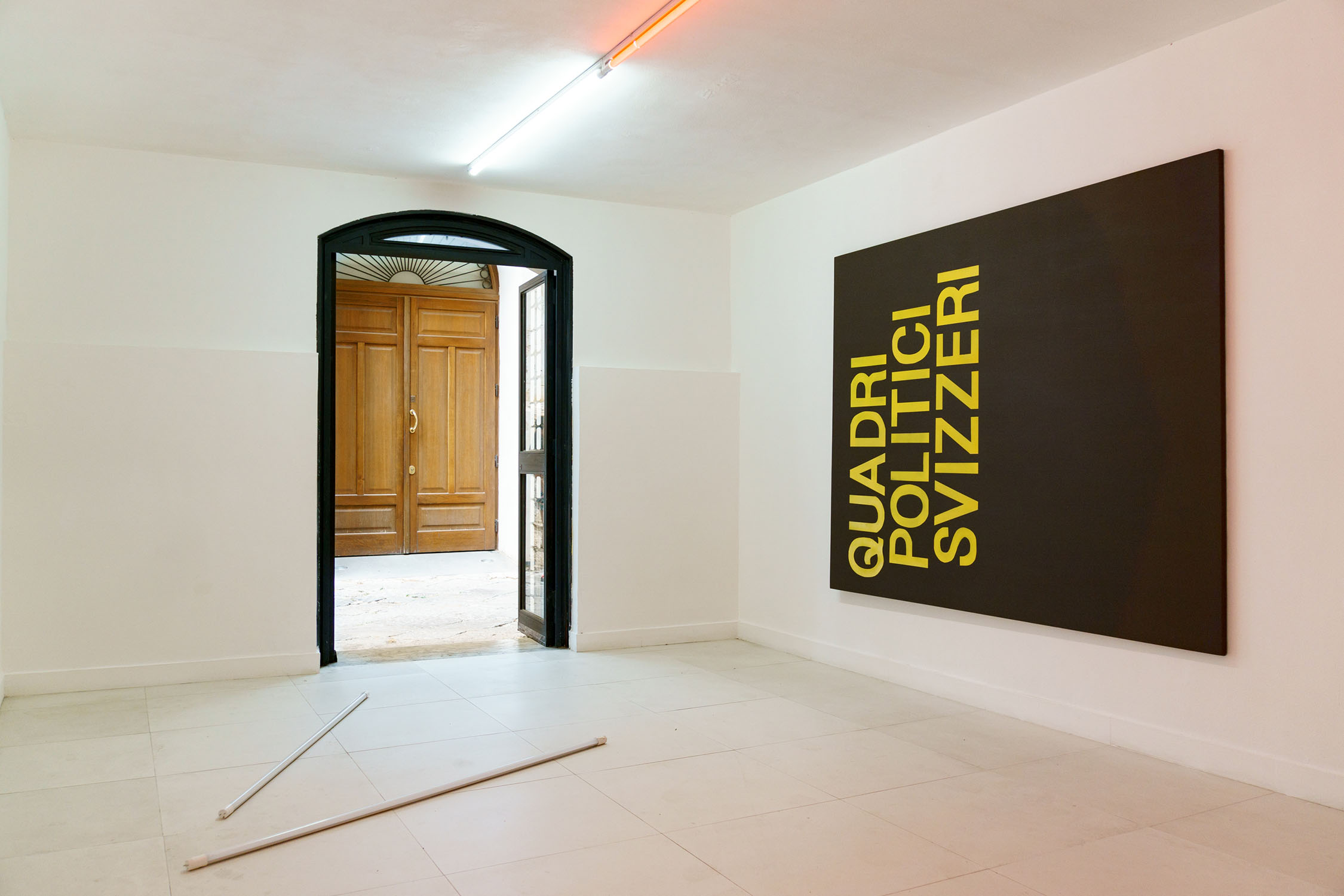
Installation view at L’Ascensore, Palermo. Photo Filippo M. Nicoletti, Courtesy the artist and L’Ascensore
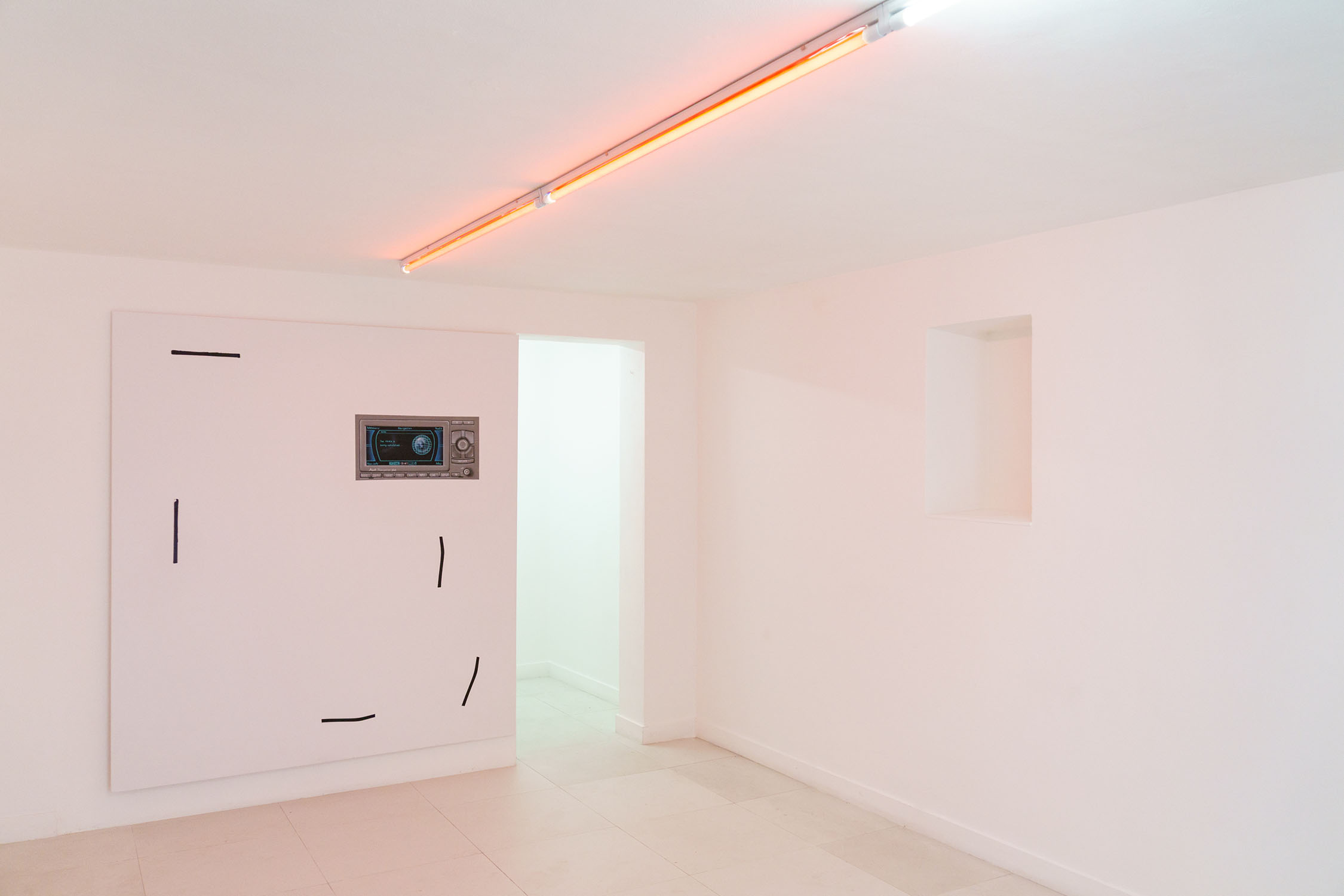
Installation view at L’Ascensore, Palermo. Photo Filippo M. Nicoletti, Courtesy the artist and L’Ascensore
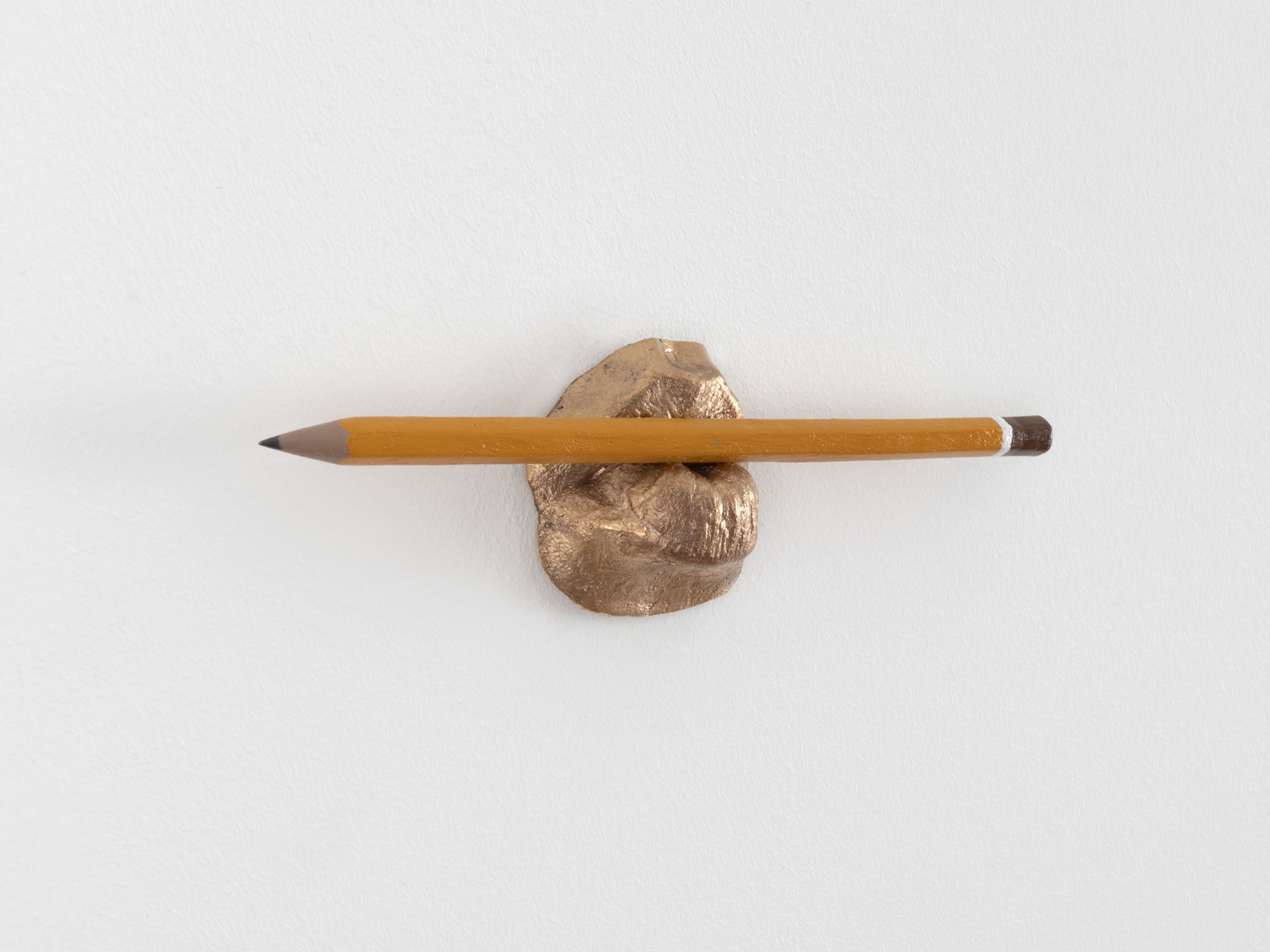
Bocca con Matita, 2021. Photo Julien Gremaud, Courtesy the artist, Kunst Halle Sankt Gallen
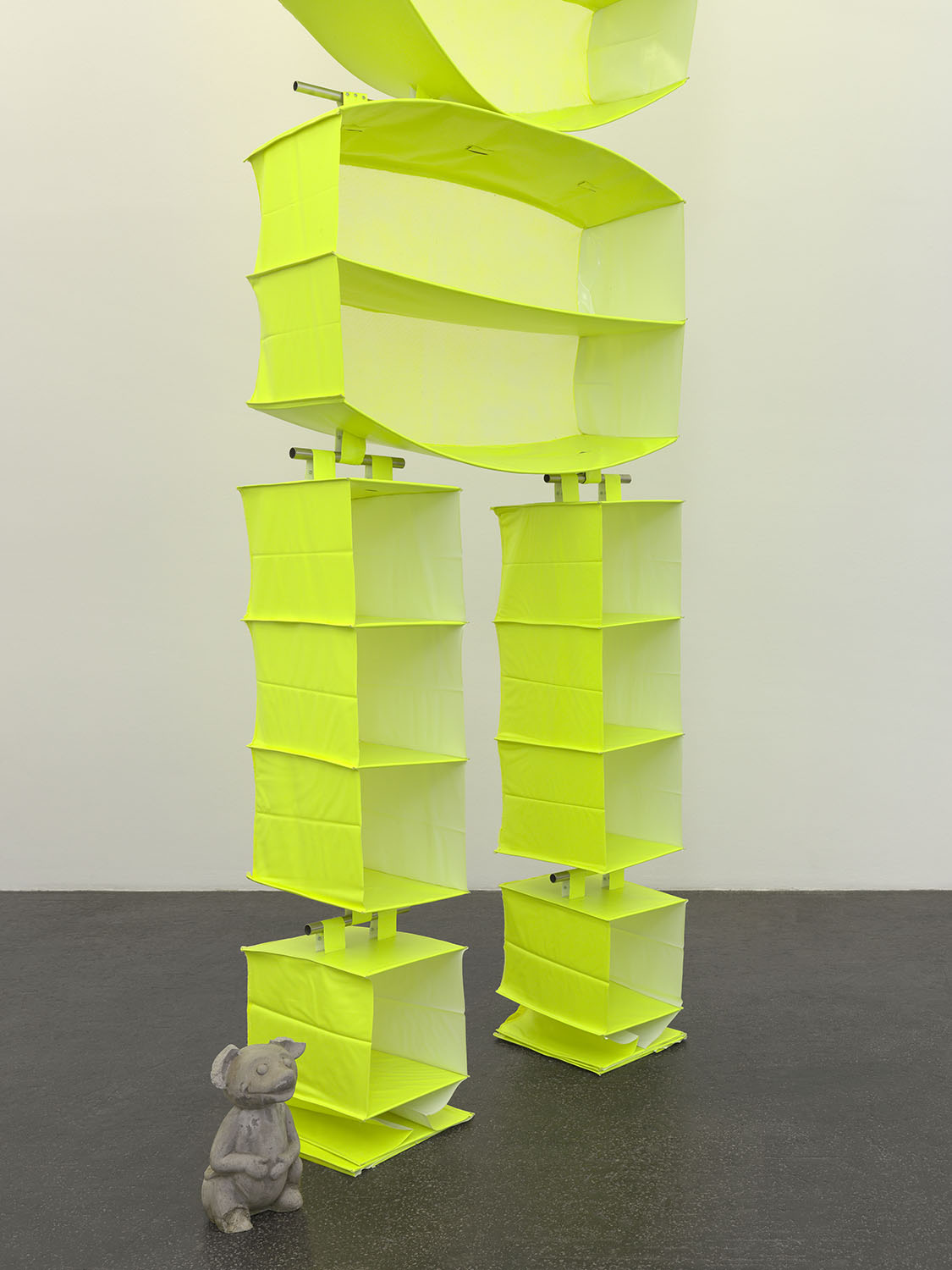
Ambarabà Ciccì Coccò, Alfredo Aceto and Denis Savary. Installation view at Kunst Halle Sankt Gallen. Photo Annik Wetter, Courtesy the artist and Kunst Halle Sankt Gallen
Despite the fact that the two paintings are not conceived as a series, there seems to be an attitude towards a coexistence.
The paintings are produced contextually yet they are not conceived in continuity. They differ from each other precisely because I was not necessarily into working on a pictorial series; I was interested in making two paintings that speak out about the act of painting as well as to disclose my relationship with the medium.
What about the sculptural aspect?
The exhibition features a piece, which is more consistent with my practice. It is a neon light removed from the ceiling and installed on the floor. I replaced neons on the ceiling with a red one instead. On the one hand, this is a tribute to a similar work made by Jason Dodge. In Switzerland, I have always been fascinated by the freedom to reproduce someone else’s work as long as it is conceptually relevant for the exhibitions. Authorship has no such strict coordinates. Beside the reference to Jason Dodge, the actual rationale behind this work is to make a part of the space economically exchangeable – as if you were able to tear off a piece of architecture and take it away. A simple and quick action everyone can do but as you install it on the ground, it becomes an object you can detach from its context – therefore turning into an artwork.
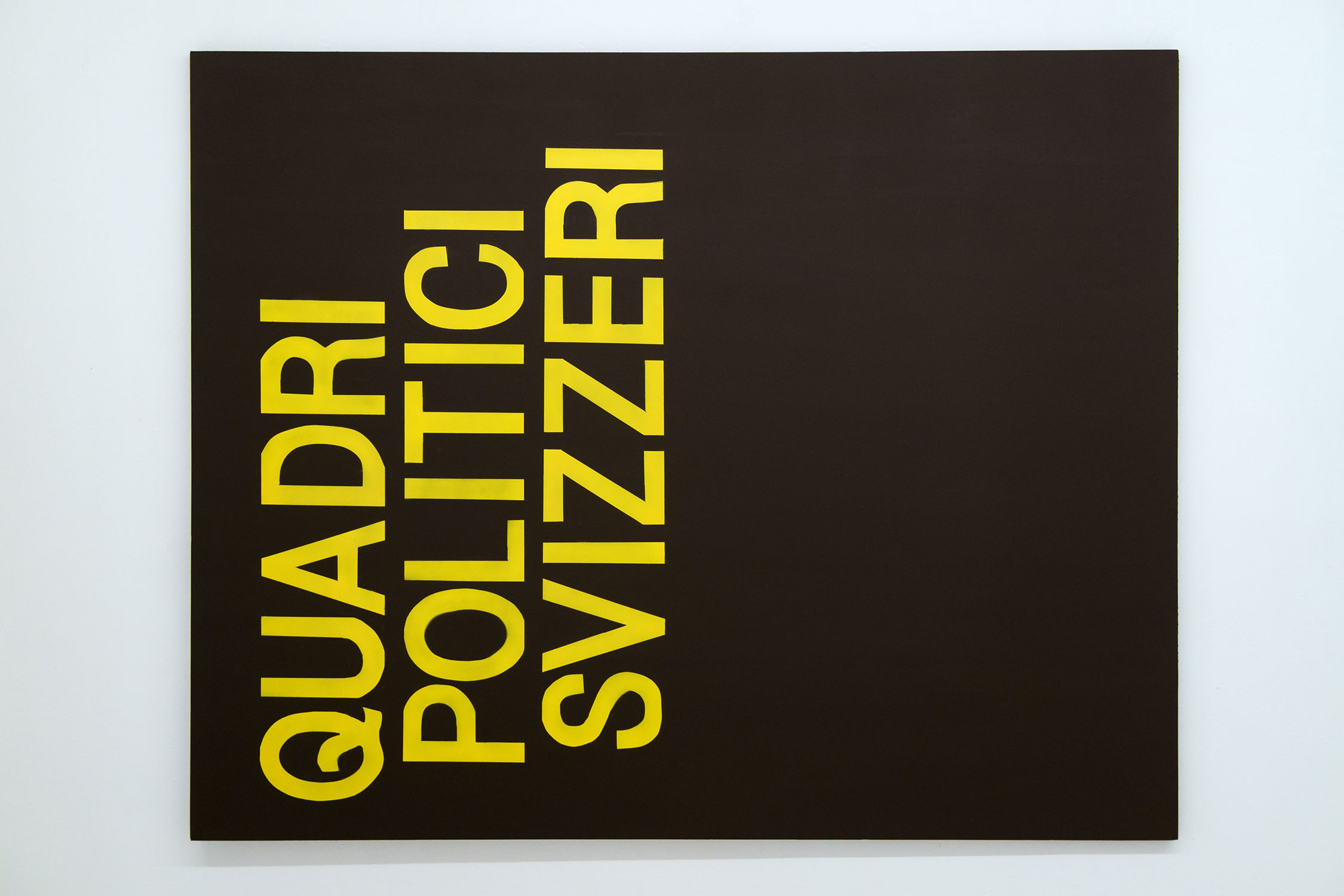
Quadri Politici Svizzeri, 2021. Photo Filippo M. Nicoletti, Courtesy the artist and L’Ascensore
As much as the Duchampian attitude you have just described, the title also praises surrealism combinatory logic.
Beside the clear reference to the dessert, I would have liked to trigger more or less expected references. The title Tiramisù for Two comes from an OPI polish I often paint my nails with. I like playing with gendered stereotypes as well as with heteronormativity – wearing ties and try to unlearn heterosexual dominance people attribute to them. Gesturing with objects that speak of less binary positions is a core of my practice.
Paying homage to other artists’ work is a potential way to shift the focus. On the other hand, it seems you have always been looking for the “heart of the world” – this is the title of an exhibition of yours dating 2016 as well as this current exhibition subtitle. How do you deal with liminality and decentered bodies?
As an artist, geographic centrality is a sensitive issue. It has always been an obsession of mine yet I have always been unable to resist in places that I consider “central”, such as main cities. Not because I do not like them but because life has always led me elsewhere. Places where I stop by often end up being places gravitating around larger cities. As far as the work is concerned, I believe the issue of de-centrality is linked to trends.
I wonder how do you interact with the object and with defusing their function.
Whenever I interact with an object, I always attempt a short circuit. In the frame of my current exhibition in St. Gallen, there is a concrete sculpture of a rat – or a koala? – coming from Switzerland. Here, an interesting relationship takes place with private property. Think of a building that has apartments and a communal garden. Often you cannot even access this space as only the people from the maintenance can. Non-places are then created that do not belong either to the tenants or to visitors. A bizarre relationship between private and collective is established. Thus, I have “borrowed” this weird sculpture from a common area of a building for the exhibition to then bring it back once it is over. By placing these objects within the exhibition space, I re-shape their centrality. An object placed in an exhibition space always speaks of its de-centrality, as it speaks of something else.
A Museum “sacralizes” by means of re-contextualization, as an exhibition does so.
An exhibition is a place where an object detaches itself from its own context to play with the architecture and determine something else. This is a life practice. In fact, I do not just work towards an exhibition, I rather consider my practice to be a continuous flow. As I do not have a studio, making an exhibition is exactly like a studio practice; an instant where you combine things in such a way as to project a free world.
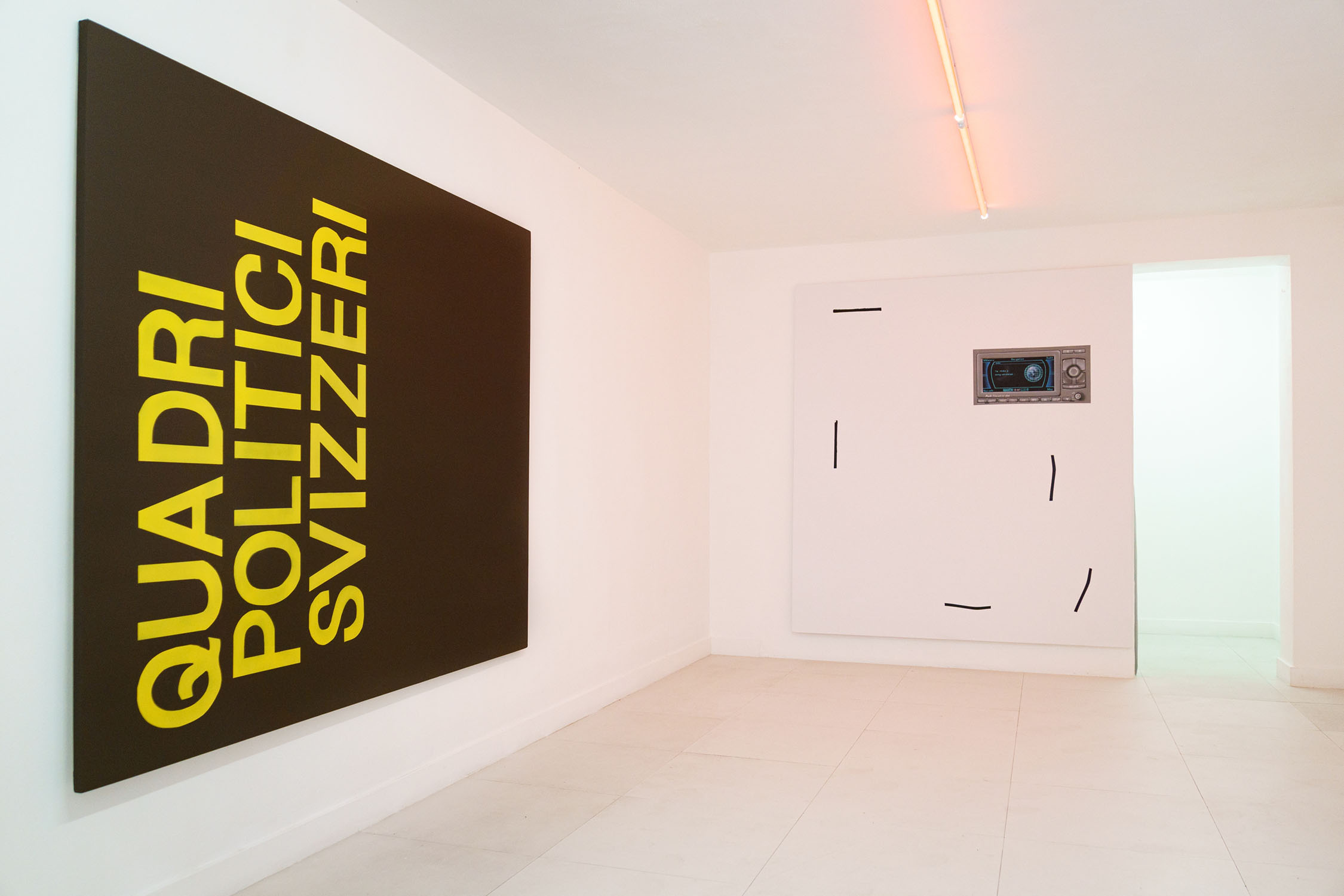
Installation view at L’Ascensore, Palermo. Photo Filippo M. Nicoletti, Courtesy the artist and L’Ascensore
You are currently playing with aural combinations likewise.
This is a biographical matter. Last year, I would have undergone mouth surgery. Prior to this, I had to re-educate the tongue muscle, as I realized it was not. I realized there are myofunctional exercises to modify the behavior of the tongue inside the mouth cavity without surgical proceeding. When I started training, I noticed a sort of exercise scheme; each exercise, both in the way it is conceived and put into practice, echoes the playful activity of drawing. From there, I experimented with mouth sounds and gestures – see Bocca con Matita, 2020. Beside this, since I was a child, I regularly record the sounds of cars made with my mouth, although it is an amateur activity. Once I realized I was pretty into it, I initiated a series of sounds – such as the one on Godzilla. In the frame of an upcoming exhibition at Parliament Unlimited in Paris, I am going to present a reading spurring from a hodgepodge of mouth and automobile sounds. The exhibition focuses on an unpublished text curator Stephanie Moisdon wrote fifteen years ago titled Infamous people (Oublier Vezzoli). I appropriated this text replacing the name “Francesco Vezzoli” with “Wanna Marchi” to then have the text translated from French by Dimitri de Preux. The text is going to be performed along with the mouth exercises.
Why Wanna Marchi – a feminine character who has been an Italian tabloid “villain” in the early 2000s?
Wanna Marchi epitomizes my interest in failure. She has been on the up and up but suddenly she was arrested. Nonetheless, she attempted to get back to the scene. There is then a non-linear life path – as it happens with success instead. Failure triggers a breaking point where your life is no longer the same. Embracing this character’s shift in a museum exhibition means to me to totally change the trajectory of this story.
What is your relationship with failure?
Failure is a watershed establishing a “before” and an “after”. It is a fascinating storytelling cliffhanger, a moment of unexpected interruption which shuffles the deck.
Speaking of storytelling, your practice unfolds in a scattered cartography of images merged into a long lasting film made of uncanny and ironic characters.
When at work, I make huge mind maps where I force all things to live together. During my residency at Istituto Svizzero in Milan, I had the chance to talk with Chus Martínez and we came to the conclusion that my work has a sometimes very austere framework. It becomes relevant to break it up with totally playful things, creating a kind of suspension. Last night, I read this absurd story about the etymology of “bluetooth”, which somehow reminded me of Lili Reynaud Dewar’s 2014 movie Live Through That?!, whose protagonist holds a dental floss so strongly to let his gums bleed blue-ish blood.
Alfredo Aceto
Tiramisù for Two
L’Ascensore, Palermo
Photo Julien Gremaud
Courtesy the artist, Kunst Halle Sankt Gallen