Text by Günseli Yalcinkaya
CURA.45
The Blackout Issue
The New Now

A collaboration between photographer Karl Felix and performance artist Candela Capitán for @90antiope
Photo: Karl Felix Courtesy: the artist and 90antiope
How do virtual bodies move through screens, to perform themselves being seen by others? In Sound Cell, the second iteration of a three-part solo series X, the Spanish artist Candela Capitán explores the role of women as symbolic consumers under techno-capitalism, comparing the control mechanisms of a cowbell with the commanding nature of the algorithm. She crawls through the audience on all fours, a heavy cowbell hanging from her neck, before eventually reaching a standstill. Clanging noises reverberate across the gallery floor. Her crotch points to the camera, live-streaming the entire thing. Once the live performance is over, it no longer exists in the physical space. However, its image is cast across social media in the form of short-form fragments and eventually absorbed into the feedback loop of online culture. Aestheticized, commercialized, and commoditized—Capitán traces the smooth flows of the digital production line, breaking the image down into binary code to be fed back to the machine.
Drawing on this online condition in X (2025), a three-part solo series, Capitán confines herself to a literal content cage to establish a parallel between two spaces of productivity: industrial dairy factories and the dystopian phenomenon of influencer farms, where hundreds or even thousands of content creators are confined to small pods with ring lights and a smartphone, with the sole aim of streaming e-commerce. Juxtaposing the role of the female body producing milk with the role of the influencer, who is presumably milked for content, the live performance—inspired by Bruce Nauman’s Double Steel Cage Piece (1974)—sees both the artist and spectators generate content, inadvertently transforming the exhibition space into an actual production farm. As Capitán livestreams her performance from inside the metal structure, or “body containment device,” the audience records clips on their phones, where the act of recording becomes part of the experience itself. Yet, it’s these very technologies that extract value and exert influence over us. Through steel cage optics, Capitán reveals the illusory nature of this connection, as something that gives the vibe of togetherness, while remaining entirely individualistic, as disembodied as avatars on a screen.
By now, it’s clear that data is not a natural resource, but the product of labor, as the internet saying goes: “If you’re not paying, you’re the product.” This is a recurrent theme across Capitán’s work, which often involves scenes of bodies trapped in digital environments, captured online through various technologies—laptops, phones, social media, and live streaming services, some of them aired on Capitán’s own Instagram account. In SOLAS (2023), five dancers in matching pink Lycra bodysuits and high boots twerk in repetitive motions in front of a MacBook screen. Like digital clones birthed from the same source code, their standardized movements are live-streamed in high-resolution onto Chaturbate, a live webcam chatroom, where users can interact with models in real-time. Posted and reposted across social media, the performance was said to convey “the (in)visibility of the female body in the immaterial market of data that invades today and where the body continues to be considered the main object of desire.” No doubt reaching a climax in 2024 when Kanye West shared clips onto his own Instagram, the exact moment that Capitán calls the performance’s “orgasm.”
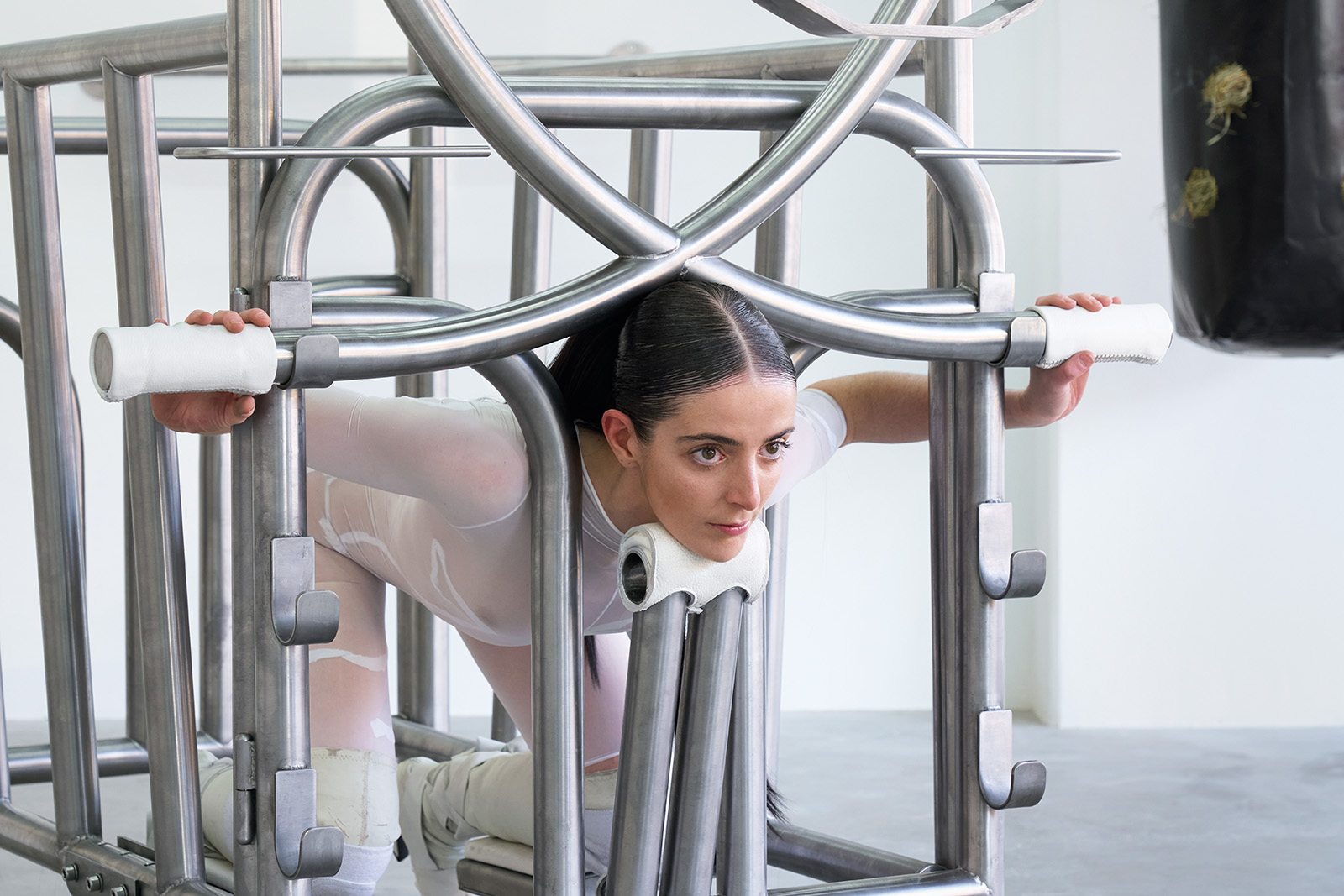
Content Cage Sculpture, X exhibition, inter, Copenhagen Courtesy: the artist

Content Cage Sculpture, X exhibition, inter, Copenhagen Courtesy: the artist

Content Cage Sculpture, X exhibition, inter, Copenhagen Courtesy: the artist
“You have to feed cash into ‘feminization’ to be both real—convincing, relatable—and not-real, alluringly ideal” – Alex Quicho
“You have to feed cash into ‘feminization’ to be both real—convincing, relatable—and not-real, alluringly ideal,” writes Alex Quicho in her essay, Everyone Is a Girl Online, pointing out the web of exposure that defines the online condition. Similarly, Capitán’s girlswarm is hyper-optimized for online consumption, where women watch themselves being looked at. They move in sync, playing out an uncanny series of choreographed positions that are repeated in cycles, mapped out by the artist herself on a piece of paper. As objects of desire, they are immediately perceived, yet deleted from physical existence soon after their image reaches our screens. The hybrid nature of performing in both online and offline spaces explores the limitations imposed on the body by contemporary technologies, highlighting the tension between hardware (body) and software (soul).
A comparison could be made between SOLAS’ own it-girl aesthetics and that of Anna Uddenberg’s Balenciaga-clad sculptures; immaculately styled, inhabiting smooth, futurist environments that operate on the same semiotics of coolness, typical of the ultra-contemporary aesthetics so often associated with avant-garde fashion and underground club music scenes—past musical collaborators have included musicians such as Lee Gamble and Slim Soledad, and architect Daryan Knoblauch, whose elaborate metal contraption forms the sculptural centerpiece of X. As with the Kanye moment, these are familiar engagement metrics that hint at the mimetic nature of online aesthetics, where images are fed and filtered through the digital churn, only to have algorithms reflect our own tastes back to us, fragments of which form the building blocks of our own digital identities.
A similar idea is explored in Alone and Connected (2022): six performers are literally chained to a para-theatrical device to demonstrate how social media suspends us in an infinite scroll of data, the inertia of automatic and circular movements recalls the carousel of information and slop that keeps us connected in the Cloud, and yet isolated in our relationship to others. “Human users are perceived and reflected not through demography but through statistical distributions,” writes K Allado-McDowell to describe the machinic constellations that shape online identity. “Neural media reinforce identities as they are perceived by machines, that is, as locations (or embeddings) in a statistical landscape.” Mirroring their online condition back at them, the audience sees themselves as nodes in a network of impersonal data, as standardized as the bodies on stage.
In our hyper-mediated present, Capitán’s use of repetition reads like a pre-programmed script. The automated qualities of algorithms and machine learning are inseparable from the experience of being online. Increasingly, it feels like our every decision, movement, and thought is being controlled by an invisible cursor, through recommendation algorithms, engagement economies, and personalized search results that micro-target users with the aim of influencing our behavior, to modulate and manipulate reality itself. Their technological capacities to extract value and exert influence over us will only worsen as AI agents and companions further install themselves into our daily lives, embedding themselves like microplastics into the ways we experience online connection, communication, and control, and eventually even act on our behalf.
Becoming-bot will eventually no longer be an option but the next stage in the ongoing hybridization of AI-human selfhood. So, how might we avoid becoming bots altogether? We might accept the machine’s definition of ourselves, falling deeper into narcissistic, sycophantic self-affirming feedback loops, the most extreme version being a form of AI psychosis? Or, perhaps we might find ways to resist or recontextualize the algorithmic currents that are pushed on us: “Rituals are characterized by repetition,” Byung-Chul Han points out in The Disappearance of Rituals (2020).
Drawing on the disruptive and riotous potential of the dancefloor, MOLOKO VELLOCET does just that, using techniques of repetition and mechanization to draw on the ritualistic qualities of rave culture, where the decks become an altar and the dancefloor, a body-without-organs. Byung-Chul Han describes this “ritual body as a communal body,” which pulls the subject out of itself and towards the Other. Capitán’s performers stand up, roll, stand up, roll again for hours until each dancer eventually collapses on the ground from exhaustion. The simplicity of the repetition is mesmerizing, if not primed for virality, the digital currency of our times. Yet, for a brief moment, there’s not a machine in sight.

Celda Sonora (performance), X exhibition, inter, Copenhagen Courtesy: the artist

Flight Room (performance), X exhibition, inter, Copenhagen Courtesy: the artist

Solos y conectados with Tanzkassel Company © the artist Photo: Juan López Courtesy: the artist
Candela Capitán
Text by Günseli Yalcinkaya
CURA. 45
The Blackuout Issue
All images:
Courtesy: the artist
CANDELA CAPITÁN (b. 1996, Sevilla, Spain) develops a practice which unfolds at the intersection of contemporary dance, expanded performance, and visual arts, as a critique of platform capitalism and a reflection on the image in the hyperconnected era. The body is her conceptual core: a territory where feminized corporealities are transformed in constant dialogue with technologies that materialize and modify them. She is particularly interested in creating scenic and sculptural devices that restrict movement, forcing the body to negotiate with its limits and the machinery that frames it, to question power relations and project non-normative futures.
GÜNSELI YALCINKAYA is an artist, curator and writer based in London. Her practice of internet folklore explores emerging technologies, online culture and the myths embedded within those systems. She is a contributing editor at Dazed and the former host of Dazed podcast, Logged On. She has appeared in talks and panels at the Architectural Association, BFI, Somerset House, Sónar+D, Serpentine Galleries, LAS Art Foundation, Unsound Festival, Vienna Digital Cultures and X Museum. Her essays have been published in Dazed Magazine, Spike Art, Vogue, Zora Zine and 032c, as well as in books for Aksioma, Julia Stoschek and Metalabel.


