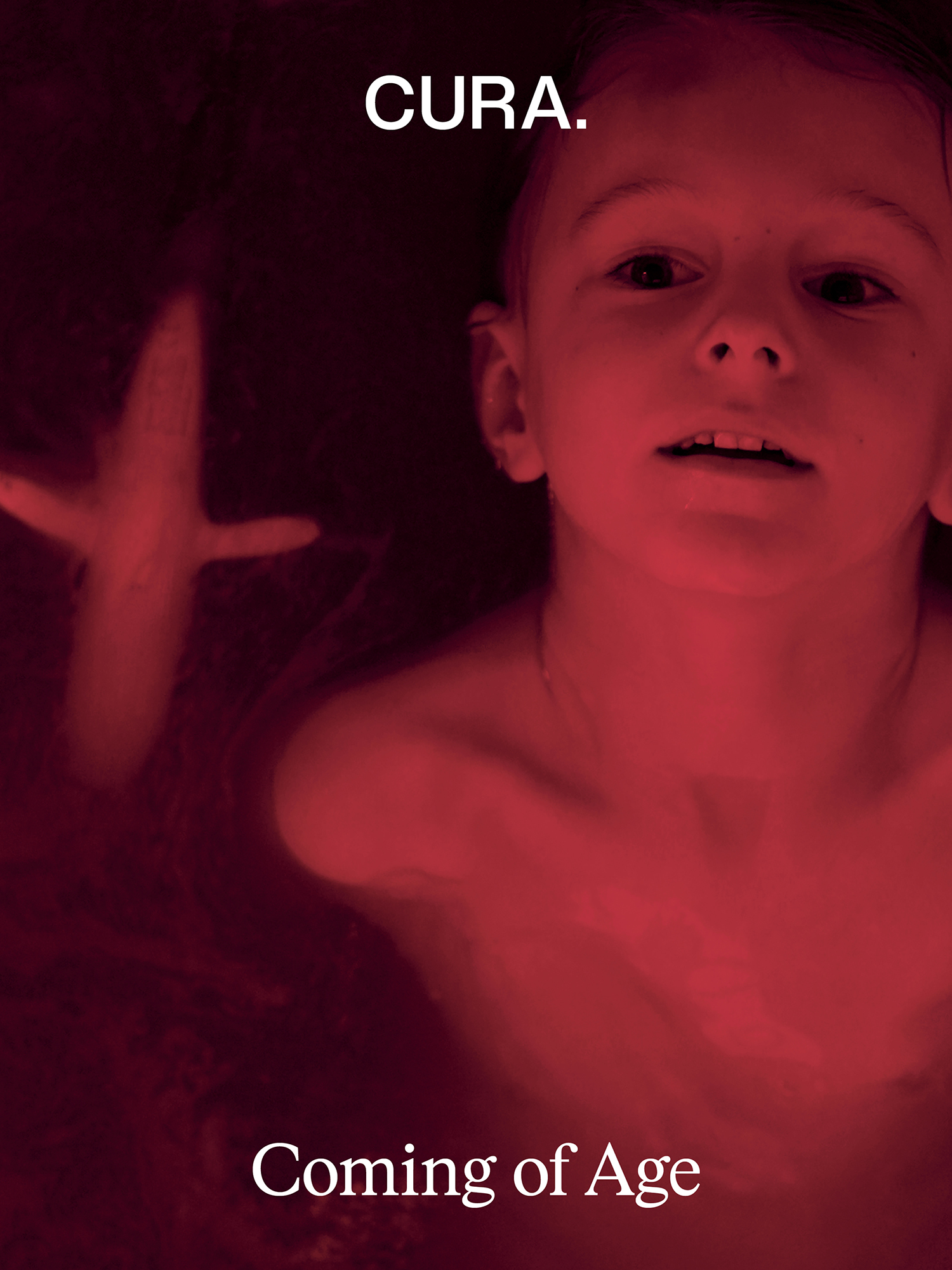
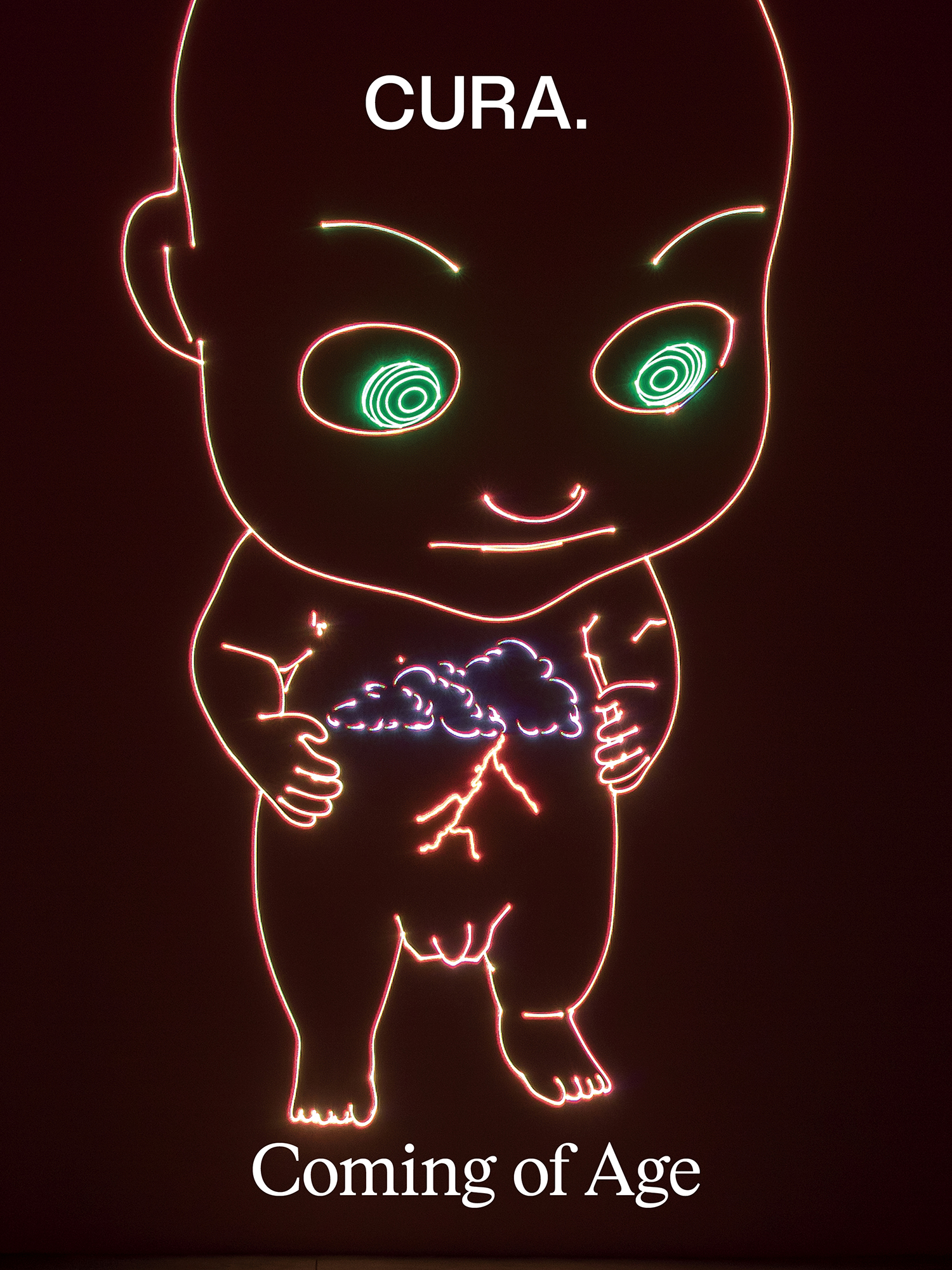
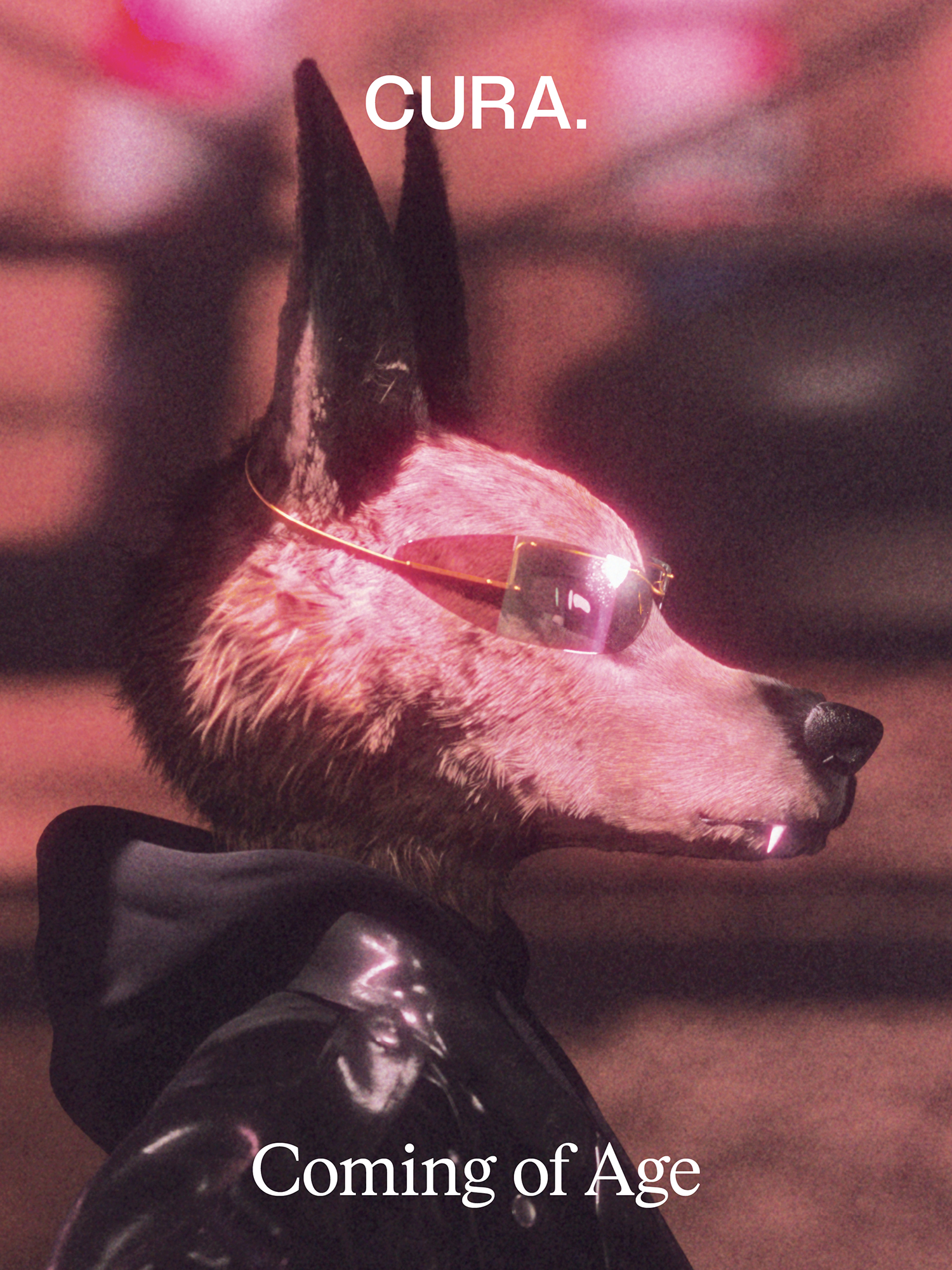
in conversation with Emma Enderby
CURA. 43
Coming of Age
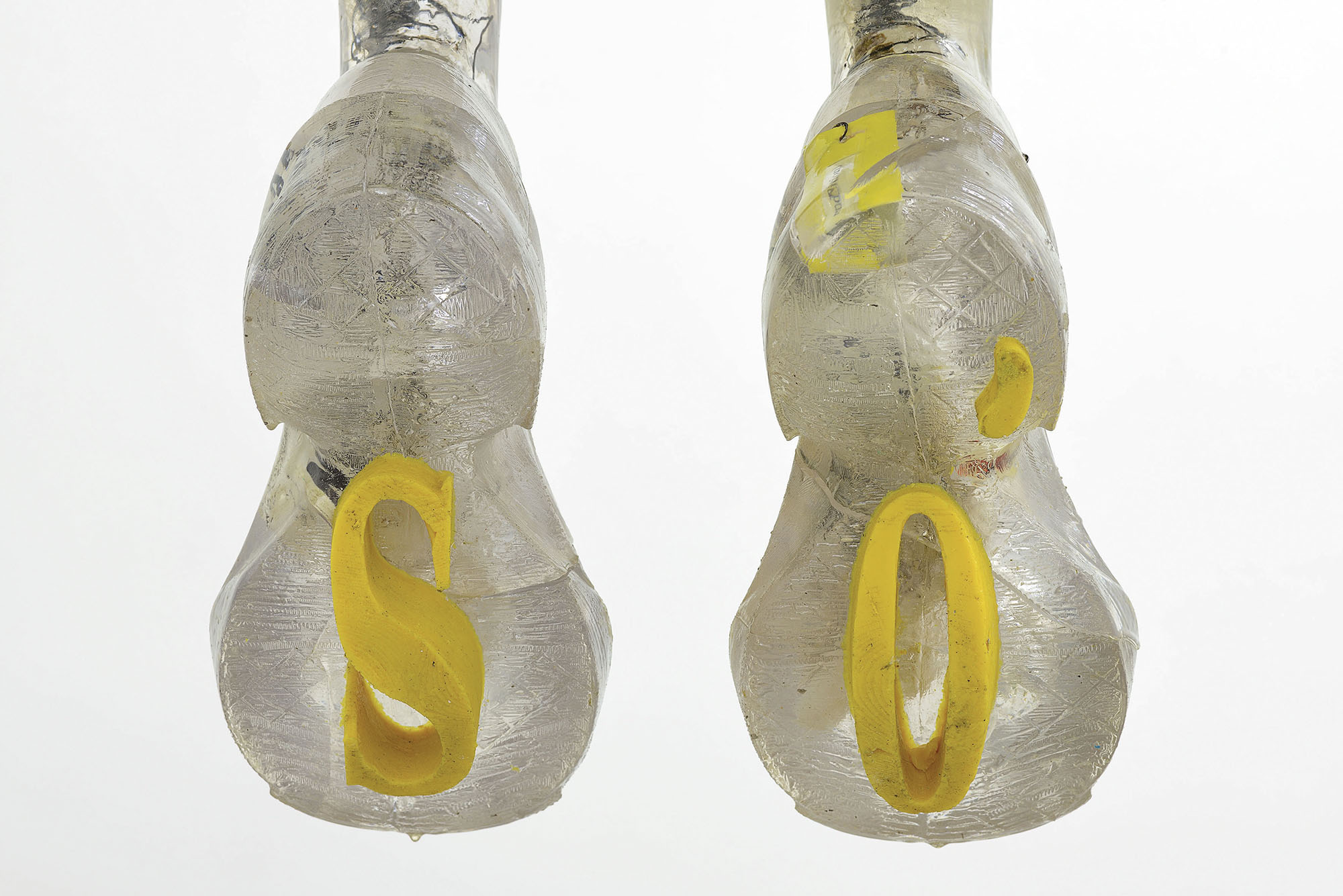
SO, 2014 (detail) Courtesy: the artist
Where are you in the world?
Right now, I’m in the south of France, in my father’s house.
In Perpignan?
Yes, I am staying one week here. I enjoy it. My father, who is a gardener, is here too. I live in a big garden.
That somehow makes sense with your work.
Oh, do you think?
Yeah, and maybe we can begin from there… What’s always struck me about your work, something that I personally appreciate, is that there is no antagonism between the so-called digital and the real. This aspect resonates with me. I’ve often found it kind of strange when people talk about the digital and the physical as if they aren’t the same thing—the digital holds the physical and the physical holds the digital.
You’re right. Actually, it’s funny that I’m here right now. I was watching TV, had a computer quite early and played video games a lot here. So I remember I put at the same level the TV, the screen, and the window… I put digital reality at the same level as the flowers outside, the animals, the wind, the sun, everything. That was really important for me to have those things together at the same level. Later I was thinking about how it could be possible to translate this materiality of the digital and its emotional effect. I was watching a lot of TV then, so the outside was corrupted by what I saw through technology—the TV, the computer, the internet. I guess that’s my generation. I figured out that I could use this new platform to express myself and enter a space where I could exchange with other people. I realized that I could also connect with people through this platform and not only be passive with it. So I started to work from this feeling. That was my departure point. It was not about the knowledge of technology, but about the emotion and feeling that you have from your experience with technology. That’s why I like Fluxus—they made dead objects, but alive inside. It’s a failure, something is wrong, something doesn’t work. I like that.
Do you ever think about Robert Rauschenberg as well? I was just thinking about his Combines while you were speaking, how they are time capsules in a way, but are also speaking about the anonymity in the world of reproduction, the world of information, and our emotional attachment to them. I’m referring to common images and our relationships to them when they work and fail. His work came to my mind while you were speaking and I was wondering if it’s ever been a reference for you.
Rauschenberg, yes. But I came to his works later, at the beginning I was more inspired by Broodthaers. In the end, it was more conceptual. And it became something material, but it was unintentional at the beginning.

Scan from collage (black and white), 2020

DD_ACHéTE LE NACRé à LEURS âMES_KFG_B, 2023 (detail)
Photo: Roman März

UN’FOLD, 2023 (detail)
Right. I think Rauschenberg said something about a picture being the real world for him when it’s made from the real world. But I guess you don’t intend to represent the real world through the materials you are working with, but rather the emotional reality of these things in our world. One thing that I think is interesting though is the anonymity related to both of these artists, Broodthaers and Rauschenberg—materials are anonymous through their commonness. Clearly, that’s been something that you’ve been drawn to and worked with a lot. When you source online conversations, poems or images to make them become your material, they’re often anonymous.
Yeah, it came from the beginning again, and my intention to be an artist without any actual intention. I came from graffiti. I did a lot of graffiti here in the south of France, and I remember the way the use of language was important to me because this form of expression entails the corruption of language. I found it important for me because, as Burroughs said, when you cut on the newspaper, you cut society. Graffiti was like that for me, even if I was not aware of Burroughs at that time. I was very inspired by this idea of making a mark on society. Graffiti is a presence in the street, in the city, using language, but for myself. And, of course, it’s related to anonymity. When I started to discover all of those things online, and to make objects with them, I was inspired by the Anonymous movement, because I found the same energy in graffiti as on the internet platform. It started with Facebook and some blogs. It was very helpful at that moment to read some writers who were using a collage of blog texts—Dennis Cooper, for example. It is again a matter of borders, because the words and the language in the plaster were like a form of vitality, like a ghost inside the material. Anonymity is essential for me because it’s a part of my work, which is political somehow—through anonymity I can use a mask. I also think about the destruction of an ego in a work. When I started doing research about poetry online, the most important aspect was the people who chose avatar names or anonymous comportment online. I found this silent presence really interesting. Who knows? Who cares about that? But it is still there and I investigated how it could be present and material in my work.
I remember that feeling, those early days of AOL chat rooms and MSN Messenger where everyone was anonymous in a sense. Although it came with darkness in some ways, I kind of loved that you could project whatever you imagined or hoped onto this person, you could make them whoever you wanted them to be. I guess that’s the danger too. I’d like to ask about architecture and environments. I had just seen the Isa Genzken exhibition at MoMA, and then I got on the train and went to the SculptureCenter and I saw a show of yours for the first time. I remember thinking that made so much sense that those two shows were on at the same time in the city. I’m sure it was not remotely intentional by the curators. I thought about your work in relationship to Genzken’s, post Fuck the Bauhaus, where she started making these insane objects, materials, colors, recreating architectural skyscrapers and the city streets. Your show was also about the city, and the kind of urban systems that are essential but that you don’t necessarily experience, like sewage. I saw a connection in you both abandoning—or maybe shredding is a better word—ideas around order and power. For me, this was really tied to the way that you were thinking about architecture. So, I just wanted to hear your thoughts about that relationship and how this aspect has become more and more present in your work.
Thank you. I remember I saw that show too at the time. That was a great experience. Architecture is important, always. And yes, it’s become very important recently, more and more. I think when I started to do it, it was the extension of sculpture, let’s say, like volume in general, with the idea to create an environment for sculpture. I do believe that in contemporary art we can build things with an idea of corrupted architecture, things that are schizophrenic and about the thoughts that we have at the time. The public and the private space are intertwined, and I’m super excited by that. The colors of the wall in the private space and then fences in public spaces. My work mixes these realities to build the experience of the space.
You just mentioned color. That’s another element that has always struck me about your work and environments. We have just experienced with brat, yet again, how color can capture a moment, a vibe, a collective feeling. I would like to hear more about color, because you’ve used it since the beginning in very direct ways and it plays a very prominent role in your work. How do you connect those colors to the kind of wider emotional state that you’re creating with your works?
I really enjoy working with colors in my studio, with a particular attraction to colors that are not pleasant to live with. The colors used for administration interest me the most, and especially the ones we find in children’s schools and globalized modern cities. There is an emotional artifice in the use of colors that fascinates me. What I do most often is to think of color as an emotion that diffuses into the sculptures, like a form of contamination. This allows me to conceive the exhibition space as a fluid place, where the environment is connected to the objects it hosts. In my opinion, this is what we do as humans.
You’ve been in shows or made works about the mirroring of essential things in our lives or systems that aren’t necessarily visible or seen, like the sewage system or transport, or generally ideas about public space. It’s interesting that you’ve been included in a few shows that look at that type of abstraction artists are exploring. Infrastructure, architecture and technologies are being explored through abstracted terms because they’re often abstract to us. There isn’t a kind of transparency in the way that we operate in the world, at all. A friend of mine once called this approach “infrastructural aesthetics,” a definition I liked. This feels really relevant to your work, that kind of layering and abstracting of information to create an experience of a thing. I would like to hear about how you see abstraction in those terms.
That’s a good question. It’s hard to explain. I often think about the right to respond we have in the face of the dictatorship of industrially produced objects. The emotions we maintain about something like an IKEA table, for example, fascinate me; it’s a visible form of our state of mind on an object. It becomes the foundation of our lives. I like to understand an object in that way. When I start to make an object, I have an idea. And it’s a lot about the collage, and how you can have an object, which is like a ready-made, something I bought or found in the street. I turn it on every side, see every shape, and it becomes something else and then it starts to have different elements around it, until it finally becomes abstract. I also realized that my objects are hard to catch or understand—it’s not about being intentionally obscure but more about using abstraction as a form of resistance in the world. I am also looking for something when I’m making an object that I’m still learning about—this new object doesn’t exist in the world, but it comes from that which already exists. My use of abstraction comes from not wanting to shape the object in a political way—objects don’t have to say anything to the world, although they of course contain something. I really like abstraction as a form of resistance to objectivization, but then the object always has something to say.
It makes sense. Something I’ve often felt when I’ve looked at your work is that there’s this kind of dizziness. Your use of abstraction connects to this dizziness. You talk about abstraction as a form of resistance, but there’s also a radical refusal of any kind of consistency. One might recognize something, or connect things in a work, but then it also breaks apart with contradictions.
There is a certain desire to highlight a form of inefficiency, softness, a weariness of being, while using the shapes or materials of power, like a corruption of thought. I see passivity as a form of resistance to the forced march of the world. That’s probably why the adolescent world fascinates me so much, and why I constantly return to it to capture images and postures. I believe objects are receptacles, witnesses of life, and my work is to make these objects emit their contained energy, without ever confining them. This goes through multiple contradictory states in which I have established my language. From abstraction, or inefficiency, and sometimes even from absurdity, a kind of truth often emerges. I believe we need to learn to let go, allowing things to unfold without trying to control everything. It’s also a belief in the capacity of works of art to make life gentler. I must feel so much anger at times, considering the world in which I live, that even a simple plastic flower can calm me down. It all depends on the importance we give to things.
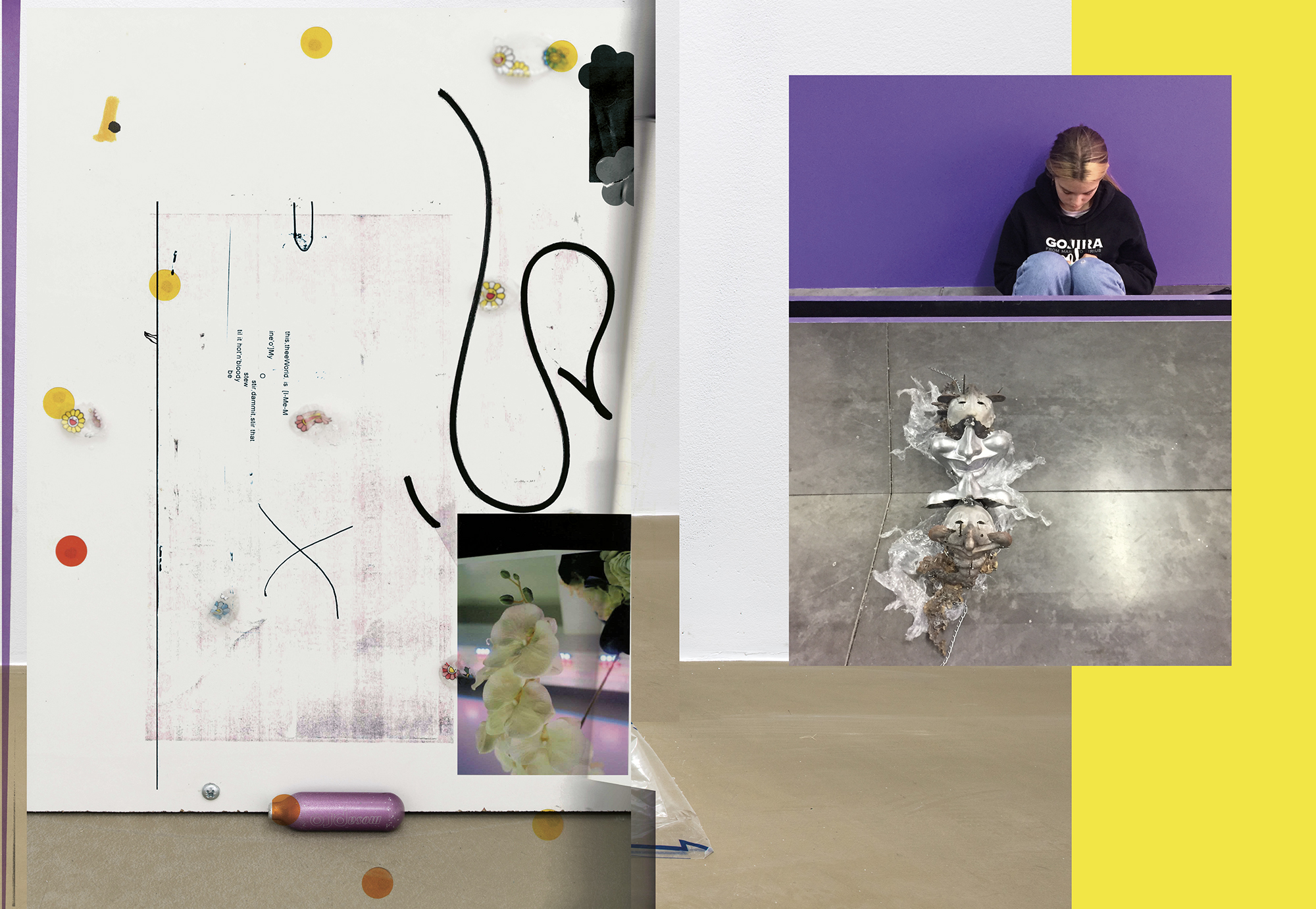
Graphic composition with images from O’ ti’ Lulaby, Frac Île-de-France, 2020

Scans from collages, 2023
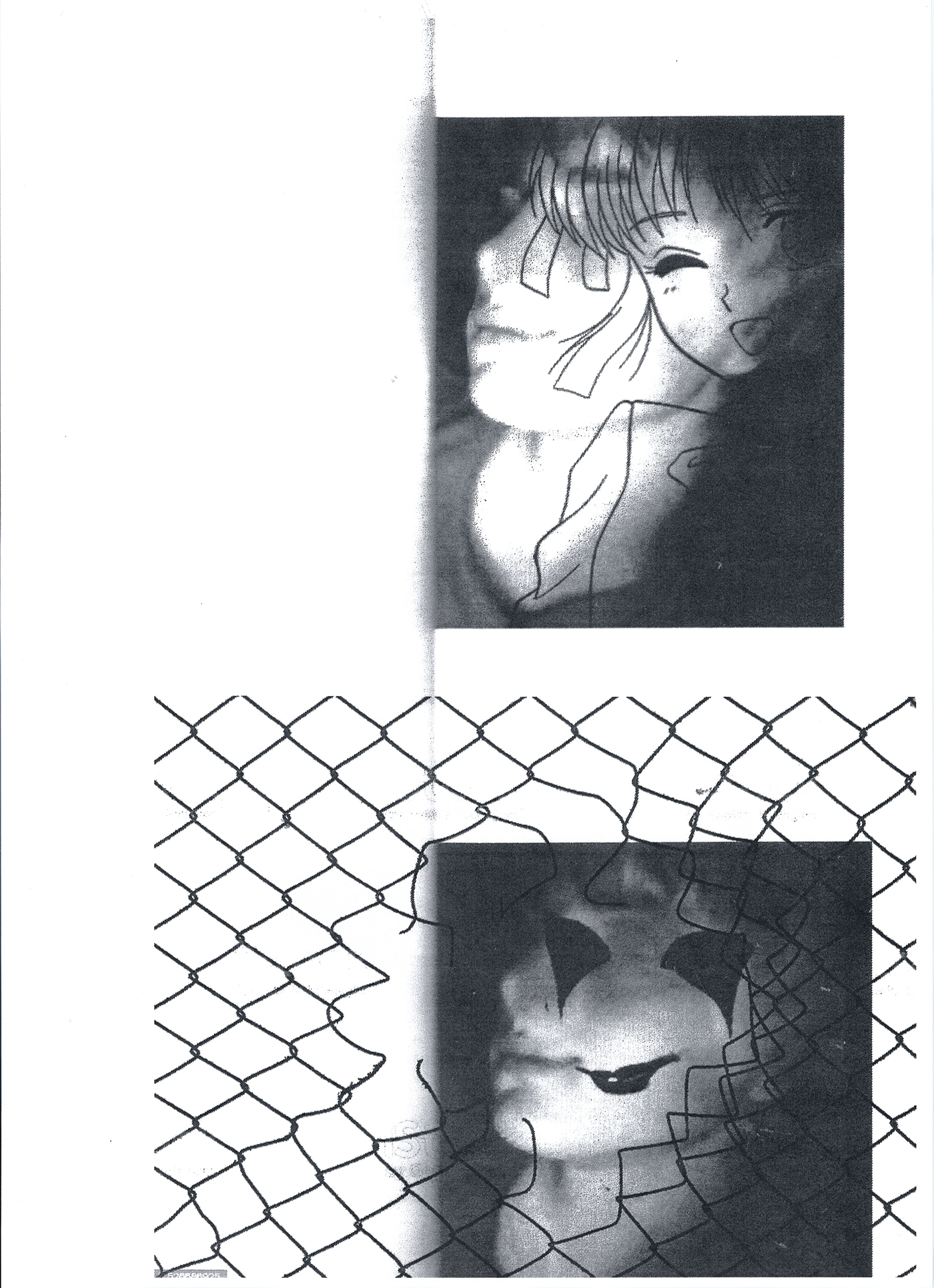
Scans from collages, 2023
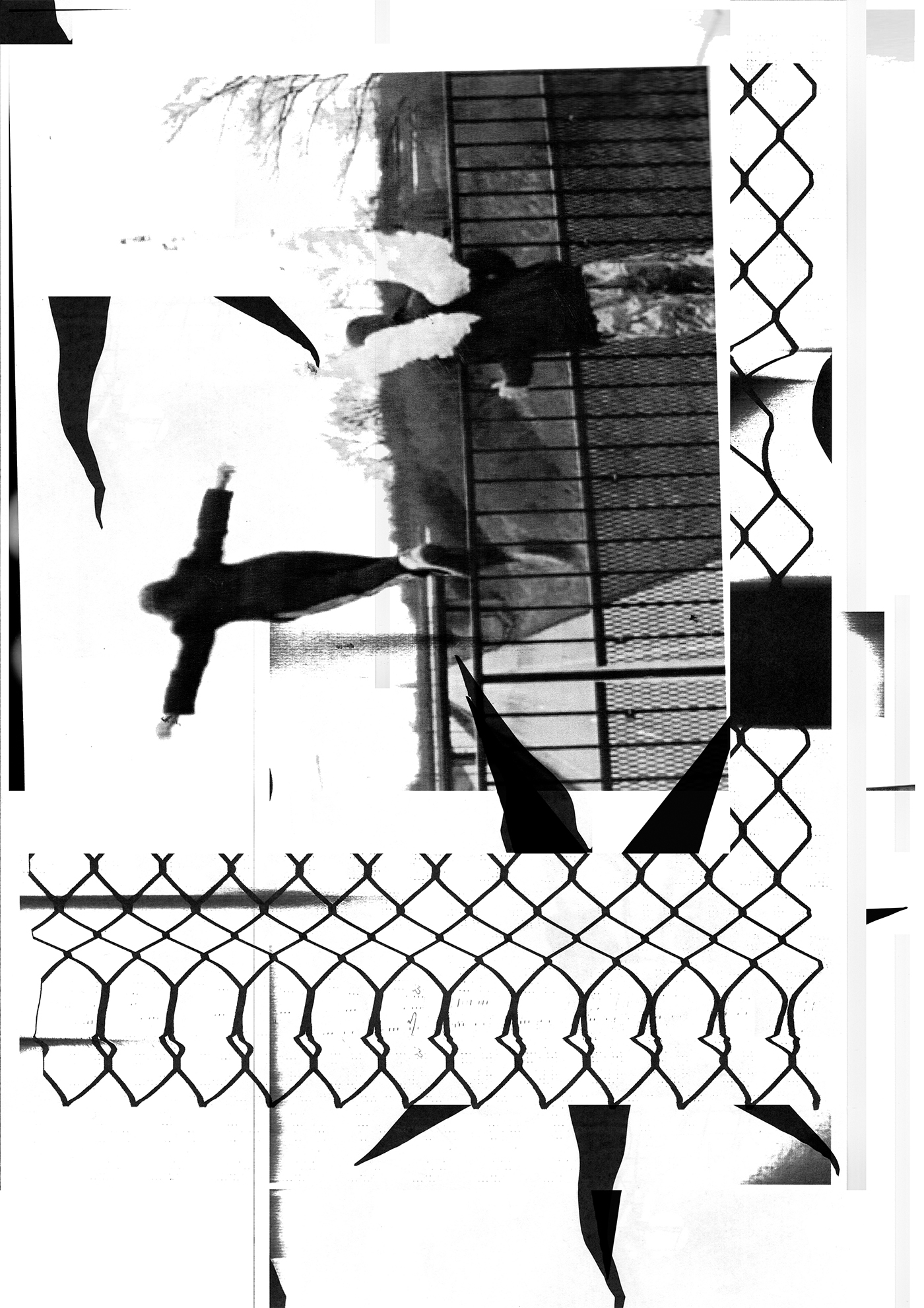
Scans from collages, 2023
I was triggered by this thought when you mentioned the dirty flower. I was recently rereading a text by Mike Kelley about the uncanny, and I was trying to think, what is that now? What Kelley was trying to connect to is this Freudian understanding, where there’s this perversion of mass culture or the fear of the thing that generates it. And I guess I get that same feeling when I look at your work. You already used this word—contaminating.
That’s a nice compliment. Yeah, Mike Kelley!!! I am also a big fan of Tetsumi Kudo. Maybe the key point to understand what can be an uncanny today is to go back to Kudo, I guess. Like this pollution, and corruption of technology. He was very visionary about the world we live in today, wasn’t he?
For sure. And the way Kudo criticized the unique status of the human being, for example. You have curated a group show at CURA.’s Basement Roma space, which makes sense, given also the way you work. I was curious to hear about your approach to this show as a network, which is how it feels.
I really enjoy working on collective projects. This is an exhibition that reflects my generation, shaped by my emotions about how those around me do things, and we all inspire each other. I think it makes sense today. The starting point was this Winnie the Pooh by Nicolas Ceccaldi, which I’ve lived with in my apartment for a while. I wanted to talk about the global state of alienation through connected objects and their underlying control over bodies. I also wanted to showcase Dennis Cooper’s animated GIF novel, captured from his blog. The idea here is to use today’s visible tools and turn them into poetry and emotion, with a strong adolescent aesthetic present throughout. I also invited Valerie Keane to show a sculpture, where I was thinking about the ornament of imagination. I was imagining someone on their bed, lying, and thinking about something, and then I wondered how I could materialize this. Valerie Keane’s sculpture for me was the ornament that you need to have inside your head, and inside your body, to be strong enough to grow up, after the Winnie the Pooh childhood moment [laughs]. The sculpture is like an armure, but it’s just a sculpture, you cannot wear it, it’s just there. I also invited Antoine Trapp, who is working with an artificial intelligence platform, which he is trying to cannibalize, the machine cannibalizing itself. He creates an image with this, which is quite beautiful, he makes research binders with it. I was super inspired by this idea of the machine cannibalizing itself, like a solitary machine by Duchamp or something.
In the exhibition there is also sound, as always in your work. I was watching the Louvre video you made. It is so good, like a Pokemon zombie situation in the museum, and that basically is the experience one has there, right? A zombie on a Pokemon quest but the Pokemon is Delacroix. The sound in it is so hyper and catchy and dark and weird. I’d like to hear about how sound plays a role within your work and exhibitions.
Yes, sound is very important. I do music on the side, as well. For this video, the Louvre one, I used a feed recorder. And then I put some other sound that I made on it, like emotional things that I had inside of me when I was in the Louvre. But in general, when I’m working with sound, it’s like a stuttering—a sound that is like a promise of something but it never comes. Through sound, one is always aware of something going on in the exhibition space, it draws attention. And it becomes something that I don’t control. I do some beats on my computer and then also in the space, but it’s not just one speaker, I try to put speakers everywhere. It’s a challenge for me to make a silent object. Sometimes the sound is literally inside the sculpture. For me, it’s to create attention for the viewer, so they pay attention to something going on. Which is also about time. Because when viewers come into the space, they are on their own time, but the sound can put pressure on that time, so it’s about attention and time. It’s like color, actually—it’s like, “Hey, something is happening here.” But as the sound is never complete, it’s a surprise. I use a lot of silence too, so people don’t know when the sound comes in. I like this deception, you know, I like when people ask, “What is it? Why?” I think I can’t do a show without sound now. I love that.
Sound, object, architecture, color, are creating this attention, but also movement? There’s a sort of choreography in how you can move people in space.
It’s all of that. And attention is important for the object. To pay attention. It also reminds me of the political ideas that I want to put in my work. I’m interested in political movements that cannot be captured. By definition, sculpture captures life, but the goal is to render things muted and underground so they become more corrosive and powerful over time. I really like the idea of something being haunted by a thought, but that thought never being fixed. It’s a challenge I love when working with objects. That’s why sound, colors, and environments are important, as they reveal and affirm the presence of an absence, which feels accurate to me in relation to the world I live in. It’s about challenging objectification while using its own power structure.
It’s that idea of abstraction, again.
Yes, that’s why I love the Joker mask so much. It only shows a smile, but it contains so much of our time. It hides a vitality that dances in silence. We can dance with it if we give it attention.

Carte Blanche à David Douard with Nicolas Ceccaldi, Valerie Keane and Antoine Trapp, inner GLOw’ replica (installation view), Basement Roma, 2024
Photo: Daniele Molajoli Courtesy: the artist and Basement Roma

Optimized Heart (installation view), UCCA Center for Contemporary Art, Aranya Gold Coast, Beidaihe, China, 2023 Photo: Sun Shi
Courtesy: the artist, UCCA Center for Contemporary Art and Galerie Chantal Crousel, Paris
David Douard
in conversation with
Emma Enderby
CURA.43
Coming of Age
DAVID DOUARD (b. 1983, Perpignan, France) lives and works in Aubervilliers, France. His work has been shown in solo and group exhibitions organized by international institutions such as UCCA Dune, Qinhuangdao (2023); Serralves Museum, Porto (2022); FRAC Île-de-France, Paris (2020); Irish Museum of Modern Art, Dublin (2019); KURA. c/o Fonderia Artistica Battaglia, Milan (2018); Palais de Tokyo, Paris (2014, 2018). Douard participated in several biennials: Belgrade Biennale (2021); Biennale de Lyon (2013); Taipei Biennial (2014); and Gwangju Biennale (2018).
EMMA ENDERBY has been the Director of the KW Institute for Contemporary Art in Berlin since 2024. After being Chief Curator at The Shed, New York, from 2021 to 2024 she was the Head of Programs and Research/Chief Curator at Haus der Kunst, Munich. She works as a visiting lecturer, critic, and speaker at several universities and institutions, as well as an editor and writer for multiple publications and catalogs.