Text by Gareth Damian Martin
CURA.36 SS2021
FUTURITY
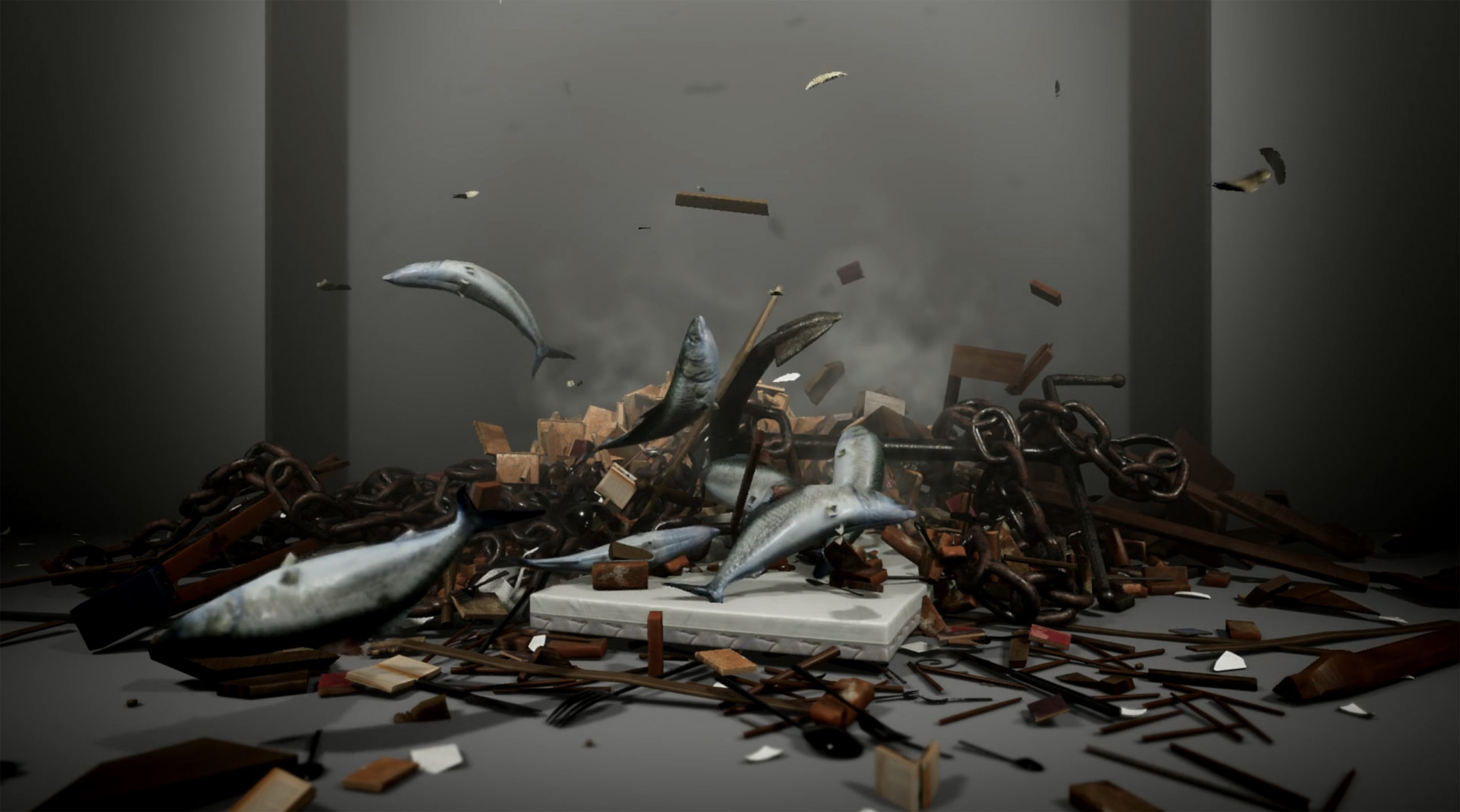
“Anecdotally,” Ed Atkins tells me over email, “I think there’s still a fish required just out of shot throughout, rotating in mid-air. When we tried to take it away, the whole thing would crash without fail when it started to rain. So it stays, without our [sic] really knowing why.” He’s talking about Refuse.exe, his 2019, two-channel real-time 3D simulation wherein a carefully orchestrated cascade of objects (a piano, fish, feathers, bricks, etc.) fall in real time from one screen to the next where they accumulate in a haphazard pile. The fish in question speaks to the nature of Refuse.exe, which rather than being a linear or looping video is a live simulation, made in collaboration with 2n Design who specialize in ‘immersive experiences’ and built in Unreal Engine, a tool typically used for high-end videogame development. Though so often appearing to be slick and glossy, palpably real and technologically sublime, videogames are fragile assemblages, their realities patchworked from proprietary technologies and ornate codebases, wrangled into performing strange illusions. There’s an element of materiality, an element of ritual and an element of the bizarre accumulation of workarounds and hacks that defines almost all games and simulations. Hence Refuse.exe’s spare fish—an anecdote that points to all three. The incantation that makes the world.


Of course when I say materiality, I mean it in a different way than we typically understand it. After all, how can a digital world be material—isn’t that an unassailable binary? But then what else should we call the qualities and characters that digital objects and worlds possess? These are not simply properties, but the rules on which these surrogate spaces are built. The intangible physical laws of a specific game engine (such as Unreal), open to revision but not total erasure. The fish must spin or reality collapses, say the laws of Refuse.exe, but you can conceal it outside the frame.
There’s a surrogacy to this kind of materiality, just as there is a strange surrogacy to Refuse.exe. On observing its parade of non-sequiturs, falling with a palpable sense of weight and rotational spin, we are not convinced of their reality. Yet they are also not just symbols, stand-ins for their real-world counterparts. They are instead compelling in their particularity, in the way which a brick might spin with an unlikely velocity, or an anchor chain gathers enough momentum to oscillate impossibly back into the air. Atkins tells me that in Refuse.exe he wanted to “engage with mistake in a way that was familiar from videogames. The ways in which games suddenly ‘corpse’; the brinkmanship of any kind of suspension of disbelief… I wanted that.”


We are, of course, familiar with these kind of “failures” of representation that define digital simulation. From bad CGI in blockbuster films to videogames glitches, to Zoom backgrounds that phase out the shoulders of video call participants, we live among the limits of these aesthetic systems on a daily basis. Yet Refuse.exe and Atkins’s wider body of work feels interested in recasting these mistakes as qualities, to pursue that strange materiality that exists in relation to our own. There’s a resistance to this, a resistance to the naive teleology of simulation, which otherwise places us somewhere on a rising path towards complete and total virtual reality.
“I’ve always confused the physical with the immaterial, at either one’s limit, I think,”
Atkins admits. “I have very strong fantasies of transubstantive magics for media.” We are confused too, often willing ourselves to be, by the immaterial. In a period in which the material became a threat or risk of contamination due to the Covid-19 pandemic, the immaterial, the surrogate space where we accept other materialities, has become increasingly centralized. We transubstantiate the qualities of our flats and houses into the qualities of restaurants, gyms, and cinemas. “Holidays” are taken in videogame or video form, where we invite confusion of place and context, rather than simply tolerate it. We actively incite apps, systems, schema to transform us, through exercise, meditation, sleep patterns and visualizations. Atkins mentions an early work of his “that was in two parts—one video, one long text—and both promised to give the viewer/reader a tumor.” He tells me of an interest in “resolution, ‘realistic’ CG, excessive foley, emo music. All these things meant to generate physical stuff: tears, maybe once, a repulsion?”


The confusion, the surrogacy, the immaterial materiality, it is generative. It is cumulative. As Refuse.exe simulates, its lower screen slowly fills with objects. At first distinct, but then generalized, a mound of trash, soaked in rain, dusted with snow. This weather feels coded as time in the work, not literal precipitation. I am reminded of Death Stranding, a 2019 videogame which feels like a dramatic preamble to the Covid-19 crisis, where you travel across a blasted American landscape (strangely transubstantiated into Icelandic tundra by the apocalypse) as a courier, re-networking bunker-like houses occupied by an isolated population. In this game rain is replaced by “timefall”, a liquid which accelerates time for whatever object or being it touches. Refuse.exe’s sense of time is equally relentless and crudely poetic, simulating and re-simulating different accumulations, independently operating without need of input or observation. It goes on and on. This is not a new quality for Atkins’s work. “For ages,” he tells me, “‘etc.’ was a textual trope of mine. Bathetic plummet, a sentence begun effortfully profound, then abandoned to an ‘etc.’—which was always basically to signify everything.” Perhaps “etc.” is a good emblem for the poetics of Refuse.exe—inclusive of everything but also failing to represent it, a gesture towards a meaning that fails before it arrives. A sense of giving up in the face of, well, all of it.
This insufficiency is part of the work. Unreal Engine, which is claimed to be “the world’s most open and advanced real-time 3D creation tool” and which has been notably used to conjure the environments for Disney’s The Mandalorian, as well as countless big-budget videogames, is a platform built on the idea of being sufficient, of meeting the visual fidelity required to create an “immersive” environment, convincing human actors, the qualities and behavior of light, objects, particles. Audiences demand convincing worlds, and Unreal is one of the premier facilitators of this demand. Held alongside the fidelity of the likes of Death Stranding and other games, Refuse.exe is adamantly insufficient, eagerly failing in its perceived need to convincingly represent. Yet it does represent the qualities of this engine, its failings and idiosyncrasies, as much as any other project built within it. The materialities of Unreal are on full display. As Atkins himself puts it, “Refuse.exe was a ghastly, knowing, poignant demo reel for Unreal Engine 4.”
In the same conversation Atkins suggests Refuse.exe “rhymes with realism” rather than engaging with it directly. There is an echo here of Atkins’s ideas around “etc.”, a language game of pointing indirectly to something, of attempting to conjure a presence. In my own experience I can’t break away from the idea of Refuse.exe as a generative text. Its list of nouns (fish, feathers, furniture, etc.) proceed down the upper screen like lines in a poem/shopping list/inventory smashing into the accumulating narrative that grows tumor-like on the lower screen. Our need to build a narrative from these pieces becomes stronger the longer we watch. Might the oil barrel suggest an angle of environmentalism? The bones signify genocide perhaps? Are we seeing a landfill of human waste or just the world turned upside down and shaken until all its pockets are emptied? We wait and see if the next object might support or rule-out these readings, waiting for the proverbial penny to drop. But the penny isn’t coming, and perhaps that is where that second meaning starts to grow on us, refuse, refusal. Because however material and real the interactions might be, or absurd and fake, Refuse.exe remains “over there” on the other side of the screen we cannot cross. We have been refused entry into our own immaterial digital future, and all that is left to do is watch it crumble… and then reset itself.

CURA.36
Spring Summer 2021
THE FUTURITY ISSUE
CREDITS:
All images Courtesy: the artist and Cabinet, London, Gladstone, New York, Galerie Isabella Bortolozzi, Berlin, and dépendance, Brussels
ED ATKINS (b. 1982, Oxford, UK) lives and works in Copenhagen. His exhibition, Get Life / Love’s Work opens at the New Museum in New York at the end of June 2021. Forthcoming exhibitions include Tank, Shanghai, and Tate Britain. A new book of his drawings for children is published by Koenig Books this Spring.
GARETH DAMIAN MARTIN is an award-winning writer, game designer and artist. They are the editor and creator of Heterotopias, an independent zine about games and architecture, and have lectured on the history and theory of games and architecture at the Bartlett School of Architecture, University College London. Find their work at jumpovertheage.com.