Not Quite Tomorrow
Perrotin, Paris
April 26—May 24, 2025
Review by Caterina Avataneo

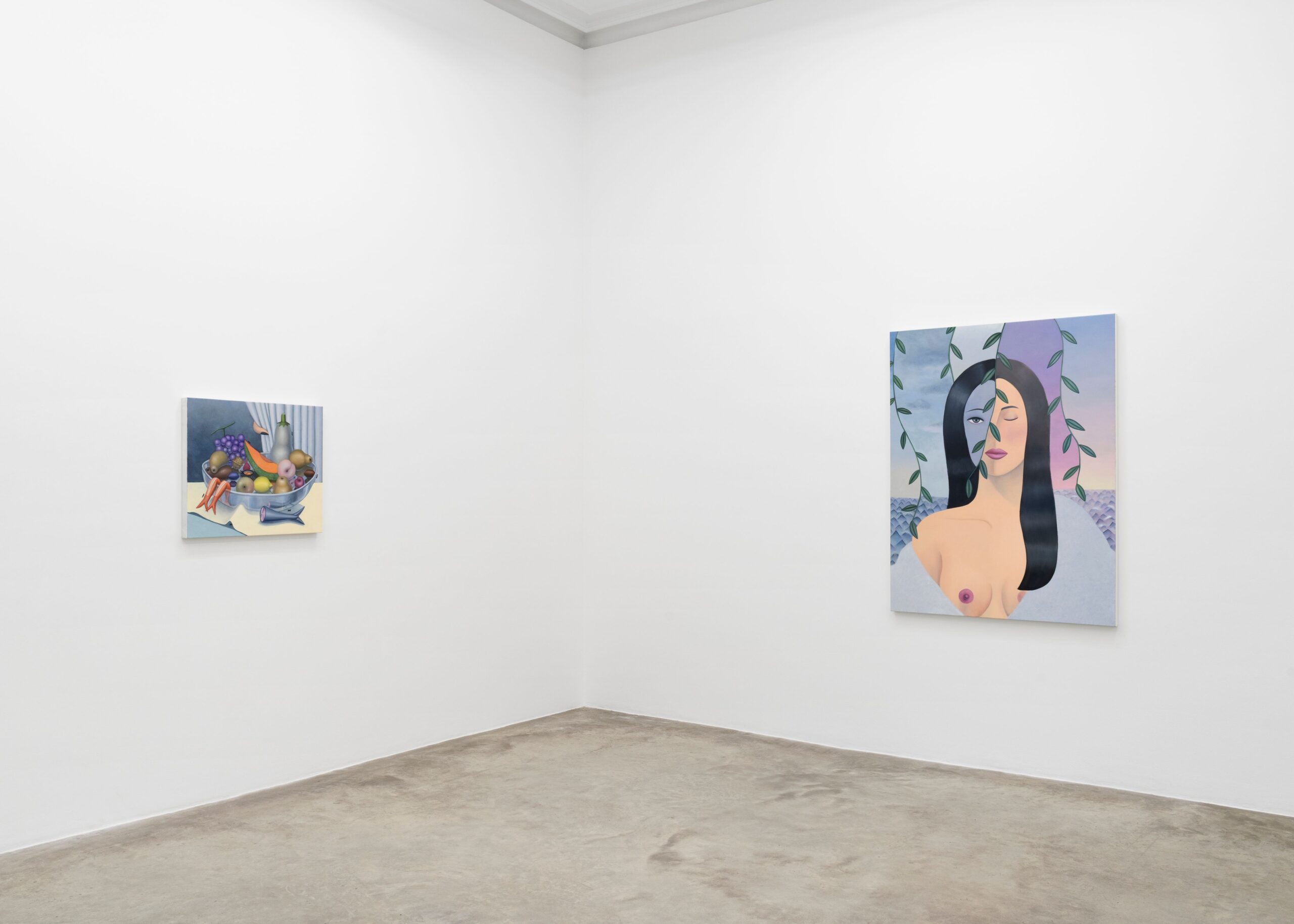
The title Not Quite Tomorrow, given to GaHee Park’s latest show at Perrotin (Paris), holds a feeling of suspense. It embodies a temporal interstice—or a tension— that remains unresolved, perfectly mirroring the suspension characterising Park’s new body of work. Oscillating between sensual immediacy and detached observation, her paintings offer glimpses into domestic scenes and mental landscapes, conveying an interiority that teems with life, yet cohabits with mortality. It’s no coincidence that at the heart of the exhibition lies the motif of duality. Often depicted in contemplative poses, allowing for a sense of absence to permeate, Park’s figures may unveil a mouth or an eye too many, or a bluish shadow suggesting the presence of a double within the figure itself, alluding to inner contradictions, desires and the subconscious. In Woman with Cocktail, Olives, and Caterpillar (2023–2025), for instance, a figure rests her forehead against her interlaced fingers, staring pensively at a martini glass, while an eerie second face peeks out from behind her hands. Similarly, in Blue Thoughts (2023–2025), a woman leans against a round dining table, gazing toward something beyond the limit of the canvas, deliberately withheld by the artist. Her hand rests on the table, and from the embrace of her posture emerges one of the bluish forms mentioned above. The doppleganger reaches for her hand in a gesture of twine that is both tender and ghostly. Crucially, the woman seems unaware of this touch while, nearby, a small dead fly on the tablecloth becomes an uncanny emblem of absence, echoing the core tension that animates the artist’s compositions. Park’s handling of time compounds this sense of doubling, destabilising linear time. In Memory of a Mountain (2025), two hands on a table interlace once more, while the background shifts from night into day, containing multiple temporalities within a single frame. Walls, curtains, windows, and frames within frames act as both compositional tools and metaphors for psychic thresholds. Each painting becomes a diptych unto itself, divided not just in space but in affect. As Amanda Holmes notes in the exhibition text, Park’s paintings are permeated by ambivalence. Her scenes often blend the sensual with the uncanny — bodies recline in erotic proximity to ripe fruit, dead fish, or swarms of insects. Proportions twist subtly out of scale; perspectives tilt just enough to create unease. Following a surrealist lineage, Park draws the viewer into spaces that feel familiar but are imbued with psychic tension, where the line between desire and discomfort collapses. Still life plays a recurring role too, though Park’s take on the genre is far from traditional. Emblematic in this sense is Still Life with Fruits, Fish, and a Finger (2025), where the artist subverts the classical arrangement of objects by introducing a severed human finger amid the spread. The overripe fruits and dead fish suggest decay and abundance, and while the presence of the fragmented body could disrupt any symbolic distance, it actually conveys a sense of detachment. By collapsing boundaries between animate and inanimate, Park proposes a familiar continuum between objects and bodies, desire and death. Overall, her compositions stage irresolvable tensions, suggesting a narrative but never a closure, just as a holding pair of pointed fingernail hands.
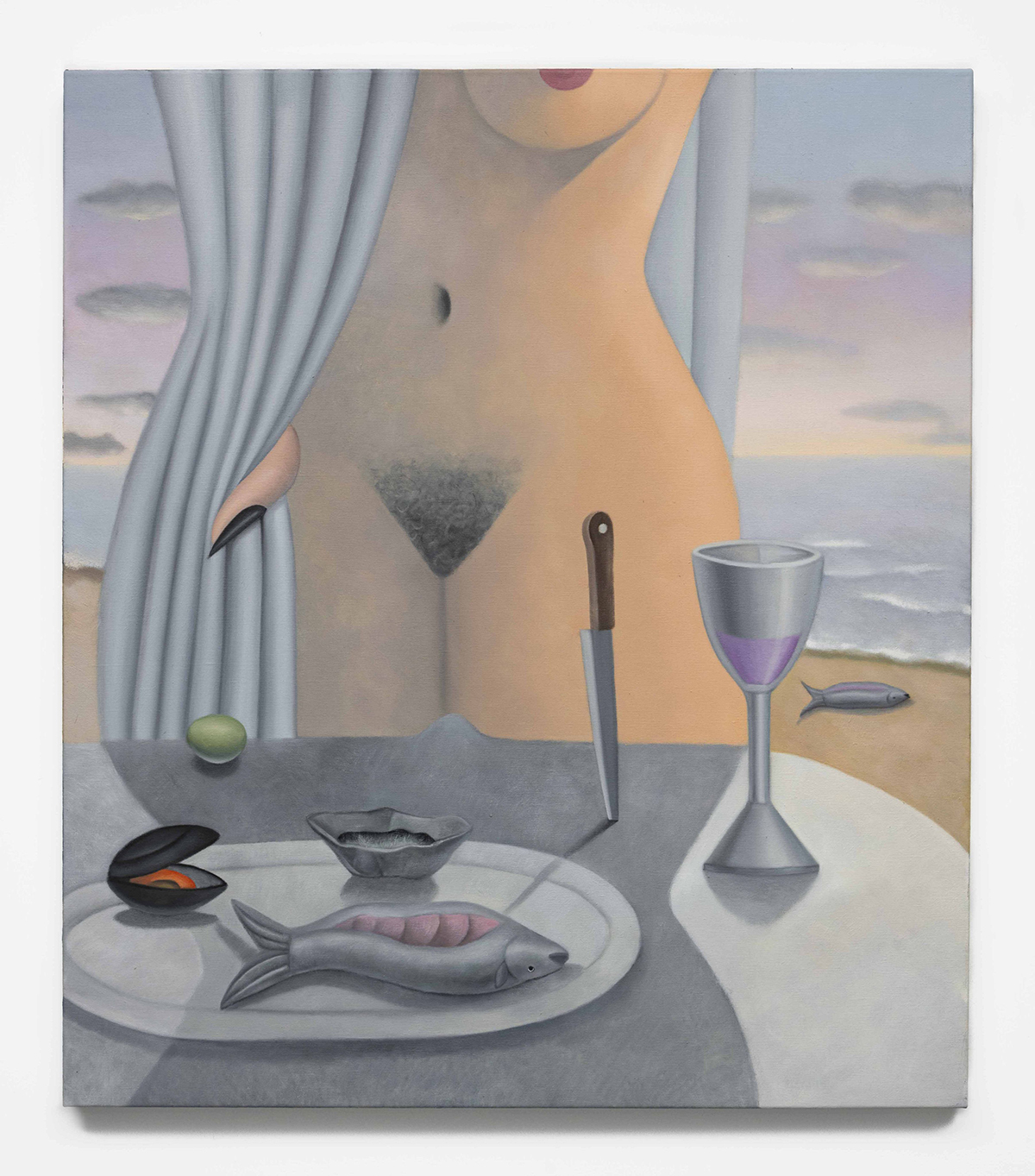
Stab, Shuck, Slice, Filet, 2024 – 2025
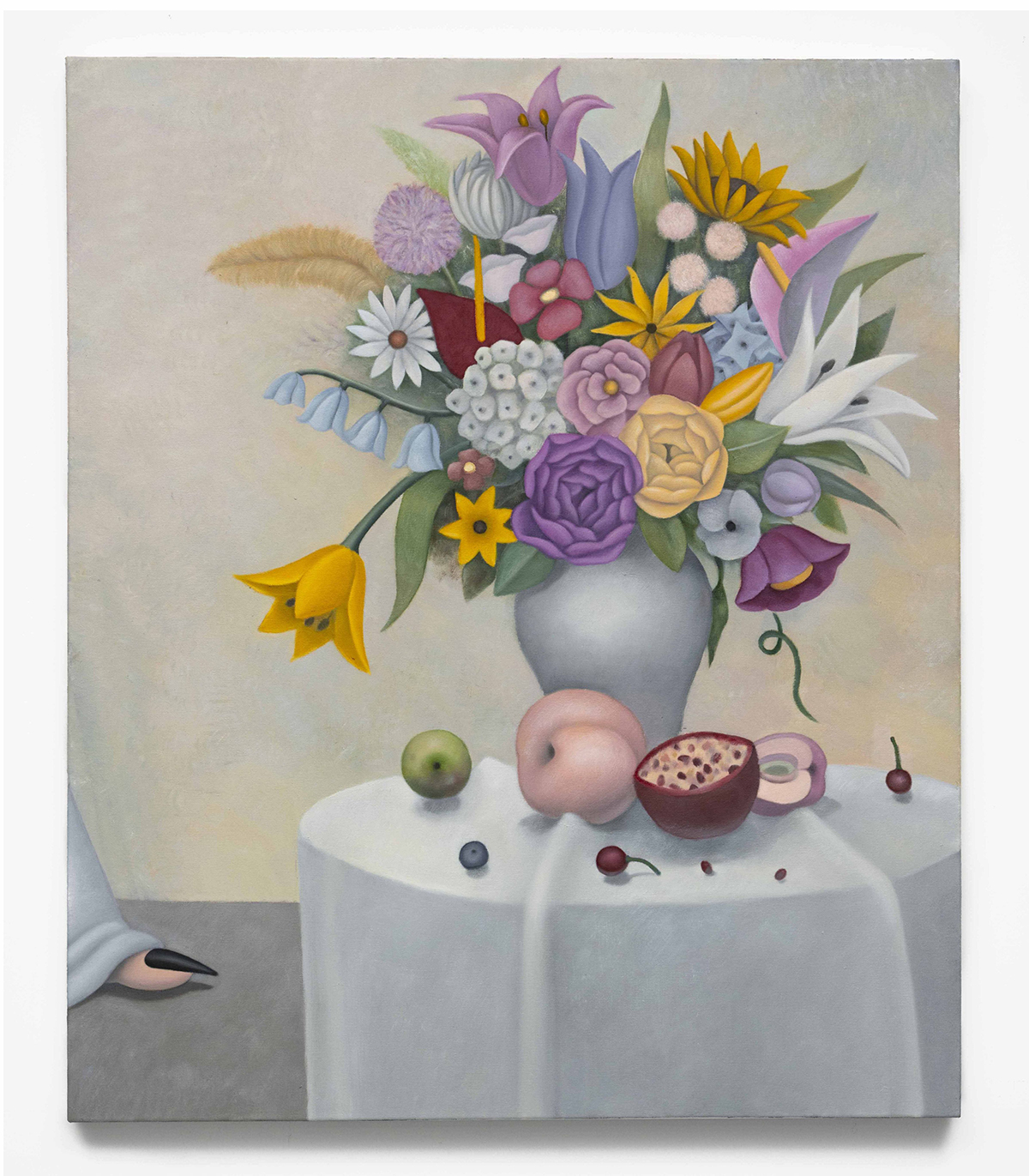
Still Life with a Visitor , 2022 – 2025
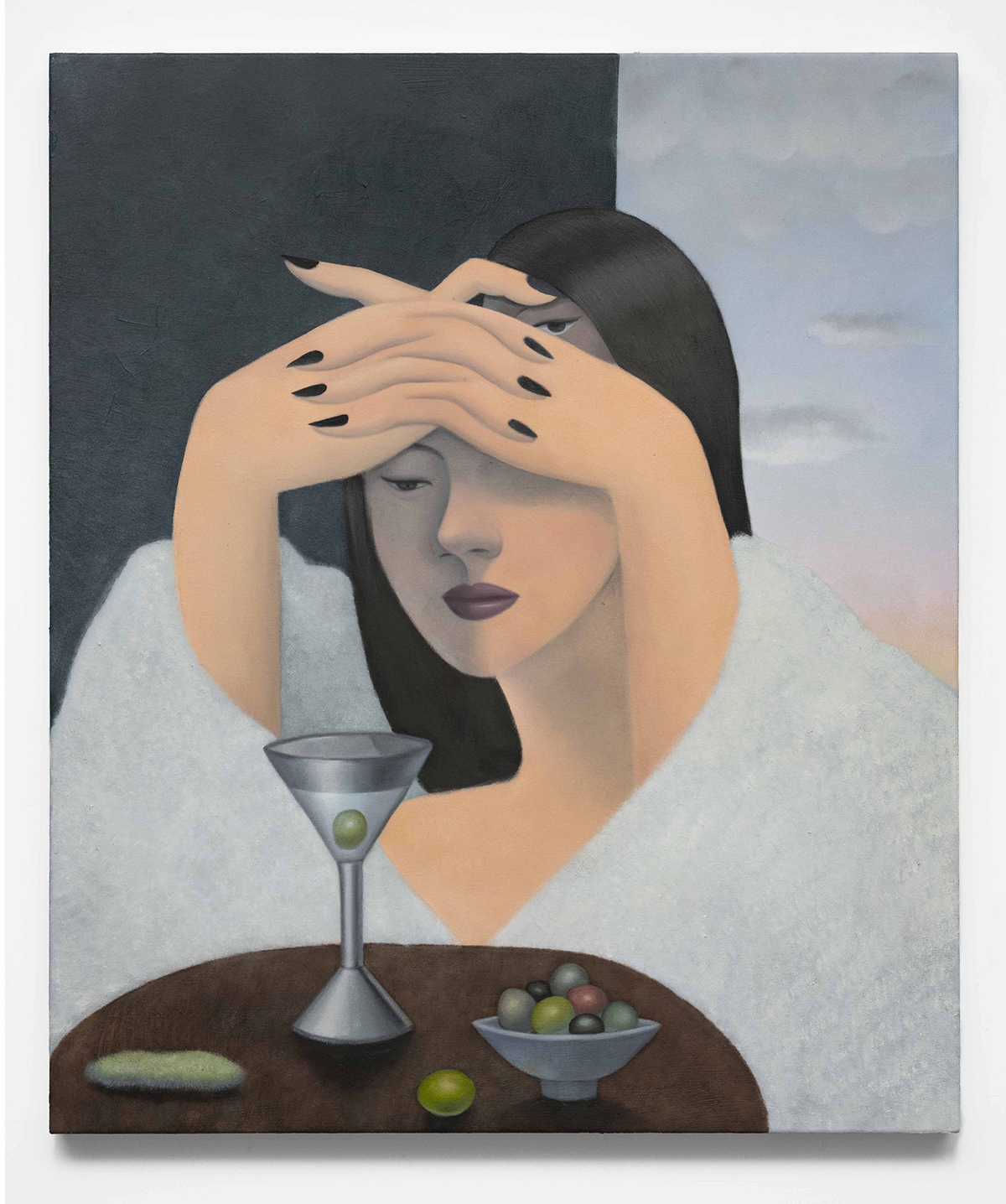
Woman with Cocktail, Olive and Caterpillar, 2023 – 2025
GaHee Park
Not Quite Tomorrow
Perrotin, Paris
April 26—May 24, 2025
All images:
Photographer: Paul Litherland
Courtesy of the artist and Perrotin