Works/Sculptural
Istituto Svizzero, Rome
26 March – 27 June, 2021
Text by Gioia Dal Molin
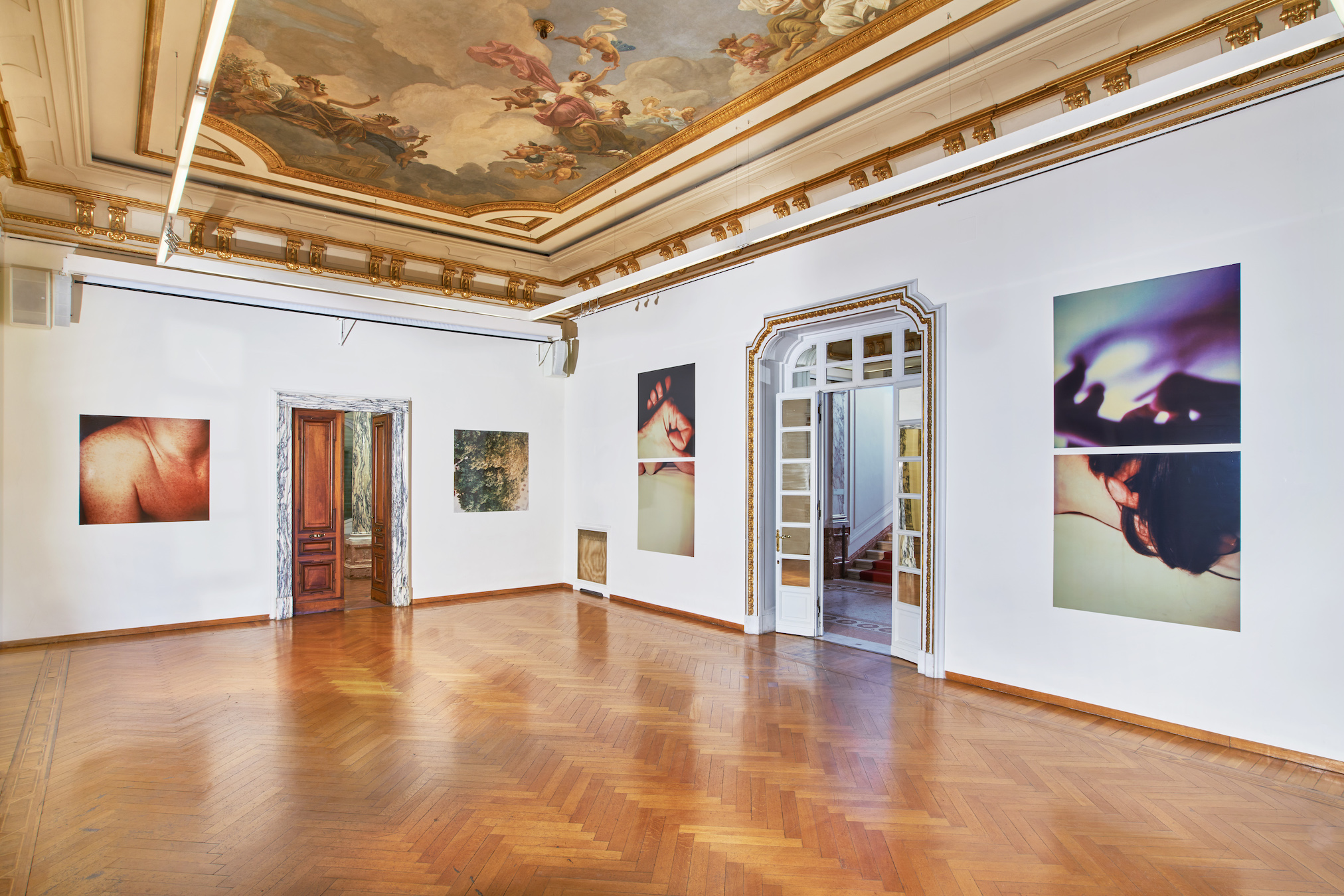
Installation view, 2021
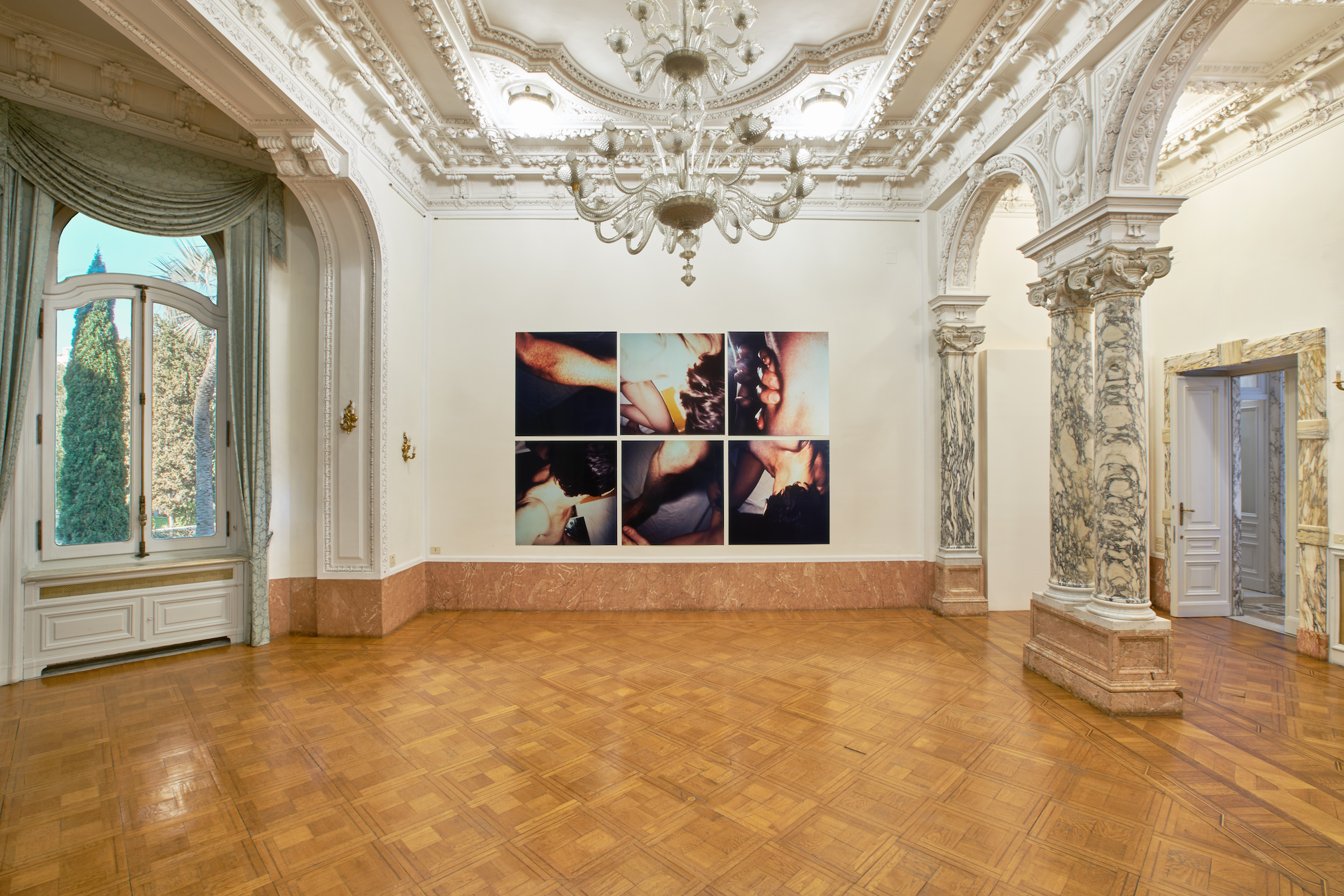
Installation view, 2021
With Hannah Villiger – Works/Sculptural, Istituto Svizzero presents the first major solo show of the Swiss artist Hannah Villiger (1951–1997) in Italy. The exhibition spans all of the artist’s creative phases, placing a special focus on the works Hannah Villiger created during her residency at Istituto Svizzero in Rome in the mid-1970s. In addition, a selection of the artist’s work diaries is presented for the first time, as well as other previously unpublished photographic material.
Following her first photographs and objects in the 1970s, Hannah Villiger becomes known for her large-format photographs in the late-1980s. These consist mainly of fragmentary close-ups of her naked body, taken with a Polaroid camera, then enlarged via an intermediate negative, and mounted on thin aluminium plates, which are presented individually or in large, block-like arrangements, depending on the exhibition space. Photography is Hanna Villiger’s medium, the camera her instrument. Yet she describes herself as a sculptor. Initially she refers to her photographs as ‘Arbeit’ (Work). But starting around 1983, she begins calling them ‘Bildhauerei’ (Sculpting) and then ‘Skulptural’ (Sculptural)—the latter a term she also sometimes uses as the title of her exhibitions. “I am the sculpture,” she notes in her work diary in 1983.
On the one hand, Hannah Villiger’s body images are in the tradition of introspective work in the studio, where the artist confronts materials and things that are readily available—often one’s own body. In Bruce Nauman’s work from the late- 1960s, for example, he performs before the camera in his studio, carrying out movement sequences and playing games according to self-imposed rules. On the other hand, Hannah Villiger’s work can also be viewed in the context of the artistic self-portraits from the 1970s and 1980s—such as works by Urs Lüthi or Cindy Shermann. However, Hannah Villiger is less interested in the moment of ironic self-staging or in the media’s and society’s grip on the (female) body, than in its actual plasticity. Her own body serves as a material which she works with like a sculptor—shaping, deforming, and depicting it in sections. The body also sets the parameters for her visual creations: “The greatest distance between camera and body part is the length of my outstretched arm to my toes,” writes the artist in a text from 1986 about her book Neid (Envy), which was published on the occasion of her solo exhibition at Kunsthalle Basel.
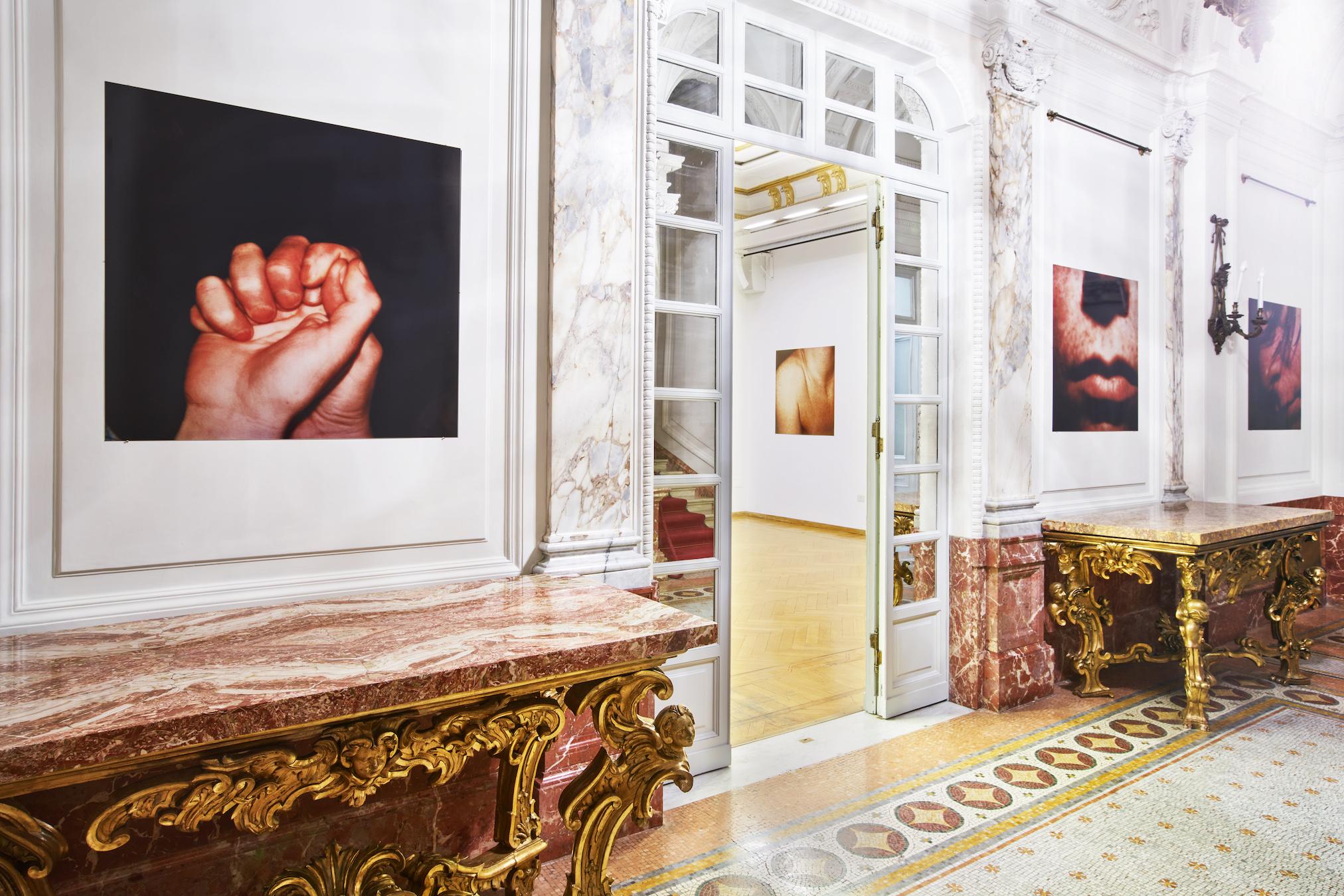
Installation view, 2021
The large two-part works on display in Room 1—both titled Sculptural and realised in 1996 and 1995/95—were produced for the first time and specifically for this exhibition, based on Hannah Villiger’s original Polaroids. Not all of the depicted body parts are easy to decipher. We can recognize a hand clenched into a fist, toes, fingers, hair—shaped by light and shadow. In these two works from the 1990s, the skin pales in the cold light, a white surface that is barely recognizable. In contrast, in Sculptural (1984/85) we see a skin surface that is bathed in warm light. The works convey a strong sense of the sculptor’s gaze and methods. What interests Hannah Villiger are surfaces, volumes, and space. Using the two-dimensional medium of photography she generates a sense of plasticity. Pigment spots, hollows, and wrinkles form a landscape, a sort of body topography. The skin—the largest sensory organ in the human body—is all too present as a surface, the outermost shell of the body, an interface with the world. It becomes the actual skin of the picture, as Claudia Spinelli notes in her essay for the 2001 catalogue raisonné of Hannah Villiger’s work. At the same time the artist complements the view of her own body— the view inwards—with views outwards: views out of the window or from the balcony of her apartment or studio. What seems at first glance to be a contrasting work from around the same time is in fact based on similar principles: just as the artist scans her skin with the camera, looking at her body, she also looks at a tree. From the balcony, the tree (1984/85) takes a perspective that is reserved for her alone—making it equally private. The surface structures of skin and tree, respectively, become landscapes all their own.
Hannah Villger arrives in Rome in the autumn of 1974. At just 23 years old, she is already considered a shooting star in Switzerland. She lives and works at Istituto Svizzero until the summer of 1976. Then she rents a flat in Trastevere, and after that she moves to Montefalco in Umbria, where she remains until September 1977. In Rome, the young artist encounters a new environment that differs in many ways from Switzerland, which is still quite conservative at the time. Pasolini is in town, and Janis Kounellis had already exhibited live horses at the renowned Galleria L’Attico in 1969. Rome is an escape for Hannah Villiger, according to her friends. Her work gains in complexity through her encounters with Land Art and Arte Povera, which is very present in Rome at the time. As she did as a student at the School of Applied Arts in Lucerne, she works with drawings, sculptural objects, and photography. The outlines of hands often feature in her drawings. She creates small objects from feathers and twigs, she sews plant leaves into her work diary. And she develops powerful, spear-like creations from branches, palm fronds, and string, staging them in the garden of Villa Maraini and posing with them on the terrace of the annex. “I am an Amazon,” Hannah Villiger records in her work diary alongside a sketch of the spear objects.
In 1976, at an exhibition in Bevagna in Umbria, she shows a kind of giant Mikado game with huge, pointed sticks. During her stay in Rome, Hannah Villiger’s photographic work becomes increasingly distinctive. The artist tosses burning palm fronds from the terrace of Villa Maraini, photographing them as they fell to the ground. She begins staging her objects exclusively for her camera, capturing the ephemeral events as a moment in time. The idea of photography as a sculptural medium, which will shape Hannah Villiger’s entire future oeuvre, is brewing in Rome.
In her early photographs, Hannah Villiger frequently takes photos of things flying through the air. “Wherever you look, that’s where you’ll fly,” she notes in her work diary in April 1976. Here, too, it is the very moment of movement and the simultaneous transience of the visual motif that interests her. The artist arranges photographs of an advertising blimp hovering in the sky over Rome (Work from 1976) as a triptych, a three-part set, which breaks with the static nature of photography. In Work (1979)—one of the first colour photographs in her oeuvre—she captures an airplane’s fading contrail. She photographs flocks of birds, footballs, and airplanes taking off and landing at Fiumicino airport. The images emerge from her confrontation with the everyday, immediate world, with the vivid reality all around her. It is worth noting that Hannah Villiger does not enlarge and exhibit every image that she takes. Many of her motifs exist only as small prints, bearing witness to traces and topics that capture the artist’s fascination.
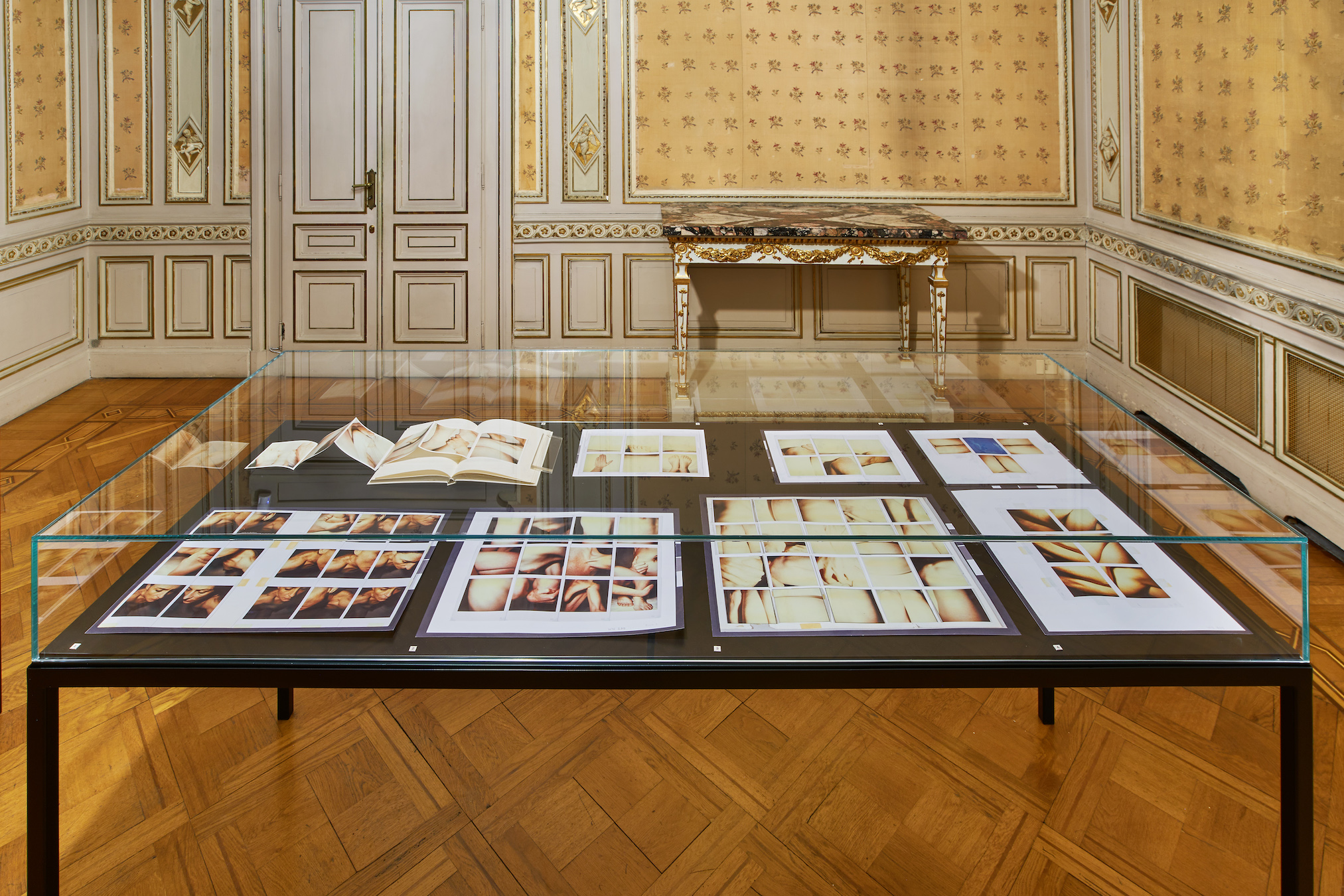
Installation view, 2021

Installation view, 2021
In the autumn of 1977, Hannah Villiger returns to Switzerland, where she rents an apartment in Basel with her girlfriend. The curator Jean-Christophe Ammann, at whose invitation she exhibited at the Biennale des Jeunes in Paris in 1975, takes over as director of Kunsthalle Basel in 1978. The city becomes the centre of a lively contemporary art scene in Switzerland. Hannah Villiger continues to move between media: drawing, creating objects, and taking photographs. Her near-total turn to photography occurs around 1980, after she comes down with a severe case of tuberculosis; at that point, the Polaroid camera becomes her working tool. The instant picture process captures the aesthetics of a snapshot, and saves her trips to the photo lab. In a world shrunk by her illness, Hannah Villiger finds motifs in her immediate surroundings. More and more she captures bodies with the instant camera, first those of friends, then increasingly her own body. Sometimes the camera is very close, sometimes further away. Around the same time, she begins to present her images in large block-like arrangements. Work (1980/81) is an early example of this approach, in which the artist arranges various perspectives on the body alongside each other, simultaneously asserting intimacy and withdrawing from it. Facial contours are blurred, and the outlines of the body dissolve under water. From around 1983 onwards, the other bodies disappear almost completely from her work. In the Kunsthalle Basel annual report, she writes: “I am my closest partner and the body closest to me.”
As in Sculptural (1984/86), the lines of her body, created by pressing her foot against her thigh, for example, determine the composition of the picture—here, again, in a constant play of intimacy and distance. We rarely see her face, and if we do, then only in excerpts, from skewed perspectives, or with strands of hair masking her eyes, as in the two photographs titled Work from 1980 in the staircase.
In the late 1980s, expansive multi-part photo blocks become increasingly important to Hannah Villiger. Using her camera, she explores her body, piece for piece. Her first large block arrangements generally follow strict principles of order, lining up similar body fragments such as armpits or nipples. But soon she begins arranging the body fragments more freely and intuitively—for example in Block XVIII from 1989/90, which is more than 4 metres long. The body parts are not always clearly discernible; what appears to be the head or body hair might be misleading, while the use of a mirror multiplies
the limbs. The sometimes raw views Hannah Villiger shares of own naked body can also be read as a commentary on the media’s regime of the gaze. The naked female body—photographed, sculpted, or painted—is a constant theme throughout the history of art and culture, with a conspicuous imbalance of power between viewer and viewed. Hannah Villiger challenges this imbalance. Her larger-than-life format imposes itself on us, challenges us, rendering impossible any kind of powerful or voyeuristic appropriation. At the same time, repetition and fragmentation renders the artist’s body indeterminate. “Through constant repetition my body becomes ‘a body’,” she writes. Her approach could even be seen as a dissolution of the body altogether. Fragmentation of the body deconstructs the very thing that secures our identity—through which we constantly define ourselves and confirm our individual existence. This perspective on Hannah Villiger’s work also reminds us that, in the context of postmodern theory, the human body can no longer be understood as a self-contained whole. Instead, it interacts in many ways with social reality. The body is a battlefield for struggles over gender identities, and is subject to normative biopolitical assertions. In Sculptural (1994) the human body is only hinted at, barely recognizable. The four-picture panel is arranged to form an abstract composition. Parts of limbs (are they finger or toe tips, or perhaps the underside of a heel?) wind across the surface like a dynamic ornamentation.
Starting in the 1980s, Hannah Villiger uses the Polaroid camera exclusively. The camera’s unique handling and the distinctive colours of the prints determine her way of working. Describing her relationship with the camera in her 1983 work diary, she writes: “Let’s pretend we’re two people.” The speed and spontaneity of the instant camera enable the artist to work directly and independently—in a private dialogue between her and the camera. She triggers the shutter, sometimes without looking (or being able to look) through the viewfinder, checks the image, changes or maintains her position, and then triggers it again. This creative process recalls performance art and body art of the 1970s, which was particularly prevalent in Italy. In her essay for a catalogue of Villiger’s works published in 2001, Griselda Pollock notes the connection to Il Corpo Come Linguaggio (The Body as Language, 1974) by the Italian art historian Lea Vergine, who sees the body in performance art as a language. Perhaps Hannah Villiger’s images of the body are also an attempt to create a kind of new alphabet, explored in a performance between the artist and the camera. Hannah Villiger produces countless Polaroid images that serve as working material. Taking the most interesting ones she arranges them into blocks, occasionally turning them upside-down. Sometimes she has the photo lab enlarge certain pictures or compositions to an intermediate size— this helps her to decide whether they should be mounted on aluminium as an even larger work.
Although Hannah Villiger clearly follows certain methods and motifs, she remains open to experimentation and new ideas. In 1985, for example, in the context of her first major solo exhibition at Kunsthalle Basel, she develops the book Neid (Envy), gluing small prints of her body images into the publication herself. But how can the monumental, even sculptural, nature of her work be put into book form? Hannah Villiger finds an answer in the form of a fold-out leporello. Shortly before her death in 1997, she begins experimenting with new visual creations, editing Polaroid photos of the view from her window. Cutting out the architectural elements, she re-arranges them into utopian cityscapes. Her own body and the architectural body—who knows, perhaps this could have led to entirely new kinds of body images?
Hannah Villiger
Works/Sculptural
Istituto Svizzero, Rome
26 March – 27 June, 2021
CREDITS
All images
Courtesy: Swiss Institute and THE ESTATE OF HANNAH VILLIGER
Photo credit: Ela Bialkowska, OKNOstudio
Hannah Villiger was born in 1951 in Cham (CH), near Lucerne (CH). In 1997, she died of heart failure in Auw (CH). Her artistic work has been exhibited both in Switzerland and internationally. As early as autumn of 1975, she represented Switzerland together with other Swiss artists, including John Armleder and Martin Disler, at the 9th Biennale de Paris.
In 1981, she was part of the group exhibition Künstler aus Basel (Artists from Basel) at Kunsthalle Basel, where the curator Jean-Christophe Ammann showed her works again in 1985 with the solo exhibition Neid (Envy). In 1986, she had a solo exhibition at Centre culturel suisse in Paris, and then another at Museum für Gegenwartskunst in Basel in 1988/89.
In 1991, she showed her work at Kunstverein Frankfurt, and in 1994 she represented Switzerland together with Pipilotti Rist at the 22nd Bienal de São Paulo. After her death, further solo exhibitions followed: in 2001 at Kunsthalle Basel and Kunsthalle Bonn, in 2002 at nGbK Neue Gesellschaft für bildende Kunst in Berlin, in 2007 at MAMCO Musée d’art moderne et contemporain in Geneva, in 2008 at Museum für Gegenwartskunst in Basel, and in 2012 at Centre culturel suisse in Paris. In 2020/21, her work is included in group exhibitions at Kolumba in Cologne and at Museum zu Allerheiligen in Schaffhausen.