in conversation with Margot Norton
CURA. 42
We Monsters
Spring Summer 2024

Sympoetic Being “Camille”, 2018- 2024 (detail) work in progress, 2024
Photo: Sarah Ringrave All Images Courtesy: the artist

Sympoetic Being “Camille”, 2018- 2024 (detail) work in progress, 2024
Photo: Sarah Ringrave All Images Courtesy: the artist
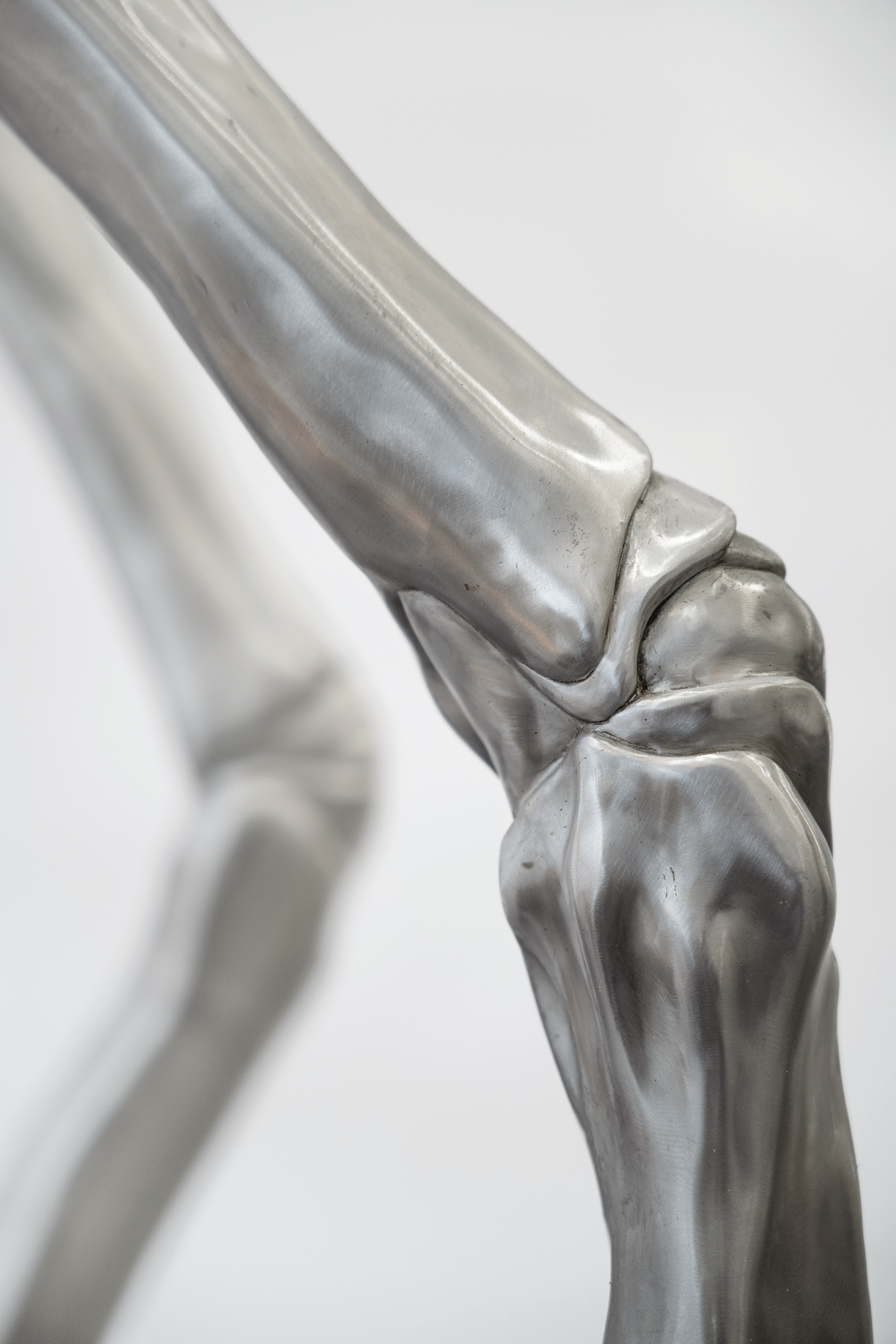
Sympoetic Being “Camille”, 2018- 2024 (detail) work in progress, 2024
Photo: Sarah Ringrave All Images Courtesy: the artist

Sympoetic Being “Camille”, 2018- 2024 (detail) work in progress, 2024
Photo: Sarah Ringrave All Images Courtesy: the artist

Sympoetic Being “Camille”, 2018- 2024 (detail) work in progress, 2024
Photo: Sarah Ringrave All Images Courtesy: the artist
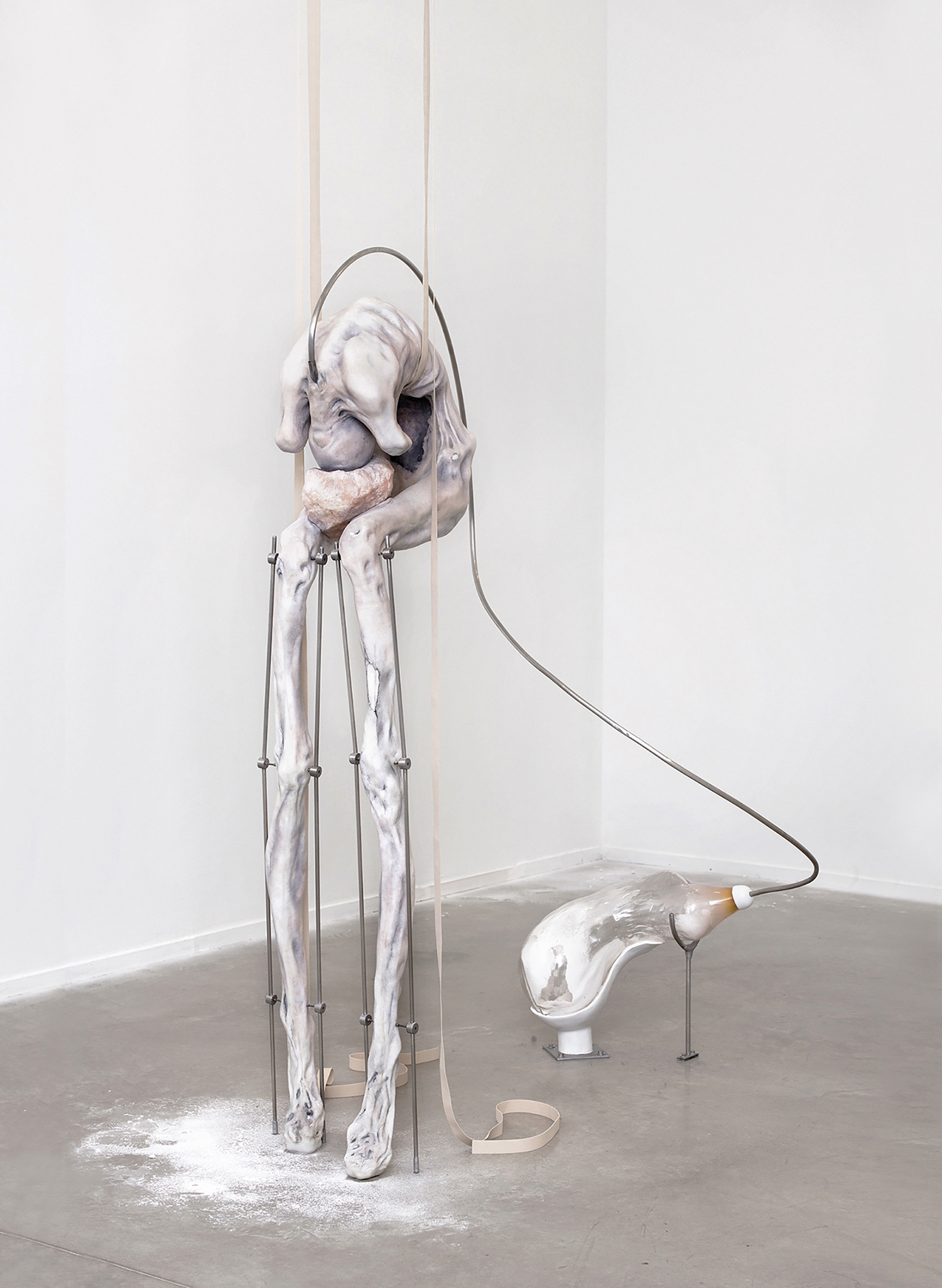
Belay My Light, the Ground Is Gone, 2018 Courtesy: the artist
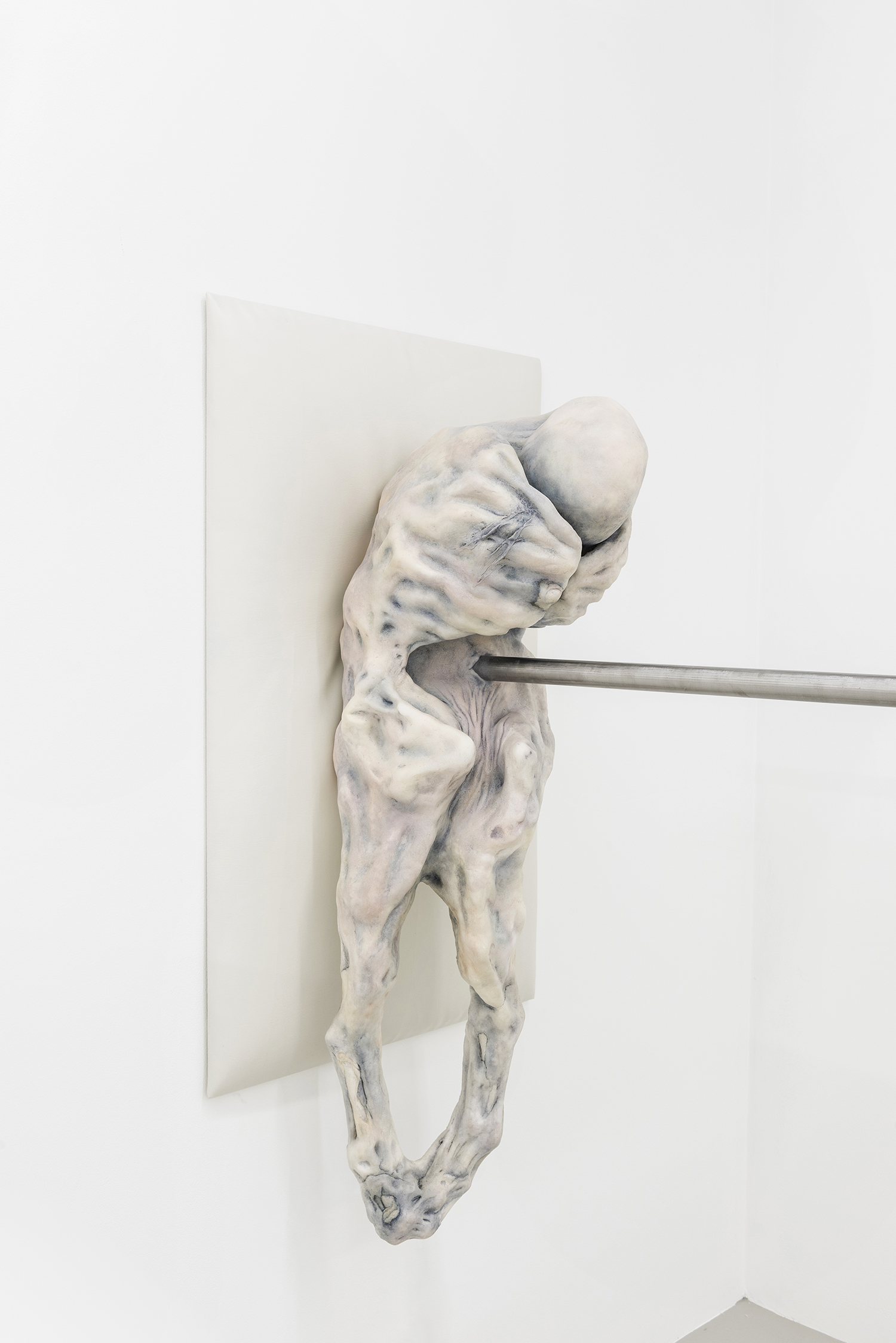
Population of phantoms resembling me #1, 2016 Courtesy: the artist and Annka Kultys Gallery, London
I thought we could start with dust—a material that has been central to your practice. It conjures an ending, but I think it can also be a beginning. When we think about dust, we think about something that becomes ether—something that was once perceptively solid that transforms into something we can’t perceive. In the first works that I saw of yours, there was a hunk of alabaster connected to a metal structure that repetitively hit the stone, so that it would eventually slowly dissolve into dust. Tell me about your fascination with this material.
To me, dust refers to the process of slow reduction that we are all undergoing—reducing with each breath until we reach the point of the irreducible—dust itself. Since everything could be reduced to dust, dust is the substance that contains everything. For me, this makes dust a composite of everything that exists. It is like a particle of life without life itself—the smallest unit of creation. It is an anonymous substance since the origin of each particle of dust is unknowable. If we go deep enough into the origin of being or into the nature of the substance we will reach the point of the unknown. This unknowable point inserts endless potential into our understanding of what a human is and can be. If we are thinking about the body’s reduction into dust and construction from it, we are talking about the construction of an alien, since the substance itself is of unknown origin.
When you were talking about dust being this composite of many materials that are unknown, I was thinking about how this counters the prevailing vision of ourselves as being distinct entities. If the materials that we consume and encounter in our everyday lives are a part of us, then we lack the borders that separate us from everything around us—human and non-human.
Dust makes visible that which is invisible, and that which is in all of us—our common nature and origin. It erases all the hierarchies that we have constructed. We tend to see limitations, borders, and particularities in our lives, yet this massive unknown lies within all of us. It is a mystery of our own existence, and it is also a substance that ties all of us together. For me, this underlying idea of unity is so powerful, and way more potent than any boundaries we keep constructing.
This idea of the unknown can elicit a kind of fear—something we can’t understand or name, but a fear that we are hopefully moving away from, or at least can continue to resist.
I think it is also a fear of our own power and potential. This fear is what creates our intolerance towards the other. I think we are saturated with this fear, and it is important to continuously push against it. If we can counter this fear, by surrendering and opening up to the unknown, we can recognize the tremendous potential we carry within ourselves.
Seeing your work in the context of the Dreamlands exhibition at the Whitney Museum, I immediately thought of all these alien creatures in cinema. When we encounter these beings that are slightly human, yet also unknown, they have an uncanny quality where you become aware of your own body in relationship to them.
In all my sculptures, I am trying to find the exact spot that contains both the human and non-human. If you veer too far into the other, you create a repulsion or rejection. It is important that a sculpture looks enough like us that we can recognize ourselves within it. At the same time, we should also recognize something that we do not know about ourselves. This is why it takes me fifteen months to sculpt a piece. I’m trying to find a very delicate balance, where you don’t back away, but get pulled in to contemplate the unknown with a kind of tender curiosity—and recognize the other within yourself.
Also, the bodies in your works often contort in ways that are impossible for the human body to physically perform. This brings awareness to the limitations, but also the possibilities within our own bodies.
The deformation in my sculptures denotes a kind of unbinding from material reality—a release of everything that is prescribed to how a human can and cannot be. The deformations and contortions function as a rejection of how normalcy and wholeness are constructed in relation to our bodies. I want to liberate the bodies in my sculptures from the expectation that they should be confined to the conditions of the world around them. Because my sculptures are always in the process of transitioning from one state into another, they’re also ungrounded—in a metaphysical and very literal sense. My sculptures never touch the ground—they are suspended from steel rods, or they rest on prosthetics, or they hang from harnesses. They are floating in unstable positions because they are shedding their current conditions—they don’t align with them. I have yet to make a piece that stands solidly on the ground because the bodies are defying and transcending the conditions of this world.
There’s a vulnerable and fragile quality to them, yet they simultaneously feel powerful.
There is certainly both violence and fragility. My pieces are in a constant push-and-pull dynamic. The Balkans is a place of immense trauma—it is a territory that has been occupied and torn apart by foreign oppression for more than five hundred years. Over time, this violence has created a kind of monstrosity where the trauma that was inflicted upon the nation becomes the trauma that the nation perpetrates itself. This is a process that we continue to see repeated in many other parts of the world. Growing up in the Balkans, in a family carrying deep war trauma, I saw how the pain and suffering that is inflicted upon humans can evolve into a kind of monster. I think my sculptures embody this monstrous quality while also speaking to the violence and mutilation that created this condition in the first place. In my sculptures, both vulnerability and violence are contained within one single figure, and this duality is also reflected in my material choices. I use very fragile materials including wax, glass, and oil paint that is applied on top of the surface. Everything is just barely there and the tiniest impact can break it. At the same time, there is the violence of the metal material—stainless steel, which does not corrode. It’s atemporal and unbending. These materials clash in my sculptures—they are violent and tender at the same time.
The metal structures in your work are either exerting a kind of violence or holding something up in a state of precarity. Can you elaborate on your use of steel in relation to these vulnerable materials?
In my material language, stainless steel speaks to the inevitability and violence behind the forces of life and death—hard forces that act upon the body. Steel reflects the unbending mechanics and forces that we encounter throughout life—these can be life-giving, but they can also act upon us, reducing us, harming us. The core forces of life can support and care for us—but there is an inevitable violence in them. The tension between these fragile and hard materials is something I seek to embody within my sculptures. Materials such as glass and wax seem extremely fragile when they are in their solid state—but in their liquid form, they are practically indestructible. The substances that make up my work seek to be liberated from their own forms, and from the inherent fragility and temporality that any single form implies. Just as the figures in my sculptures yearn to return to the formless—the primordial, the eternal.
I wanted to ask you about material transformation, and what this means for you in your practice. You often work very hard at polishing certain stones or manipulating materials like glass or wax in ways that transcend what we assume we know about these materials. There are moments in your work where stone becomes fleshlike, or glass evokes the quality of air, or even wax appears to be solid.
In the same way that I work with the forms, I am trying to make us understand that there is a potential within us to become something we cannot even imagine. In my material language, substances are literally pushed to their limits until they take on a new kind of materiality. This involves a lot of mistakes, broken pieces, and failed material tests to understand how much pressure I can apply, and how much care I have to give for the pieces to transform into something entirely new. As a result, wax starts to appear as marble, steel starts to appear as bone, breath translates into glass, and stone into flesh. In this way, everything in my practice is in a process of transubstantiation. For me, it is important that both the materials and the figures go through that same process.
Sometimes it’s hard to tell where one material ends and another one begins—they also become part of the same being, which relates to what we were talking about earlier in relationship to the composite nature of dust. Tell me about the show that you’re creating for the Schinkel Pavillon. I know that it has been many years that you’ve been working on this body of work. How do you see these works in relationship to one another within this installation and the architecture of the pavilion?
I see each piece in the exhibition as marking a stage in the transformation of a single entity as it goes from human, form-bound, and earthly towards a state that is celestial, immortal, and atemporal. Each sculpture correlates to one of these stages. The different pieces relate to one another so that they face the next phase and progress as you go through the spaces. The beginning of the show is darker, as if underground, and there is a feeling that these pieces are in the process of cocooning. As you climb up to the top floor, the show becomes more luminous, and hopeful, opening up to the transformation and what it will bring. It was important for me to have the machine present in this space, which is connected to the slow process of the figures’ transformation and reduction.
The central machine in the exhibition seems to be connected to everything in the show. While the pneumatic breath slowly destroys the stone in the middle of the machine, it also becomes this life force, that is both powerful, yet also vulnerable, ethereal.
I think of the central kinetic sculpture as a kind of breathing machine, enclosed by glass. In my work, glass always represents breath, because it’s the ultimate fragile material, and because it’s formed through the force of breath. For the body, breathing is a slow, degrading process—yet at the same time, it is life-giving. I think of breath as a symbol of life—the word breath, pneuma, is etymologically related to spirit.
The title of the show is Metempsychosis: The Passion of Pneumatics. What does that title mean to you?
We have been talking about the physical materials of my work, but included in my materials are also immaterial substances such as breath, pressure, torque and other forces that act upon the body and have their own agency. I work with these immaterial forces as well, and I give them the same amount of space and agency as I do with the physical materials. Breath has been one of the elements that I have been working with throughout my entire practice. I think of breathing as an essential part of the process of slow reduction to dust. I think of capturing breath as a marker or timer. The transformation that all the pieces in the show are undergoing comes from the central kinetic sculpture. This machine is itself made out of race car exhaust headers, which are themselves breathing apparatus. The kinetic sculpture also uses pneumatic hammers, which operate through air pressure. The stone at the center of the machine is slowly being pulverized under the force of breath—which mimics what happens to our bodies every time we breathe. This breathing machine is the engine behind everything in the exhibition—since the machine itself is pneumatic. In Eastern Orthodox mysticism and Gnostic Christianity, pneumatics are ethereal beings that experience life as a sort of entrapment. They have the urge to go back to the immaterial, back into ether. For me, this title, The Passion of Pneumatics, also echoes how passion is used in the biblical sense, such as “The Passion of Jesus,” or “The Passion of St. Matthew.” For me, passion signifies a becoming, an elevating beyond the limits of a physical boundary. Metempsychosis signifies the journey of the spirit through different bodies. This is the first chapter of a larger journey that I’ll be on for many, many years.
So it’s continuing after this exhibition?
It is, but it is also changing. The place that I started from in my earlier works was very much about the visceral body, the flesh itself, and the trauma inflicted upon it. With these pieces, I have moved into a less human and more otherworldly realm. I feel like the next stage is moving further into the ethereal. I don’t yet know exactly what that is going to look like in sculpture, but I have an idea.
You’re also imagining a new world for your forms now. Trauma is still present, yet you’re also imagining a new future for them.
The capacity of the work to be a proxy of a possible reality is important to me. Otherwise, it just becomes an art object, and that’s not my interest or intention. Realism and sensory world-building are strategies that enable a porosity between art and actuality. I want them to feel real, to feel possible.
Ivana Bašić
In conversation with
Margot Norton
CURA. 42
We Monsters
IVANA BAŠIĆ (b. 1986, Belgrade, Yugoslavia) lives in New York City. Her recent exhibitions include: Schinkel Pavillon, Berlin (2023); Lafayette Anticipations, Paris (2023); National Gallery, Prague (2021); Museum of Art+Design, Miami (2020); Het HEM, Amsterdam (2020); Contemporary Art Museum Estonia, Tallinn (2019); Kumu Art Museum, Tallinn (2019); NRW Forum, Düsseldorf (2019); Athens Biennial (2018); Belgrade Biennial (2018); Künstlerhaus, Graz (2018); MO.CO Panacée, Montpellier (2018); Hessel Museum of Art (2017); Kunstverein Freiburg (2017); and the Whitney Museum of American Art (2016). Bašić’s work is in the collection of the Whitney Museum.
MARGOT NORTON is Chief Curator at the Berkeley Art Museum and Pacific Film Archive (BAMPFA), which she joined in 2023, and where she recently curated the exhibition Gabriel Chaile: No hay nada que destruya el corazón como la pobreza. She was previously Allen and Lola Goldring Senior Curator at the New Museum, where she curated exhibitions with Wangechi Mutu, Pepón Osorio, Bárbara Wagner and Benjamin de Burca, and the 2021 New Museum Triennial: Soft Water Hard Stone.