COMING OF AGE: A PHANTASMAGORICAL CHORUS. Text by Charlie Fox
CURA. 43
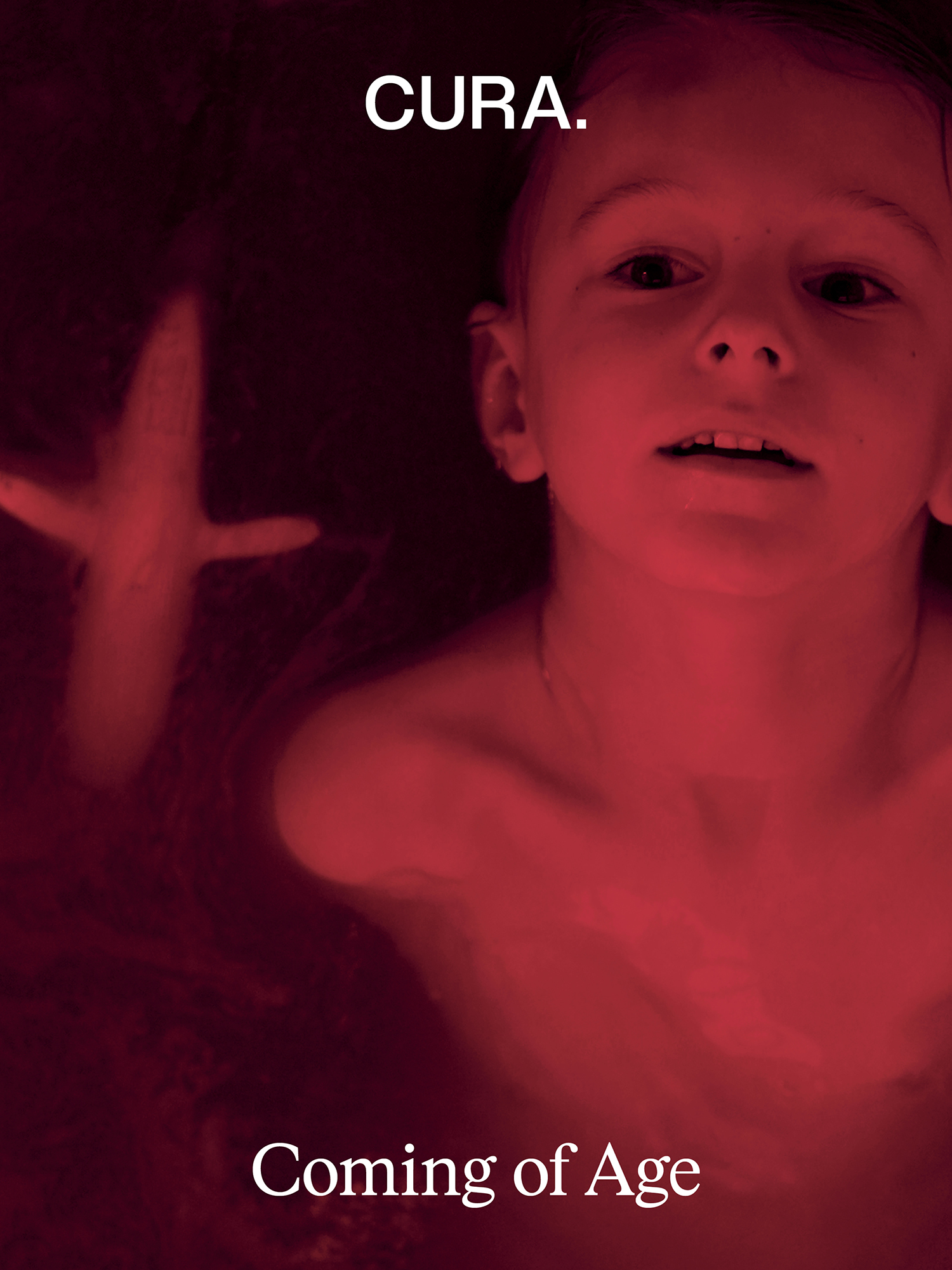
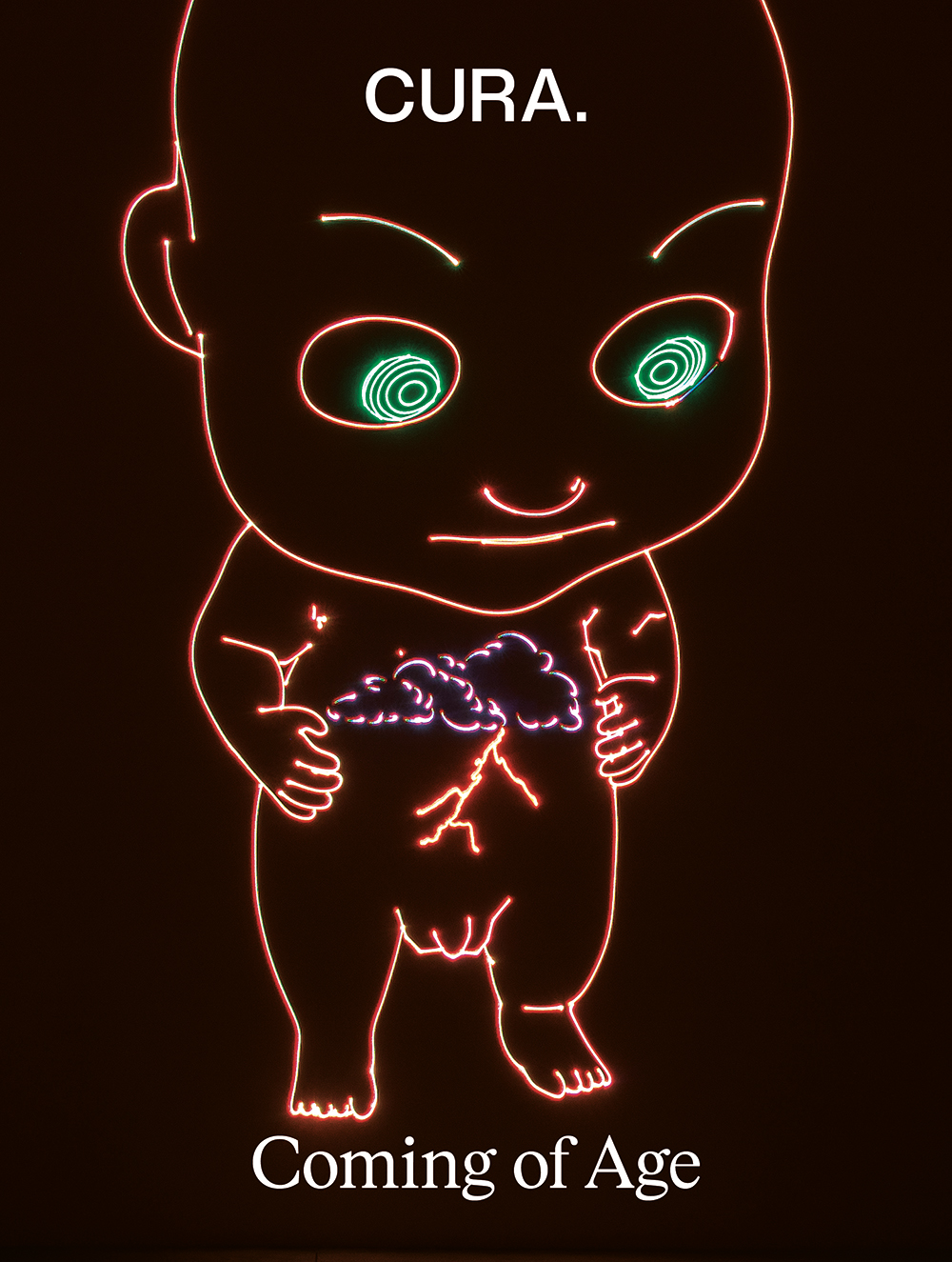
Coming of Age

Age of Coming, 2021 Courtesy: the artist and Lodovico Corsini, Brussels
In honor of Coming of Age, Matt Copson’s trilogy of laser installations, I’ve gathered together a phantasmagorical chorus of voices, living and dead, real and fictional, cartoon and animal, to express their thoughts on the work… The ambition of this occult venture is that, in the spirit of Coming of Age itself, it provides a flash of intoxicating light, an escape from the darkness, while knowing, of course, that the darkness is the real subject and the dream is doomed.
PERSEPHONE (queen of the underworld, consort of Hades):
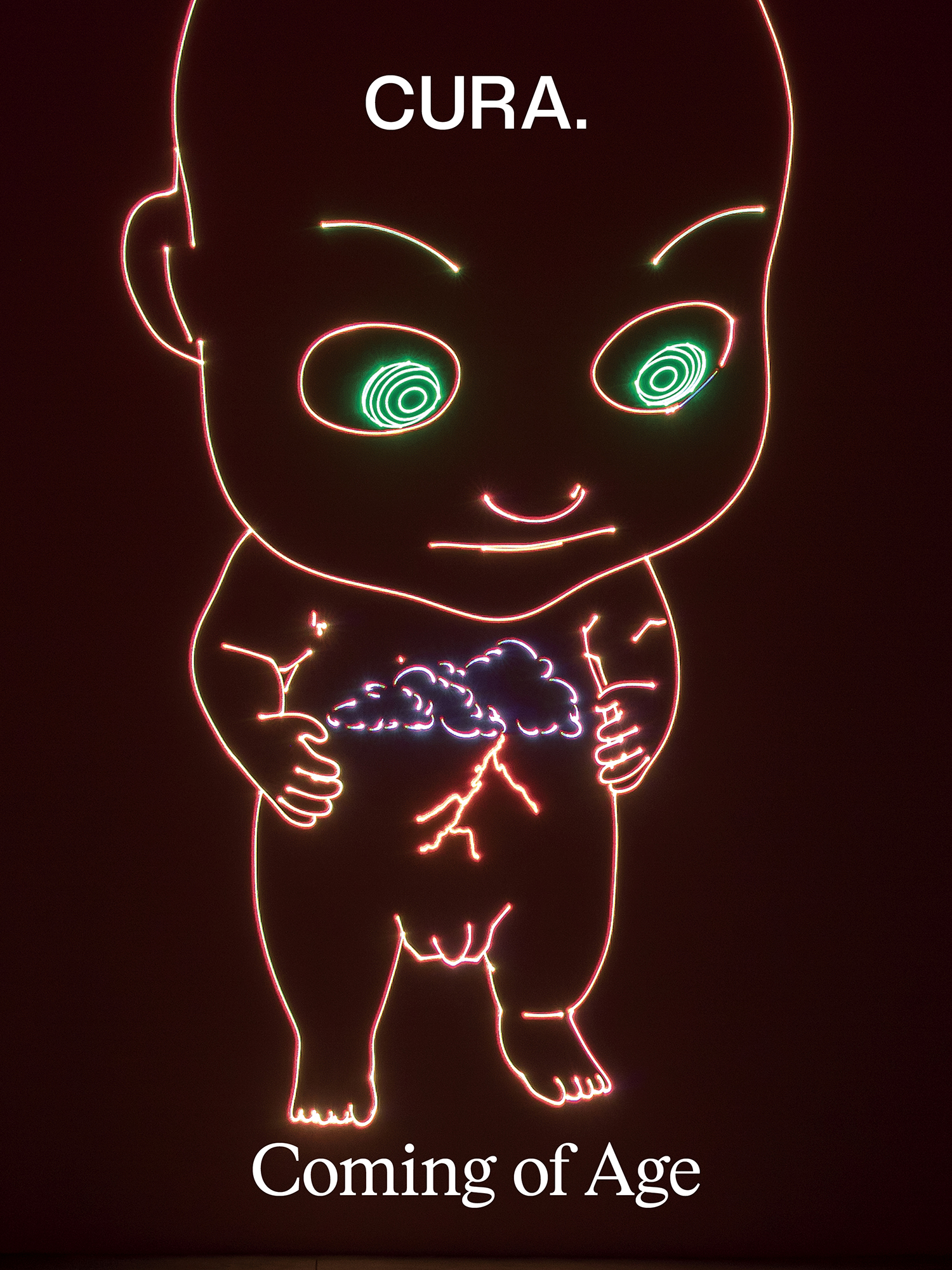
Since the trilogy takes place in darkness, I am well versed in it. Coming of Age sees the infant alone, bereft, until a mischievous pencil, powered by some disembodied godly hand, conjures a world and a friend. Age of Coming finds the baby growing ever bigger, fed on a diet of objects—chair, gun, plane—before he gulps down a mysterious void, which scrambles him into gibberish and nonexistence, only for the trouble to begin again, back at the beginning. In Of Coming Age, our poor hero is alone and mute above a raging sea that swallows him. Down will come baby, indeed.
They are, my child, strange allegorical games explored with remorseless logic: a world is built, a world is destroyed. New players arrive and causes chaos. Things explode. Finally, there is no winner or loser; there’s only the adventure, which must be played out to its conclusion. And, of course, as a smart boy once observed, “to die would be an awfully big adventure.”
SCAR (power-hungry beast/anti-hero from The Lion King):
I see the works in this trilogy as great tales of ambition! Ambition fed, explored, and, at last, gone to waste. A tragedy perhaps, but delicious fun.
My favorite part? When he conjures a brother from thin air. Heartbroken, I recall the cub-hood battles with my late brother, Mufasa, on the sun-dappled foothills of Pride Rock: who had the loudest roar? Who would grow to possess the more luxurious mane? Who would survive in a battle to the death? Though the baby does not slay his brother or his heirs which…. surprised me. No, I’ve never done anything of the sort, I’m wholly innocent. Ask the hyenas.
LIZ ASHER, MD (medical practitioner):
It’s deep: it’s called Coming of Age but the baby doesn’t actually age. At first, I thought, Oh? But then I was like, wow, because that’s the dream you can ultimately experience in art, whether it’s Bart Simpson or Wile E. Coyote or Titian’s Marsyas, the poor little faun getting flayed—they stay the same age. It’s archetypal.
RICHARD D. JAMES:
It is very bloody ravey, isn’t it? Reminds me of being blissed off my chonk, blasting ‘Didgeridoo’ at ear-bleed volume in some slimy Cornish cave at 4am. Or like cave drawings coming to life and that. Proper psychedelic madness.
CAVEMAN FROM LASCAUX:
How does he make the light dance inside his caves? That was always our dream for the drawings of the hunters and the beasts we carved into the rocks. That they might live. The baby in the first part sings a motto for us all, too: “I came/I saw/I wrote/I drew/I killed.” Humanity, stripped down to its bones.
MARINA WARNER:
Coming of Age, the first part, is the instalment that most closely aligns with a classical Edenic narrative: the innocent is gifted a world in all its mystery and wonder. He is taught the rudiments of that world via a disembodied hand making inscriptions in the sky, reminiscent of as much of late Guston [The Line, 1978] as it is in the ‘The Magic Pencil’ [c. 1990s] from the BBC’s children’s television program Words and Pictures. They discover a friend whom he schools, who might be likened to Eve. But then we experience a patricidal attack upon this most familiar of narratives: the chief baby declares himself an artist, we dissolve into dreaming, and yet another baby is born from the first one’s stomach. Strange as it seems, this is wholly in accord with Romantic artistic ideals of parthenogenesis wherein a glorious progeny—a new work of art—is sired in solitude, without need of an erotic accomplice. What follows? Transcendence, of course: a flight from the world.
THOM YORKE:
After he has that musical piss, the second baby is speaking Kid A language, isn’t he? Like, furry electronic babble. I was reading the other day: remember how people said all the gibberish that the Teletubbies speak was wrecking little kids’ language development? But, actually, the people who made it consulted behavioral linguistics experts to mimic toddler speech, to make it a friendlier world for them. It wasn’t damaging at all. I get sick of words myself. I think it’d be nice just to speak a kind of woozy Finnegans Wake language all the time. But that’s what singing is for.
ANTONIN ARTAUD:
It conjures up fond memories of my own childhood when I was an unquestioned tyrant: my megalomania vanquished every summit set before it, every game could end in the slaughter of my foes, and my demented howls disturbed the sweet, summer air like the blood-crazed siren song of a sick wolf.
BRIAN SEWELL:
Certainly I find this notion of the pencil as a kind of god tremendously beguiling. The pencil, this thing of light, magically conjuring life itself. I recall Pablo Picasso (whom I knew well and whose leathery gauntlet, as depicted in Guernica [1937], remains in my possession as a means of summoning Cubist hawks from demented trees), telling me once that his first word was ‘pencil.’ ‘Lápiz.’ And you have the whole of the matter in some sense: a man from his earliest breath to his last consumed by art. I don’t have a crystal ball; I can only guess at the artist’s intentions but I suppose one is not meant to think of the drama staged here as entirely benign. We are to think of Frankenstein’s monster, of diabolical animation. I do think too of the phantasmagoria seen in the funfairs of my London boyhood: light shows that induced seizures, ghost train rides where erotic skirmishes occurred, and so on. LSD, too, of course. As I explained to the former England cricketer Phil ‘Tuffers’ Tufnell, that scrumptious tearaway, on some ghastly reality show or other, the trick with LSD was not to administer it onto the nude flesh of the upturned eyeball: it sent one completely bonkers.
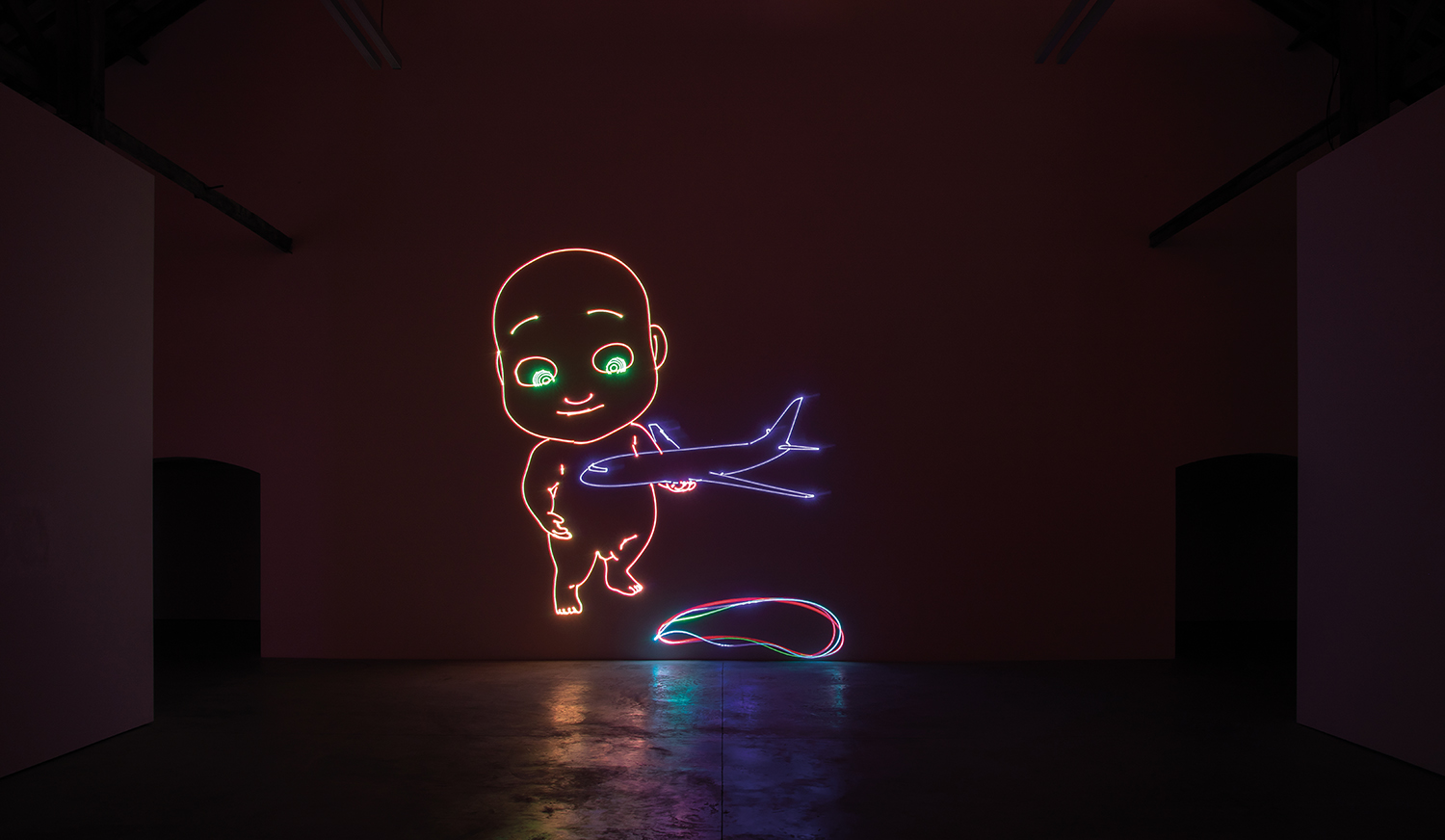
Age of Coming, 2021 Courtesy: the artist and Lodovico Corsini, Brussels

Age of Coming, 2021 Courtesy: the artist and Lodovico Corsini, Brussels

Coming of Age, 2021 Courtesy: the artist and High Art, Paris

Coming of Age, 2021 Courtesy: the artist and High Art, Paris

Of Coming Age, 2021 Courtesy: the artist and High Art, Paris
DAFFY DUCK:
This thing with the thencil remindth me of Duck Amuck! [1953] You know— the cartoon where I get eraseth down to my chatterboxth orange bill or the thackground transformth so I’m ski-ing in Hawaii dressth for winter! The torture was unstoppabubble! Who thknew art could be so cruel? ‘Animation’? More like ‘annihilation’! Of course, the culprit was that perfidith smart-mouth bunny rabbith cousin o’ mine. Coming of Age ain’t so cruel but then again, I never got totally eraseth or eaten by a black hole. When we said ‘That’th All Tholks!’ you betcha we didn’t mean ‘That’th All Tholks!’ for real. Ooh, buddy, it’s makinth me thiver…
NEVILLE (The artist enlisted in Peter Greenaway’s The Draughtsman’s Contract):
That melody is rather dreamy. (Sings) “You are the most beautiful thing I have seen!” Quite. Well, ’tis of our age: ‘baroque’ as a harpsichord played by a precocious fop in white magician’s gloves. I know it makes one a sullen bore to speak of heartache before an artwork when surely art’s purpose is to be a game, but, yes, during that gentle pas de deux between the infants in the duet, I confess, I felt my eyes grow damp and my leaden face-paint crack.
JOEL SCHUMACHER:
Oh, yes, the neon! Well, obviously, I did a lot for the mainstreaming of neon [by drenching the misunderstood Batman Forever, 1995, and the even more deeply misunderstood Batman & Robin, 1997, with it.] Am I the daddy to the baby in that sense, aesthetically? I mean, it’s probably a three-way between me, Bruce Nauman [light installations such as Run from Fear, Fun from Rear, 1972] and Hype Williams’ Belly [1998], which sounds like a fun night, doesn’t it?
JEFF KOONS:
Gosh, well, I guess scale is a big deal here. Enlarging the baby, like my heap of Play-Doh [Play-Doh, 1994–2014] or the kitten in the sock [Cat on a Clothesline, 1994–2001], is a way to fully experience its exhilarating beauty and, I believe, feel a sense of the sublime. In an odd way, it is realistic. Babies seem that huge when they’re new.
MICHAEL HANEKE:
Tempted as I am to claim that this routine of ravenous eating indulged in by the baby in Age of Coming is a critique of our hellish society, our consumerist addiction and its twin, the spiritual void, which always remains in our hearts, never to be sated, I would rather risk the claim that we are interrogating, in fact, something deeper, more… human. Note that the baby explodes. In our hunger always lies the cause of our destruction, as in the Garden of Eden, and other sinister fairytales.
ADAM (singing):
“You are the most beautiful thing I have ever seen!”
VICTOR FRANKENSTEIN:
A thundercloud appears inside this charming homunculus’ belly, signifying torment, perhaps, an internal tempest sprung from melancholy unnamable. Perhaps no creature, not even an artificial one, its engine the lightning breath of a strange new god, escapes this nightmare.
ANGELA CARTER:
The light show aspect is Disney-ish but it isn’t operating in a cute way: the mesmeric properties of the lasers are used for diabolical ends, seducing us into watching this tale of rise and fall. If they’re tickling any memories of the Magic Kingdom, they’re the memories of how huge and disorientating that level of spectacle was when you were a little kid, when shaking the gloved paw of a Mickey Mouse impersonator was genuinely a brain-melting mystical encounter. Obviously, tragically, art never has that power again…
KURT COBAIN:
It’s really, uh… bright. It’s trippy. I guess babies appear on [Nirvana’s] records a lot… I guess, it’s just nice, that dream of, like, nothing hurts, floating in the womb, and at the same time, there’s all this rage and confusion inside a baby, and, like, nobody understands them at all, all they can do is scream… I don’t know if it’s a baby or an alien but that’s what’s nice about babies, kind of, is that they’re not really from here… Or it doesn’t seem that way. Lucky them.
BABY:
Ah mabb na bluhhh jup flub. [Translation: This is the most accurate depiction of my life I have ever seen.]
CAPTAIN JAMES HOOK:
It is terribly sad how the golden memories of childhood’s Eden can never quite be recalled. How dimly I remember my left hand. To bring memories back is as hopeless as attempting to sculpt with chimney smoke. There is something of that tragedy held in Copson’s choice of light as a medium, which is brilliant but transient, gone all too soon. Many is the man who has tried to chase the divine light beneath the door of their childhood bedchamber and soon found himself bedeviled by the crocodiles of madness.
JOHN DONNE:
Verily, as Copson knows, a child making water is a perfect subject for art and for praising the Lord’s creation. Consider Lorenzo Lotto’s Venus and Cupid [1525], in which the imp sportively micturates through a laurel wreath onto the exquisite silken flesh of his mother’s body, itself garlanded with petals, pink and soft in texture as the interior of a playful kitten’s ear. Crowned with a diadem, Venus wears a look of timeless indulgence upon her face familiar to any mother: “I know but I love him more than my tongue can ever tell.” The stream from Cupid’s instrument is an ineluctable river through history, which, via its diverse and mysterious tributaries, leads us to Copson’s work today: an angel child illumin’d, shocking in its brilliance, upon a wall. In its own way, the glittering baby is as powerful a memento mori as the skull, previously render’d by Copson in Death, Again [2019], though it works in what may be a contrary fashion. Rather than showing our hopeless future, the child reveals what we were and can never be again, knowing our mortal fate.
MARIA CALLAS (singing):
The void wants cake!
ALICE (from Wonderland):
The last part [Of Coming Age] makes me sad. So sad that I might weep in fact. The baby on the swing alone above the wild sea, singing. And then the sea sucked down the plughole. Oh, how that noise used to frighten me when I was small! And then the baby all alone…
MIKE KELLEY:
Ahh, youth! What’s fascinating to me about this trilogy is that even though the hero is a baby, it’s not regressive, which means it’s not conservative, in the way that a lot of contemporary pop art I’ve seen since my death is, happy to sit in front of Saturday morning cartoons and suck its thumb and reproduce the goofy carnival shimmering upon the screen with all the energy of somebody who just gulped down a bunch of OxyContin… I mean, I do think about Blake’s dictum from Proverbs of Hell [1790], “Sooner murder an infant in its cradle than nurse unacted desires,” which is wickedly twisted here so that we have the baby following its desires: draw! Eat! Sing! Weep! It’s the diabolical energy that powers all art-making, that makes the child doodle in their shit on the bedroom wall (to quote the heavily-Xeroxed Freudian example) or deface the Mona Lisa (to be slightly more classical) run amok in its purest form: the infant’s ambitions, like those of every artist, are anarchic and tyrannical.
But Coming of Age isn’t about trauma in the same way that my work was. I dealt with childhood themes repeatedly in my work but in my film installation, Day is Done [2005–2006], or the sculpture, Educational Complex [1995], I was parodying this pop psychology impulse, which exploded the 1980s and has only grown more virulent since I died and claims we’re all victims of some formative trauma, like the Joker dragging himself out of a vat of acid. Art, according to this model, is a fucked-up symptomology, an ongoing exorcism conducted in the shadow of the nightmare we’re forced to call ‘real life.’
Where me and Copson are alike is that the last sigh isn’t ever triumphant, it’s melancholy, it’s haunted. The baby is much closer to a doomed Romantic hero, a Hamlet reckoning with the bewildering mystery of existence within a void where the concepts of ‘good’ and ‘bad’ have disappeared. Still, it all only ends one way. He sings, “Strange situation/Entertaining damnation…” The apocalypse is coming, sing your heart out.
SAMUEL BECKETT:
It was always like that. In the beginning and in the end. Alone. Came from nothing, gone to nothing. Ah, the old consolations, there’s nothing like them. No, nothing at all. The times I had when I was small and did not know what I was, by any measure, perhaps a god, perhaps a beast, indeed, perhaps a worm, and Mother and Father, still living, not yet inevitable ruins, were there to cram my feeble mind with rubbish. Strange to think of all things having a father or a mother or both but I have been told that is the case. Our Father who hath shat the world into existence and warms himself upon its embers.
For myself, I suppose I had a hunger, yes, as so many small diabolical things do. Dogs and the like, I mean. I wanted cake for myself. To recall it almost makes me feel like singing. But no, I shall not go as far as that. I shall not stain the evening air. I await the coming dark instead, yes, that is the only possibility available, the darkness which it might be said is always there and has, at the last measure, no beginning and no end.
Matt Copson
COMING OF AGE:
A PHANTASMAGORICAL CHORUS
Tex by Charlie Fox
CURA.43
Coming of Age
MATT COPSON (b. 1992, Oxford, United Kingdom) lives and works in between London and Los Angeles. His work has been shown at. Fondation Louis Vuitton, Paris; High Art, Arles; Aspen Art Museum; Swiss Institute, New York; Reens Spaulings, New York; and C L E A R I N G, Brussels and New York. Together with Oliver Leith he made the opera Last Days which was premiered at the Royal Opera House in London and had its US premiere with the LA Phil at the Walt Disney Concert Hall in Los Angeles. He has been part of several group exhibitions: Zabludowicz Collection, Picadilly Circus, London; Nottingham Contemporary, Nottingham; Dhaka Art Summit; CAPC musée d’art contemporain de Bordeaux; Centro de Arte Dos de Mayo, Madrid; Baltic Triennal 14, Vilnus; Belgrade Biennale 2021; National Gallery of Victoria, Melbourne; and Ca’ Pesaro Galleria Internazionale d’Arte Moderna, Venice.
CHARLIE FOX is a writer and artist who lives in London. He recently curated Flowers of Romance, a group exhibition at Lodovico Corsini in Brussels.