Text by Guillaume Blanc-Marianne
CURA. 44
The Generational Issue
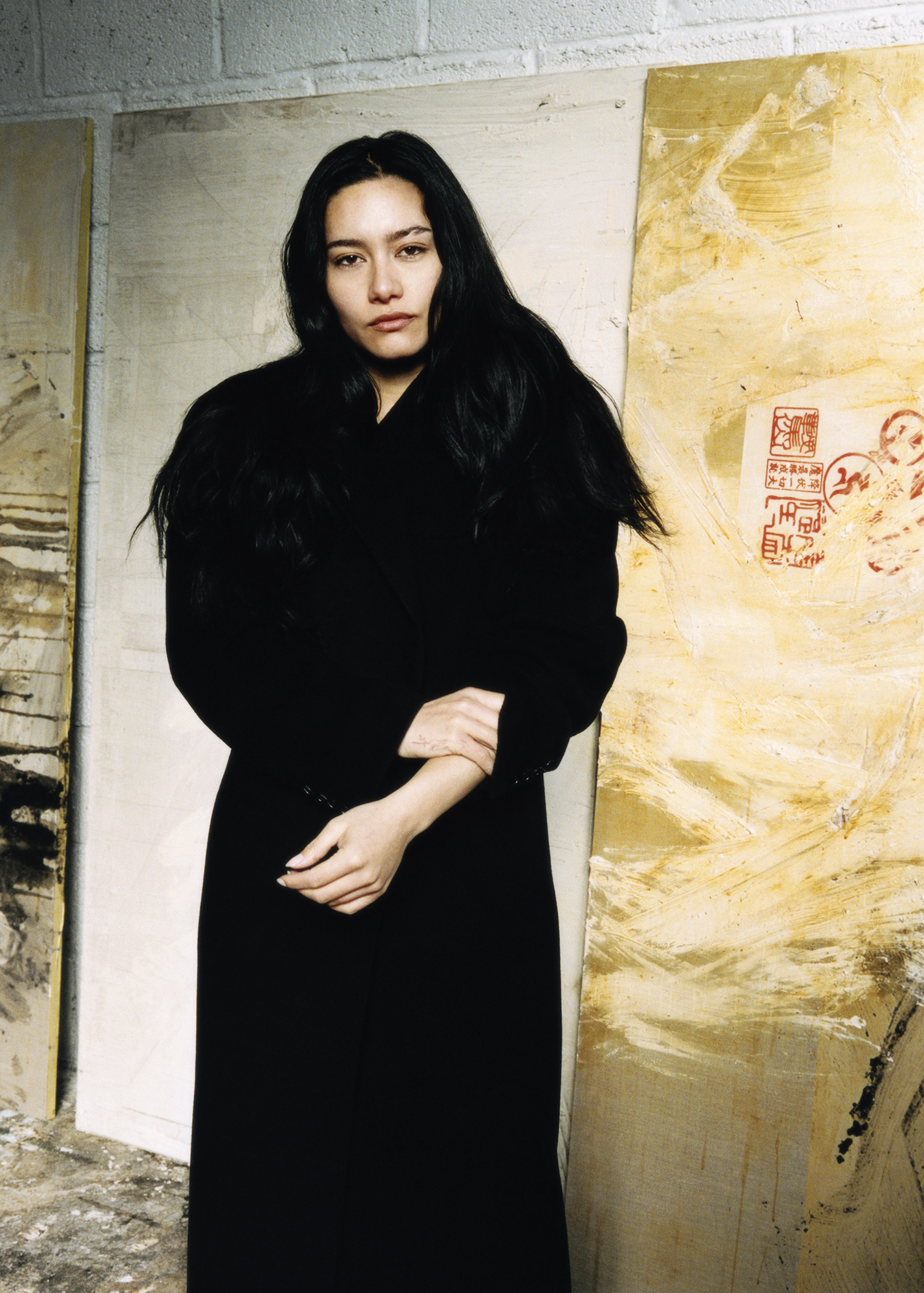
Portrait by Larissa Hofmann
To paint as one gives birth: governed by a body that places the Other at the very heart of the One. In Minh-Lan Tran’s practice, whether it is painting or performance, life rushes forth and inevitably imposes its own form. It requires no artifice that would falsify it, only a body that paints and offers it a hearth. In her paintings, endogenous and foreign images intermingle, seeking the possibility of exchange, of a dance, of fusion: giving form to the formless without betrayal. A painting thus becomes a stage in the forgetting of painting itself, a new attempt towards its deconstruction.
Minh-Lan Tran doesn’t “think about painting with the goal of painting itself,” as she puts it: she extends its domain so that the image becomes an incarnation, the composition an order—even if found in chaos—the representation a sensation, and the surface a depth. Above all, she conceives it as a confrontation: the challenge of painting what refuses to reveal itself.
There is, in this, an admission of vulnerability in the face of both the work and the act of painting, since painting what cannot truly be represented requires the search for an access. Each painting thus asserts itself as a medium, in the deepest sense of the term: an intermediary solution, a passage, a conduit for transformation. Each painting offers a space where it becomes possible to fix a fleeting disturbance, an intangible sorrow, an indescribable tremor, a magnetic potential, and to shelter its vibrations, however faint they may be. It is in reaching this point of fixation that she exhausts the painting, and in one way or another, relinquishes it to its future lives.
Everything unfolds as a risk: a birth with no certainty as to what is emerging, something that will take on a life of its own after a gestation fraught with peril, as nothing guarantees its completion. To take this risk, then: to descend lucidly into subterranean regions, to allow a “brutal writing” to emerge, as dancer Tatsumi Hijikata put it, striking against the upper walls and attempting to break through, so that something may come to light.
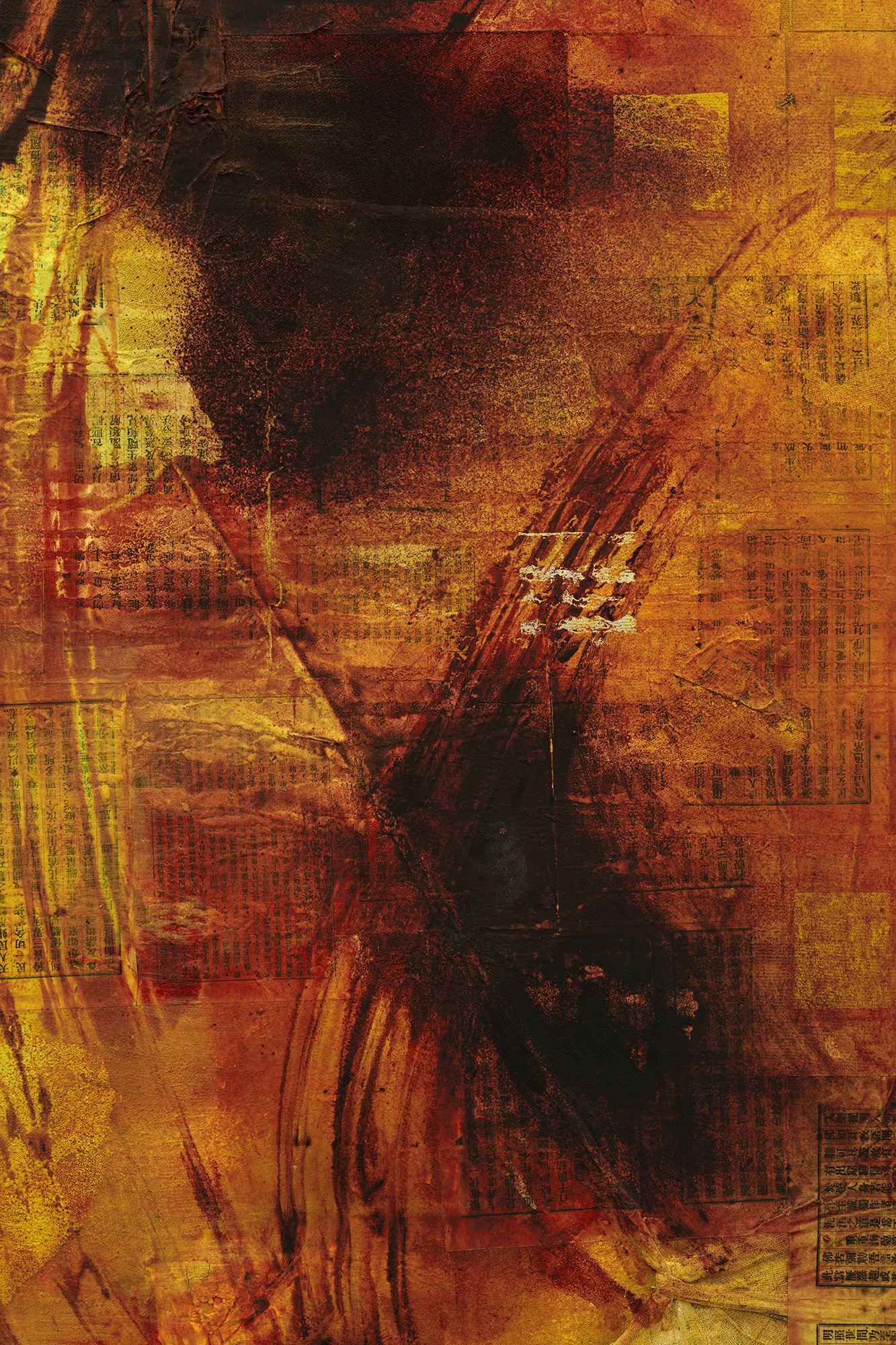
No heart bone but let it break II, 2024 (details) Photo: Mareike Tocha
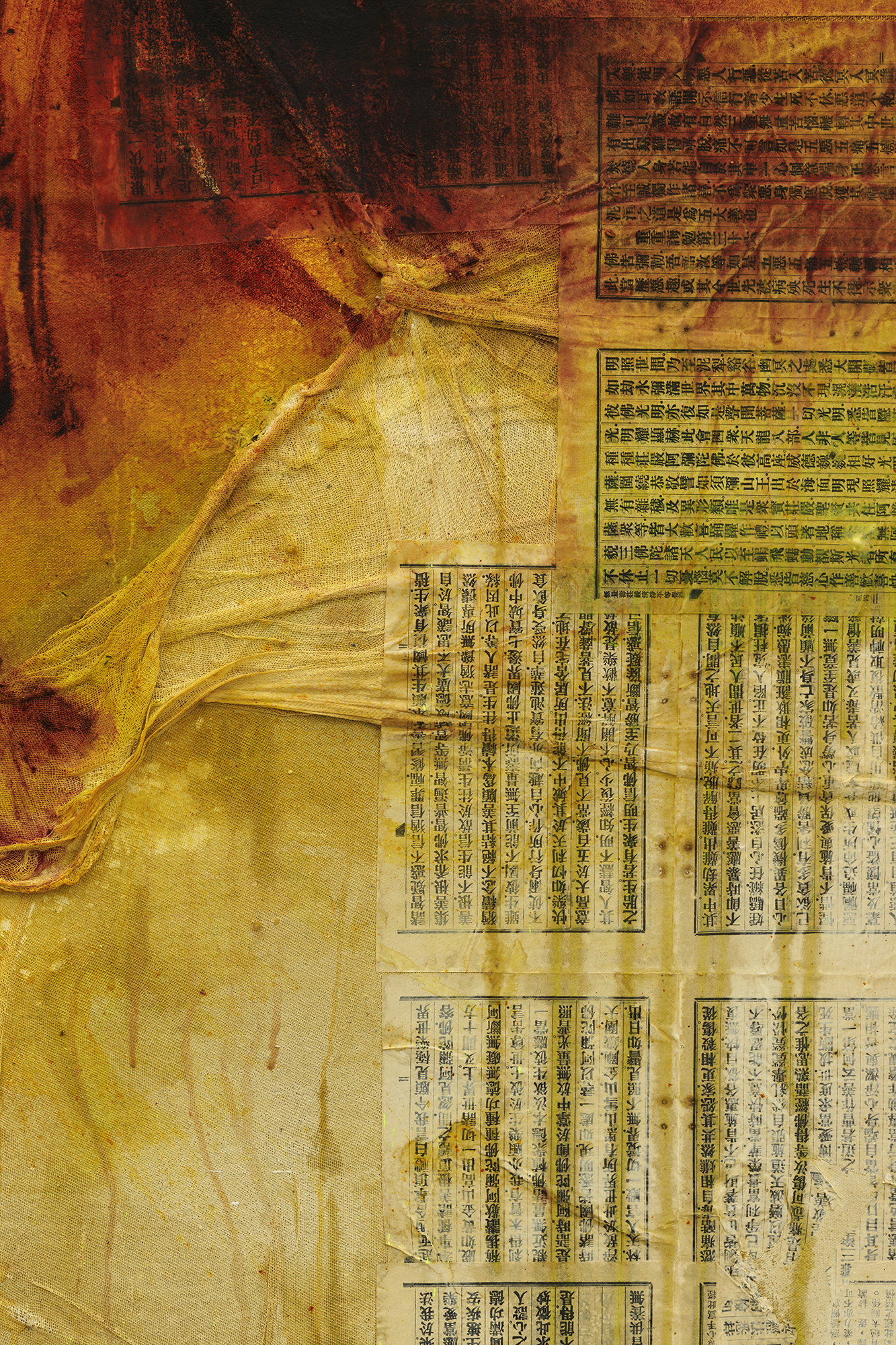
No heart bone but let it break II, 2024 (details) Photo: Mareike Tocha
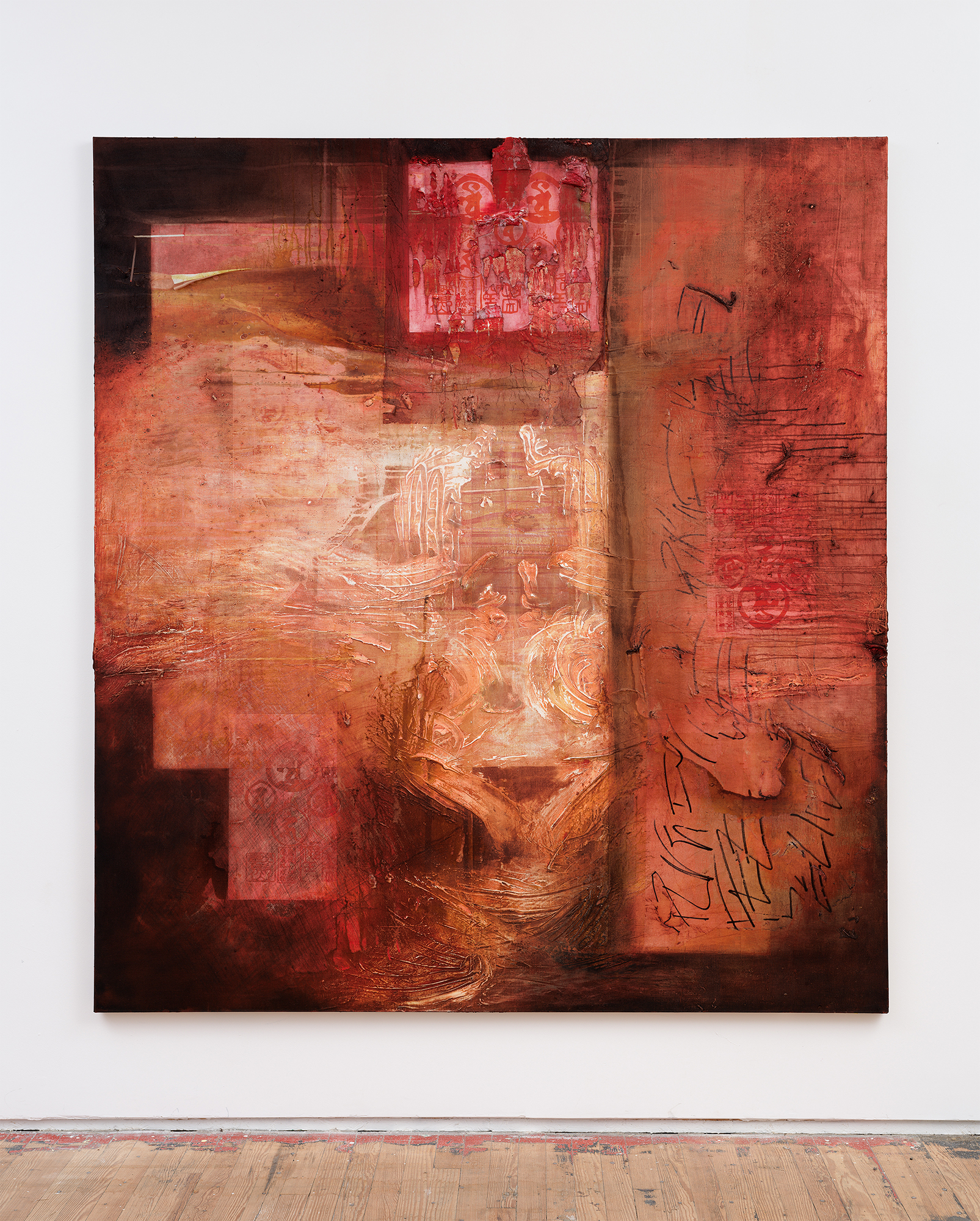
Devotion disorder, 2025
If such writing is brutal, it is because it is pure, untainted—where imposed norms hold no sway. To feel the ground beneath one’s feet, rather than reaching toward the heavens, requires a certain courage and a humble deference. And yet, everything comes from there: from the earth, from the sometimes-threatening heat it emanates, from the lava currents stretching below, seeking an outlet. To feel this, to paint from the depths and towards them, is to acknowledge the primacy of matter, of that which unites flesh and earth, ensuring that flesh returns to the earth; that there is no life without friction and burning, without the generation of heat; that fire, above all, is a space of communication—with the dead, for instance—and not merely an instrument of destruction. It is to embrace the interpenetration of flows and phenomena that govern both the world and its hidden undercurrents. It is to receive the inaudible murmur of the departed, carried by telluric movements, before reality contaminates them.
Thus, Minh-Lan Tran seeks to make her works living organisms, open to transformation and impermanence: the aim is to produce a spark, a jolt that allows one to brush against the enigma of fire and to stoke it, so that it may continue its work of metamorphosis. There is a spirituality at play in her work, one that, in a way, extends far beyond painting and manifests the anticipated effects of a prayer. Painting, in this sense, no longer justifies itself as an opaque surface: it becomes a transparency, an opening at the very least. It calls for a breakthrough, granting access to indeterminate zones that must be known and embraced. The spiritual is revealed in the intimacy of contact with matter, in the acceptance of a depth into which Minh-Lan Tran digs, scrapes, and tears. These are gestures that call for repair.
For there is yet another risk: that of confronting the possibility of a catastrophe—one that must be contained, held at the tipping point, where the painting becomes a contraction, a taming of death. Matter, in Minh-Lan Tran’s work, gradually reveals its needs and its rhythm through exchange. Ultimately, it calls for an ethics, a responsibility: to heal rather than to destroy, to nurture and support the pulsations of the sensitive world, so that they may resonate beyond the painting.
Minh-Lan Tran
Text by Guillaume Blanc-Marianne
CURA.44
The Generational Issue
All images
Courtesy: the artist and Jan Kaps, Cologne
Minh-Lan Tran (b. 1997, Hong Kong) lives and works in Paris. She recently had solo shows at: Francis Irv, New York; Parliament, Paris; Jan Kaps, Cologne; Harlesden High Street, London. Her work was presented in group shows at venues including: Hannah Hoffman, Los Angeles; Balice Hertling, Paris; François Ghebaly, Los Angeles; High Art, Seoul; HOUSE, Berlin; The Museum of Home, London; Nicoletti, London.
Guillaume Blanc-Marianne is an independent PhD researcher, curator and art writer based in Paris. His recent publications include a text for the exhibition catalogue of Oh, if only I could speak by Pol Taburet and Images de la politique, politique des images, with Georges Didi-Huberman and Enzo Traverso.