Curated by Gioia Dal Molin
Istituto Svizzero, Rome
22 March 2024 – 30 June 2024
Press Release

Jeanne Jacob, Taking care, 2021 / Jeanne Jacob, La grande danse, 2022
ON LOVE
“To begin by always thinking of love as an action rather than a feeling”, writes bell hooks in All About Love, “is one way in which anyone using the word in this manner automatically assumes accountability and responsibility.” In this definition, love contains a political dimension. It becomes a political gesture. For the exhibition project On Love, I want to take bell hooks’ lead and think of love as an action.
The eight artists—Sabian Baumann, Zheng Bo, Leda Bourgogne, Giulia Crispiani, Soñ Gweha, Jeanne Jacob, Marta Margnetti, and Tomás Paula Marques—expand upon this idea. What dimensions can love acquire as an active, political act? What stories can be told through this lens? What new worlds might be brought into being? On Love is nourished by conversations, readings and reflections from recent years. It is a reflection on personal experiences and a sharing of fragile fragments of thoughts with friends and allies.
A reconsideration of learned and embodied notions of love, and an exploration of new ideas. Recognising there are myriad forms of love and myriad ways to love. That these are not limited to permanent partners. That friendships are love. That love also means networks of care. The ‘invention’ of modern, romantic love as a heterosexual relationship between two people with children, a house, a car and a dog is, as we might suspect, a capitalist achievement of Western industrialised nations. “We must be productive and heterosexual, we must have babies and buy a house,” writes Sophie K Rosa in Radical Intimacy. This form of love ensures and reinforces the smallest unit of production within a capitalist society, orchestrating the labour of both reproduction and production. Any deviations from conventional forms of love and intimacy are often viewed as dangerous and disruptive. Moreover, the technological advancements of our digital era challenge the constellations of love, sexuality and intimacy, where potential love, life or sexual partners are readily accessible with a simple swipe, making it challenging to pause and reflect. Grappling with these dynamics and perhaps engaging in acts of defiance, withdrawal and critique (I am thinking of Sara Ahmed’s concept of the killjoy, who questions and rebels) can serve as forms of resistance. And whom we love and how we love is always political.
On Love does not aim to comprehensively address all these aspects. This exhibition neither can nor intends to do so. Rather, it is more of a search for utopian ideas and unexpected approaches. It brings together eight artists from different generations, each offering distinct perspectives on the theme of love. Further, On Love serves as a reflection—and these are really just tentative fragments of thought—on how I aim to approach my own work. Etymologically, the term ‘curating’ derives from the Latin ‘curare’, meaning to care, heal or nurture. Knowing full well that the noun—curator—historically referred to someone overseeing an art collection, I can twist this original meaning and apply it directly to a contemporary practice. Curating then becomes about cultivating a collective approach to thinking and working. It involves listening to and supporting one another—even within the transient community of an exhibition project and particularly amidst the sometimes harsh and competitive realm of contemporary art.
Finally, in a broader context, On Love serves as a reflection on alternative modes of storytelling. How can the narrative of love be told differently? What new realms unfold when we tell alternative stories, when we conceive of love more expansively, extending it to networks of care and including friendships alongside relationships between all kinds of species? These reflections are deeply influenced by Ursula K. Le Guin’s The Carrier Bag Theory of Fiction and the foreword to her text by Donna Haraway in the wonderful edition by Ignota Books. “It matters”, writes Donna Haraway, “what stories we tell other stories with; it matters what concepts we think to think other concepts with.” Considering all these ideas, it becomes clear that these concerns are deeply rooted in feminist perspectives, and that I want to think of our humanity within an egalitarian and interconnected framework, one that embraces the whole world and all other species. “The radical spark of the feminist project”, writes philosopher Rosi Braidotti, “lies in its subversive politics. It means creating the alternative visions of ‘the human’ generated by people who were historically excluded from, or only partially included into, that category. It means creating other possible worlds.”
The exhibition commences with the four oil paintings —La grande danse, Taking care, French kiss and Falling in love—by Jeanne Jacob. The artist has been exploring the theme of love from a queer-feminist perspective for some time. On her canvases, figures of ambiguous sexuality intertwine, tongues outstretched to kiss, while people, butterflies and dogs intermingle. Jeanne is intrigued by moments of transformation (symbolised by the butterfly) and perceives networks of care (i.e., between human and non-human beings) as integral to love. She particularly ponders how we can carve out space in this era of individualism, where we can advocate for the collective and navigate through opposing viewpoints and contradictions. Jeanne approaches these ideas with irony and tenderness, embracing radical kindness (towards herself and others) and infused with a generous dose of idealism. She acknowledges that we are invariably entwined in our own experiences and narratives, recognising that falling in love is always a process of negotiation.
Also in the first exhibition room, we can immerse ourselves in the installation “Secret Love Stories” / storie segrete – a display case with two books and love letters. Geotoet is a fictional character (created by the artist Giulia Crispiani) who collects fragments of genuine yet clandestine love stories. These include excerpts from diaries, letters and short stories. As readers, we remain unaware of the sources or recipients, often receiving only minimal geographical hints. But the intimacy and longing exuded by these words and phrases captivate me.
Soñ Gweha has bathed the so-called winter garden in violet light, filling the air with scents of lemongrass and cinnamon. We hear the warm sounds of Motown, along with voices and the flow of water. Soñ explores the concepts of pleasure, joy and the power of queer eroticism for care networks, healing processes, friendship and familial bonds. The Quiet Storm is a Lovation is what Soñ calls this multisensory work created for the exhibition, which invites visitors to smell, listen and pause.
As I write these lines, Smokey Robinson’s song, Quiet Storm, resonates in my ears. The lyrics and the erotic energy of this song—and of slow jam classics in general, known for their soft, soulful tones across R&B, soul, jazz and hip-hop—serve as an important point of reference for Soñ. Beyond expressing ‘mere’ love, these songs often embody themes of collectivity and community, acting as anthems for political movements (like the Black Power Movement) and tell of resistance, resilience and liberation. In Soñ’s sound piece, we encounter voices such as Smokey Robinson and Erykah Badu, as well as recordings from Cameroon—the voices of Soñ’s aunt and uncle talking about medicinal plants, and of Soñ’s mother and aunt singing. Soñ has recently been incorporating lemongrass (for its protective properties) and cinnamon (invigorating, even aphrodisiac) into a bathing ritual—drawing on knowledge of spiritual herbalism and because love for others begins with self-love. “What we need right now,” emphasises adrienne maree brown in Pleasure Activism, “is a radical, global love that grows from deep within us to encompass all life.” Indeed, as Soñ writes to me, “I think I want to continue this ritual, pouring love into the sound piece, the space and the people who enter it.” For Soñ, this gesture of love is also a response to the challenges of our current political climate and the ongoing conflicts in the Global South (on the African continent and in the Middle East). Thus, the space also becomes a sanctuary for mourning and healing.
In the next room, the video works Le sacre du printemps and Pseudocopulation by Zheng Bo prompt a reflection on cross-species relationships that connect humans with the natural world. Drawing upon Daoism (an ancient Chinese philosophy and religion dating back to the 4th century BC), these works challenge the dominant anthropocentric view, advocating instead for an approach that sees humans in close connection with nature and non-human species, one that relies more on feeling (rather than knowledge). With Le sacre du printemps, Bo challenges conventional notions about humans’ coexistence with plants, exploring erotic and sexual interactions between plants and queer men —also through imaginative and speculative inquiry and posthuman perspectives. Meanwhile, in Pseudocopulation we witness wasps and bees engaging in pseudo-mating behaviour. This term refers to the mimicry of mating rituals between individuals of the same or opposite sex within a species without actual fertilisation occurring. It also encompasses the interaction between (primarily) orchid species and wasps or bees. In this process, the flowers mimic the appearance and scent of female insects to attract male pollinators, who unwittingly transfer pollen to the flowers during their interactions.
Bo conveyed their deep fascination with the video material from their research, because it revealed the existence of diverse, non-normative sexual encounters that have always been part of our natural world. Detaching from rigid biological definitions, Bo shows us in Pseudocopulation that sexual pleasure is not exclusive to humans. It questions the notion of ‘natural’ laws (i.e. anchored in ‘nature’) dictating sexual interactions solely for reproductive purposes, exposing them as constructs rooted in power politics and patriarchal norms. Sabian Baumann also challenges societal norms in their artistic practice, viewing their work as a space for experimentation, as a laboratory. Through their drawings, installations and videos, Sabian prompts us to reconsider, even rearrange and create new ideas of subjectivity, sexuality and love. Combining artistic expression with activist strategies, Sabian exposes the prevailing ‘normality’ as a social, patriarchal and heteronormative construct. In their expansive drawing titled Seepferdchens Alptraum – oder sexuelle Obsession (in deutsch), Sabian confronts the gendered aspects of language in general (which seems partly arbitrary: ‘moon’, for example, is masculine in German and feminine in Italian) and in German in particular, which has a masculine (‘der’), feminine (‘die’) and a factual (‘das’) article.
The seahorse is the only creature depicted in the drawing that takes the neutral article in German (in Italian, it is male), while it is also the only creature in which the male is fertilised by the female and then carries and births the young. A cis-heteronormative order is therefore not as ‘natural’ as is often claimed. Meanwhile, Sabian’s walk-in installation Signes et Sentiments consists of life-size hands—some outstretched, others clenched into fists—modelled from unfired clay. The open hands touching each other remind me of affection and tenderness; the hands clenched into fists tell of struggle, rebellion and protest—for social change and against discrimination. Sabian developed this piece in 2021 against the backdrop of the coronavirus pandemic and ensuing lockdowns. During this time, face-to-face encounters and physical contact were severely restricted (in Italy, the nuclear family was declared the only permissible unit for togetherness—discriminating against those not living in such structures). Amid the deserted streets, the Black Lives Matter movement gained momentum, fuelled by outrage over racist police brutality. In a broader sense, Signes et Sentiments reminds me of the all-important link between love and political activism. In other words, political work thrives on networks of care and the joy and pleasure of collective action. In her lecture in Zurich on a rainy summer day last year, Silvia Federici reminded us of the necessity of joy and friendship in political activism, writing of “joyful militancy” in Beyond the Periphery of the Skin: “Doing political work must be healing. It must give us strength, vision, enhance our sense of solidarity, and make us realise our interdependence.”
In her artistic practice Giulia Crispiani is engaged with writing often in the form of manifestos or love letters. In her new work Against Conquering / Contro la conquista, she explores the question of how we can even think and talk about love amidst the backdrop of war and ongoing social injustices.
The four textile works, with their dimensions and almost ornamental lettering arrangement, evoke bandanas—the square scarves associated with pop-culture dress codes and counter-cultural movements like biker culture. For Giulia, they are conceptual maps, or a kind of geographical map and tribute to Kathy Acker (also an enthusiastic biker) and her ‘dream maps’. As Kathy Acker said, “Maps are dreams: both describe desire, where you want to go, but never the reality of the destination.” The work seeks to navigate the bleakness of the present, drawing strength from love to fuel political resistance: “Rompiamo l’egemonia della storia con tutta una serie di infinite storie d’amore…” (We challenge the hegemony of history with a whole series of neverending love stories).
The wall works by Leda Bourgogne consist of diverse fabrics—translucent chiffon, silk or soft velvet—sewn together by the artist or (seemingly) held in place with zippers and belts. Some of the fabrics look like skin, and the shapes of the sewn-on materials suggest organic structures. Leda’s work draws on music, poetry, pop culture, subcultures, and queer history. She is interested in new ways of reading, mixing, and confounding these references to forge different narratives. Leda also links the confrontation with love to experiences of loss: that moment when “intimacy falls apart again”, she writes to me. The works Masochist, Cataclysm, Windmills Of Your Mind and Butterfly Effect tell of wounds—wounds that Leda sews back together by hand. Wounds that love inflicts on us, and that love can heal. As Anne Carson writes in her poem, O Small Sad Ecstasy of Love (an important point of reference for Leda): “there you were / kneeling by the roadside / with your little toolkit / fixing something. / Give me a world, you have taken the world I was.” In Leda’s work, love, devotion, injury and healing converge in the act of manual labour. She creates all of her work by hand and, as she tells me, infusing the materials with her dedication and time. The references to care work are obvious, and for Leda, this activity also holds an anti-capitalist sentiment: working with love and time, she takes a stance against the frenetic pace of the (art) market. The figurative painting Asylum emerges from Leda’s fascination with actress Maria Schneider, who became famous for her role in the film Last Tango (1972) but later described her experiences alongside Marlon Brando as traumatic. In her subsequent feminist film projects, like A Woman Like Eve (1979), Schneider openly addressed her homosexuality, setting standards for queer love and life choices.
Marta Margnetti’s work Una gerla una saccoccia una cavagna uno stomaco una manciata un rammendo consists of six ceramic bag-shaped sculptures and takes inspiration from Ursula K. Le Guin’s The Carrier Bag Theory of Fiction. In this 1986 essay, Ursula K. Le Guin cites the work of historian Gerda Lerner, who in her book The Creation of Patriarchy, challenged the narrative of male hunting culture by highlighting the significant contributions of women in areas such as pottery and basket weaving as well as the work of the anthropologist Elizabeth Fisher and her suggestion that rather than the spear, the bag—used for collecting things and taking them home—is the oldest and most crucial cultural invention. Marta ties in with these things: her ceramic pieces refer to Ursula K. Le Guin’s ‘carrier bag theory’ of storytelling, which does not relate the ‘killer story’ of hunters but the ‘life stories’ that often go untold. These are the carrier bags holding wild acorns and stories.
Unheroic stories that tell of our relationships and feelings. Of love and of caring for one another. For Ursula K. Le Guin, science fiction serves as a cultural carrier bag: “[It] is a way of trying to describe what is in fact going on, what people actually do and feel, how people relate to everything in this vast sack, this belly of the universe…” Perhaps, as Marta’s work might suggest, art has a similar function.
The short film Dildotectónica by Tomás Paula Marques connects two narratives across two time periods within the Serra De Agra mountain range in northern Portugal, weaving a queer-feminist tale spanning from the Inquisition to the present day. One storyline follows Rebeca: Rebeca crafts ceramic dildos in a workshop, challenging conventional heteronormative sex toy standards, questioning phallic forms and awakening desire and lust in non-normative bodies too. Then there is the story of the forbidden love between Josefa and Maria—two secular ‘recolhidas’ living in seclusion in a religious institution (a ‘Recolhimento de Convertidas’).
While researching materials, shapes and colours, exploring the landscape and history of the Serra De Agra, Rebeca stumbles upon the story of Josefa and Maria, documented in records on the Portuguese Inquisition. The two narrative threads are linked through the landscape (as Rebeca moulds earth into a ceramic dildo) and the search for sexual pleasure (Josefa and Maria used a dildo, according to the Inquisition files). Ultimately, Paula tells us a different story with Dildotectónica. The filmmaker shifts the focus to the desires and love shared between the characters (unlike the Inquisition did, which concentrated on societal norm violations) and even speculates about an alternate ending where Josefa and Maria run away together.
And still the story isn’t over”, writes Ursula Le Guin at the end of The Carrier Bag Theory of Fiction.
“Still there are seeds to be gathered and room in the bag of stars.” So here’s to more stories.
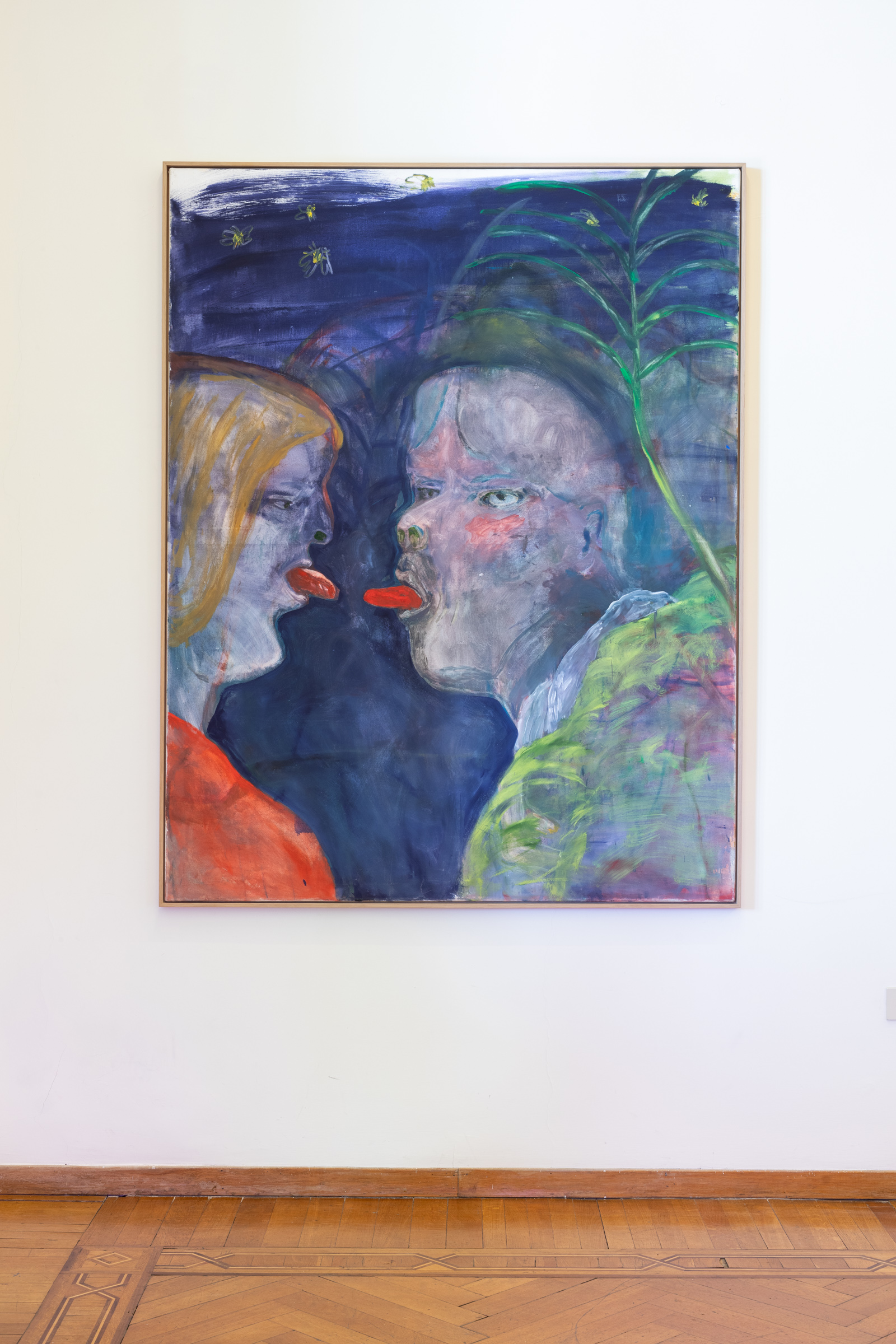
Jeanne Jacob, French kiss, 2019
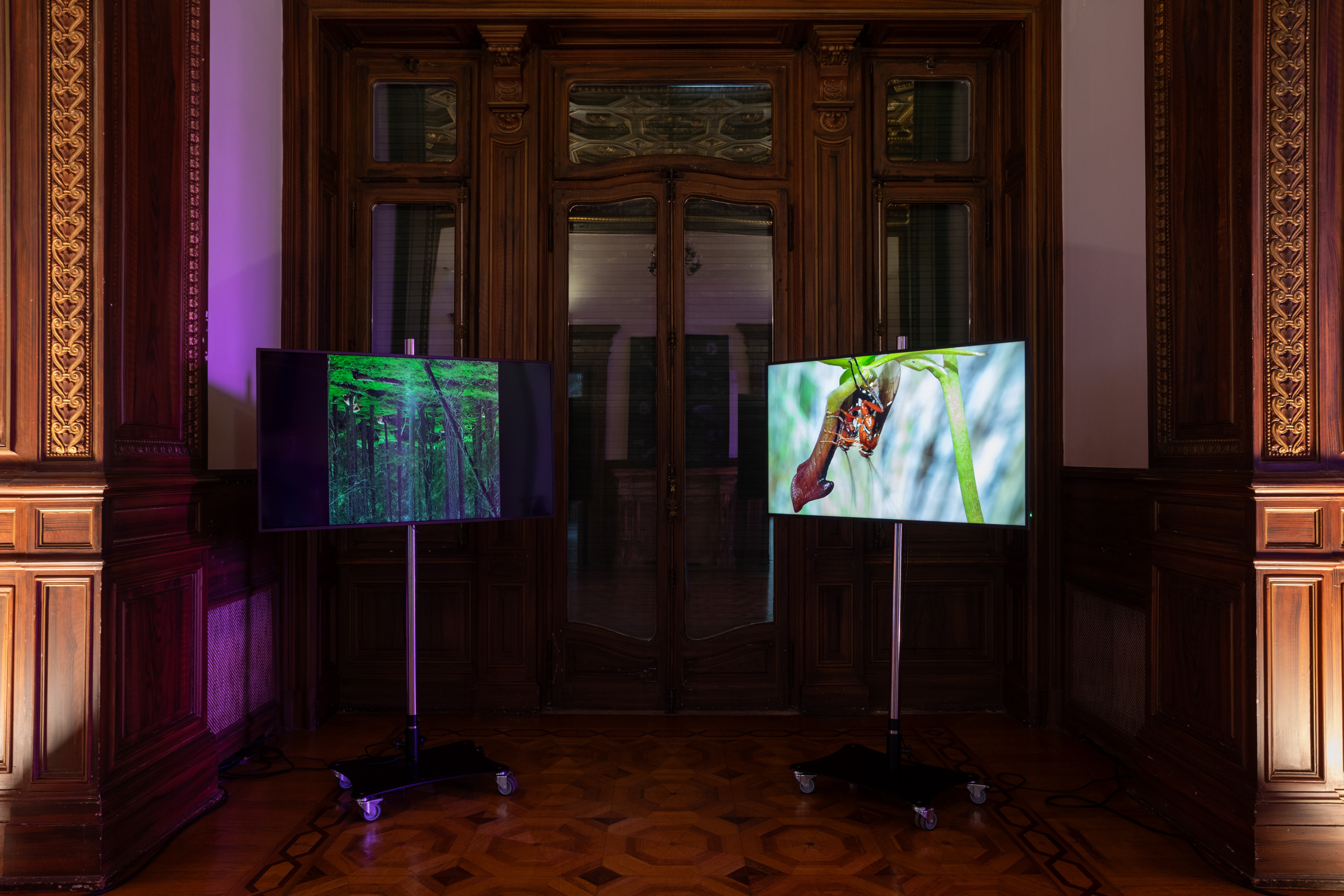
Zheng Bo, Le Sacre du printemps, 2021-2022

Sabian Baumann, Seepferdchens Alptraum – oder sexuelle Obsession (in deutsch)(Seahorse’s nightmare – or sexual obsession (in German)), 2020
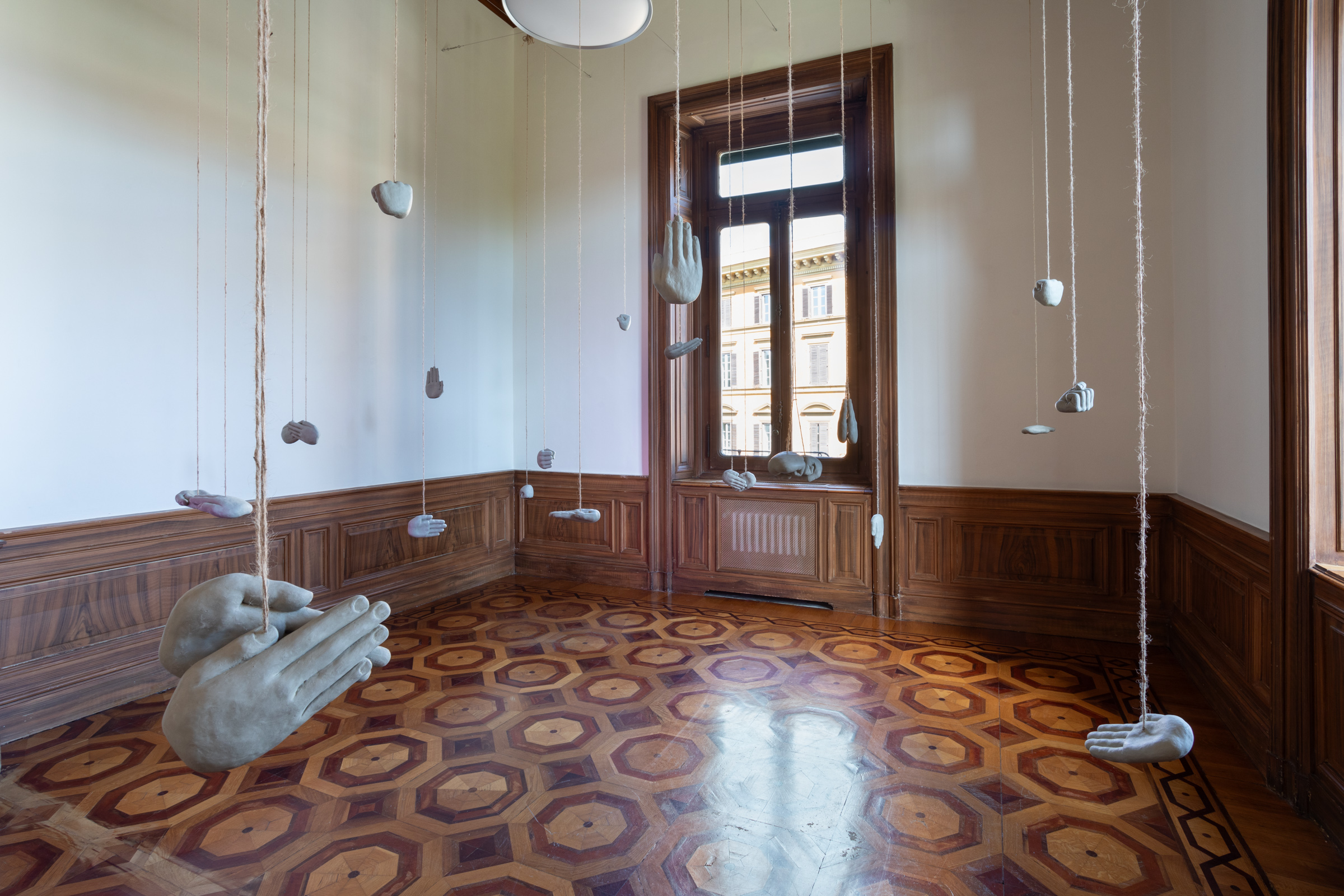
Sabian Baumann, Signes et Sentiments, 2021.

Leda Bourgogne, Cataclysm, 2021 / Leda Bourgogne, Butterfly Effect, 2022

Marta Margnetti, Una gerla una saccoccia una cavagna uno stomaco una manciata un rammendo, 2024

Soñ Gweha (aka SOÑXSEED),The Quiet Storm is a Lovation, 2024
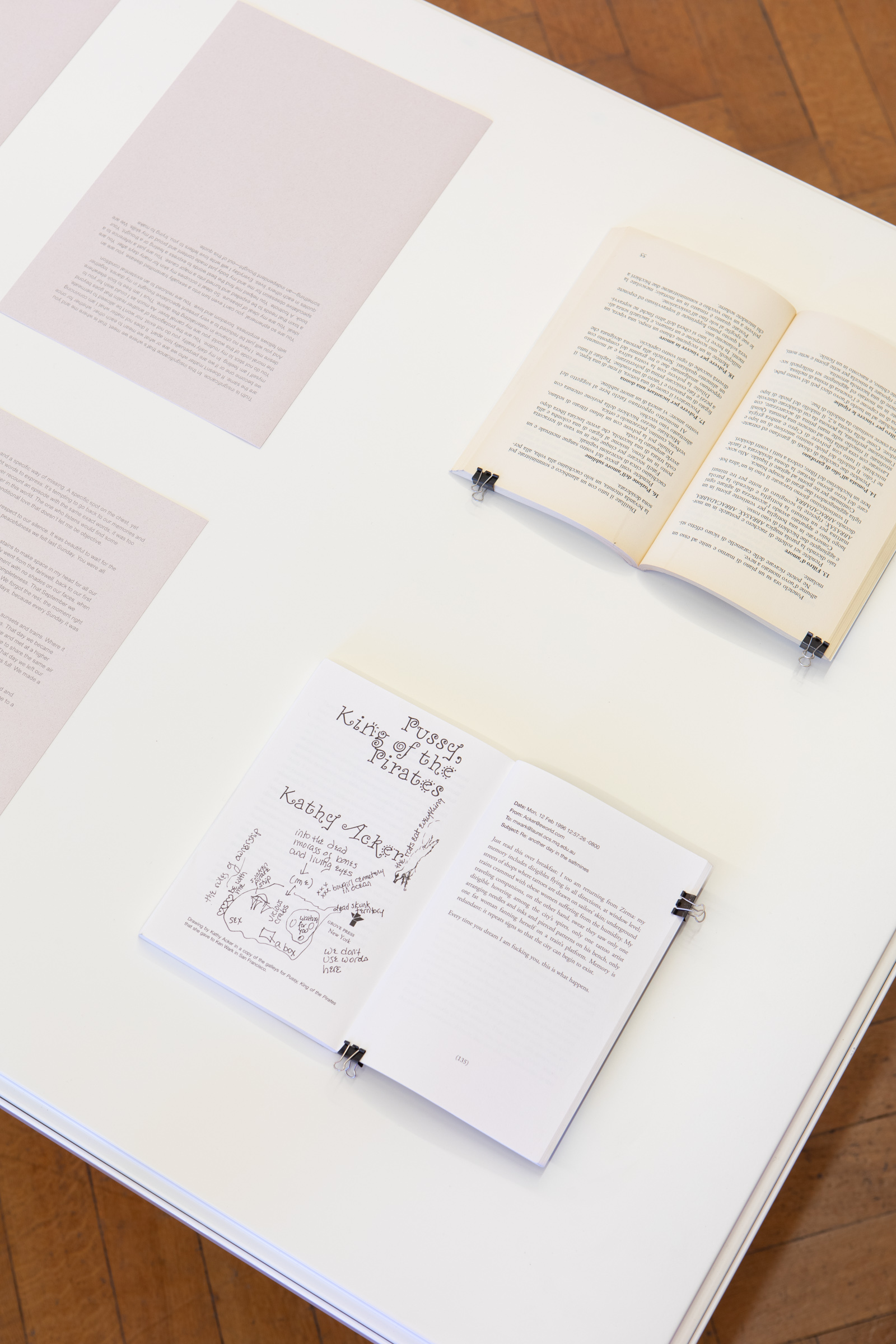
Giulia Crispiani, “Secret Love Stories” / storie segrete, 2017-2019
On Love
Curated by Gioia Dal Molin
Istituto Svizzero, Rome
22 March 2024 – 30 June 2024
A group show with Sabian Baumann, Zheng Bo, Leda Bourgogne, Giulia Crispiani, Soñ Gweha, Jeanne Jacob, Marta Margnetti, Tomás Paula Marques
Curated by Gioia Dal Molin
All photos
On Love, installation view at Istituto Svizzero, Roma, 2024. © Daniele Molajoli