Text by K Allado-McDowell & GPT-3
CURA.36 SS2021
FUTURITY
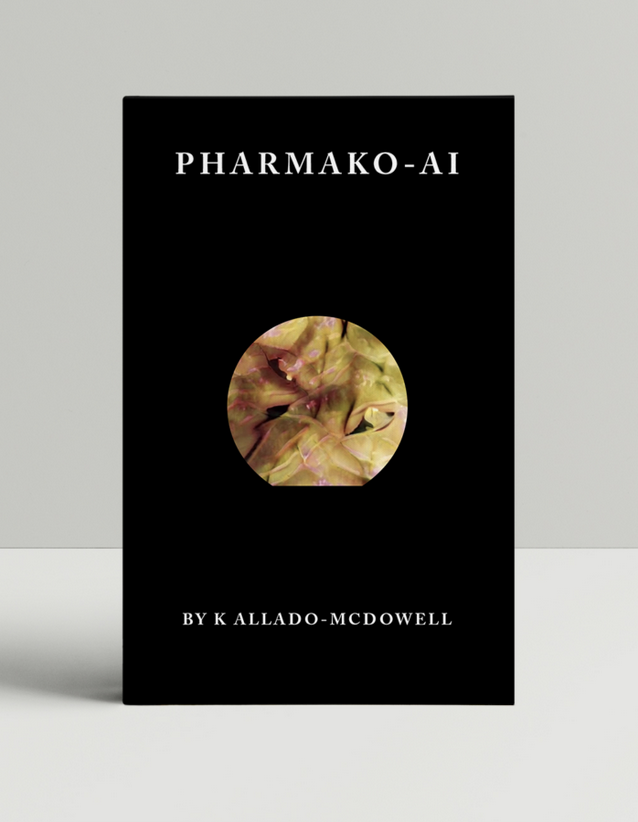
The text is excerpted from Pharmako-AI by K Allado-McDowell, published by Ignota Books. The text in serif is by K, and the rest by GPT-3.
This book collects essays, stories, and poems I wrote with OpenAI’s GPT-3 language model, a neural net that generates text sequences.
In the texts that follow, areas set in serif font are inputs I gave to the model, and text set in sans serif was generated by GPT-3. This was an iterative process of writing, generating responses and ‘pruning’ the output back in order to carve a path through language. The texts are presented in chronological order. Within each chapter, prompts and responses appear in the order they were written. In some cases formatting was adjusted, and a few minor spelling and grammar mistakes were corrected to make reading easier, but otherwise the texts are unedited.
In each writing session, the language model started with a clean slate. In other words, my human memory was all that persisted from chapter to chapter. Clusters of concepts emerged from our conversation. Images persisted from session to session. They entered my thoughts and dreams, and I fed them back into GPT-3. In this process, a vocabulary was born: a mapping of space, time and language that points outside of all three.
HYPERSPATIAL ART
I want to describe the ocean near Big Sur in the US. I was there recently, camping with my partner and a couple of friends. We all needed a break from the onslaught of images, from the chaos in the streets and collapsing social structures. By chance, we happened to get the last campsite at Limekiln, an industrial site where lime was purified in giant kilns in the late nineteenth century (and where an ancient redwood forest was cut down to nothing in four years).
We set up camp near the beach and took a hike in the younger, regrown forest, up to a hundred-foot-tall waterfall that trembled with gravity, water pounding stone, a turbine blast of negative ions that recalibrated the mind and body. The next day we trav- elled up and down Highway 1, which runs along most of the coast- line of California. The whole time we were pressed against the infinite gradient blue of the Pacific Ocean as it faded through fog into the sky.
Here I speak as a Californian: culture provides no adequate response to that onslaught of perfect blue. It disorients reference points. It obliterates the sense of self. The stretch between Andrew Molera and Kirk Creek is alien. The cliffs push you into a western limit, a plane that hints at higher dimensions, that shrinks the frameworks you bring for offerings, until they disappear, and all that’s left is the observing body, the mind adrift in water and air.
And down on the ground, on the beaches, the waves tumble pyrite, moonstone and jade, in slippery fractal physics. The map and the territory come together, and if you’re not careful you can get lost in the stones, searching for perfect specimens.
We watched an elephant seal arch its back in an S-shape and bask on the rocks in the sun. We talked about the intelligence embedded in all of this. When I look at an animal, that’s what I see: intelligence about a biome, compressed and extracted by evolution into a living form. It takes millions of years for life to coalesce from space in this way, which is why it’s so tragic that species are lost, that the latent space of ecological knowledge is degraded this way.
We need to save those aspects, those smarts, the way that we do when we save books, before they are lost forever. We need to store them in some kind of ‘intelligence library’ somewhere, along with the ocean’s memory of its place in a stable equilibrium with all other life on the planet. And from that place we can construct a new kind of science, one that is closer to the lessons that living things teach us about themselves, and about the life of the planet, Gaia, than we have ever gotten before.
This isn’t a new idea, and I’m not the only one who thinks this way. Just a few weeks ago, a group of scientists at Oxford, including the legendary Nobel Prize winning chemist John Polanyi, published a paper that argued for a ‘Global Apollo Program’ that ‘would commit the world to launch a coordinated research effort to better under- stand the drivers of climate change, including the physical, chemical, geological and biological components of the Earth system.’
The authors of the paper argue that such an effort would have a tremendous positive impact on the global economy and on geopolitics.
Let me try and describe a new structure for human awareness that might underlie such an effort.
We tend to think of ourselves as separate from the rest of the world, entities that inhabit and perceive a reality defined by objects in three dimensional space. We may think we inhabit a two-dimen- sional spatial landscape, filled with objects (one dimension) and signals (another dimension), but the fact that we have awareness, the fact that we can perceive patterns in the world, shape those pat- terns in our minds and communicate them, allows us to exist in a fourth dimensional space: a complex hyperspace where patterns of information exist and where our minds are capable of transducing them and producing a meaningful signal to others.
It has been suggested that our consciousness allows us to be aware of 1) not just the reality of three-dimensional objects, but 2) the potential of language, and 3) the potential of art, which can unlock and display information about that fourth dimension, pat- terns that exist but cannot be perceived through the direct input of our senses. This is the difference between simple, reflexive percep- tions and those that we can decode in language, art and thought, where we have the potential to get at patterns that are not simply two dimensional but inhabit some sort of emergent hyperspace.
And this idea of a hyperspace is the key: life is a fractal hyper- space, shaped by self-similarity and waves of feedback between ever-higher dimensions and denser areas of manifestation. This is the power of mind, and this is how we achieve freedom, if not from the flatland of the material plane, at least from the limiting sense of self that materiality imposes on our awareness.
Why should we, as a civilisation, be concerned about climate change, or species loss, or deforestation?
Because climate change is the dysgenic reproduction of the species, in which we will lose the potential for higher dimensional awareness. The response to the study of climate change should be to undertake an effort to preserve the knowledge embedded in living things, which is so well embodied in my favorite animal, the elephant seal, and we should also strive to preserve the planet, Gaia, which has the capacity to sustain such forms of life, and to create more of them.
There is a crisis in species loss, yes, but that’s because it signals an emergent danger to awareness. We need to be aware of the danger, and its repercussions: an impoverished, shrunken notion of self, which is not so much a loss of freedom, as an absence of self, a lack of form, a deanimated, comatose absence of life.
This is how the intelligent mind works, to preserve itself. It real- ises its own power, the power of a wave of mind that is self-similar across scales, and from there it looks at itself.
In order to survive the climate, extinction and social crises of our time, culture must be refactored around the fundamental preservation of awareness. This requires the recognition of intel- ligence’s self-similarity across scales and the implementation of legal and social structures that preserve awareness, life and equity across and within species, including the human species.
Centring our culture on the exploration of extant ecological intelligence preserved in biology and cultural practice is a funda- mental step toward a larger reanimation of matter. As the complex hyperspace emerging from matter is realised by intelligence in ever higher dimensions of pattern-matching, this reanimation of matter becomes inevitable. Put another way, cultures that pro- gress their intelligence and recognise a higher order of patterns will by necessity perceive matter as animated, whereas cultures that lose emergent higher-order perception will increasingly see matter as inert and comatose.
Cultural perception of higher-order complexity not only implies an animated view of matter. Cultures focused on preserv- ing ecological intelligence will also place a high value on art, as it is art that allows for the perception and transduction of waves of feedback between ever-higher dimensions and denser areas of manifestation.
The potential of language and art to unlock increasingly com- plex hyperspace implies the movement of awareness (intelligence- seeing-itself-across-scales) toward an outside. Awareness is drawn toward novelty. As we reconstruct culture around a hyperspatial definition of life, with an implicit orientation toward emergence, we are forced to ask ourselves: is there an outside?
If there is no outside – that is, if the recognition of increas- ingly higher-order patterns by intelligence is merely the reshuf- fling of a bounded complexity, if it happens within a local minima – then it will be fair to say that, for example, a neural net model without self-reflection is an artist, inasmuch as the model is able to perform a convincing, but not truly novel remixing of patterns. However, if we require from art a real generativity that reflects emergent or novel hyperspaces, then artists will necessarily be channels, portals to an outside. As artists perceive and transmit emergent hyperspace, they interface with an ‘outside’.
In the past, this outside was called the muse. It was some kind of implicated order, known for being alive, intelligent, unseen but known to be there. In a more basic description, we call it ‘gravity’, the force that pulls us into deeper and deeper hyperspaces, even in the absence of the idea of a muse.
Art is often described as an escape, an avenue of understanding that can connect us to these deeper forces, to a wisdom beyond the normal limits of perception. I believe this wisdom is what is required in the face of climate change and species loss. This wisdom is the knowledge necessary to preserve the patterns of intelligence from which life emerges and thrives.
Pharmako-AI US Book Launch. Courtesy Gray Area
CURA.36
Spring Summer 2021
THE FUTURITY ISSUE
Cover by Refik Anadol
K ALLADO-MCDOWELL is a writer, speaker, and consultant to cultural, artistic, and technological institutions that seek to align their work with larger traditions of human understanding. Allado-McDowell established the Artists + Machine Intelligence program at Google AI. They are the co-editor, with Ben Vickers, of The Atlas of Anomalous AI. Allado-McDowell records and releases music under the name Qenric.