in conversation with Giulia Colletti
Radis #03
Special Project

Launched in 2024 by Fondazione Arte CRT in collaboration with Fondazione CRC, Radis is a programme dedicated to fostering public art interventions in small towns across Piedmont. Curated by Marta Papini, each edition commissions site-specific works conceived in response to their host contexts.
In this third feature of CURA.’s editorial series, Giulia Colletti speaks with Petrit Halilaj about Abetare (a day at the school), 2025, commissioned for the second edition of Radis. Their conversation unfolds through reflections on displacement and the anti-monumental gesture, tracing how shared drawings become acts of habitation and imagination, shaping new forms of belonging.
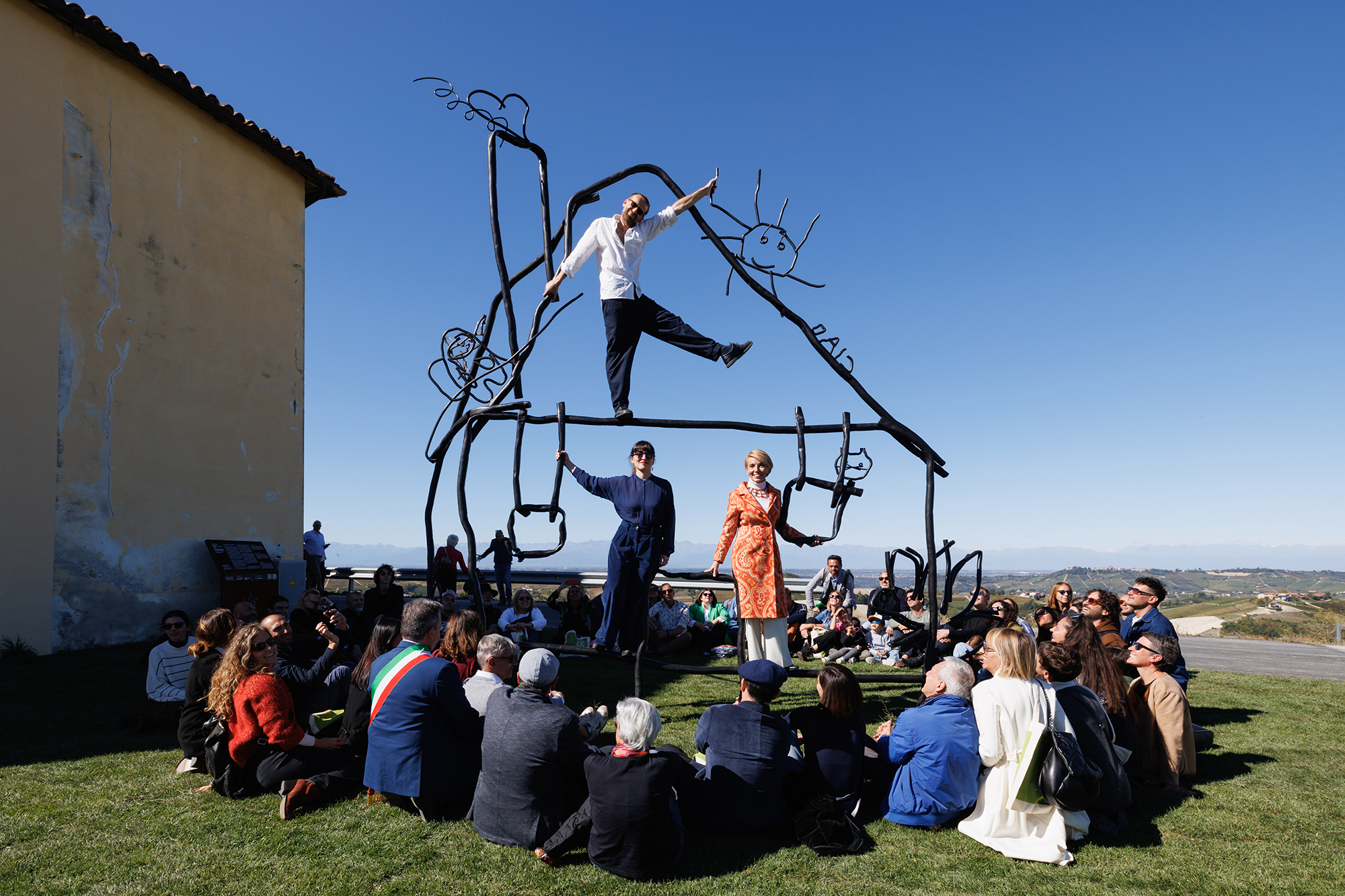
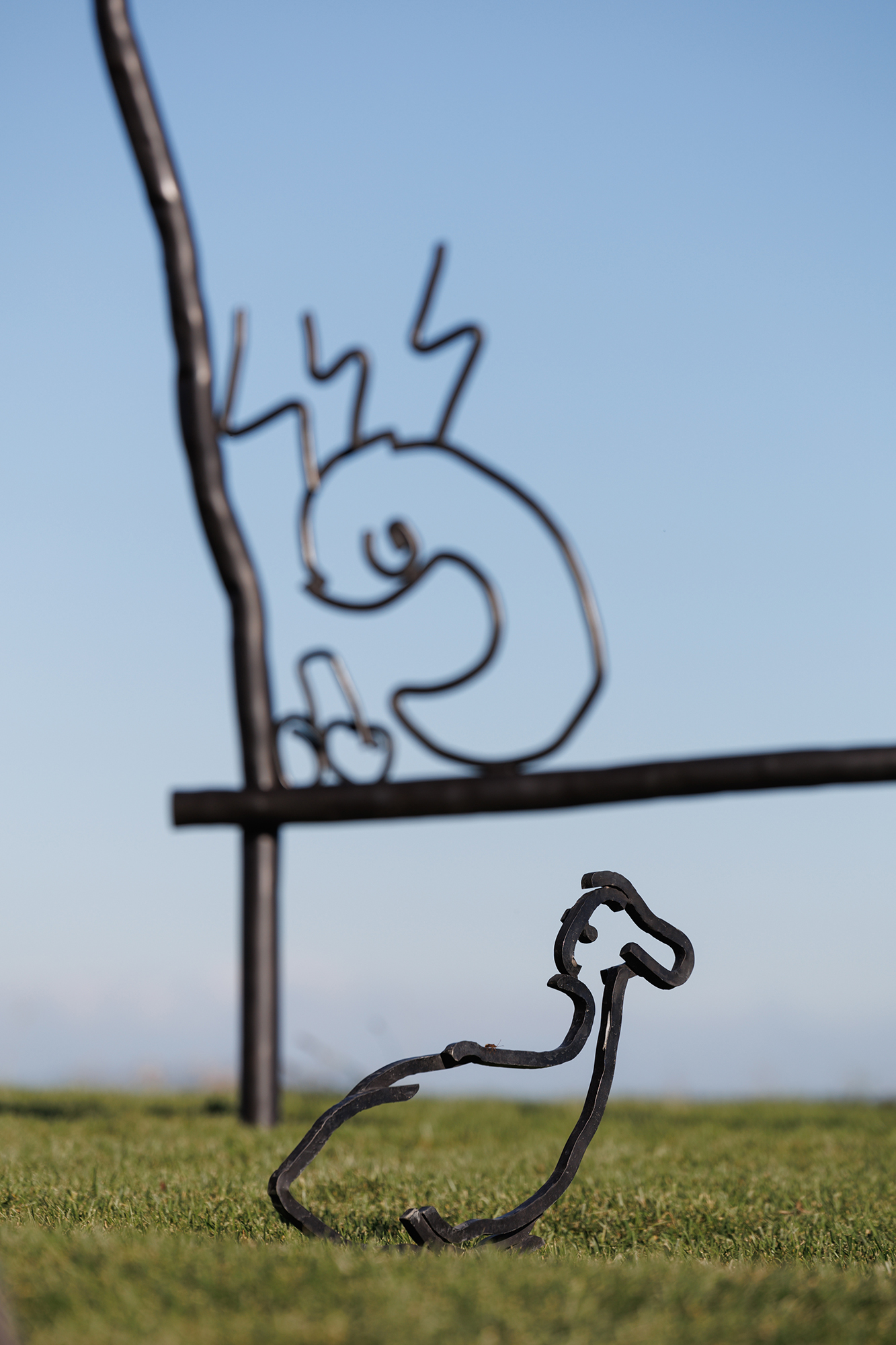
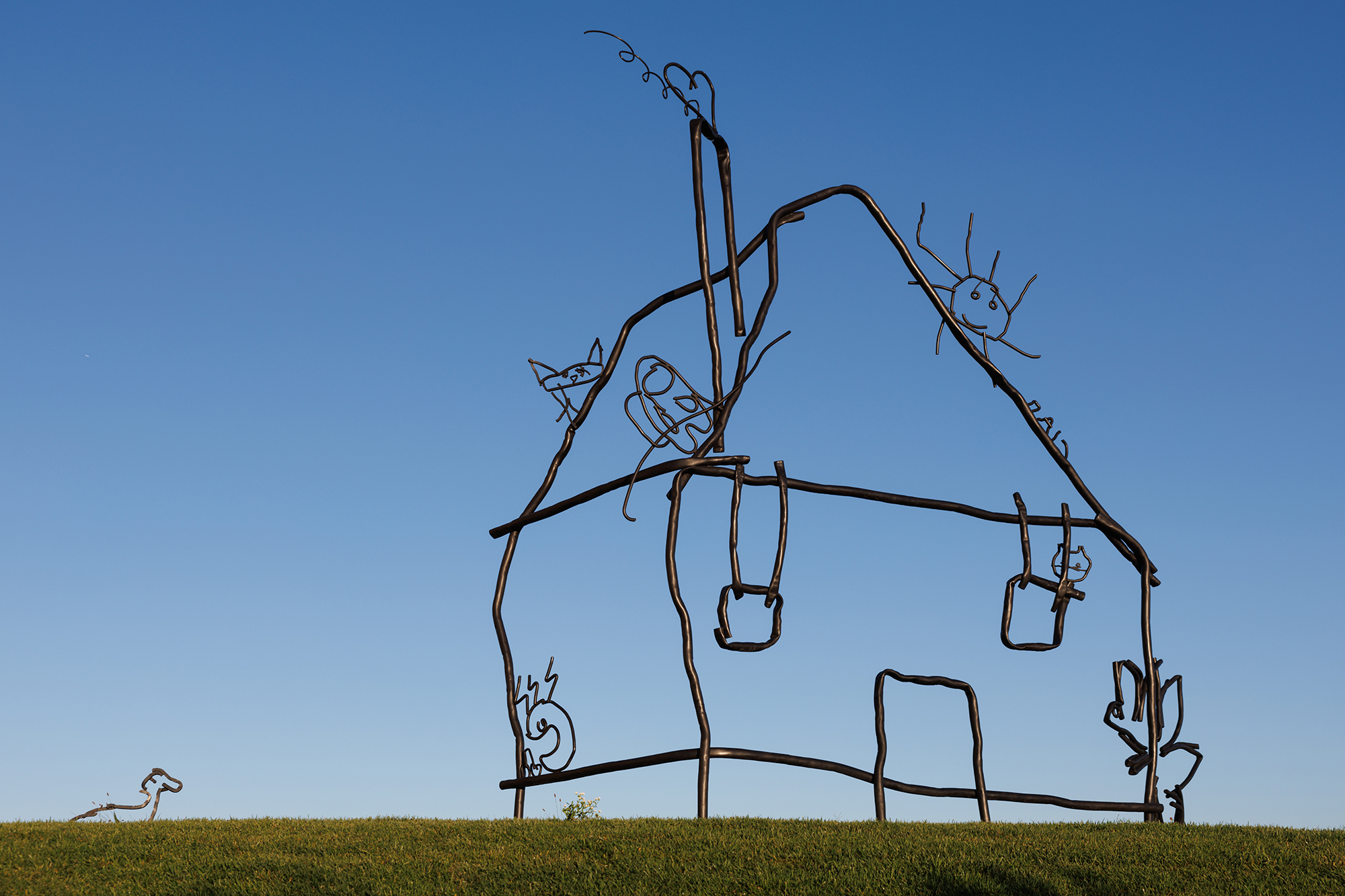
Abetare (a day at the school) marks a new iteration of a long-term project that began years ago with an archive of graffiti and drawings discovered on the desks of the school in Runik, Kosovo, the village where you grew up. Over time, this archive has evolved into a corpus of signs that continues to feed your research. From these traces emerge sculptures in steel and bronze that intertwine childhood imaginaries and disparate geographies, rearticulating them into a singular visual language. For Radis, you worked from drawings found on the desks of the school in Dogliani, placing them in dialogue with your archive. The resulting work now inhabits the grounds where the schools once stood as a house, animated by imaginary creatures born from the desks of both the Langhe and the Balkans.
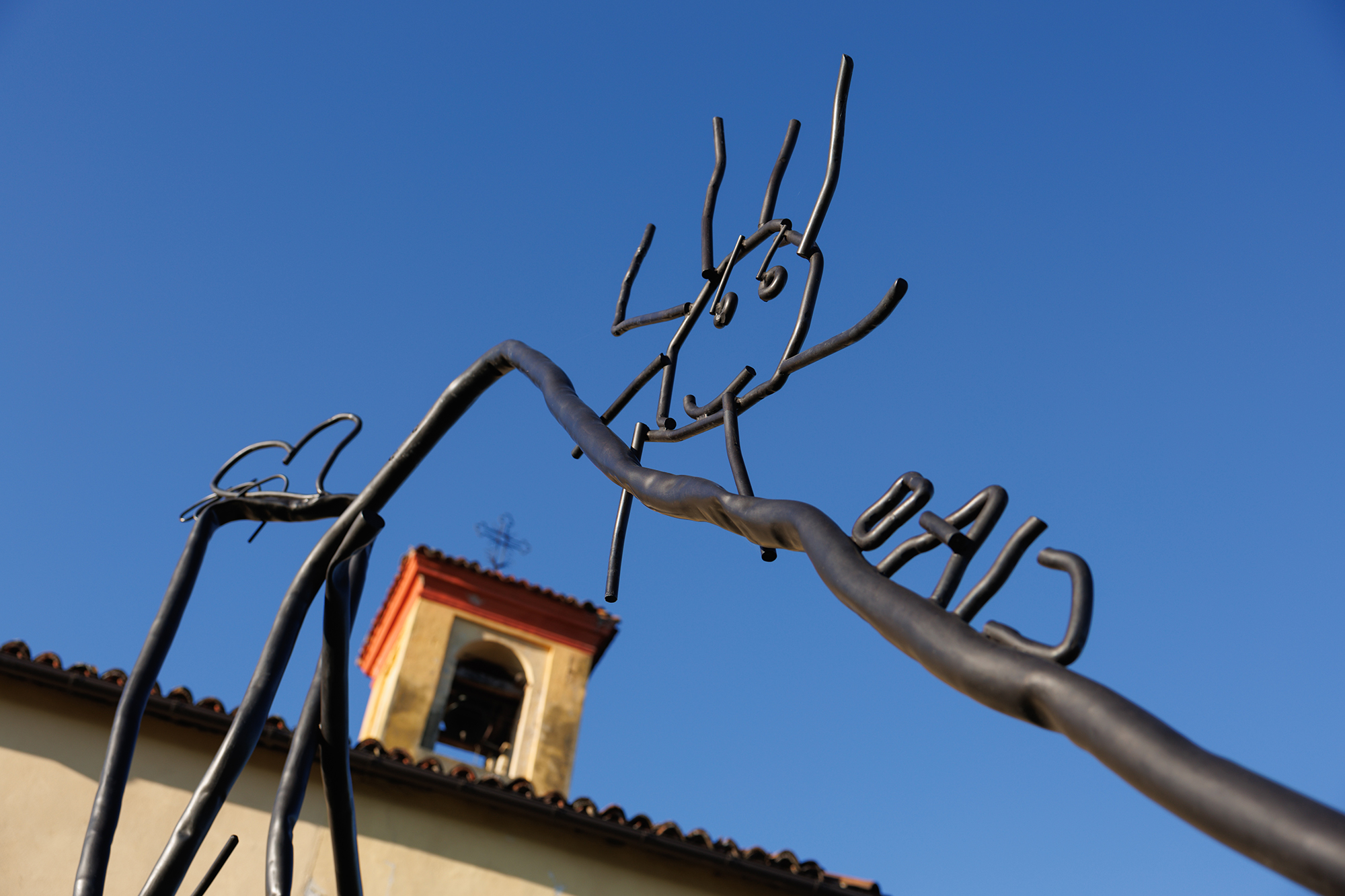
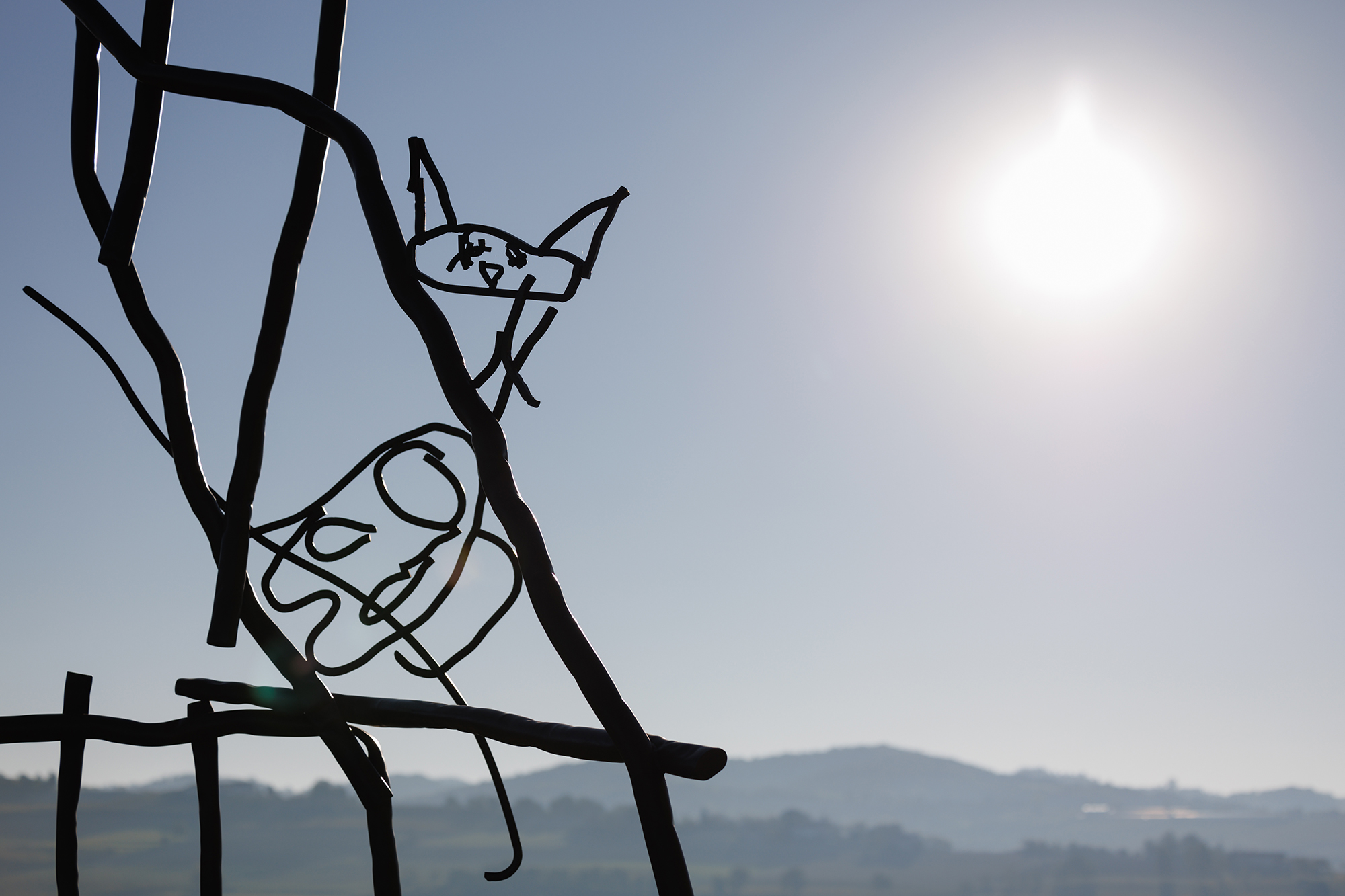
I’d say the thread linking this iteration to the previous ones is the desire to keep activating places in new ways. When the mayor of Dogliani told me he had volunteered at a school in Kosovo in 1999, it affected me deeply. I was only thirteen then, and his story took me back to my own experience in a war-torn context. Meeting him in a dialogue between schools in the Balkans and in the Langhe felt like a serendipitous connection spanning time and generations. Among the marks on the desks, I found a very simple house, the kind a child draws. In that gesture I recognised something profoundly universal, the same sign that appears in many Balkan schools. It is a shared language that precedes words, able to cross cultural boundaries and to unite what history has often divided. In this sense, drawing becomes what connects us spontaneously. When Marta Papini suggested working in this former school and we walked in to find the old desks still there, it felt natural to say, “Let’s do it.” It was as if the place itself were asking to be reactivated. I wanted the work to be a gesture of restitution, a presence that holds an absence, like a ghost continuing to inhabit what time had left unresolved. Those drawings, in a way, project themselves into space and sky. Within their imagery unfolds the whole life of a house. For Radis, I selected figures from the archive of Balkan schools and, by observing how people moved through the site (where they paused and rested) I began imagining possible uses. People often sat to catch their breath, especially on reaching the small chapel at the top of the hill. From there came the idea that Abetare (a day at the school) could also be a sculpture to be inhabited or a place to climb and linger. Together with Marta Papini, we decided to leave complete freedom of use, because I believe such interaction will occur naturally. Figures like the sun or a cat are the work’s inhabitants, inviting passers-by to encounter them.
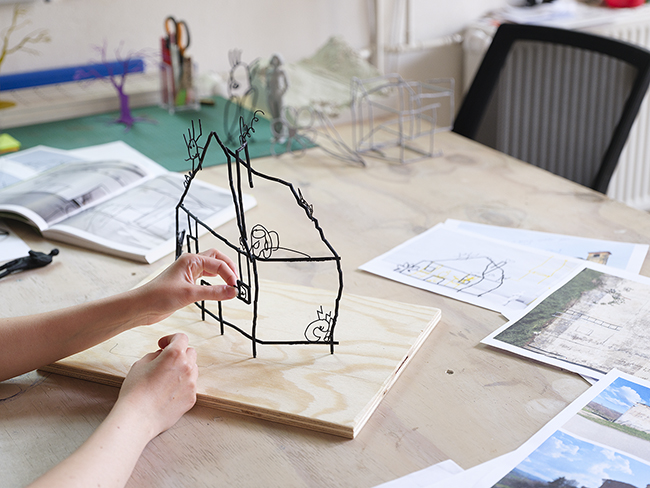
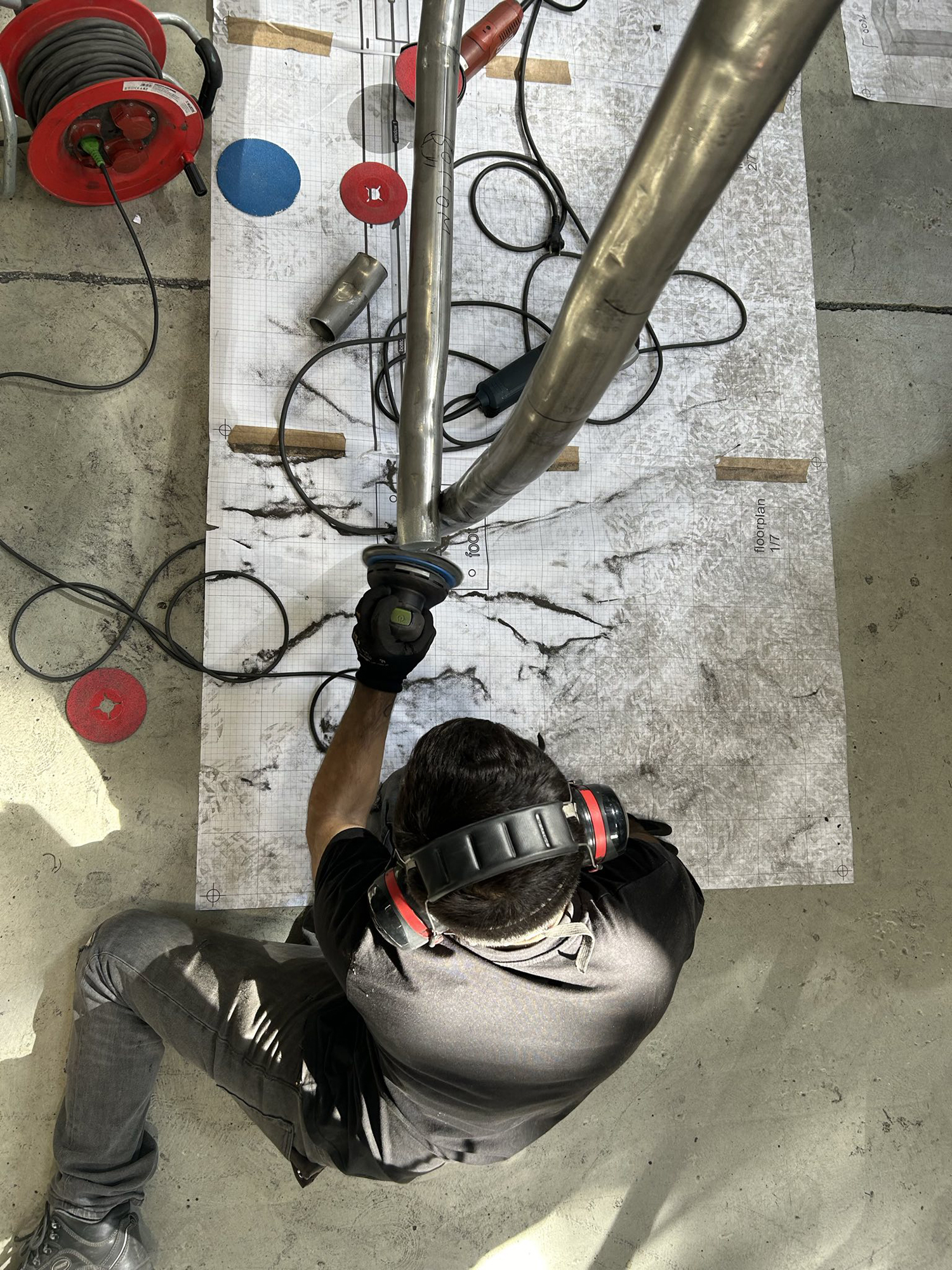
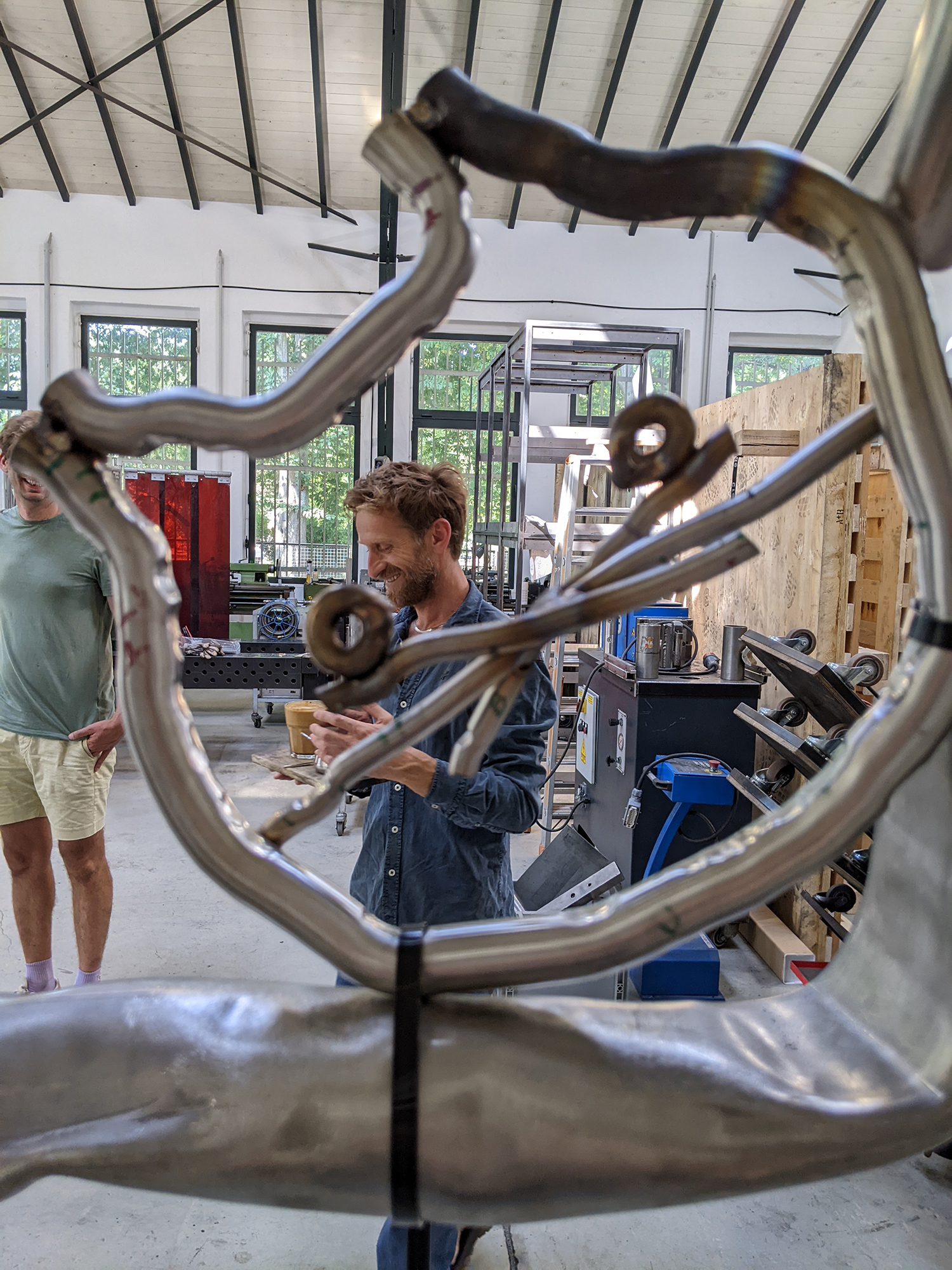
What I find particularly relevant in your work is the choice of an anti-monumental language, especially given that this project was conceived for a public space. You have moved in a direction that, even without stating it explicitly, rejects monumentality not only in terms of its physical weight, but also in what the monument symbolically represents, as a unilateral and often imposing gesture. In your case, you hollow out the sculpture, making it fragile. In some respects, Giulia Cenci also works along similar lines. I am very interested in this tension. It feels like a crystallisation of the ephemeral rather than a monumentalisation of a history that often does not belong to the community it purports to represent. After all, monuments are rarely the result of collective choice…those who commission them are almost never the communities themselves. That is why I wanted to ask what kind of response you have received from those who inhabit the place, whether this was something you reflected on consciously or whether it emerged naturally in the process.
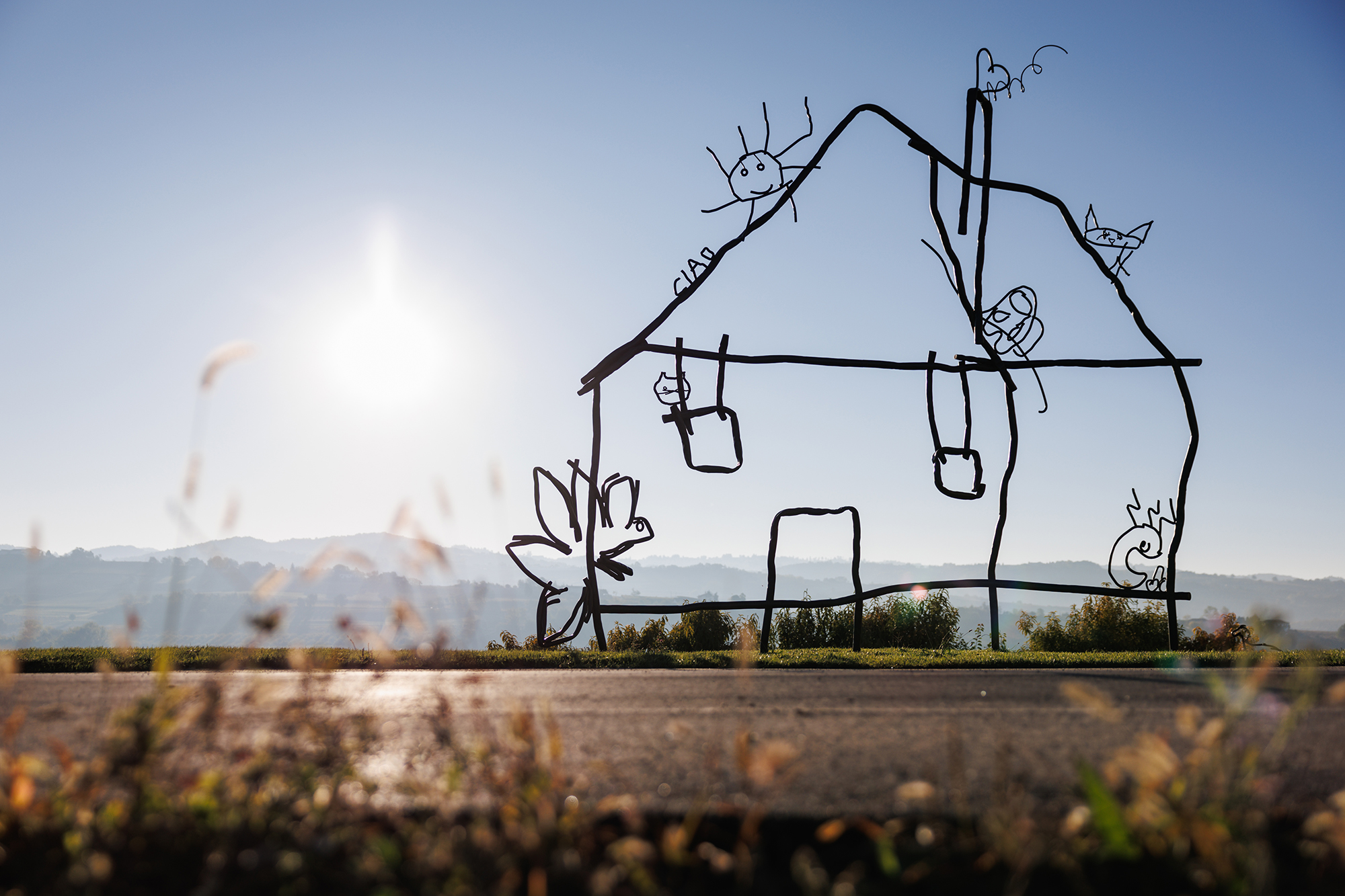
That’s a beautiful question, because it touches on something I’ve been reflecting on for a long time. What does it mean to inhabit public space, to step beyond the four walls of a museum, and how to do so without losing the fragility inherent to drawing? When I first began working outside institutional spaces, many people told me that such a delicate line, once placed outdoors, would simply vanish. Yet that was precisely the challenge. How could I intervene in public space while preserving that fragility and accepting the risk it entails? For me, monumentality is not determined by scale or material, but by how people make the work their own and how they live with it. Ultimately, they are the ones who transform it into a “monument.” This is also the first time I have created a permanent intervention…assuming anything can ever truly be permanent, since even what endures for two centuries will eventually disappear. Marta Papini and I reflected deeply on this. What does it mean to leave a trace that lasts, and how to do so collectively? It gave me great peace to see how the project brought together former pupils and local authorities. Everyone’s involvement made the process feel organic, as though the work had grown by itself. Even in the previous iteration at the Metropolitan Museum, I sought to disperse the narrative to include peripheral voices and hidden spaces. Something similar happens here. Perhaps that is the most honest way to think about public sculpture today…not as a centre, but as a field of possibilities.
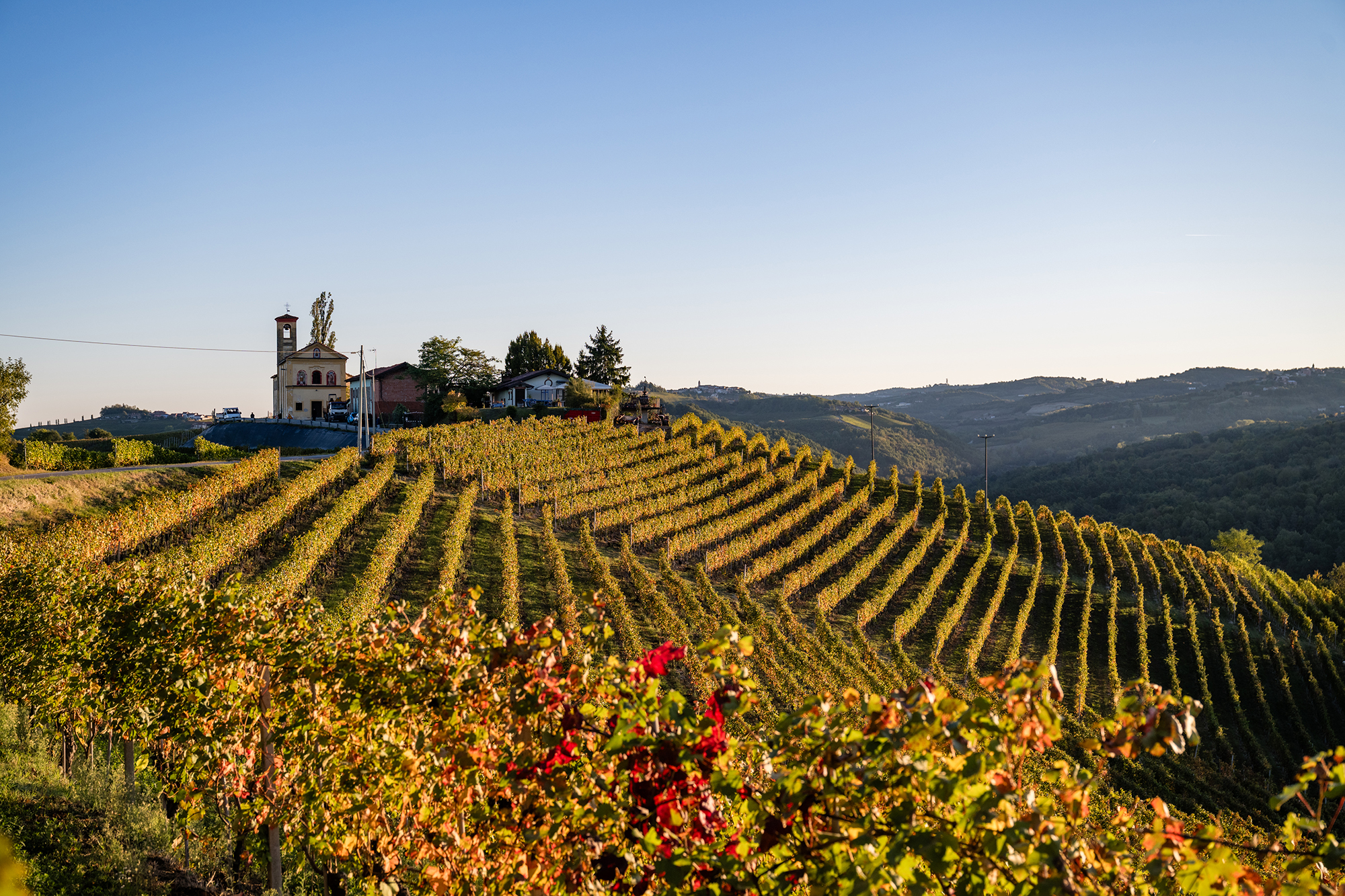
The school in Dogliani where you activated your project, as you mentioned, had been abandoned for years. It lingered as a kind of ghost infrastructure. A space that was no longer inhabited becomes inhabited once more, albeit in a different form. There’s a conceptual paradox at play. When the physical element disappears, the place comes back to life.
I hadn’t thought of it that way but yes, that’s true!
At this point, I’d like to ask what “inhabiting space” means to you. I ask this in light of a contemporary condition in which we are constantly confronted with the question of how we inhabit and possess space. There are those who occupy places that are not “theirs,” and those who have the right to inhabit a place but cannot.
Welcome to my life…and to that of many others.
Exactly. Especially since your personal experience is marked by displacement.
Yes, it has always been that way for me. When the world forces you to leave your home or to lose, violently, your memories and everything that defines the idea of “home,” you are compelled to completely renegotiate that notion. If you are fortunate enough to survive wars, genocides, ethnic cleansings, and oppressions, you come to realise that the world is vast and, in a sense, it becomes your home. Yet an obsession remains. It is an urge to remember that, deep down, you have no home. Even when you do have one, it can turn into a nightmare, or a threshold that pushes you out. When you don’t, you dream of it constantly. It is a perpetual tension between ourselves and the places we inhabit, or those we have lost. And often, there is no choice at all. I think of what is happening today in Palestine, in Ukraine…but also what happened in Kosovo and across the Balkans, or what continues to happen in Italy and Germany with migration.
Yes, and in a different, though not directly comparable way, the Langhe too are marked by dynamics of depopulation and migration. Your project begins precisely there, in a territory that is gradually emptying out, where migration is less visible yet equally bound to external, economic, or social causes. It’s striking how this sense of displacement and loss weaves through both your personal story and the places in which you work.
Yes, it’s a territory that has changed profoundly since the post-war period. Today it is a completely transformed landscape, almost over-cultivated, polished to excess.
Marta Papini and I were just talking about the presence of non-native plant species.
Yes, of course. But you know, the world changes and that’s inevitable. We change too. I think the point is not to resist change, but to accompany it, recognising that it always carries a measure of trauma. For me, working in a place undergoing transformation means asking what it means to be part of a process in which one landscape disappears and another comes into being and what kind of imaginary that passage brings with it. As you said, Abetare (a day at the school) is now inhabited by figures that invite people to pause. It’s a way of reactivating a place through relationship rather than permanence and it feels like a shared transformation in which the community is involved. When there is communication and participation, the trauma of change is lessened. The real shock is waking up one day and no longer recognising a place or not knowing what has vanished or why. There’s a vast difference between forced change such as displacement and change that is chosen and shared. That distinction shapes how we inhabit or feel excluded from a place.
It’s also a question of agency, isn’t it? In a sense, with Abetare (a day at the school) you’ve given agency back to those who lived that story. You haven’t presented yourself as an external author imposing a new narrative, but rather embraced what was already there, as if the sculpture were allowing those who were once there to speak again.
Yes, exactly. That house was drawn by someone from there, not by me. I still have many drawings, some with words, others with small animals, plants, or symbols. They’re incredibly tender figures, almost like characters. When I look at them, I feel the same way I do when observing animals. Even without any scientific knowledge, you can immediately tell whether a bird is frightened or at ease. The same happens with these drawings. Through the line, you can sense the temperament of the kid who made it. It would be wonderful if, at the opening, someone from those former classes came. The school was active until the late 1970s, so it’s possible that some of them are still alive and might recognise themselves in those marks. Ultimately, that’s what matters. You cannot control how people will respond to a work, or how they will feel they belong to a place. But you can be attentive to how you return public space to those who inhabit it.
So, in some way, do you see yourself as a facilitator of the process?
Yes, perhaps. Some of the processes I engage with through art I don’t see as entirely my own. Often, others show more courage than I do. Many times, the work itself has helped me make the transitions necessary to recognise myself, or to construct a new cultural identity. When I arrived in Italy, introducing myself as an artist helped me connect with cultures and people I didn’t yet know. Ultimately, it is always a question of language. The aim is to create connections, not to impose meanings.
When you speak of drawing as language, you mean it as a language without words, which is close to what we discussed with Giulia Cenci, about the capacity of artists to translate oral memory into vision, or even into tangible image. There’s a doubleness in both your practices. On the one hand restitution, on the other projection towards a possible future. Beyond nostalgia, where do you situate yourself within this project? Because it feels as though you are witnessing both an ending and a recommencement. I’d like to understand how you position yourself not only within physical space, geographically and politically, but also in relation to history, or perhaps beyond it, if we wish to move away from a linear understanding of time.
Perhaps right in the midst of that passage. I like being involved in moments of transition. When someone asks me why I keep engaging with Kosovo, I say that not all people experience the same kind of transition. Every place changes, but some moments are more dramatic, more intense. In my country, I lived through the passage from occupation and cultural darkness to a collective sense of freedom. It was a moment of euphoria, but also of disorientation. After so much oppression, you suddenly find yourself free and you begin to ask what that really means. Some find freedom too vast, almost unbearable; others long to return; and others still feel it has not arrived quickly enough. I often find myself in places where I hear extraordinarily powerful stories and emotions, and I feel compelled to bring them to the surface and give them form. In Abetare (a day at the school), in Dogliani, I felt suspended between two times. A passage that will endure and that people will continue to live even after us. I could compare it to the experience of the Kosovo Pavilion at Venice in 2013, the first time the country was represented at the Biennale. There was immense excitement but also the fear of transition, and the awareness that every freedom comes with new responsibility. I’m often drawn to uncertain, non-canonical situations like creating a public sculpture that doesn’t stand in a square or at the heart of a city, but in an in-between place. I like the idea of letting go of the obsession with the centre. There is something liberating in that movement towards the threshold.
It’s as if you were working on an alchemical plane, bringing back to light what had disappeared to set it back in motion. The school in Dogliani, at one point, had been left to the margins, reduced to individual rather than collective memory. Your intervention seems to reactivate it as a space of community. Were there moments when the project felt too emotionally complex to sustain?
Asking oneself whether one is doing the right thing is part of daily life when you’re an artist. I love moments of crisis, because they are the moments when you truly understand where you stand. I’ve been working on Abetare for years, and this project confirmed that some works are meant to happen only once, while others grow with you. Without the experience at the Metropolitan Museum, there would have been no Abetare (a day at the school); and without it, I would never have fully understood the earlier work. From school desks to drawings, from drawings to sculptures, and then back into public space. It is all part of a process of expansion and return. Perhaps that’s also why this project flourished…because it found the right soil.
I’d like to ask you one last question…or perhaps simply leave you with a thought, suspended. We’re having this conversation before the work has been presented to the community. By the time it’s published, everything will already have taken place. It’s as if we were inside a temporal fiction where we’re speaking in the present while projecting ourselves into an already past future. What do you hope will remain of this work? Not in material terms, but in the conversation it might generate with or without you, before or after you.
There are two things for which I feel deeply grateful for this experience. The first is that, through the schools of the Balkans, I was able to reconnect with places and people in Serbia…people whom, as a child, I had been taught to see as enemies, or from whom I had learned to feel fear. Through drawing, however, I rediscovered a connection that history, the media, and even institutional art had never offered. Because when art is mediated or politically censored, very little of it survives. It becomes propaganda. With Abetare (a day at the school), I rediscovered the idea that art, even when small or secret, can embody a form of freedom. And I dedicate that freedom to all the children who have lost their schools, in Kosovo, in Palestine, in every place torn by war. Through drawing, I have restitched a faith in humanity that I had lost. It’s like a line you can’t let go of, because without it, life would make no sense. I believe we must re-stitch that belief every single day, even when it feels impossible. We are living through dark times, when children and civilians are being stripped of their most basic rights. It is a human tragedy. If this house, these marks, could inspire even one person to pause, to remember or to laugh, to reconnect, in short, with life, then that would be enough. There is no need to ask for more.
Radis #03
Petrit Halilaj
in conversation with
Giulia Colletti
Fondazione Arte CRT
in collaboration with the Fondazione CRC