Text by Ben Broome
CURA. 42
We Monsters
Spring Summer 2024
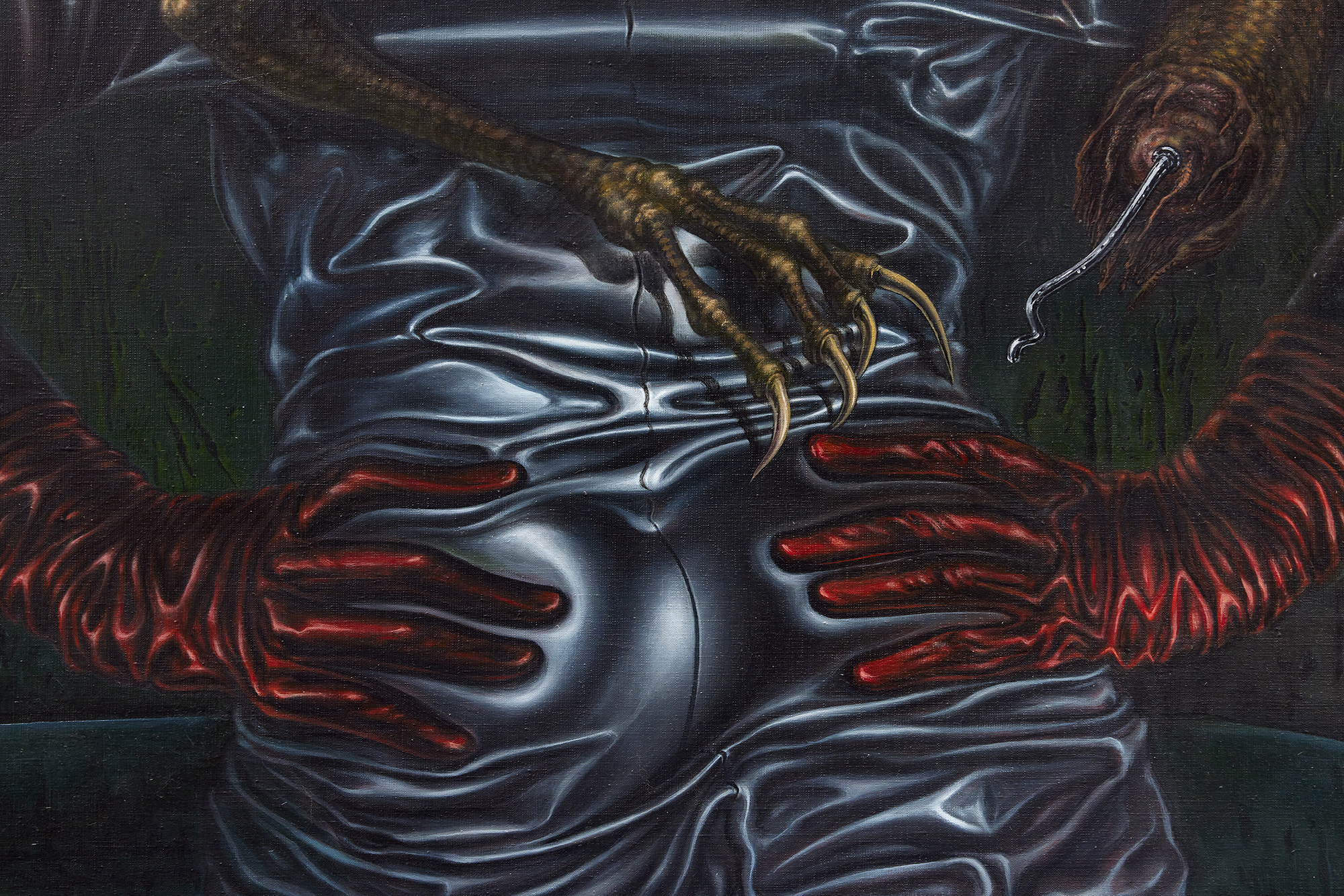
Le Sacrifice, 1980 (detail)
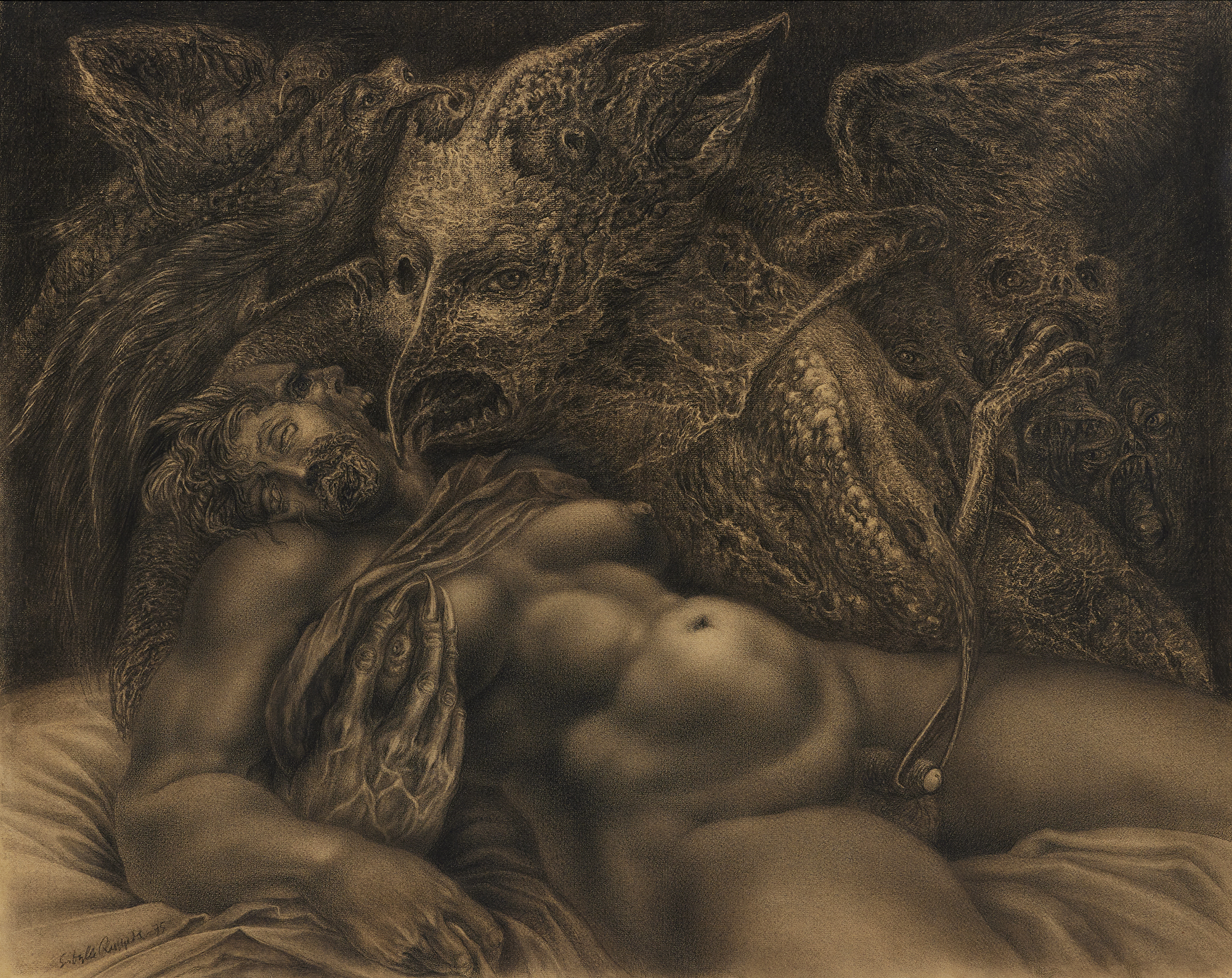
Ma Soeur mon Epouse, 1975
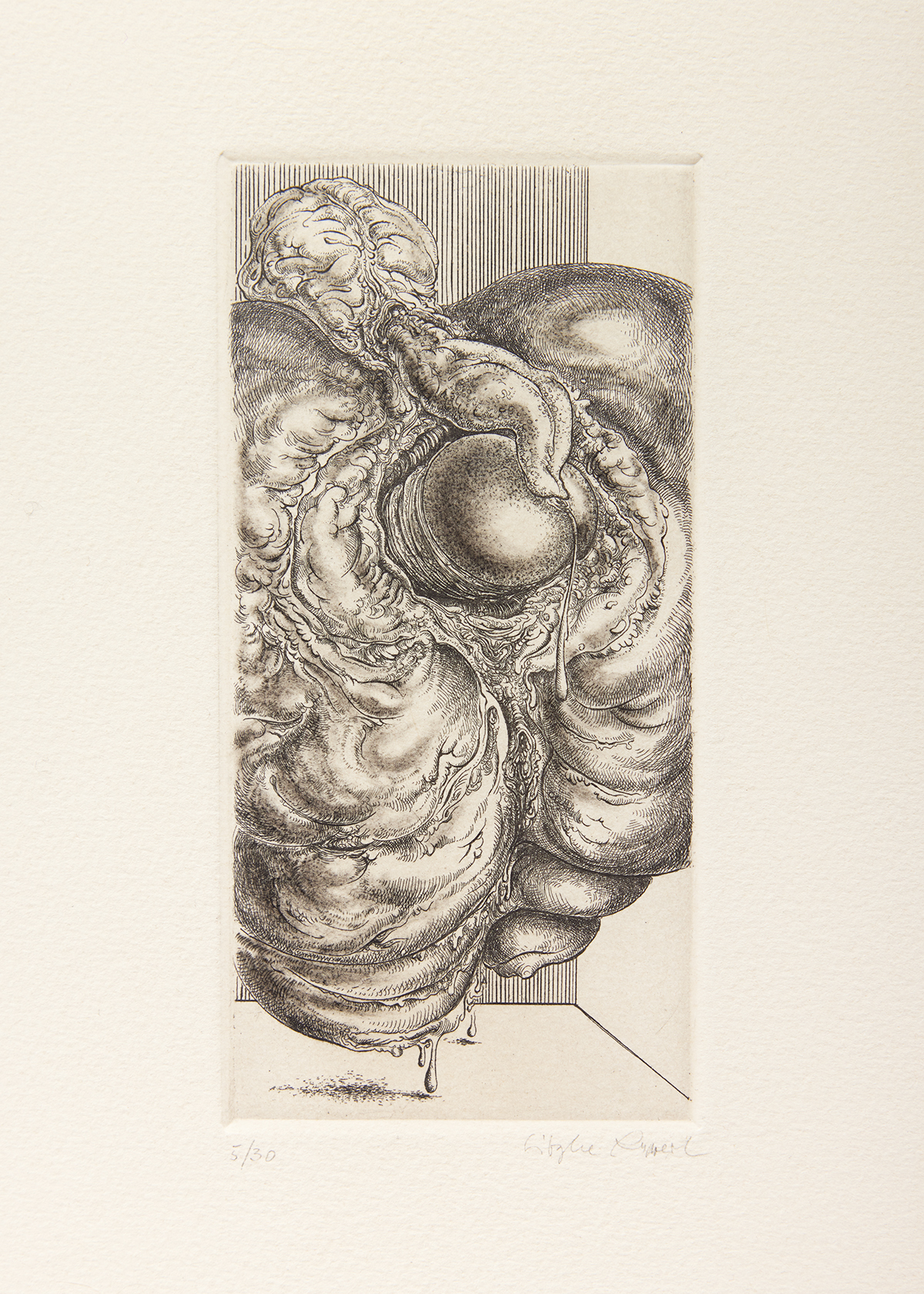
A Sade, 1972

La Fontaine, 1977

Le sign / zeppelin, 1978

Secret Service, 1978

Escargot / Cortège, 1978
THE DARK ART OF SIBYLLE RUPPERT
Flesh reigns supreme in the carnal paintings, drawings and collages for which Sibylle Ruppert has begun to become known. The corporeal mutates into the extraterrestrial and form becomes amorphized: an anatomically perfect human torso might give way to a phallic stump or supernatural orifice. Born in Germany in 1942, Ruppert existed right at the heart of the surrealist Biomechanical movement popularized by H.R. Giger and the cult 1979 film Alien but, where Giger—her close friend and longtime supporter—enjoyed fame and adoration from legions of sci-fi fans, Ruppert faded into obscurity; turning away from exhibiting and from society until her death in 2011.
The single accepted biography of Sibylle Ruppert seemingly originates from a feature about the artist in the July 1985 edition of the erotic magazine Penthouse (French edition) before being translated and reworked ahead of her 2010 exhibition at the H.R. Giger Museum, Gruyères, Switzerland (to date, contemporary biographies have failed to acknowledge this origin). To summarize the chronology:
1942: Sibylle Ruppert was born in Frankfurt in the midst of a bombing raid.
1944: The family flee to the German countryside where they suffer abuse from the farmers who housed them.
1948: Ruppert’s first drawing aged 6: a fist viciously pounding a face.
1952: Ruppert, aged 10, fixates on becoming a nun.
1959: Ruppert takes the entrance examination for the Städel Akademie in secret, passing with flying colors.
1960: Ruppert escapes to Paris and enrolls in a dance school, pursuing her other passion of ballet.
Early 1960s: Ruppert joins the dance troupe of Georges Rech and tours the world.
Mid-Late 1960s: Renouncing dance and rededicating herself to art, Ruppert returns to Frankfurt where she teaches drawing whilst pursuing her personal work.
Early 1970s: The artist begins exhibiting at Sydow-Zirkwitz Gallery in Frankfurt and begins to become known.
1976: Ruppert returns to Paris and begins exhibiting at Gallery Bijan Aalam.
1982: Following the closure of the gallery, Ruppert teaches art in prisons and mental hospitals becoming increasingly withdrawn from society.
2010: An unauthorized retrospective of Ruppert’s work takes place at the H.R. Giger Museum.
2011: Ruppert dies in Paris.
Now subsisting on the antiquated Giger website, this biography paints a perhaps sensationalized picture of Ruppert’s life and work. Whilst we have no reason to doubt the authenticity of the 1985 Penthouse biography (it was, after all, written by Ruppert’s one-time gallerist Bijan Aalam), the intended audience was readers of an ’80s porno mag—a degree of melodrama is to be expected. What Aalam censored in this account of the artist’s life (and later described in unpublished writings) was the abhorrent abuse Ruppert suffered as a child at the hands of her own father, this unthinkable trauma no doubt affecting the character and psyche of the artist.
The Biomechanical aesthetic as an extension of surrealism is rooted in the imagination, a permission granted for the unconscious mind to express. Ruppert’s works are indeed monstrous but where did the imagined monster end and the non-fictional monster begin for the artist? Did her own real life behemoths show up on the canvas? Her monolithic 1975 work La Bible du Mal split across four abrasive panels offers up an ocean of writhing pseudo-human creatures, piercing, clenching, and gasping. Man and beast, victim and victimizer are indistinguishable in this work and, across Ruppert’s oeuvre, they exist entwined as equals. Human anatomy is never depicted without its monstrous counterpart to the point at which it’s conceivable that Ruppert saw no difference between the two. This brutal and venereal draftsmanship found fans amongst the hedonists of Paris and her work quickly became intertwined with the erotic arts scene. This was a reluctant marriage for Ruppert who was forced to reckon with the male gaze of those who collected her work for the sake of her own career. The Giger website’s biography namechecks “notable German and French intellectuals” Peter Gorsen, Theodor Adorno, Alain Robbe-Grillet, Pierre Restany, Henri Michaux as supporters of Ruppert, who were “fascinated by her work and tried to interpret her infernal world.” Ruppert’s largely male contemporaries might have been drawn to depictions of the sordid by their own sexuality and sexual desires but surely their interpretations of Ruppert’s world could only be informed by their own masculinity? For them, erotica was a fantastical curiosity and a subject of desire ultimately rooted in fiction.
A quote from the Penthouse profile reads “Sex is the twin of violence, Sibylle Ruppert declares, and sadomasochism is its most tangible expression.” One can’t talk about the work of Ruppert without acknowledging this tense coupling. Her 1977 exhibition Dessins pour D.A.F de Sade paid homage to the architect of sadism and Ruppert even illustrated a 1980 edition of Marquis de Sade’s Philosophy in the Boudoir in which Sade makes the argument that “true pleasure” cannot be felt without pain. Ruppert’s personal relationship to sex and pleasure should not be presumed but, certainly in the work, she didn’t shy away from depravity as a subject matter: across Ruppert’s output, the erotic walks hand in hand with pain and violence as opposed to passion and sensuality.
Barbara Creed’s studies on gender theory in cinema position the identity of the monster as inseparable from gendered power dynamics, the horror of the monster existing in symbiosis with what is most alien to it: women and death. Creed’s 1993 book The Monstrous-Feminine challenges patriarchal representations of women in horror as only victims, arguing that the genesis of the monster in contemporary culture is the female reproductive body (recalling the iconic chestburster scene in Ridley Scott’s Alien—a monster conceptualized by Giger). Sibylle’s Ruppert’s often androgynous monsters penetrate and are penetrated but their copulation spawns only despairing and tormented creatures. Yes, Ruppert’s monsters concern the reproductive body according to Creed’s hypothesis, but the horror of her work lies in its disregard for the woman’s body: creatures are birthed from torsos, muscle and eyeball sockets; everything is orificial and nothing is sacred.
It’s rare to hear Ruppert’s name without mention of H.R. Giger (and these comparisons are apt given the closeness of their subject matter and their working relationship) but, where Giger imagined new worlds and alternative dimensions, Ruppert’s work contemplates the collapsing of these worlds. Ruppert’s catalog concerns a reckoning for humankind and/or ‘other’ more akin to John Martin’s imposing scenes of the apocalypse or Francisco Goya’s Black Paintings. Her work describes endings—as opposed to the ‘new beginnings’ of her contemporaries—as if she was willing an impending day of judgment. These illustrated reckonings did, at times, escape the imaginary; referencing pop culture and global events: in Le sign / zeppelin (1978) the Hindenburg’s fireball bursts from the chest of a faceless creature spewing fiery debris over bare breasts. Did the artist see these real world catastrophes as harbingers of things to come?
The 1979 Iranian revolution and the overthrowing of Mohammad Reza Pahlavi, the Shah of Iran, meant a loss of income for Aalam, the son of an important Iranian politician. As Ruppert’s gallerist he’d provided her with an apartment and a stipend to afford her the freedom to create but, as money dried up for Bijan, so did it for Sibylle. Following the closure of Aalam’s gallery, Ruppert turned to teaching, spending the next 20 years leading art classes at Paris’ Marmottan hospital and La Santé prison. In the early 2000s, following the passing of her father in 1997 and Ruppert’s retirement, she moved back to Germany to care for her ailing mother. Here she converted her mother’s garden house into a studio and began making work once again: abandoning the anatomical and the monstrous in favor of much more loose, almost abstract, black and white figuration. Aalam’s writings describe how the artist was disappointed by the reactions of H.R. Giger and her former gallerist after showing them photos of the new works over lunch. Ruppert never exhibited again, even refusing to be involved in the 2010 retrospective of her work at the Giger Museum. For her, she said, “it was too late.”
I discovered the work of Sibylle Ruppert through the recent exhibition of her work Frenzy of the Visible at London’s Project Native Informant gallery and my motivation for this writing was rooted in the intention to introduce new audiences to Sibylle Ruppert’s nightmarish brilliance. As I began to better understand the art and the artist through research and conversations with those who knew her, it became clear that Sibylle Ruppert was, over the course of her life, subjected to men and the male gaze: her abusive father, her collectors, the Penthouse biography and even the writers and fellow artists who supported her practice. I questioned my own position: am I only adding to the objectification and all-male reading of Ruppert’s work through my own male gaze? With this in mind, I attempted to only add to the biography of the artist based on the oral histories and unpublished writings of those who knew the artist personally. Much of these writings and personal accounts are unavailable online and don’t presently exist as part of the narrative surrounding Ruppert’s work. It’s important to acknowledge that it wasn’t until recently that Sibylle Ruppert began to re-enter public consciousness and, with so little information readily available, we must leave space for the definition and re-definition of Ruppert’s life and work. The Project Native Informant exhibition contextualized her output alongside the writings of feminist theorist Linda Williams; particularly Williams’ groundbreaking feminist study of the pornographic Hard Core: Power, Pleasure, and the “Frenzy of the Visible”. This is an important work and one hopes that the examination of her oeuvre according to a feminist position can continue as the dark arts of Sibylle Ruppert move increasingly into the spotlight.
THE DARK ART OF SIBYLLE RUPPERT
Tex by Ben Broome
CURA. 42
We Monsters
All images:
Courtesy of the artist, Blue Velvet, Zurich and Project Native Informant, London
German Swiss artist SIBYLLE RUPPERT (1942–2011) created a radical oeuvre of paintings, drawings and collages throughout the ’60s, ’70s and ’80s in a brutal aesthetic between dark surrealism, eroticism and an intimate but fierce processing of her own private traumas. Her large format charcoal drawings and etchings are all characterized by an extremely detailed and elaborate depiction, inspired by the morbid and obscene writings of Marquis de Sade, Lautréamont and Georges Bataille, as well as the artistic work of Henry Fuseli, Hans Bellmer, William Blake and Francis Bacon.
BEN BROOME is a curator, writer and artist based in London.