Text by Camille Bacon
CURA.45
The Blackout Issue
The New Now
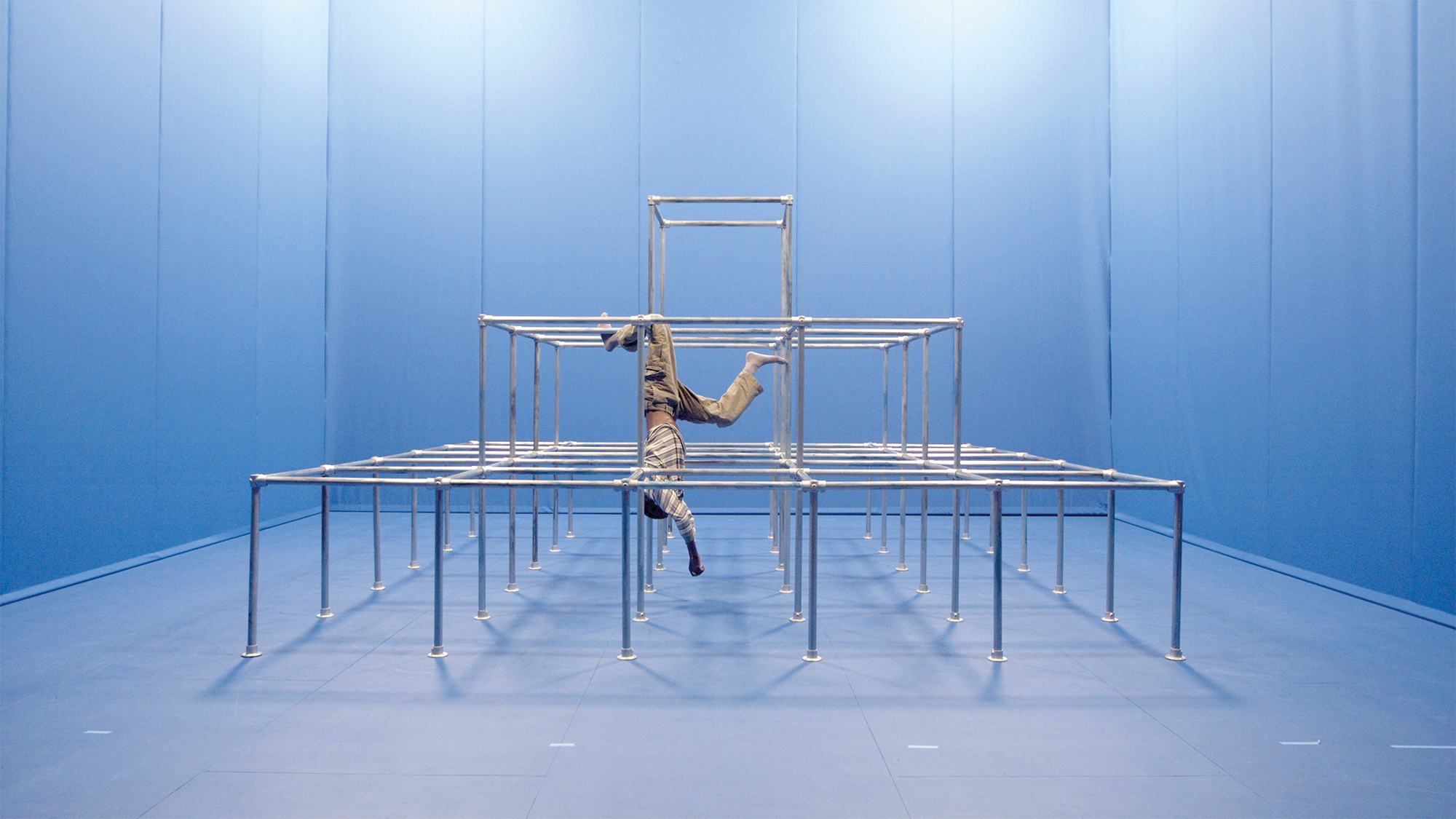
Research still, video work-in-progress, 2025 © the artist
A glistening stone is flung into a body of sky, piercing its glassy visage. As it begins to sink, the sky rearranges itself around the rock’s touch, just as water would: like all encounters, this one yields ripples, a wobbling circumference. Just as the rock hits the sky’s ground, another begins its parabola towards the surface conjuring a ceaseless motility in which there is no bottom. Just circles and circles and circles.
That’s how it feels to listen to Steffani Jemison speak about her work. No bottom. Just circles and circles and circles.
Imagining each artwork as a “rehearsal” for the next, she continues to transform not necessarily what she asks but how she asks it, lending her practice a decisive conceptual consistency. As the questions that pervade her work echo, her method of making never tires of chasing its own tail and each subsequent offering contains trace elements of those preceding it, while simultaneously spinning out in unforeseen directions. No bottom / just circles, circles, circles.
On the occasion of her solo exhibition clear skies / troubled water at Lafayette Anticipations in Paris, she returns to the faithful companions that are her threads of inquiry by way of two modular sculptures modelled after New York’s early 20th-century jungle gyms, which also serve as supports for a film and several drawings, a lenticular photograph, two silvered glass triptychs installed atop an archival theatrical backdrop, and a weather vane (which holds the eye of this essay’s attention), which Steffani thinks of as a “self-portrait.”
Like a conventional weather vane, this one includes cardinal directions and depends on velocitous air to spin in its characteristic circle. Uncannily, it also assumes an anthropomorphic quality: the appendage used to denote the wind’s direction is modelled after Steffani’s arm, while its other limb takes the form of a feather. Together, they create a horizon that rotates around a central axis, which is scaled to the artist’s height and holds the whole sculpture together, atop which is a silhouetted form of the artist’s own head. Imagined as a “site-responsive work,” the weather vane is perched on a bed of minerals that nod to the composition of the Paris meteorite, and is animated by meteorological data.
Amongst the fascinations Steffani’s practice orbits around are the myth of Icarus as an allegory for the conditions that incite a body into flight (conventionally read as a warning, don’t fly too close to the sun, she draws attention to the fact that Icarus’ wings were built to transcend the tower in which he and his father, Daedalus, were imprisoned – we might interpret the feathered arm in the weather vane as a call back to this fable) / the architectural qualities and capacities of the corpus (the ballad Bridge Over Troubled Water and the aforementioned modular structures are, respectively, recurring sonic and sculptural motifs through which she considers what it takes to “be a bridge” for another and “what it means to allow yourself to be of service, to allow yourself to be an instrument…”) / the contagious qualities of ideas (as she articulated in her talk at the Experimental Media and Performing Arts Center and again at the Art Institute of Chicago: “How are ideas contagious? How are we infected by one another? Are we spongier, more porous than we think? What do we really know of one another… and how do we know it? How much—or how little—does understanding have to do with cognition, with thinking?… What can we learn through contact with other people or other beings? Do we know anything ‘on our own’?”) / and the entanglement between sedition and the stars (she will not let us forget, for instance, that Nat Turner’s revolt was ignited by a series of eclipses).

Bound, installation views, Greene Naftali, New York, 2024 Photo: Zeshan Ahmed
Courtesy: the artist and Greene Naftali, New York

Bound, installation views, Greene Naftali, New York, 2024 Photo: Zeshan Ahmed
Courtesy: the artist and Greene Naftali, New York

Matrix 196, installation view, Wadsworth Atheneum Museum of Art, Hartford, CT, Photo: Jessica Smolinski
Courtesy: the artist and Wadsworth Atheneum
In clear skies / troubled water, Steffani harkens back to her observation that there’s a connection between the celestial climate, specifically eclipses, and political transfigurations that alter our social relations, judicial structures, and rubrics of morality. “Every eclipse becomes a potential signal for revolution,” she muses. When the eclipse arrived in Virginia on February 12, 1831, Turner imagined the slick penumbra cast over the sun was a Black man’s hand reaching over it. “And on the appearance of the sign (the eclipse of the sun last February) I should arise and prepare myself, and slay my enemies with their own weapons,” he explained.
The sky is, right now as I write this, not at all clear but, rather, doing that thing again where the sun, earth, and moon collude to catalyze a cosmic blackout. With each eclipse, our solar system’s light source momentarily flickers. The whole sky blinks, stutters, gasps. Long heralded as harbingers of entropy, Steffani posits that there exist “moments when an eclipse served as a historical turning point much grander than what we might have intended.” These celestial enigmas become signals for and archives of cataclysmic transformation, and perhaps the same can be said of meteorological conditions down here on earth, namely the wind. If “all water has a perfect memory,” the wind is too a vehicle against amnesia. It carries heat, sound, and debris (read: history, information) through its flamboyant dance; an emotional element, the wind never forgets either.
Unlike most weather vanes, which react to the wind as it blows in real time, Steffani’s is propelled by the past. More specifically, she has culled records of the wind’s force and direction from the summer of 1967, throughout which over 150 revolts erupted across the United States; revolts whose arrows were aimed, like Turner’s, at triggering a power outage (or blackout, or eclipse, if you will) across the permutation of this world premised on a calculus rigged against Black life. Typically, a weather vane is installed to determine the wind’s direction, which can predict the meteorological conditions on a given day: a Southern rush of air brings with it an all-encompassing chill, while a Northwestern breeze carries the sun on its back. In this sense, weather vanes foresee our atmosphere and anticipate the shape of the future. By deploying archival data, Steffani’s sculpture probes at how we may strategically orient our political ambitions in relation to the howling gust of the past.
As articulated by Frantz Fanon’s notion of “combat breathing,” we breathe differently under duress. Thus, I imagine the data fed into the weather vane indexes not only the literal wind but also the force of exhalation embedded in the songs, chants, and screams exclaimed by both protestors and their antagonists, in turn serving as an archive of the totality of conditions of Summer ‘67. Because she frames the weather vane as a “self-portrait” and puts her own body’s dimensions to work as a proxy, Steffani also demonstrates a sensitivity to the weather —as in the wind, but also the total “social climate”—of those aforementioned revolutions. By engineering a circumstance in which a sculpture that is a simulacra of her own flesh can be infected and literally moved by the wind (and the affective histories lodged in the data that calls the weather vane to revolve), she creates a physical emblem of our a-temporal porousness to periods that have preceded our own.
Revolutions, like Steffani’s practice, have a habit of repeating themselves and revolutions, like eclipses, are often remembered as singular inflection points, “a process that’s over almost as soon as it begins,” she says. Conversely, both eclipses and revolutions unfurl across a vast scale of time that cannot be reduced to the climax when planets fall into one another’s shadows or when the first shot is fired. To this end, Steffani harmonizes with the contributions of writers and artists like Audre Lorde, who noted that “revolution is not a one-time event.” The cyclicality of our social and political metamorphoses was evoked too by Toni Cade Bambara’s iconic text The Salt Eaters, and later by Lizzie Borden’s film Born in Flames, both of which feature protagonists who grapple with the failed promises of the movements they are the heiresses of and, more precisely, rail against the residue of misogyny that stubbornly remained at the close of the respective rebellions they inherited. Steffani’s contribution to this chorus extends the terrain to consider that revolution does not usher in utopia but, rather, sets off a chain reaction of critique that provokes yet another transformation.
By positioning revolution as an unfinished project in eternal orbit, Steffani’s sculpture lives as an injunction to revise our methods for movement building such that they rhyme with the planet’s circuits, with the wind itself, and strive to be in constant motion, too. Like the artist’s own mind, like the weather vane’s choreography of a continuous circumference of possibility, like revolution’s perpetual unfolding, clear skies / troubled water points towards an insurgency with no bottom. Just circles, and circles, and circles.

In Succession (Means), 2024, Centre d’Art Contemporain Genève, 2024 Photo: Zoé Aubry
Courtesy: the artist
Steffani Jemison
Text by Camille Bacon
CURA. 45
The Blackuout Issue
All images:
Courtesy: the artist
STEFFANI JEMISON (b. 1981, Berkeley, CA, USA) is an interdisciplinary artist and writer based in Brooklyn. Jemison has presented solo exhibitions and commissioned performances at: JOAN Los Angeles, Greene Naftali, Mass MoCA, Jeu de Paume, CAPC Bordeaux, the Museum of Modern Art, LAXART, and other venues. Her work has been included in significant generational exhibitions, including Greater New York 2021 and the Whitney Biennial 2019, and is part of many public collections, including the Hirschhorn Museum and Sculpture Garden, the Museum of Modern Art, the Guggenheim Museum, the Whitney Museum, and the Art Institute of Chicago. She is an Associate Professor at Rutgers University Mason Gross School of the Arts.
CAMILLE BACON is a Chicago-based writer who is building a “sweet black writing life” as inspired by the words of poet Nikky Finney and the infinite wisdom of the Black feminist tradition more broadly. She is the co-founder and editor in chief of Jupiter Magazine and manages McArthur Binion’s studio in Chicago. Camille’s work has appeared in i-D Magazine, frieze, Cultured Magazine, Studio Magazine, Momus and Burnaway, among other outlets, and she formerly held positions at GRAY Gallery, Chicago, and The Studio Museum in Harlem, New York.


