Curated by Ben Broome
FRIEZE, No.9 Cork Street


Stéphanie Brossard
Notre Dame Des Laves
28 July – 12 August
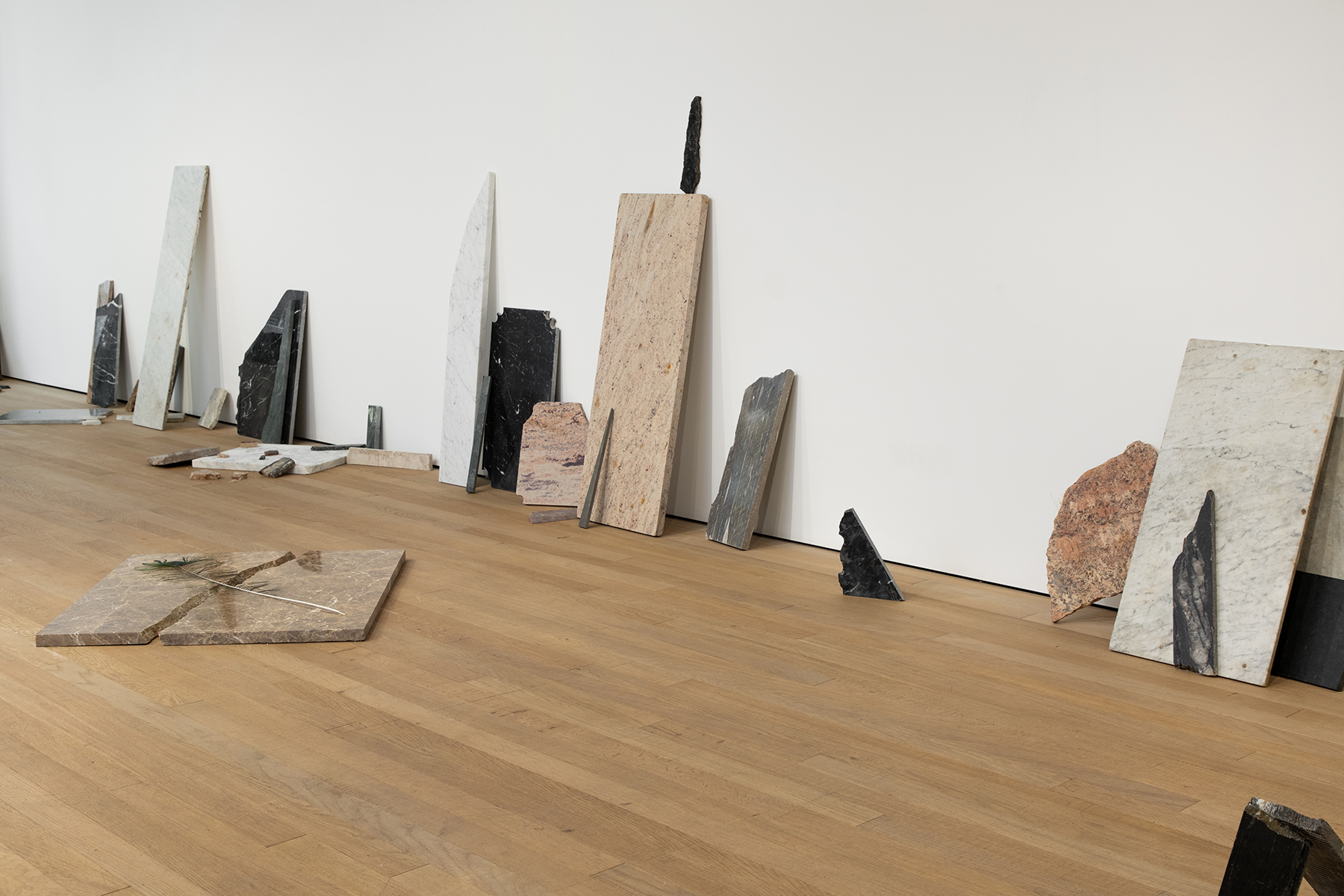
Notre Dame Des Laves exhibits the work of Stéphanie Brossard tor the first time in the UK at Frieze, No.9 Cork Street. Curated by Ben Broome, two large tormat installations are exhibited, both concerning the anthropology and ecology of the artist’s home, La Réunion. Glissement de terrain and Rendez-vous are intormed by the omnipresence of disaster tor residents of La Réunion with the threat of hurricanes and volcanic eruptions punctuating daily lite. Through these works, Brossard addresses the violence of displacement and upheaval that arises when the natural world collides with the socio-economie conditions of the French colony.
The exhibition’s title Notre Dame Des Laves (translated literally as “Our Lady of the Lava”) pays homage to a church of the same name which, in 1977, was miraculously spared when the lava flow from the eruption of Piton de la Fournaise split to flow around the church. Brossard is interested in the mutations the church experienced in the wake of this mystical event – the physical mutation of the landscape vs the cultura! mutation. The church, no longer functional as a piace of christian worship, evolved into a democratised meeting piace tor Réunionese people of any faith.
When the exhibition opens the steel tabletop of Glissement de Terrain is piled high with sand. Connected via the internet to a database of global tectonic activity, motors shake the table when an earthquake is registered in real time. Upon closing this sand will cover the floor. We the viewer, wrapped up in the cotton wool of the gallery space, are confronted by the realities presented by Glissement de Terrain: the ubiquity of uncertainty tor those in the global South vs the relative safety and security of the West.
Far Rendez-vous, discarded shards of mismatched marble populate the floors of the gallery. Marble as a natural resource isn’t present on La Réunion so its existence on the island is purely synthetic: a manifestation of human occupancy. With each marble type quarried in a different locality, their existence together, their Rendez-vous, is a natural impossibility. Collectively the marble fragments convey displacement.
Brossard herself knows what it is to be displaced. France is heralded as a land of promise amongst the Réunionese but, upon arriving in France, Brossard was met with the realities of assimilation. Now considering this eurocentric rhetoric to be insidious, the physical weight of the work (aver one tonne) helps Brossard speak about her own experience. The challenge of moving and installing her work symbolising the weight of her own displacement and the mutations she endured as a result.
The works presented in Notre Dame Des Laves function as a counterpoint: minimal and slick in aesthetic but abrasive in subject matter. Brossard encourages the viewer to reckon with the fragility of humanity and our relationship with nature from our position of relative privilege; empathising with what it means to be displaced or live in uncertainty.
Jesús Hilario-Reyes
Waywardly In Low Tide
28 July – 12 August
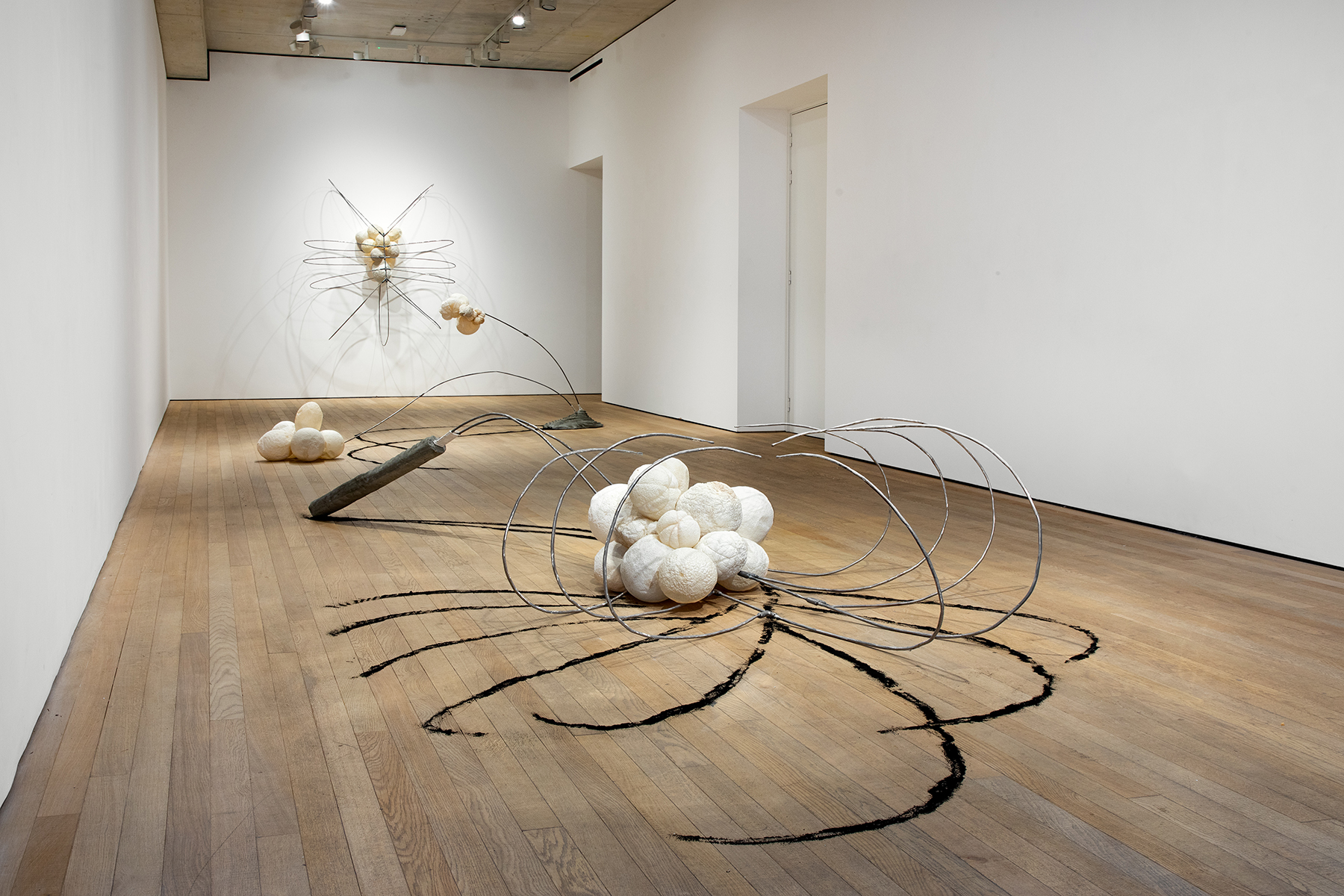
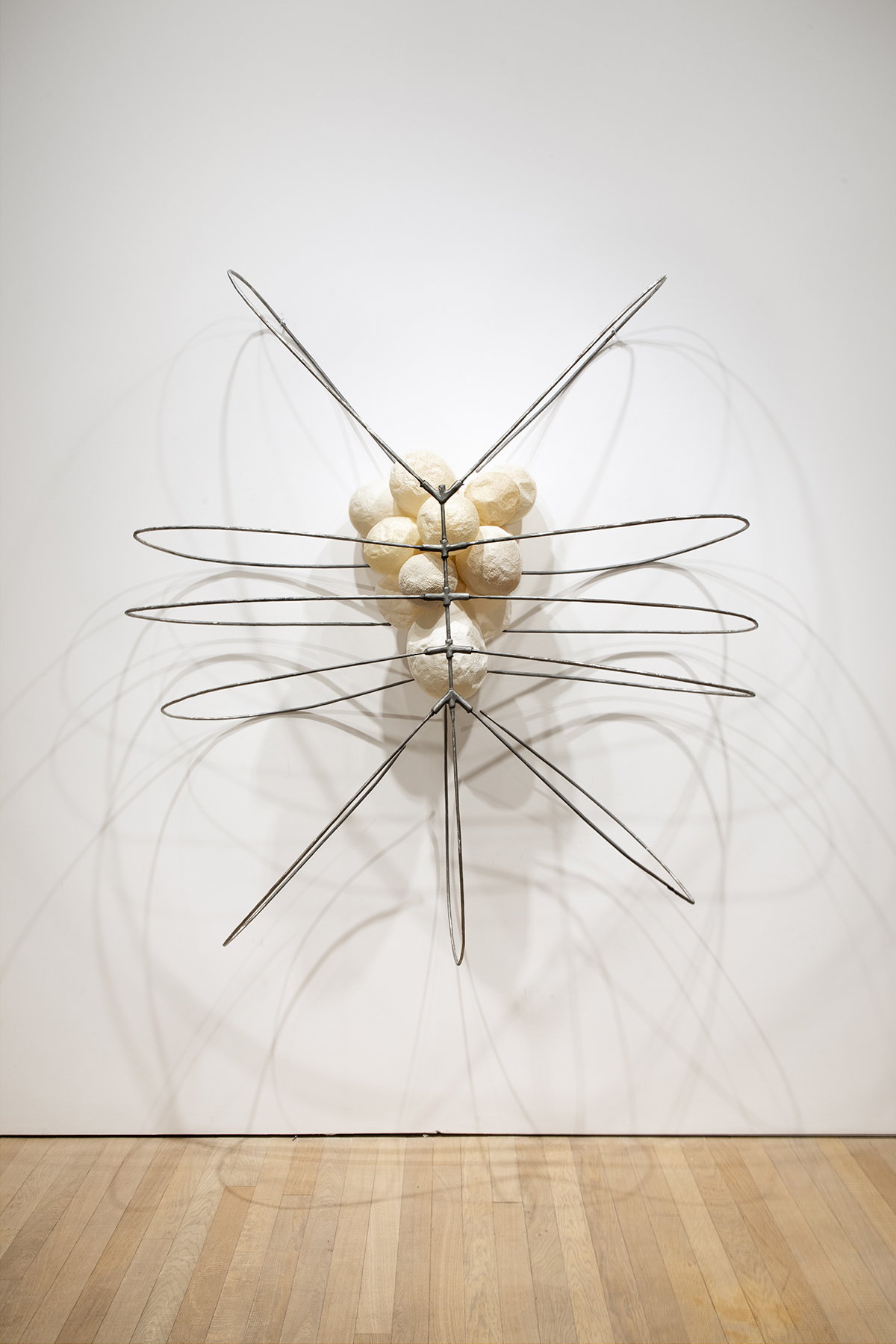
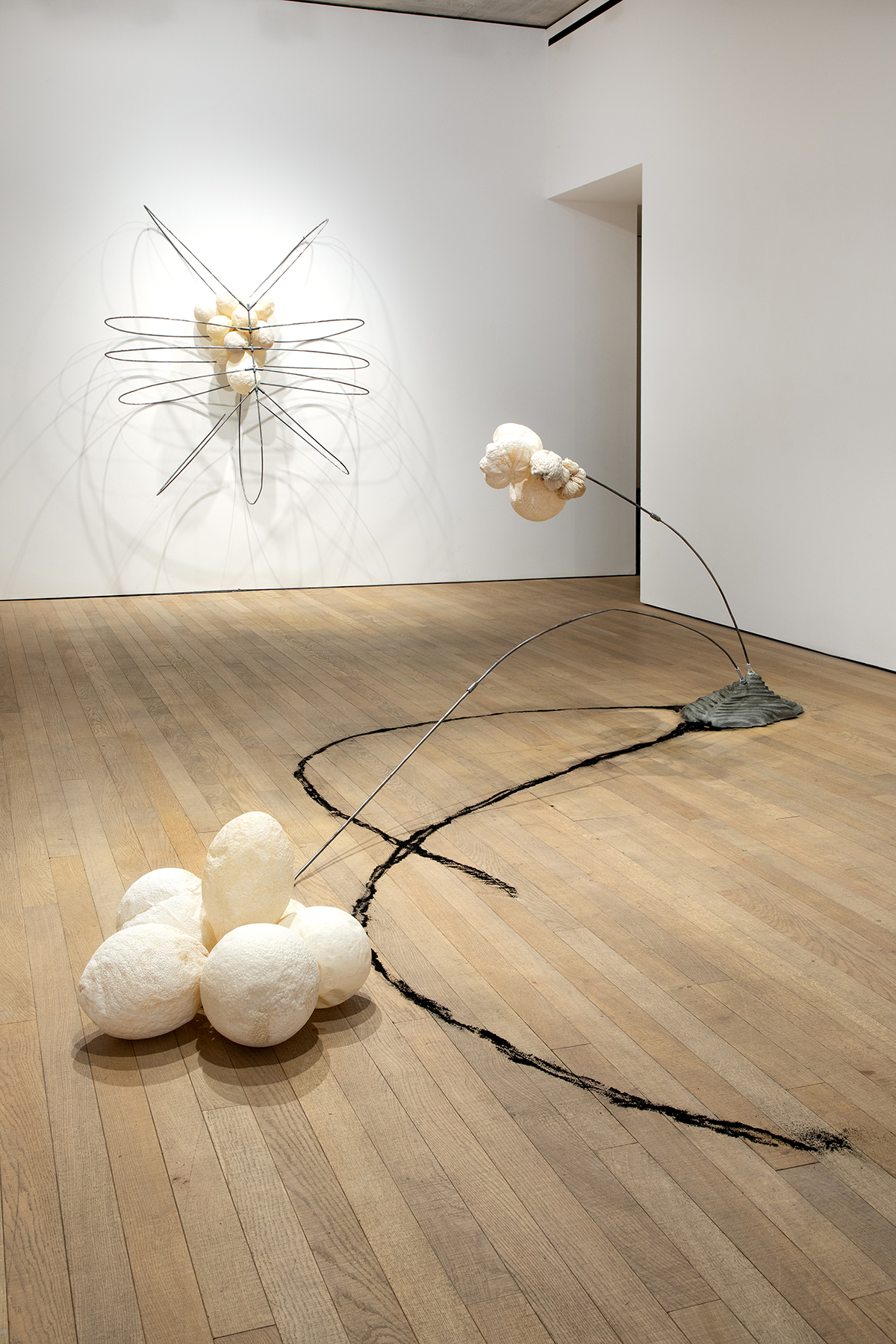
Presented at Frieze, No.9 Cork Street and curated by Ben Broome, Warwardly In Low Tide exhibits a series of sculptural works by Puerto-Rican and Dominican artist Jesús Hilario-Reyes. Utilising sound installation, cement, metal, salt, and dehydrated hog bladders, this new body of work pulls from the artist’s ongoing exploration of fugitivity through the modes of queer nightlife, the carnival, and destierro (an untranslatable Spanish term akin to “being torn from the land”).
Warwardly In Low Tide employs motifs of the mangrove, the hurricane, and the carnival towards notions of both black and queer fugitivity. In this body of work, Hilario-Reyes argues that the fugitive, and by extension the migrant condition, must be mobile and fluid; embodying many spaces in order to persist.
Organic in appearance, the metal elements of the sculptures pull their form from the mangrove forests of Puerto Rico, where networked roots protect the archipelago from the effects of annual hurricanes. The artist identifies an entanglement between the mangrove tree and the fugitive condition, with adaptability and transformative capacity integral to the survival of both mangrove and migrant. As Alexandra T. Vazquez writes in her 2014 essay for the American Quarterly Learning to Live in Miami:
By ‘mangrove aesthetics’ I mean to contribute to a Caribbean actuality and poetic and conjure a creative ecosystem that holds land together. […] And even though mangroves filter the flotsam of the continents, they must thrive in spite of their littering. No matter what is done to them, they still grow up and out into mineral-rich, mangled structures that carry the smells and sounds of antiquity and futurity.
The hurricane – a blurred centrifuge revolving around a still nucleus – is a common motif in Hilario-Reyes’ work and research. Its erosive power is reflected in the weathering of these sculptures by the artist’s hand, the scraped metal considered as adornment, or “the process of making different.” Bouquets of inflated hog-bladders, traditionally used as percussive instruments to ward off evil spirits, furnish the metal rods. They also appear at carnivals across the Caribbean, where they become harmless batons with which to hit fellow carnival goers. Engaging the apotropaic and playful potentiality of the bladders and the opposing spaces in which they’re used, Hilario-Reyes has embossed them with hosiery, fishnets and fetish wear: a further adornment which pays homage to the transient nature of queer nightlife.
The sonic installation accompanying Waywardly in Low Tide solidifies the link to the club space, the fugitive, and the spiritual. Composed by Yesenia Rojas, the soundtrack incorporates the hog-bladders as instruments, the cry of an Osprey (which signals a hurricane’s approach) and the 1992 club classic ‘Give Your Body’ by Random XS in which the repeating lyric “give your body” – both devotional and instructional in nature –conjures the corporeal submission synonymous with the queer club space and the condition of migrant fugitivity.
In Waywardly in Low Tide, Hilario-Reyes constructs a shrine to the fugitive, the migrant, and the raver –acknowledging the common transience of each of these positions and attempting to find “sovereignty for the drifting body.”