Rachel Whiteread, Vivian Suter, The Impermanent Collection #4
GAMeC, Bergamo
Press release

Rachel Whiteread, …And the Animals Were Sold.
Installation view at GAMeC / Palazzo della Ragione, Bergamo, 2023.

Rachel Whiteread, …And the Animals Were Sold.
Installation view at GAMeC / Palazzo della Ragione, Bergamo, 2023.

Rachel Whiteread, …And the Animals Were Sold.
Installation view at GAMeC / Palazzo della Ragione, Bergamo, 2023.
RACHEL WHITEREAD
…And the Animals Were Sold
For the sixth consecutive year, GAMeC – Galleria d’Arte Moderna e Contemporanea di Bergamo returns to occupy the prestigious Palazzo della Ragione venue, in the beating heart of the historic city center, with a new exhibition featuring the internationally renowned British artist Rachel Whiteread, who in the year of Bergamo Brescia Italian Capital of Culture will present a brand new installation conceived in relation to the city of Bergamo and in conversation with the architecture and history of Palazzo della Ragione itself.
Ever fascinated by those spaces that form part of our daily lives yet which are so often overlooked, for the Sala delle Capriate Rachel Whiteread proposes an environmental installation made up of sixty chairs, constituting the materialization of the empty space lying between the legs of two different models of chairs.
The sculptures are produced using various types of stone found in the building materials of both Palazzo della Ragione and Piazza Vecchia, such as the Sarnico stone in the façade of the Palazzo della Ragione and the Zandobbio marble in the Contarini Fountain, which are still extracted from quarries near Bergamo. In this way, the artist aims to establish a close relationship with the territory and its history, as well as with the architecture of the venue hosting the exhibition itself.
The title of the installation is evocative both of the pandemic—the words “And the Animals Were Sold” bring to mind the image of Asian markets where animals of all sorts are traded and which many scholars claim to be at the origin of the coronavirus mutation—and of any passing conversation of which one might almost inadvertently catch a few words.
Indeed, the exhibition constitutes Whiteread’s first opportunity to express herself artistically about the dramatic and alienating experience of the pandemic. For the artist, Bergamo marks one of the first experiences of a return to pre-pandemic life, when travel was an absolutely normal condition. And the experience had by the artist on her first visit to the city struck her to the point that she began to think of her intervention as one related to the tragic events of the initially uncontrolled spread of the pandemic in the Bergamo area.
The sixty sculptures that make up the installation thus evoke the presence and at the same time the absence of as many people. As in many of her works, in fact, the emptiness that is filled in these sculptures “is there in place of something else”: in this specific case, of a person or a multitude of people. The arrangement devised by the artist refers to the requirement of social distancing, where the chairs are placed in a grid two meters apart, emphasizing the silent dimension of the void: while accessible, it is still disorienting in its almost deafening presence. The layout, on the other hand, refers to people in conversation when the chairs are placed more freely, forming small groups, alluding to their newfound proximity.
Starting from these considerations, Rachel Whiteread came up with an installation also designed to shed light on the history of Palazzo della Ragione, which once constituted the place where representatives of the municipality would meet to discuss, debate, and legislate. But also on the present, given that the Sala delle Capriate overlooks the famous Piazza Vecchia, which, particularly in the summertime, becomes a gathering place and meeting point for both city residents and tourists alike.
The sixty chairs ultimately constitute an invitation to visitors to pause and bring to life the Sala, experiencing it as a place of exchange and relationship, of closeness and sharing.

Rachel Whiteread, …And the Animals Were Sold.
Installation view at GAMeC / Palazzo della Ragione, Bergamo, 2023.

Rachel Whiteread, …And the Animals Were Sold.
Installation view at GAMeC / Palazzo della Ragione, Bergamo, 2023.

Vivian Suter, Home.
Installation view at GAMeC Bergamo, 2023.
VIVIAN SUTER
Home
Home is the title of the first solo exhibition in an Italian museum by Vivian Suter (Buenos Aires, 1949), curated by Lorenzo Giusti. Part of the program of events of Bergamo Brescia Italian Capital of Culture, the exhibition brings together nearly 200 canvases produced by the artist throughout various stages of her career.
The daughter of Austrian-born artist Elisabeth Wild (1922–2020) and a Swiss industrialist who emigrated to Argentina, Vivian Suter lived at great length on the margins of the art system until, in more recent times, her work was rediscovered, to the point of establishing itself as one of the most significant and original contributions to the history of painting in the last four decades.
After training at the Basel Academy of Fine Arts, and going on to travel extensively throughout the Global South, Suter settled in Guatemala in the early ‘80s, on the shores of Lake Atitlán. Since then, her work has developed through an increasingly close exchange with the elements of the extraordinary natural and anthropological context in which her home-studio in Panajachel fits, amid indigenous communities, rainforests and volcanic peaks.
Open to the infinite possibilities of chance, Vivian Suter’s canvases—soiled by wind, rain, mud or the small organisms of the forest—tell of the intimate bond that couples them with the life forces of the environment from which they spring. Nature intervenes as a co-author in her works, which come across as a spontaneous grafting of shapes and colors that recall the forest’s tangle of lights, as well as the glimpses of landscape framed by the windows of her home, in a continuous cross-reference between inside and outside.
The exhibition at GAMeC restores the visual dimension of this extraordinary union, the density of the integrated system of plants, people, animals, and relationships that underlies Suter’s work. A dimension in which art and nature are seamlessly blended into one another.
At the center of the exhibition space, a wooden structure evokes this domestic dimension, while the canvases hanging on it, along with those distributed along the walls of the large room that houses them—painted in the same purple-red and aquamarine green colors as the artist’s own home—simulate the intertwining of forms, lights, and colors so characteristic of the environment in which the works originate and are transformed.
Closely bound up in one another, Vivian Suter’s canvases constitute an ecosystem evocative of climatic, sensory, and emotional experiences. Distributed freely throughout the space, the works selected for the Bergamo exhibition account for the diverse pictorial motifs developed by the artist over the past few years. What appear to us as abstract forms or colorful graphic signs are concrete elements of her everyday life for Vivian Suter. They are logs, branches, leaves, and stones from her own garden, or open views of the landscape around her home in Panajachel.

Vivian Suter, Home.
Installation view at GAMeC Bergamo, 2023.

Vivian Suter, Home.
Installation view at GAMeC Bergamo, 2023.
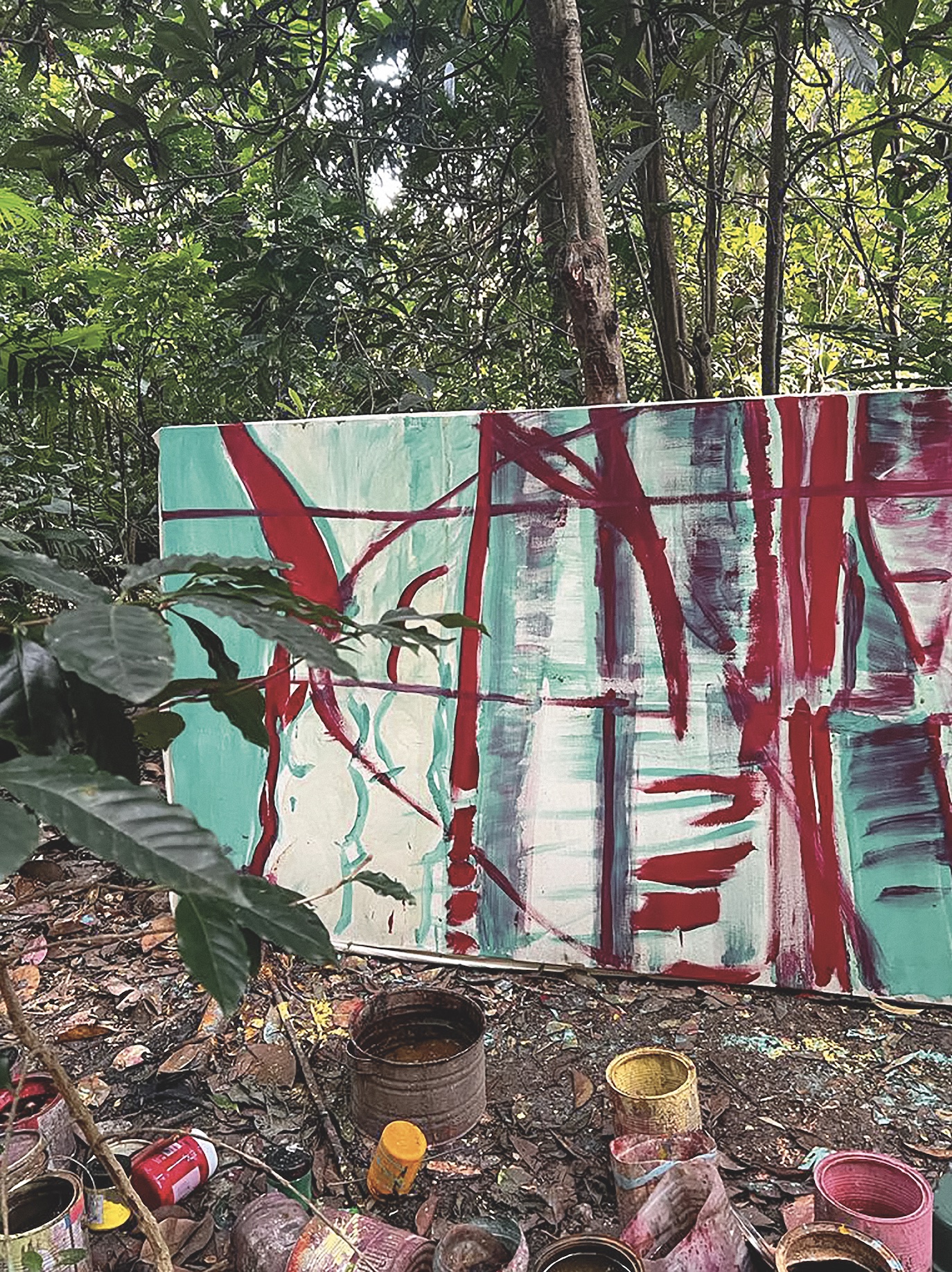
A canvas by Vivian Suter in her home in Panajachel, Guatemala.
Courtesy the artist.

A canvas by Vivian Suter in her home in Panajachel, Guatemala.
Courtesy the artist.
THE IMPERMANENT COLLECTION #4
Curated by Sara Fumagalli, Valentina Gervasoni, A. Fabrizia Previtali
The Impermanent Collection (La Collezione Impermanente) is a research, exhibition, and workshop platform that since 2018 has highlighted the hybrid nature of the GAMeC Collection, reflecting on its dynamic and at times contradictory character. After the first installment of the project—which traced the history of the Museum’s Collection—and the second—which placed the Collection in dialogue with a nucleus of works confiscated in Lombardy and destined for the Gallery—the third exhibition of the cycle was conceived as an active display to coincide with the celebrations dedicated to GAMeC’s thirtieth anniversary, and presented the public with a rich selection of works from the museum’s storerooms produced by artists of various generations, from the 1990s right up to the present day.
In 2022, The Impermanent Collection #3.0 triggered a reflection on the role of the visitor and his or her relationship with the museum, starting from a number of questions: what kind of dialogue with the public does the museum wish to establish around the collections, viewed as a shared heritage? What experience of it should be offered and with what purpose? What role should be attributed to visitors in the presentation and construction of the museum collection?
The exhibition aimed to emphasize the dialogue with visitors, who were called upon to play an active role through the declaration of their preferences in relation to the works on show: which work they would have liked to see again in a subsequent display, and why. The materials collected were subjected to careful analysis by the museum, and on the occasion of The Impermanent Collection #4, a new display will be presented on the basis of this fruitful exchange held with the visiting public.
In particular, this participatory designing of the new exhibition path will feature nine thematic rooms each revolving around one of the works chosen as the subject of visitors’ preferences. The works will thus spearhead innovative dialogues with other works selected by the exhibition curators with a view to highlighting different perspectives on each work and possible new interpretations of it.
In the year of the Italian Capital of Culture, the works in the exhibition also intend to pay homage to the city of Bergamo, in the experiences of local artists who have portrayed it and in those of international artists who, through their artistic research, have established a relationship with the city and with GAMeC, or again through the work of artists who have studied and taught at the G. Carrara Academy of Fine Arts, restoring the image of the lively cultural context that has long characterized the city.

La Collezione Impermanente #4.
Installation view at GAMeC Bergamo, 2023.

La Collezione Impermanente #4.
Installation view at GAMeC Bergamo, 2023.

La Collezione Impermanente #4.
Installation view at GAMeC Bergamo, 2023.
Rachel Whiteread
June 23 – October 29, 2023
Vivian Suter
June 23 – September 24, 2o23
The Impermanent Collection #4
June 23 – September 17, 2023
CREDITS
All images courtesy GAMeC – Galleria d’Arte Moderna e Contemporanea di Bergamo.
Photo: Lorenzo Palmieri