Aspen Art Museum
December 12, 2025–April 5, 2026
Review by Reilly Davidson
Installation view, photo by Dan Bradica
Courtesy Aspen Art Museum
Installation view, photo by Dan Bradica
Courtesy Aspen Art Museum
Between logistical efforts, conceptual byways, and pure endurance, Jacqueline Humphries tends a highly particular sphere of inquiry. Her abstract project, amoebic and evergreen, expands from a discrete, yet pliant vocabulary of motifs and operations. Her current exhibition at the Aspen Art Museum functions less as a retrospective than as a live demonstration of her recursive strategies. Characterized by undulant signs and residues, the work largely ignores a timeline, instead operating through sequences, feedback loops, and deferred resolutions. In our recent conversations she untangled some of the methodological threads that continue to structure her practice.
Her iterative, self-reflexive approach echoes Aby Warburg. A century ago, he liberated a constellation of images from linear chronology in the unfinished Mnemosyne Atlas. His panels invite open-ended readings, their order and configuration highly mutable. A similar fluidity courses through Humphries’s oeuvre, as she recombines notions from her toolbox and the world at large. She navigates multiple timelines, collaborating with past versions of herself, letting archived gestures, icons, and thoughts enter or reenter the fold. Even the most difficult—or seemingly “doomed”—idea can reemerge after a period of hibernation. Following her intuitive mode, a fragment might reappear as a “continuation of this other thought that went dormant,” according to her, offering temporary closure. Later reactivation is not only possible, but probable. Warburg’s model of shifting, time-spanning image networks reveals an elastic memory parallel to Humphries’s system. Both employ montage logics, arranging different elements into serve a larger, flexible whole that remains open to later revision. She positions structuralization itself as a protagonist, knowingly sidestepping pictorial clarification. Mistakes and wrongness pervade, endlessly reshuffled from painting to painting. Marks dash across the surface like shooting stars or brief guitar riffs, oscillating between revelation and obfuscation.
This flexibility took shape early, as Humphries recalls developing a growing vocabulary of forms and techniques while experimenting with unconventional material logics and application devices. At one point she worked in construction as a taper, a role that involves finishing drywall surfaces using materials like special knives and spackles. During this period, she began adapting techniques and tools from her surroundings to her painting practice. Reflecting on the nascent process, the artist notes that “engagement with certain tools or ways of making my paints [lent] itself to the kind of imagery emerging.”
Over time, her productive world expands further into the cyborgian entanglement of human touch and technological mediation. During a composition’s gestation, tactile and digital materials are translated–often corrupted. Aberrations are embedded in the final work as the computer magnifies, squeezes, and distorts incoming information. Her processed data fuels laser-cutter stencils, which Humphries layers, alters, and manipulates by hand. Rather than pursuing total reinvention, she participates in steady evolution, putting her work to work by galvanizing the archive. Her recent incorporation of artificial intelligence is not without complications. Prompts and images of her own paintings are cast into a strange ether of unknowing; ChatGPT responds in kind. She mobilizes these corrupted iterations without fully submitting to the machine, positing “AI does not make my paintings, obviously.” However, “it’s doing weird things that I couldn’t or wouldn’t do, [serving] certain wrongnesses.”
Installation view, photo by Dan Bradica
Courtesy Aspen Art Museum
Installation view, photo by Dan Bradica
Courtesy Aspen Art Museum
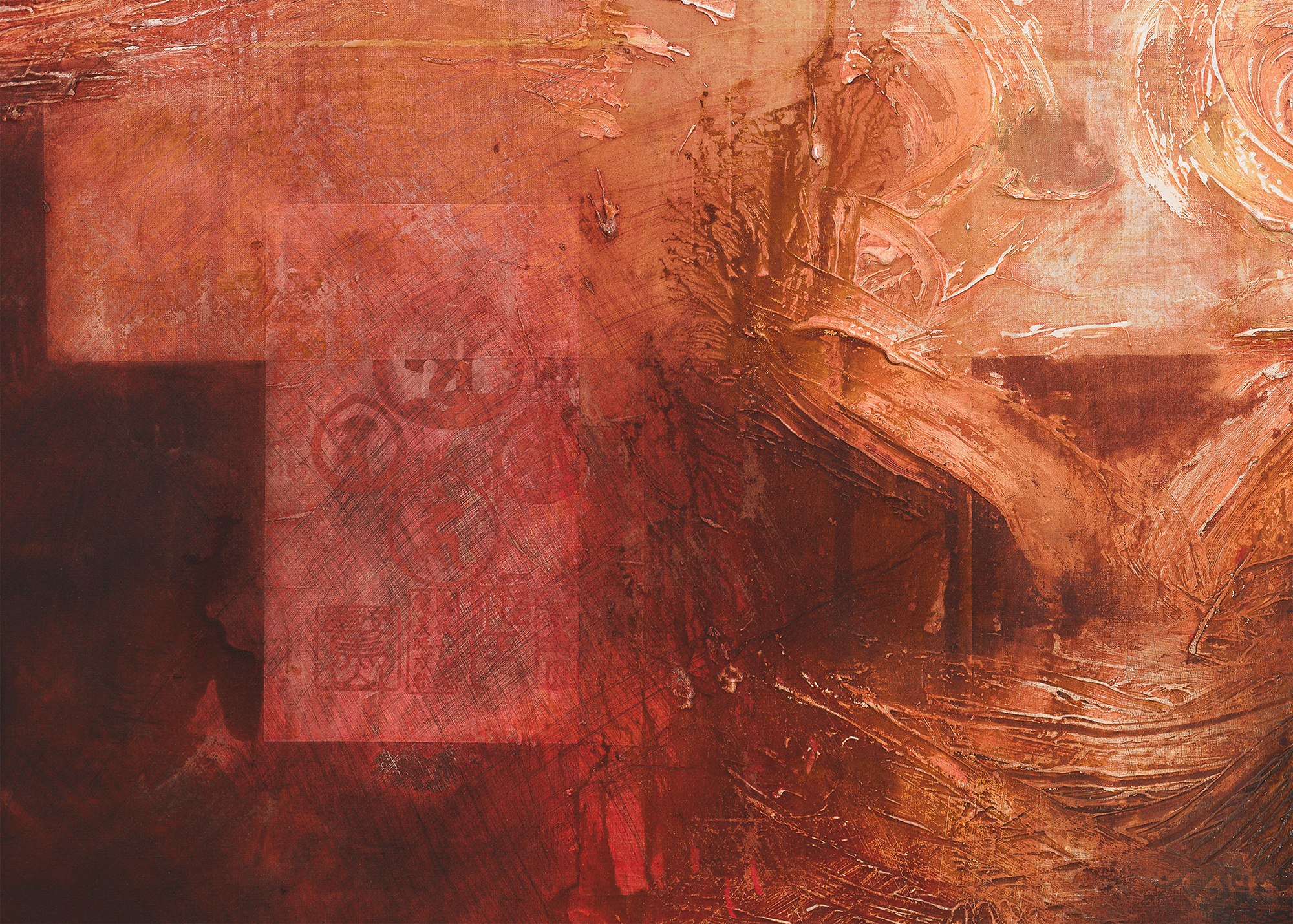
Even as computational processes intervene, the hand remains central, mediating and transforming these digital iterations into physical compositions. All of the romantic painterly fare is present here; pouring, dabbing, smearing, pushing. Each work is reluctant to divulge its own construction, instead caught in prismatic accumulations. In ✨JH123 (2025), some passages appear woven atop the fabric, other oil pools sink deep beyond the frame. Mark Godfrey identifies her predilection for “illusions of depth” in the essay “Retention, Recycling, Resistance,” noting that “the canvas acts as the plane between the viewer and the imaginary depths behind it.” At the same time, he emphasizes a two-way reading of the “screen.” Coagulated materials, layered over thinner strata, create a restless spatial interplay that encourages recognition and misrecognition of the surface.
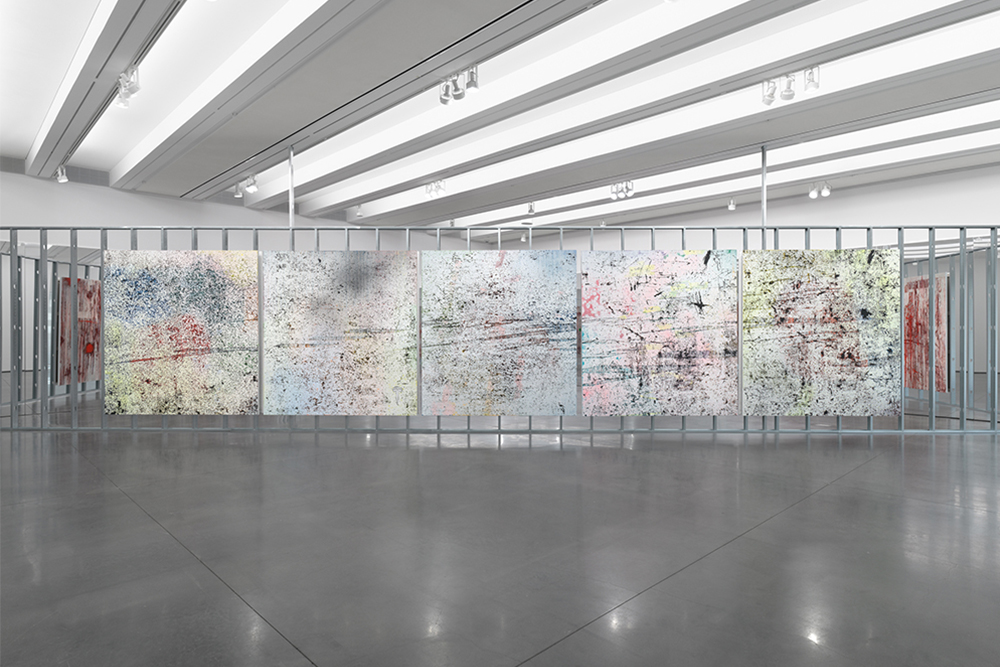
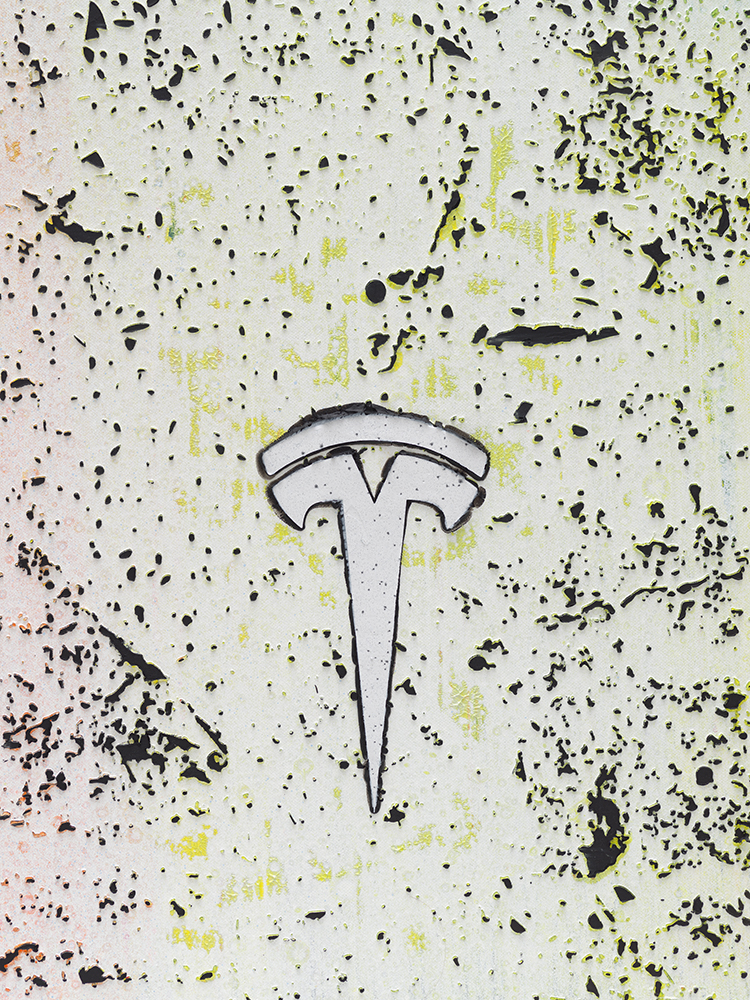
In keeping with the counterbalancing of clarity and denial, a monumental, ten-panel work is staged right at the exhibition’s entryway. Following predecessors like Neiman Marcus and JHWx (both 2021), this new conglomerate of canvases (altogether referred to as TSLA, 2025) tests modularity, informational distribution, and fragmented legibility. The immediately visible components are a set of five compositions, with sweeping pastels and black marks that culminate in outsized permutations of dirty film stills. As the viewer moves, the Tesla name appears or disappears–expanded, abstracted, disjunctive. Its logo, too, is present, though it easily vanishes into the painting’s visual noise. These branding images recur throughout the exhibition, contorted and distributed across multiple surfaces. The corporate symbology is another “bad idea” that she can’t seem to dump, functioning as a semi-empty signifier. A shorthand for technofuturism, failure, and hubris, it refuses to stabilize.
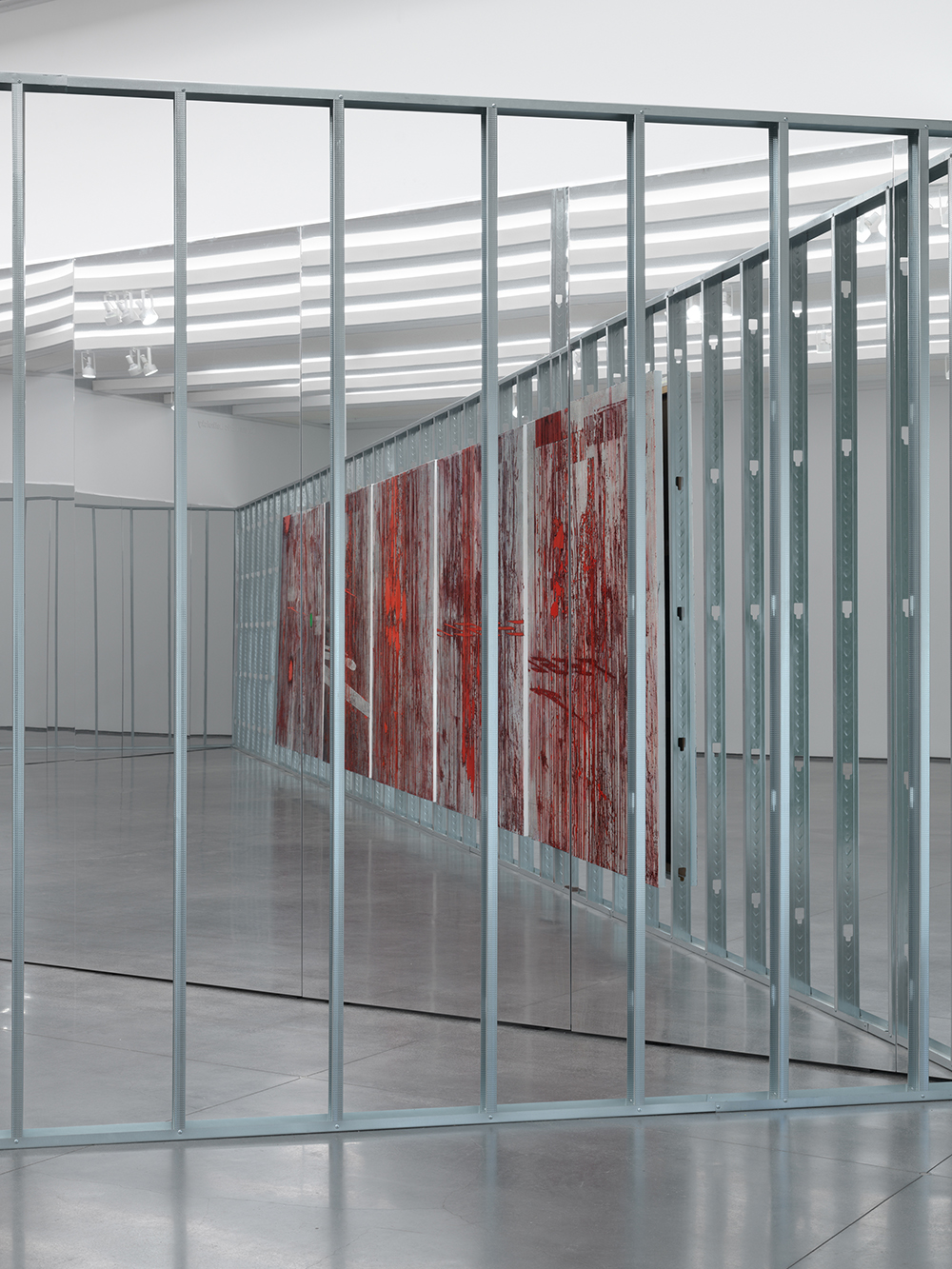
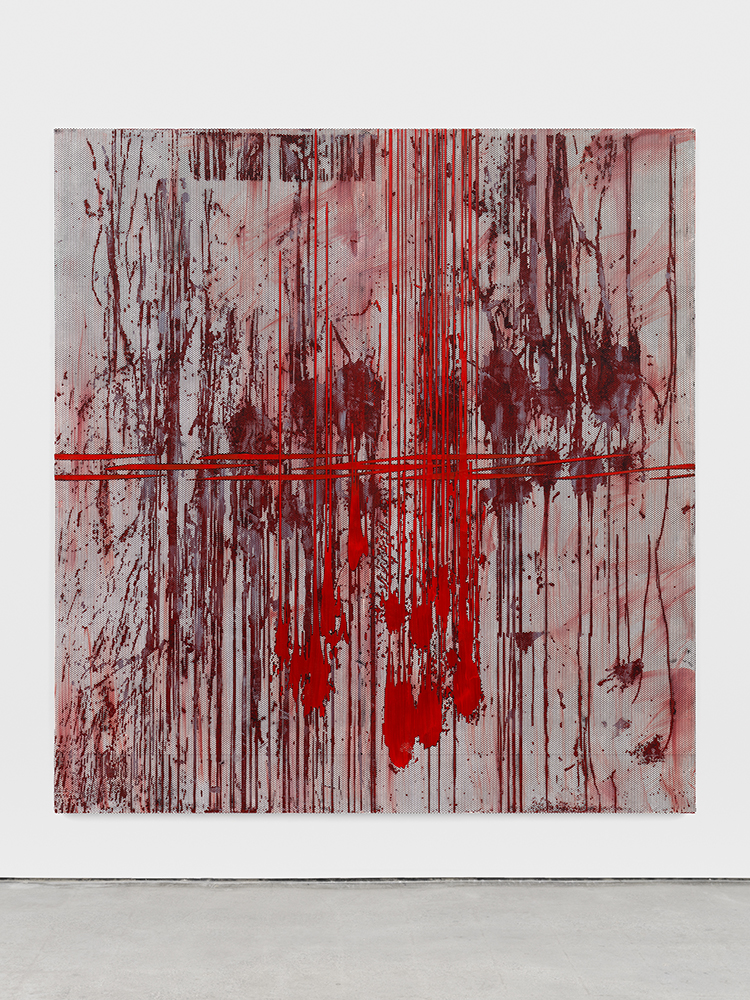
By contrast, on the metal structure’s verso, another five panels are visible only via wall-bound mirrors. This installation method denies direct, frontal viewing, instead rerouting perception through distortion. Spurred by an interest in anamorphic formats, the blood-red paintings are never visually stable. “People want to see everything,” says Humphries, “[I] define strategies for denying that, making it impossible.” She poses a question here: “what is this membrane [that] we call painting?” adding, “the planarity of it that you see into, but also reflects back at you. It’s like a screen, it’s got kind of a proscenium quality.”
These works also broach concepts that first emerged three decades ago. She embraces the flux that happens between an initial impulse and its manifestation. “I wouldn’t say I mourn the original inspiration so much as cherish the latitude I gave myself to re-explore this terrain, which back in the 90’s I had felt as though I had moved on too quickly and not made all the paintings in that mode that there were to be made. And so with new means, new motivation, new material and subject matter and a new opportunity to exhibit, any ‘loss’ was replenished by the fullness of the present moment and all that it brought as a kind of energy or fuel.”
To further complicate the issue of perception, one should take notice of the relationship between the architecture and Humphries’s installation tactics. The setting sun outside recasts the gallery window as a reflective surface upon which the installation is doubled from within. Under such circumstances, this house of mirrors expands, offering potentially infinite readings of the paintings on view.
The adjacent room is drenched in cobalt green, with a quartet of canvases on the left matching the walls. This move partially camouflages the panels, reflecting Humphries’s aim that “they can disappear and then reveal themselves. It goes back and forth, but it’s not a total revelation.” A conceptual resonance is established between physical disappearance and formal opacity within the works. What might initially register as uniform swells of oil, upon closer inspection, devolves into dense fields of emojis, letters, ASCII characters, and pixels–constantly at risk of atrophy through repetition. JH587 (2024), an oversized near-monochrome, demonstrates this: its bluish-periwinkle foundation is overwhelmed by raster dots, variable scratches, and an inscrutable set of glyphs along the lower edge.
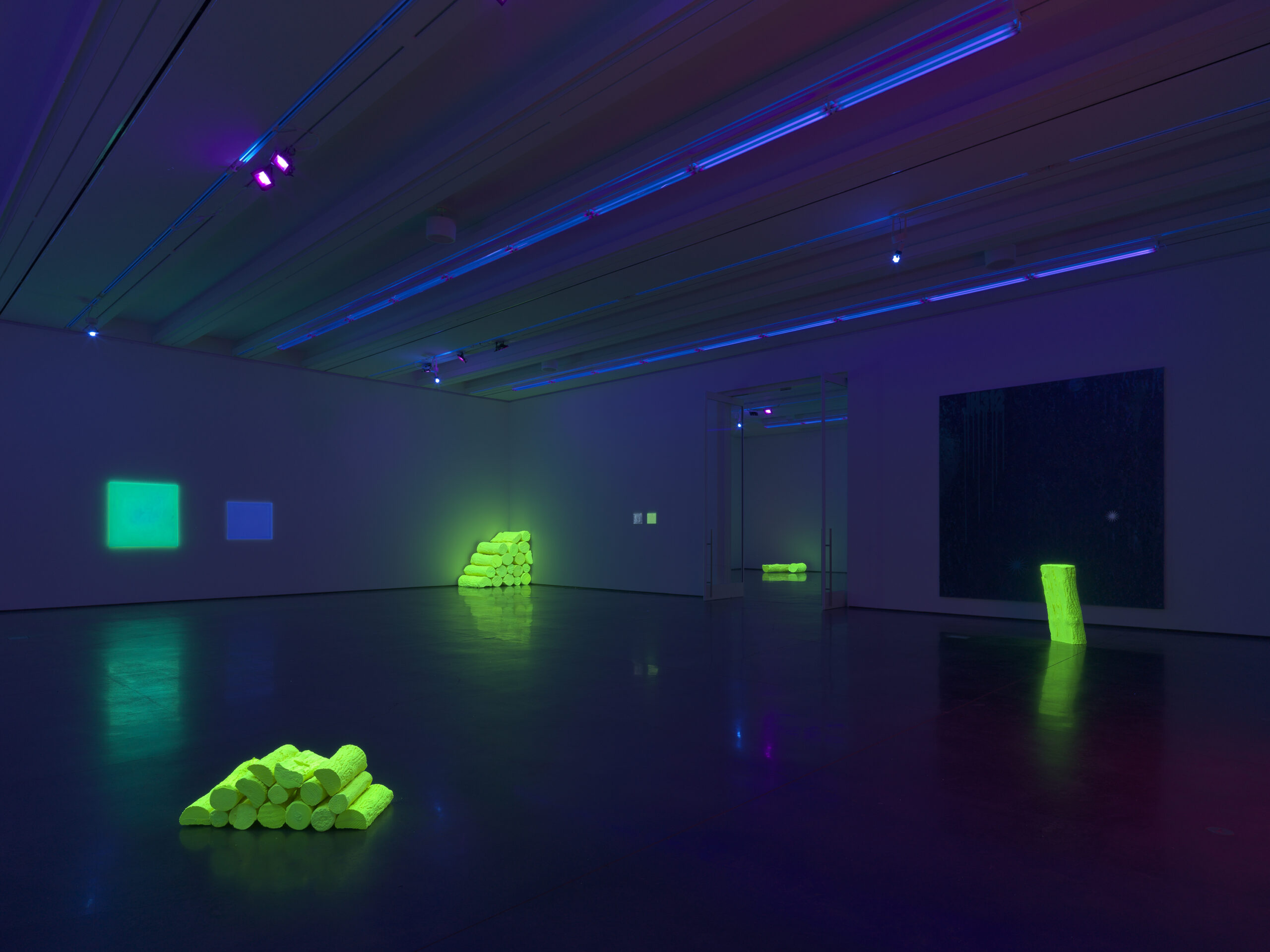
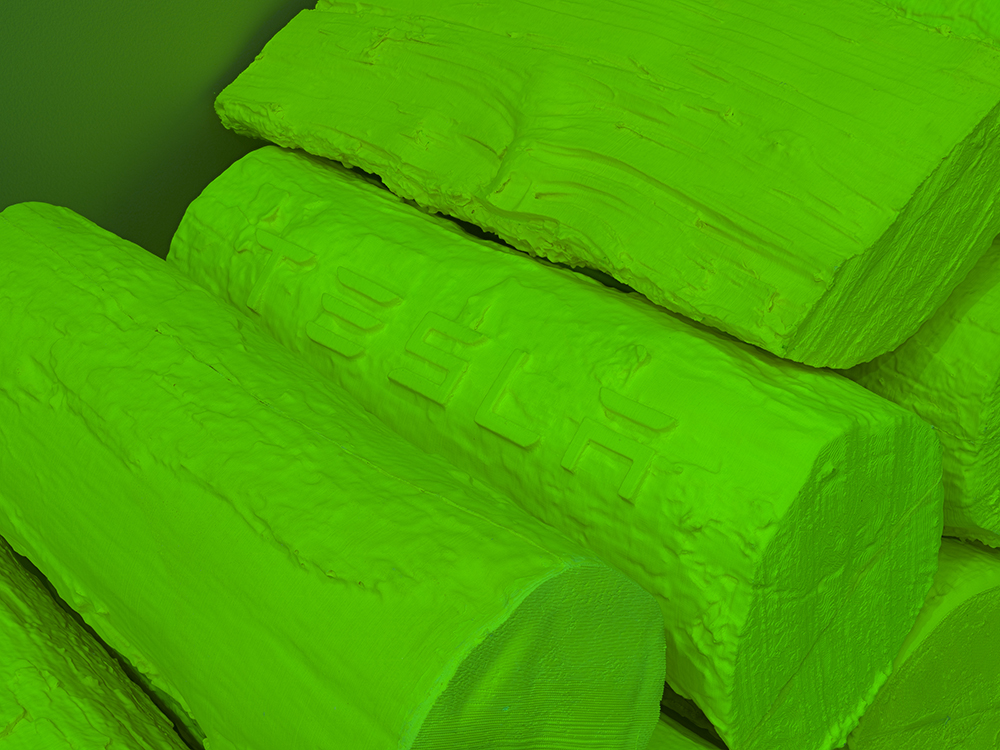
Downstairs, immersed in deep darkness, a mini survey features both recent and earlier works. Luminosity emerges under overhead blacklights as they interact with the art objects’ reactive pigments. The fluorescent paintings flicker slightly, shimmering into partial view depending on one’s vantage point. In Untitled (2015), rows of smiley faces dash in and out of sight, their graphic insistence struggling against violent pours and seepages. The composition’s yellow glow echoes onto the floor, producing a new abstraction and extending into the viewer’s domain of complicity. Bright neon logs scatter across the space, defying easy categorization. She explains, “I can’t call them sculptures, because I’m not a sculptor. I think of them as round images.”
There exists an ironic edge within her work, one that elides negativity. Humphries affirms that she’d rather “embrace perversity than cynicism,” maintaining, “one wants to be right, to succeed and to have good ideas,” herself driven toward counter-intuition. “To go against those incentives which convention would dictate.” What happens if one follows the path of resistance? Humphries maintains that she cannot define “good,” “right,” or “successful” painting. “If intuition leads you to something that feels right, then would counter-intuition lead you to something that feels wrong? And then that wrongness makes rightness? Once through the looking glass, it’s hard to know.”
Humphries lets a spectrum of frequencies drift, catch, and slip, remaining agentic throughout the process. Painting undergoes evaluations, preservation, temporary death and resuscitation, yet the artist stakes no claims to goodness or correctness. She senses potency in cataloged gestures and faulty ideas, applying them across whirling, abstract surfaces. These dynamic transmissions dart endlessly between coherence and precarity.
TSLA 2, 2025
Courtesy the artist; Greene Naftali, New York; Modern Art, London; and Galerie Gisela Capitain, Cologne
TSLA✨2, 2025
Courtesy the artist; Greene Naftali, New York; Modern Art, London; and Galerie Gisela Capitain, Cologne
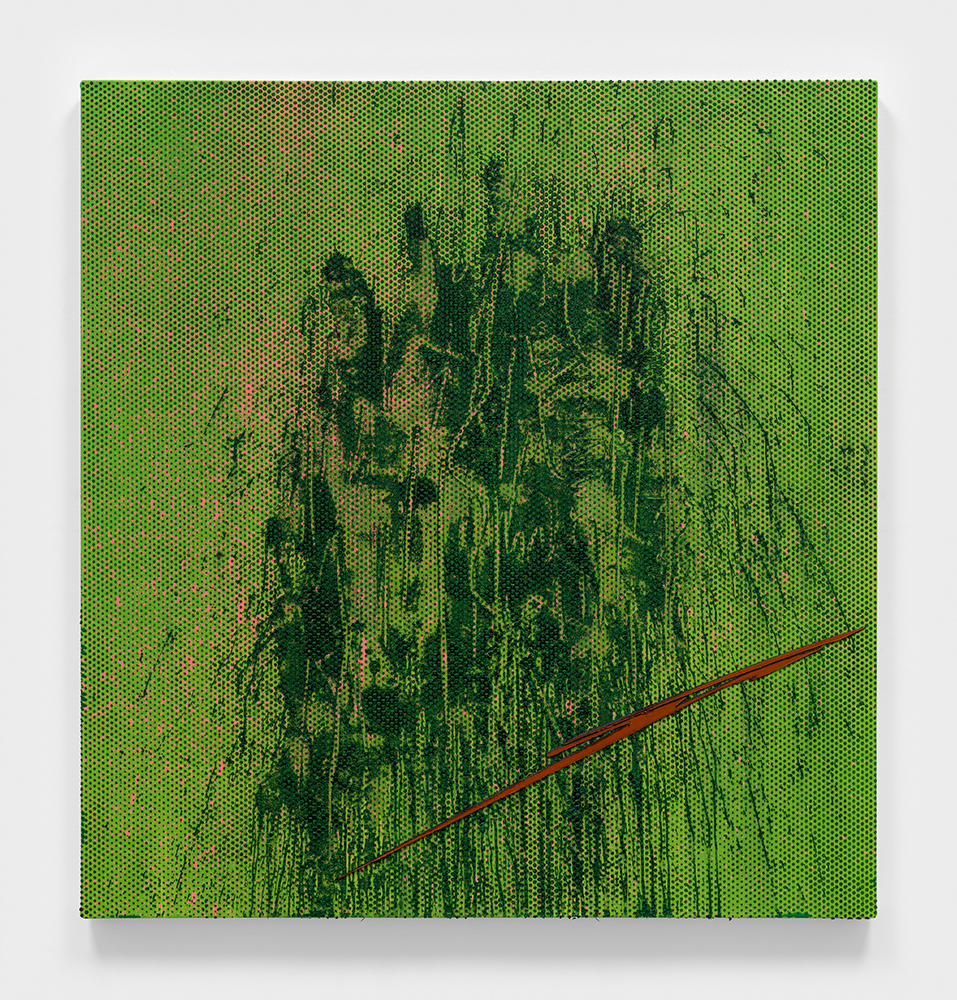
TSLA, 2025
Courtesy the artist; Greene Naftali, New York; Modern Art, London; and Galerie Gisela Capitain, Cologne
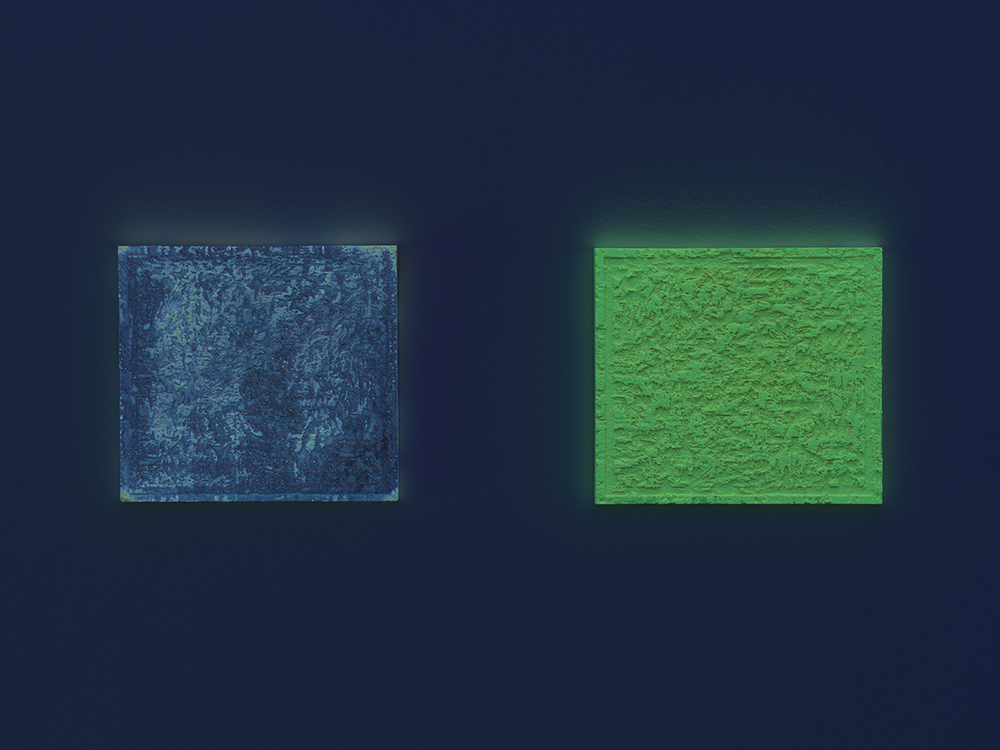
Installation view, photo by Dan Bradica
Courtesy Aspen Art Museum