Fondazione In Between Art Film
Complesso dell’Ospedaletto, Venezia
6 May — 22 November 2026
Special Venice Biennale 2026
Review by Giulia Colletti
ARTISTS
Lawrence Abu Hamdan, Massimo D’Anolfi and Martina Parenti, Roman Khimei and Yarema Malashchuk, Janis Rafa, P. Staff, Wang Tuo, Yuyan Wang, Maya Watanabe
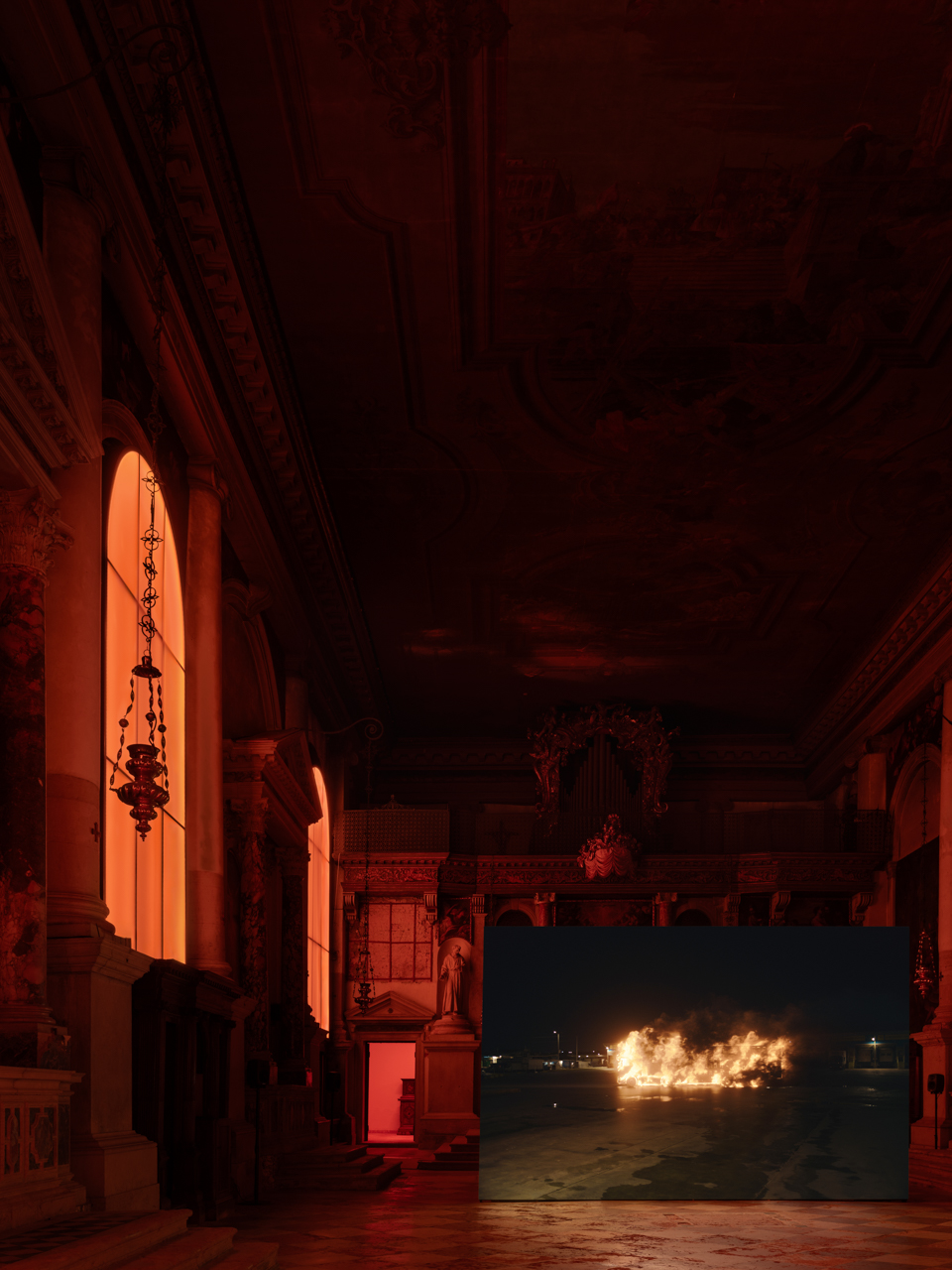
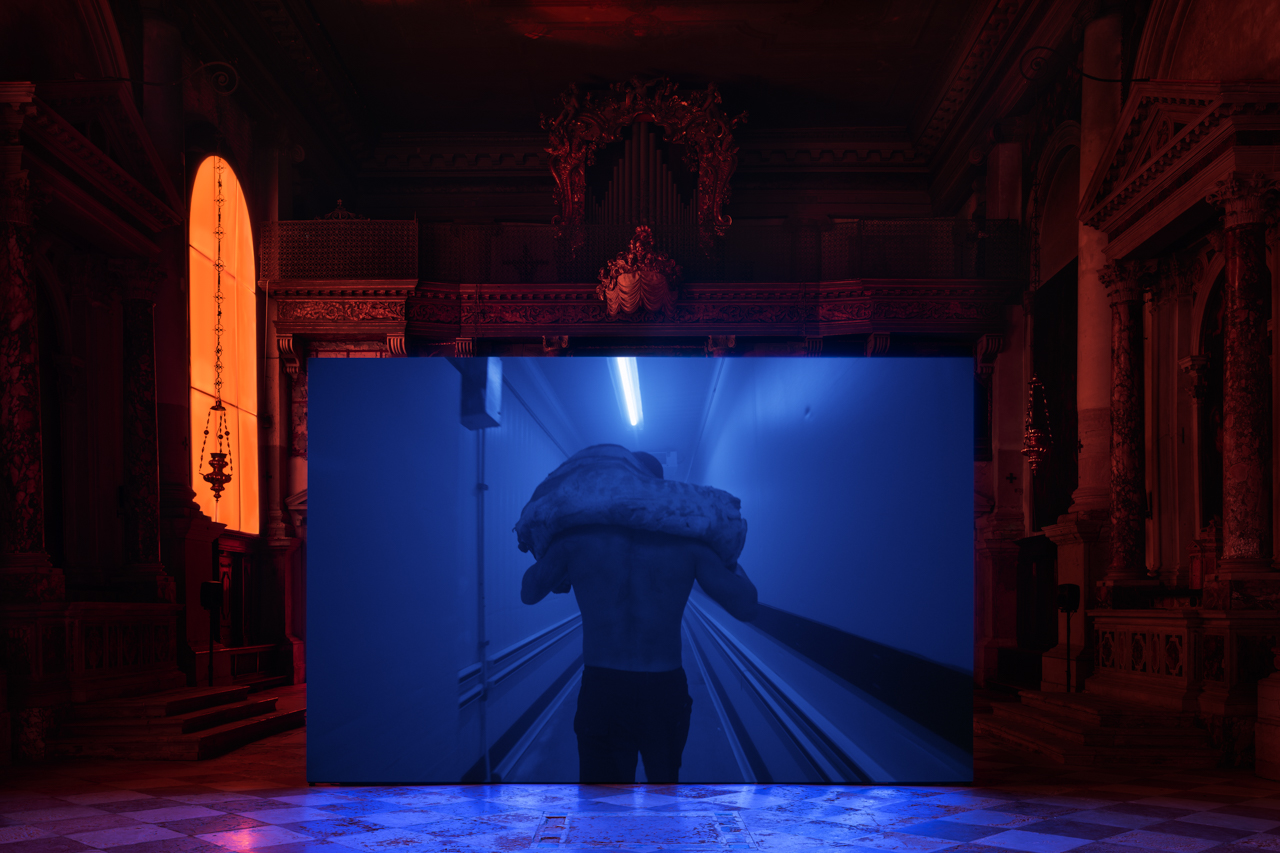
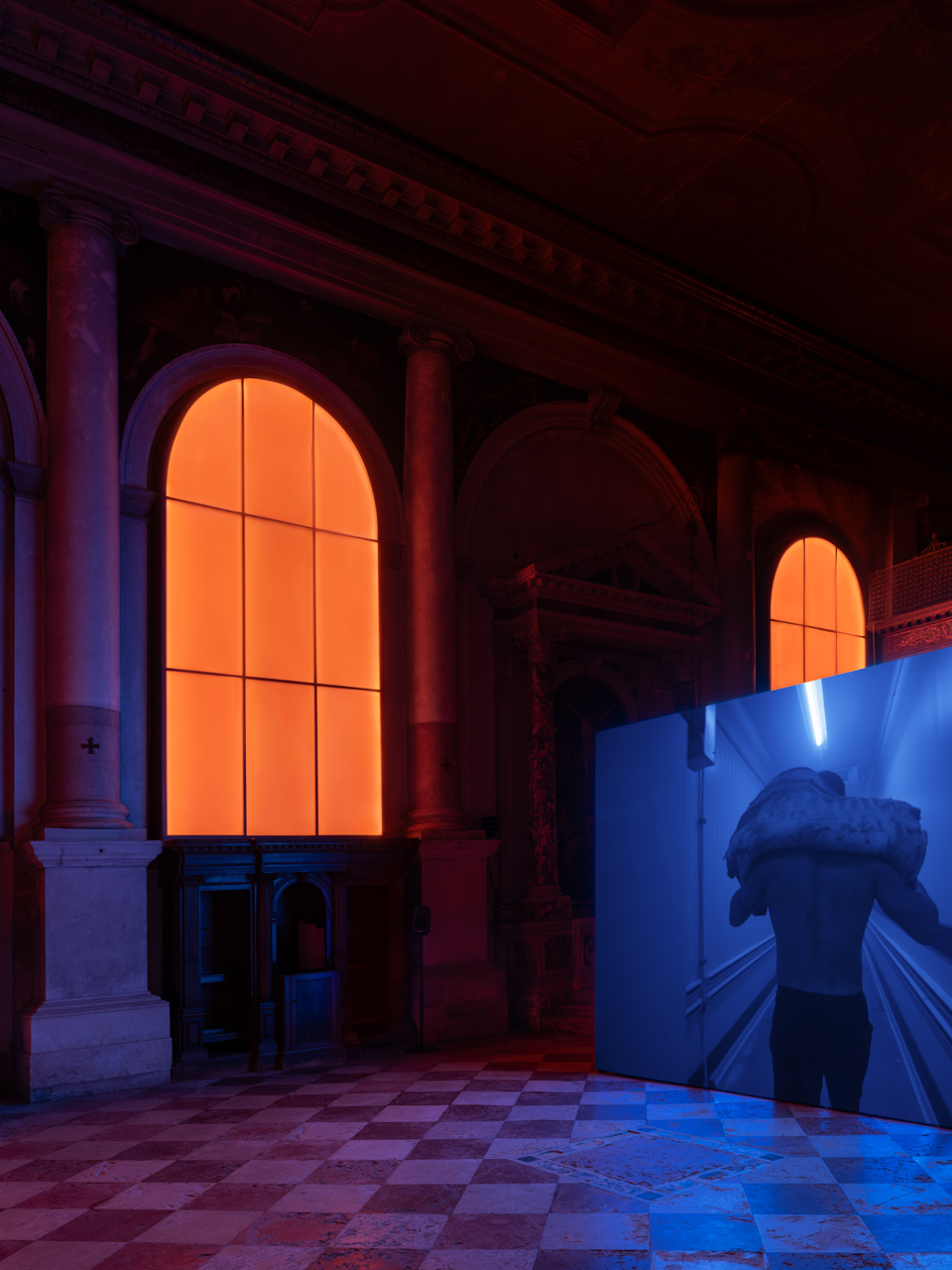
A man steps out of a cold-storage cell with the carcass of an animal on his shoulder. The same gesture returns. A human body this time, curled against another man’s back, hauled out the same way. The image, shot by Janis Rafa as part of Baby I’m Yours, Forever, floods from a vast LED wall totemically raised inside Santa Maria dei Derelitti, the church of the Ospedaletto. Bodies are everywhere. Outside, the telamons of the façade buckle under the weight of the cornice, faces clenched, holding the building up. Behind the screen, on the altar, a half-naked Saint Sebastian twists against his arrows. Canicula, the final chapter of the Trilogy of Uncertainties produced by Fondazione In Between Art Film, opens onto a chorus of bodies that continues to resonate throughout the exhibition. Across eight new moving-image commissions, human and synthetic bodies endure and yield, veering between living and dying.
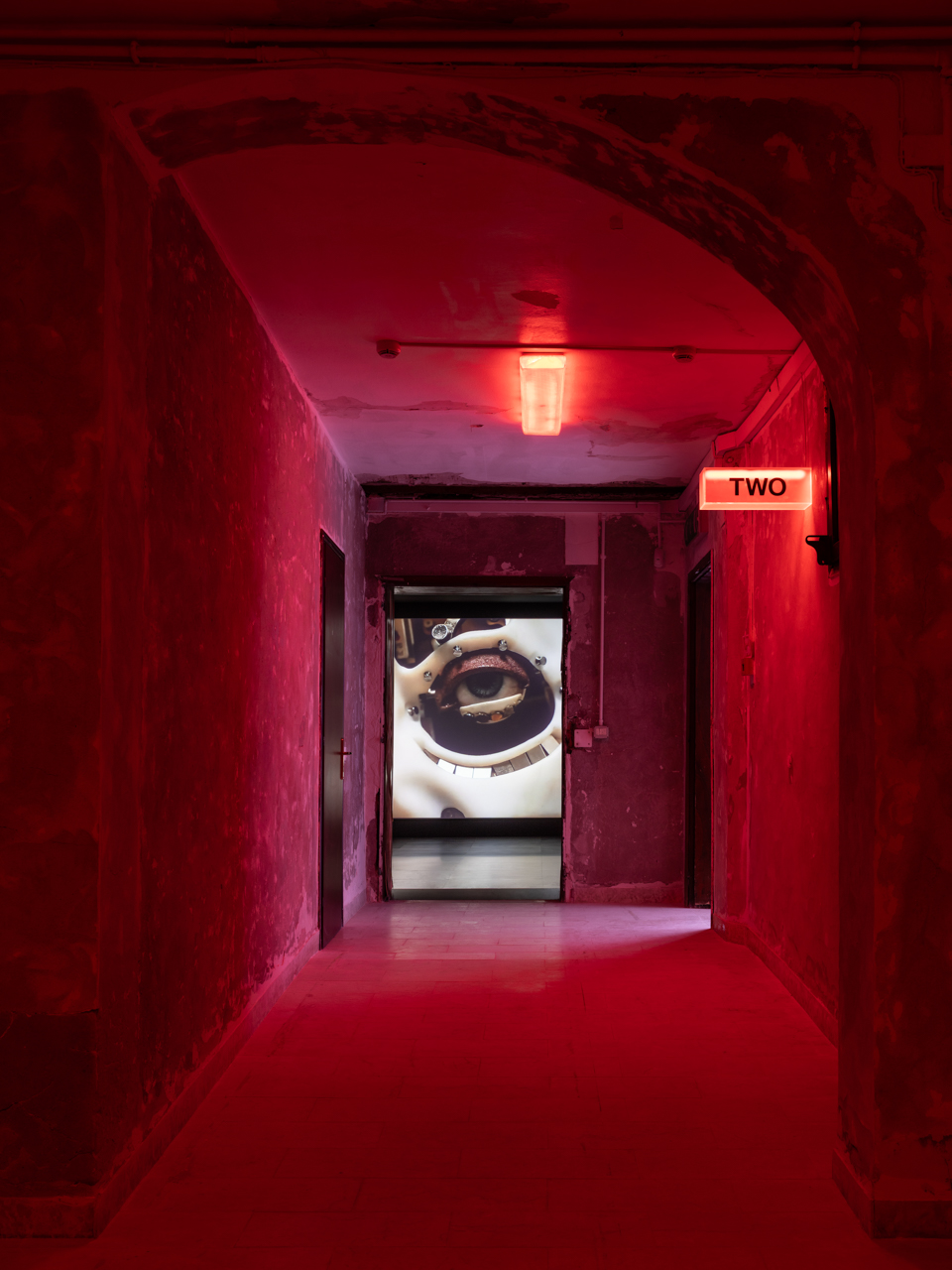
The Complesso dell’Ospedaletto was founded in the famine winter of 1527, when the starving poor of the Veneto countryside poured into Venice and were first sheltered in provisional wooden huts, put up to be taken down again once the crisis had passed. What began as a temporary refuge for displaced bodies hardened into stone and became, over the following five centuries, an orphanage, then a hospital, and finally a care home for the dying elderly. Its architecture still holds the memory of those transits, a kind of limbo. Curated by Alessandro Rabottini and Leonardo Bigazzi, with scenography by 2050+, the exhibition flows unbroken from the church down into the former hospital. The shape of the route is eschatological, echoing a catabasis into darkness, then a long climb toward the light, with the visitor’s own flesh as the medium.
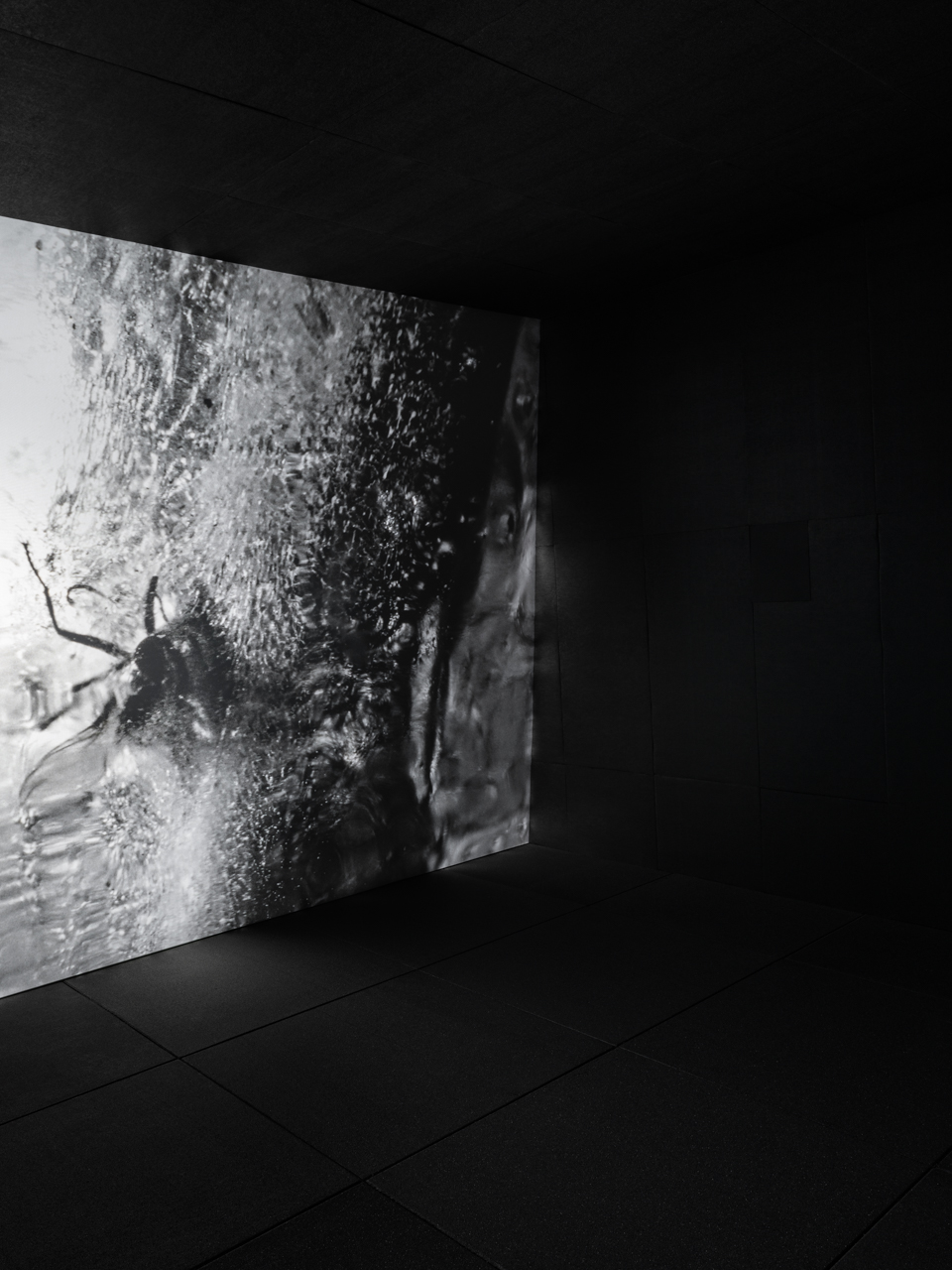
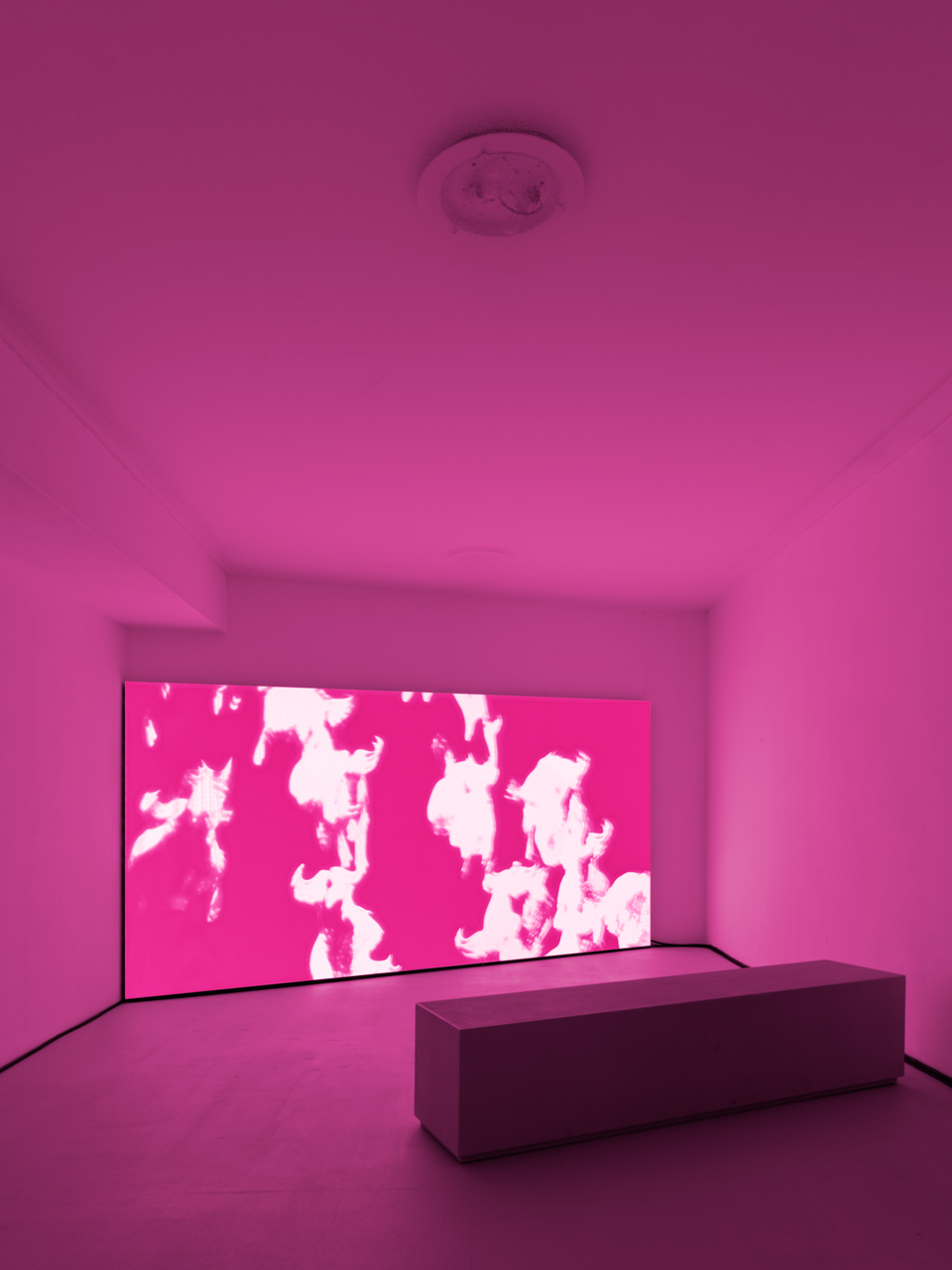
Rafa’s film governs the descent. In her hands, love becomes the instrument of slaughter. The carcass and the corpse, carried out on shoulders, are offered without comment. The church once promised that the body could be redeemed, and Rafa answers with a devotion indifferent to whose body it even holds. The descent is punctuated by Yuyan Wang’s Boring Billion, where that same erotic charge outlives the skin that carried it. Assembled entirely from found online footage of automated machinery and repair tutorials, the work lingers on viscous compounds lubricating gears as they slide into one another, interlocking in unmistakably sexual rhythms. It is an erotics of the machine, close to Ballard’s Crash. Humanoid robots drift between learning and instinct while the opening of DeBarge’s All This Love surfaces in a metallic voice, a song about the healing power of love reduced to a corrupted citation. As Rafa keeps desire within the exhausted body, Wang transfers it into a world where the organic and the mechanical have folded into one another.
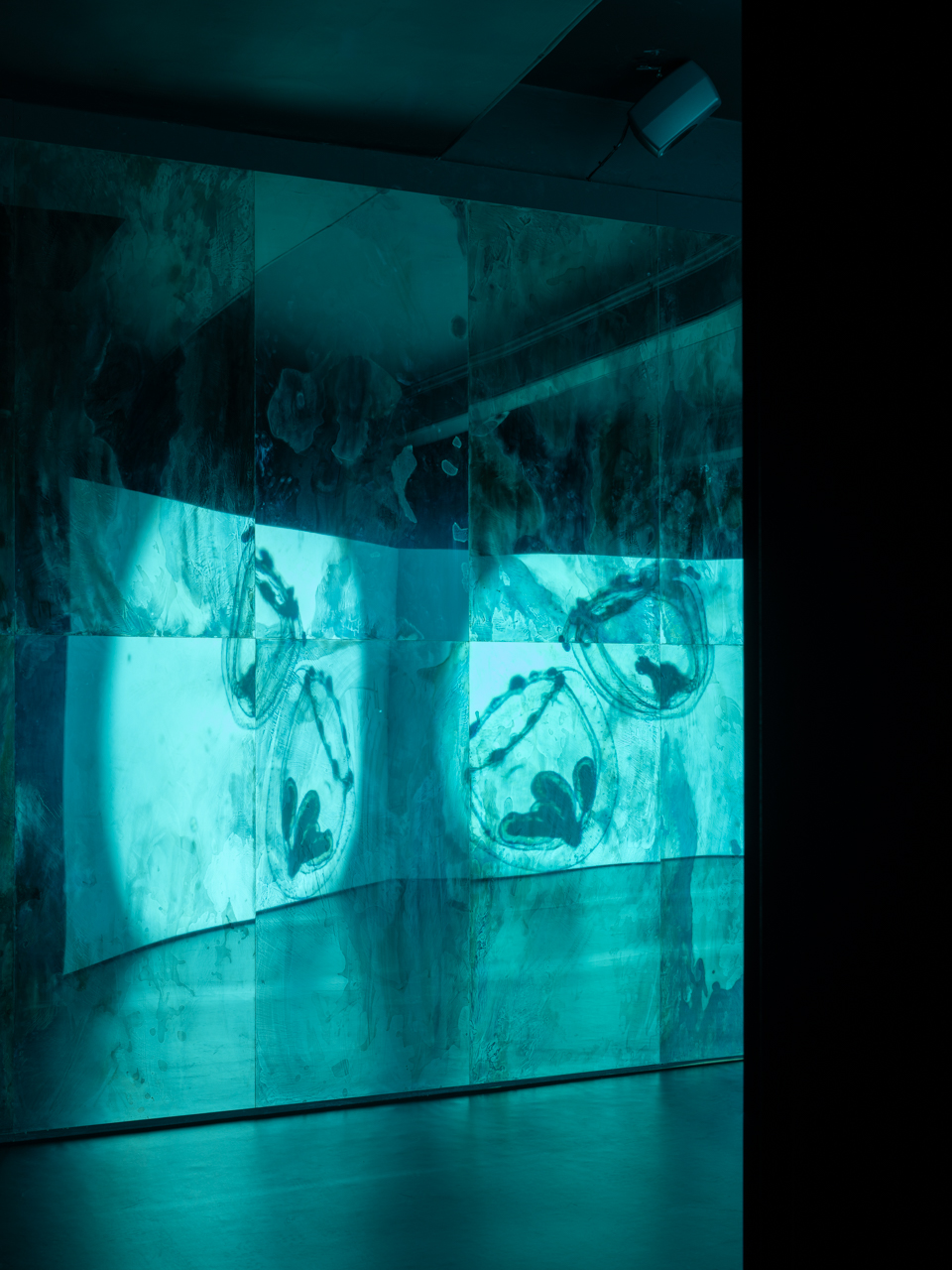
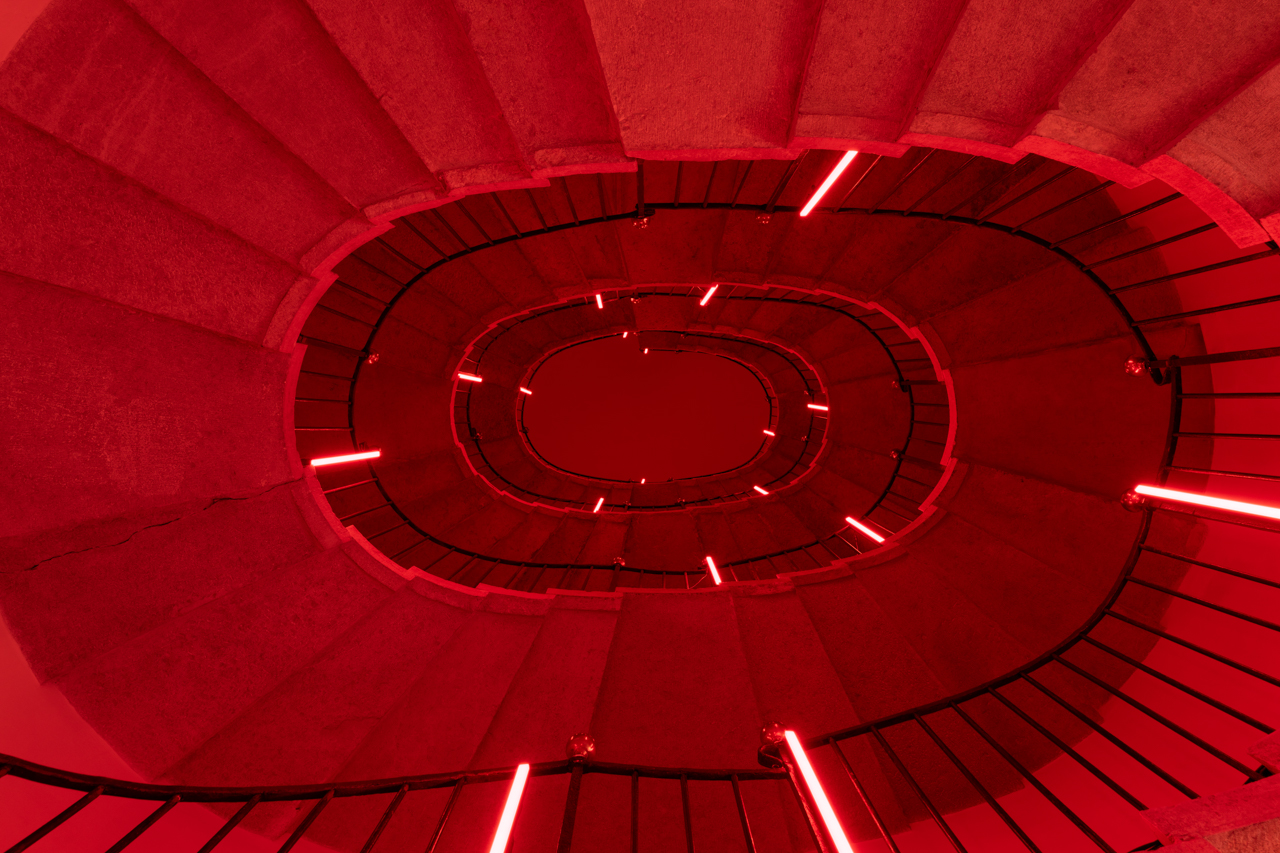
The ascent belongs to P. Staff. Terminal Lucidity unfolds along the complex’s monumental helicoidal staircase, which visitors climb through bursts of intermittent light. The title refers to the sudden return of clarity that can emerge just before death. Staff works through dissolution. White silhouettes burned against saturated colour persist in the retina as ghostly presences, while their backgrounds mutate into hallucinated complementaries. The upward spiral becomes the exhibition’s anabasis, its return to light staged as the body’s own epiphanic passage toward the afterlife.
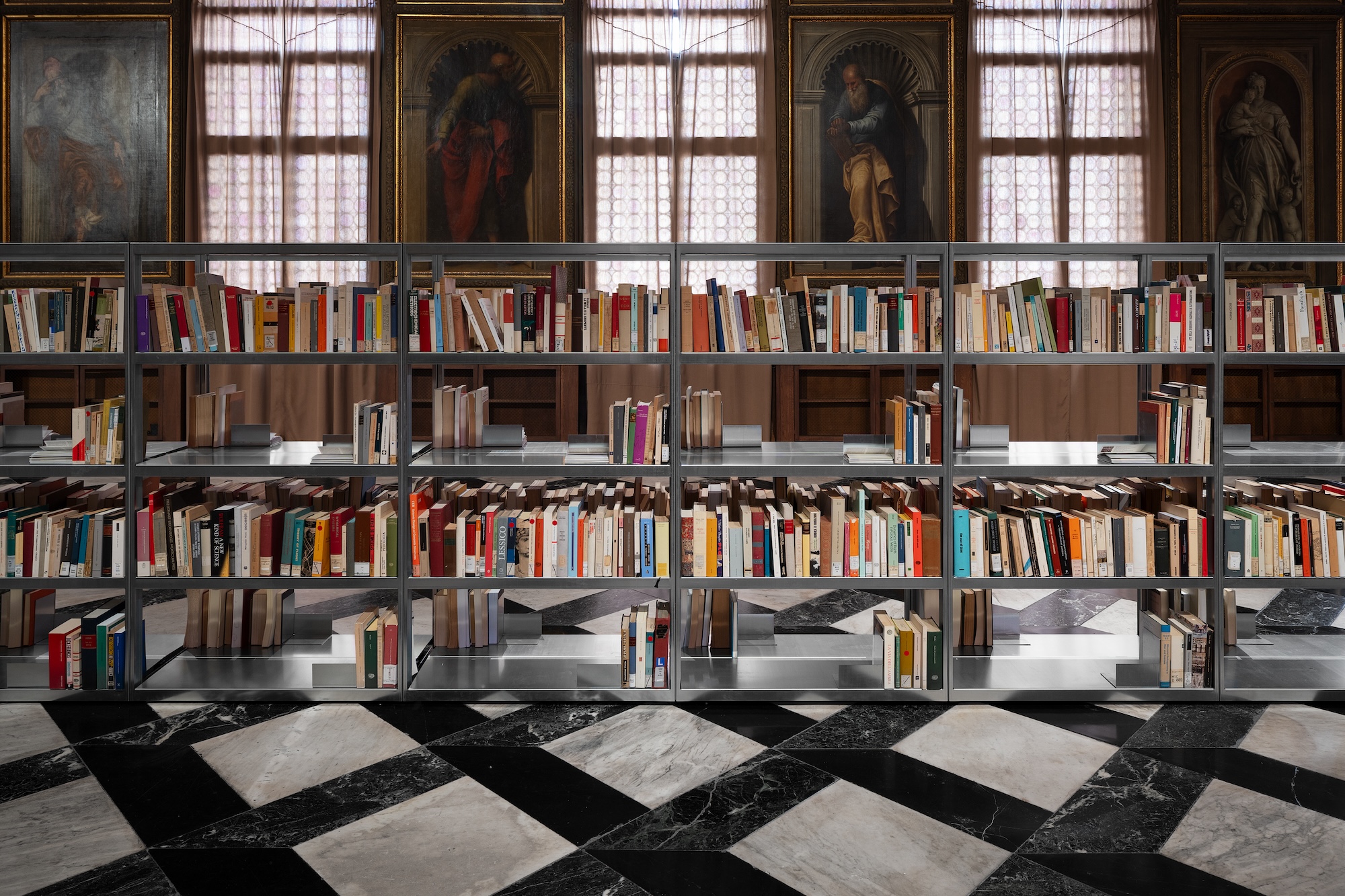
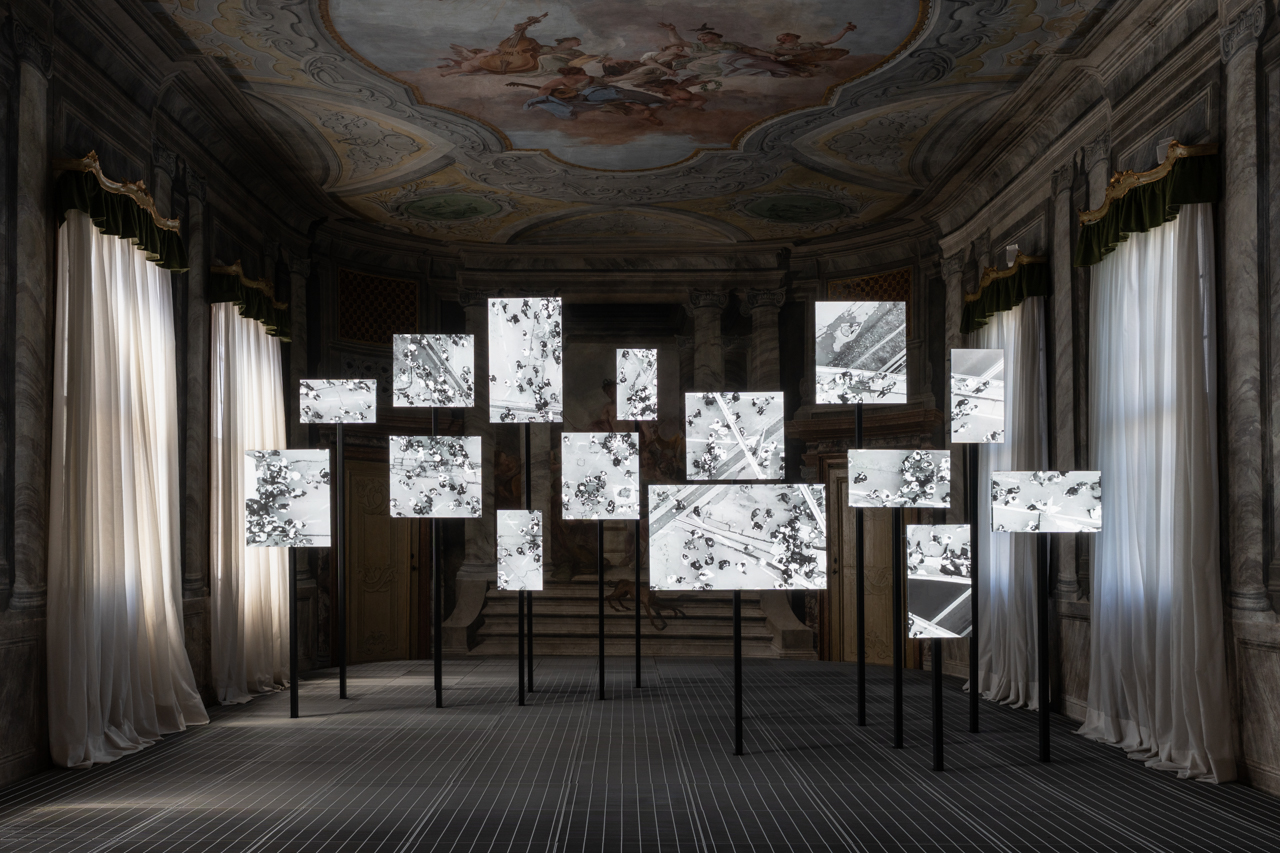
Two works set along the climb turn the body into a site of resistance. Lawrence Abu Hamdan’s 450XL: The Story of a Fugitive Sound occupies the Sala della Musica, an eighteenth-century chamber engineered so that the voices of the orphan choirs would carry, with its very corners rounded for the sake of sound, its walls frescoed with a painted concert. Abu Hamdan’s work recalls that purpose. It reconstructs the LRAD acoustic weapon that allegedly turned on a silent vigil of some 300,000 people in Belgrade in March 2025. It is a sound the authorities denied, and yet more than 3,000 written statements describe it with eerie consistency. In a room built to make voices heard, he stages a sound officially unheard. Across fifteen screens, silent earwitness testimony alternates with footage of thousands of flashlights raised in the dark, scored against a single diegetic second of the reconstructed blast. On the fresco overhead, the choir’s central singer still holds out her score “contro il destin che freme…combatteremo insieme” (against raging destiny, we will fight together) and two and a half centuries later the line answers the weapon below. Built to scatter a standing crowd, it meets the power of staying upright and still. The monitors themselves stand vertical and solid, like bodies holding their ground, so that the installation reads as a single human wall.
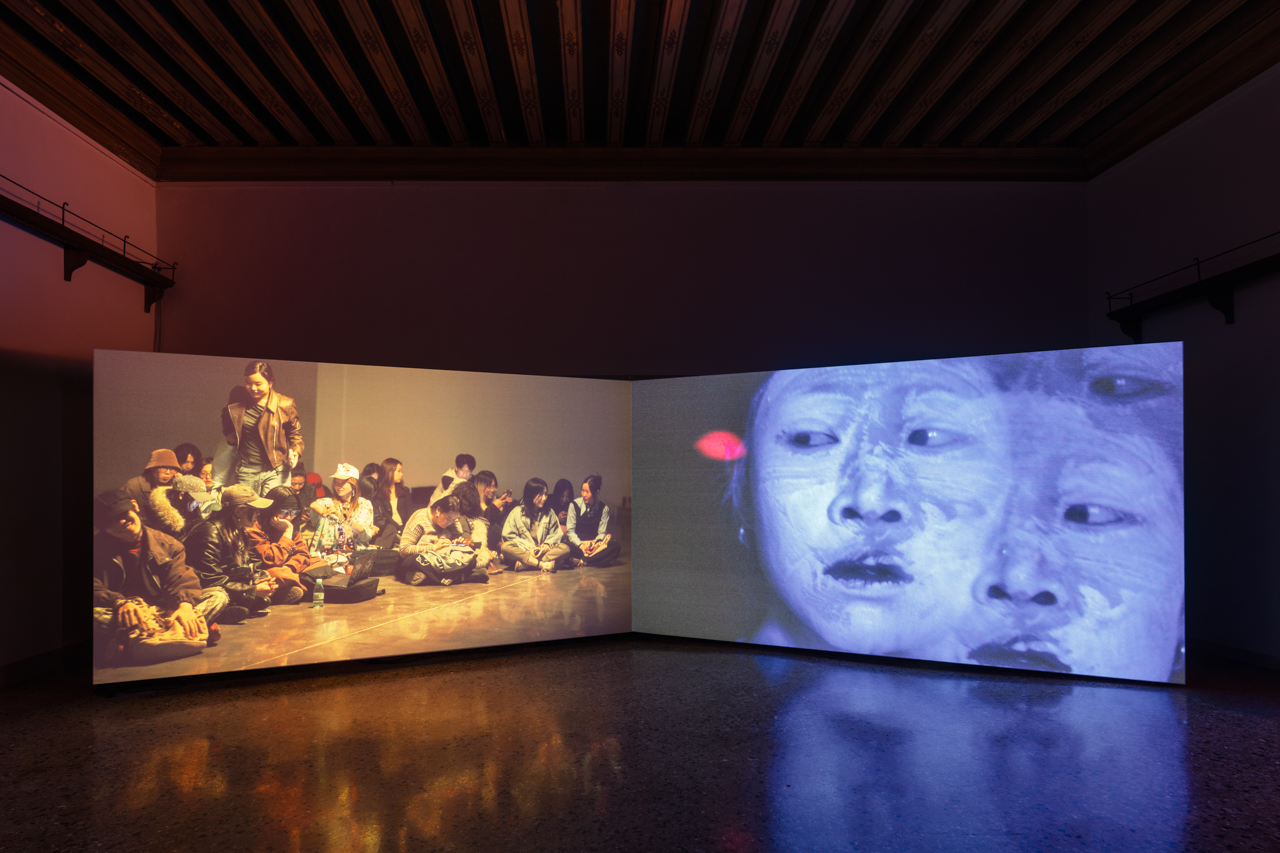
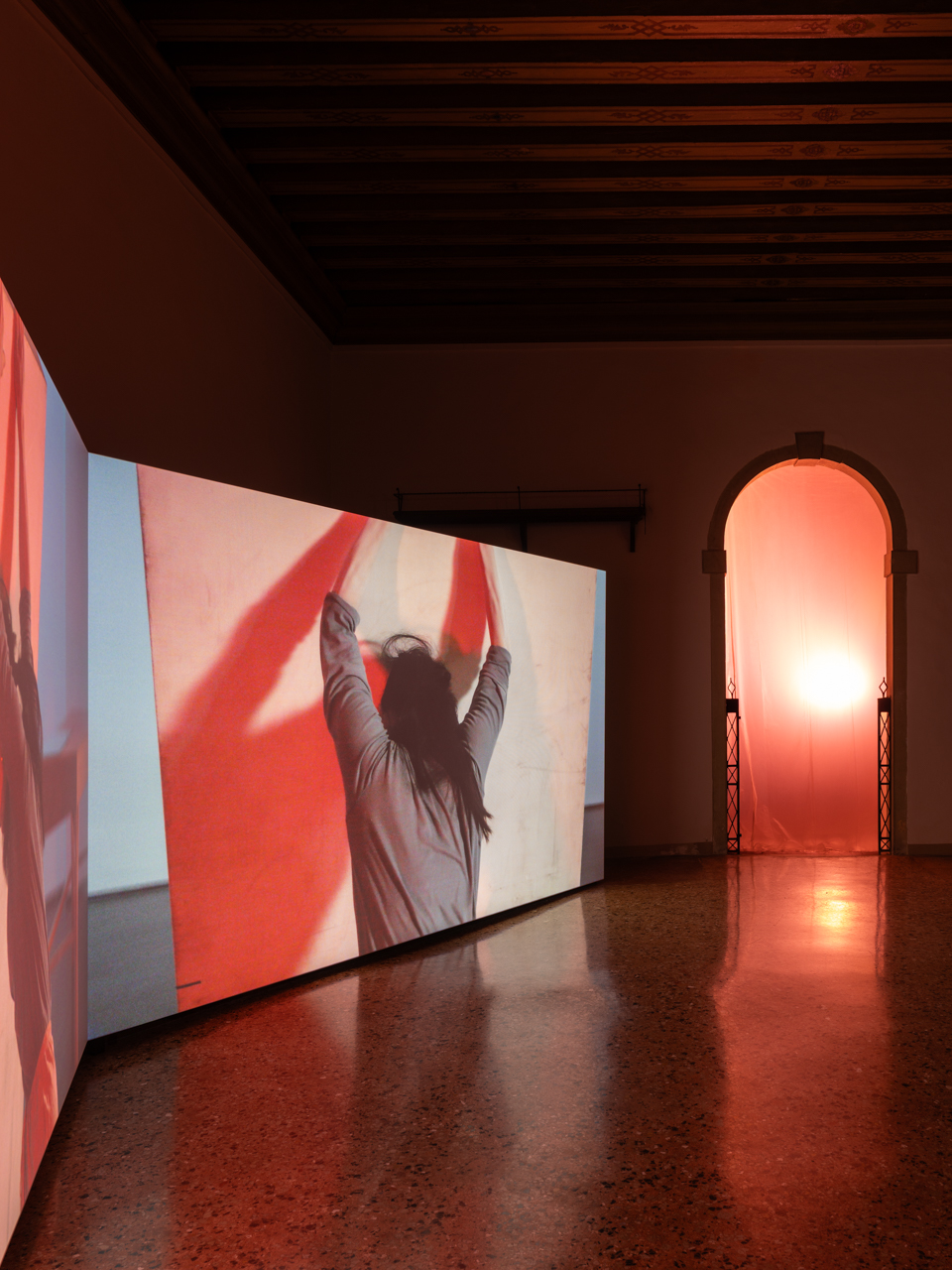
That resistance is inverted in Wang Tuo’s The Experimental Paradigm of Ownership and Autonomy, installed in the former inpatient pharmacy. Adapted from a novel the artist wrote in 2022, it follows Qū (the Chinese word for “torso”), a disabled woman in a left-wing collective who builds a performance out of the experience of her own body. Splicing personal footage with appropriated mass-media and surveillance imagery, Wang turns bodily fragility into a figure for the heterogeneity of collective memory, with past, present and future locked in a perennial cycle of control and amnesia.
The last commission works as a hinge between what is still underway and what might yet come. Roman Khimei and Yarema Malashchuk’s Wishful Thinking is set in an imagined future where Russia’s war on Ukraine is already over, and stages elderly Russian soldiers as they regret or disown their roles. Their parts, pointedly, are played by Ukrainian actors who trained on Russian literature in the theatres of Soviet Ukraine. Installed in the bare, aseptic wards of the former hospital, these bodies are filmed with the frontal solemnity of devotional figures, yet the absolution that the form promises never comes. They drift from confession into incoherence, from lucidity toward the nearness of death, holding the same threshold P. Staff named. The acknowledgment they seek keeps receding, the repair the title wishes for stays deferred, and the one certainty is the banality of evil in the present.
The church, the staircase and these threshold bodies disclose what the building is for. The question Canicula leaves open, it never settles. Five hundred years on, bodies in transit still pass through the Ospedaletto, sheltered, exhausted, undone, held standing against the force that would scatter them, carried down into the dark and brought, Dante-like, back up toward the light.
Canicula
Lawrence Abu Hamdan, Massimo D’Anolfi and Martina Parenti, Roman Khimei and Yarema Malashchuk, Janis Rafa, P. Staff, Wang Tuo, Yuyan Wang, Maya Watanabe
Curated by Alessandro Rabottini and Leonardo Bigazzi
Fondazione In Between Art Film
Complesso dell’Ospedaletto, Venezia
6 May — 22 November 2026
Credits:
Foto © Marco Cappelletti e Giuseppe Miotto / Marco Cappelletti Studio