Text by Mohamed Almusibli
CURA. 46
Soft Power
The New Now
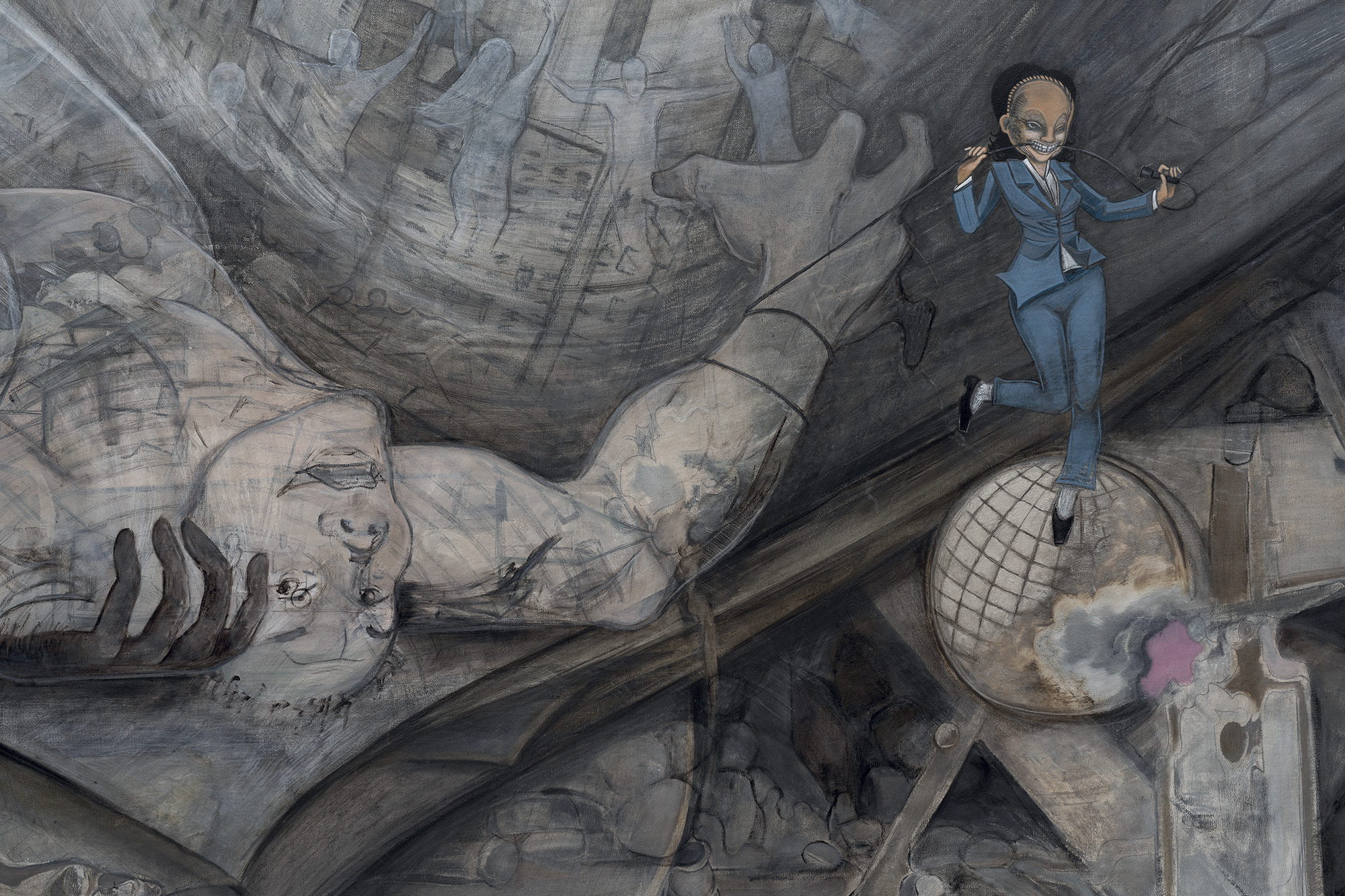
Primitive Prophecy, 2024 Photo: Joerg Lohse Courtesy: the artist and 47 Canal, New York
The first time I spent time with the paintings of Janiva Ellis, what struck me was not the imagery itself but the strange instability of it. You recognize things immediately, a figure, a gesture, a fragment of landscape, something that looks almost like a cartoon, but the recognition never quite settles. The image keeps shifting before you. What seemed descriptive becomes symbolic, what seemed symbolic turns into a brushstroke, and suddenly you realize you have been looking at the mechanics of painting rather than a scene.
That slippage feels intentional. Ellis’s paintings rarely allow an image to stay in one register for long. They move between illustration and abstraction, between narrative and atmosphere, between something that feels culturally specific and something that seems almost archetypal. You might catch a fragment that recalls art historical landscape painting, only to find it interrupted by a cartoon body or a gesture that looks closer to mid-century abstraction. The works gather these visual languages without resolving them.
I have always thought of this as a kind of pressure within the image. Different pictorial systems occupy the same surface, but none of them dominate for very long. The painting keeps reorganizing itself in front of you.
At the time of writing this text, Ellis is preparing her first institutional solo exhibition in Europe at Kunsthalle Basel. The exhibition, titled Geneva, brings together a new group of paintings that continue to push this instability further. Standing among them while the show slowly takes shape, the sense that the image is still reorganizing itself never quite disappears.
Ellis often speaks about painting as something she inherits, not necessarily done by choice. The medium carries with it an enormous historical weight, centuries of images that have structured how power, spirituality, beauty, and authority are visualized. At times, that inheritance appears almost monumental. Landscapes expand outward, architectural spaces open up, and skies split apart. But those spaces rarely stabilize into the heroic compositions that Western painting traditionally celebrates. Instead, they feel unsettled, as if the structures holding them together are beginning to slip.
In recent works, architecture and landscape appear less as settings than as residues. Structures look partially collapsed, horizons break apart, and figures hover rather than stand firmly on the ground. The environment feels suspended between construction and ruin. It is difficult to tell whether we are looking at the aftermath of something or the early stage of something forming.
This ambiguity is important. Ellis’s paintings rarely stage destruction as spectacle. Instead, they linger in the unstable space where meanings start to shift. Images associated with authority, monuments, religious symbolism, and even the conventions of landscape painting itself begin to feel provisional. They remain recognizable, but their stability is gone.
In that sense, the paintings operate almost like a kind of visual archaeology. They expose the myths embedded within painting’s history without fully discarding them. Ellis often works directly on top of those inherited structures, riffing on compositions that have circulated for centuries, allowing their symbolic logic to remain visible while quietly altering how they function. The result is less a rejection of the canon than a slow mutation of it.
What emerges in these paintings is not a clear narrative but a field of competing signals. Cartoon figures appear alongside gestures that recall European modernism. Allegorical references drift through scenes that feel closer to contemporary media imagery. The surface becomes crowded with different temporalities of painting. Some symbols appear clearly at first, while others remain buried within the image, almost indistinguishable from the surrounding brushwork.
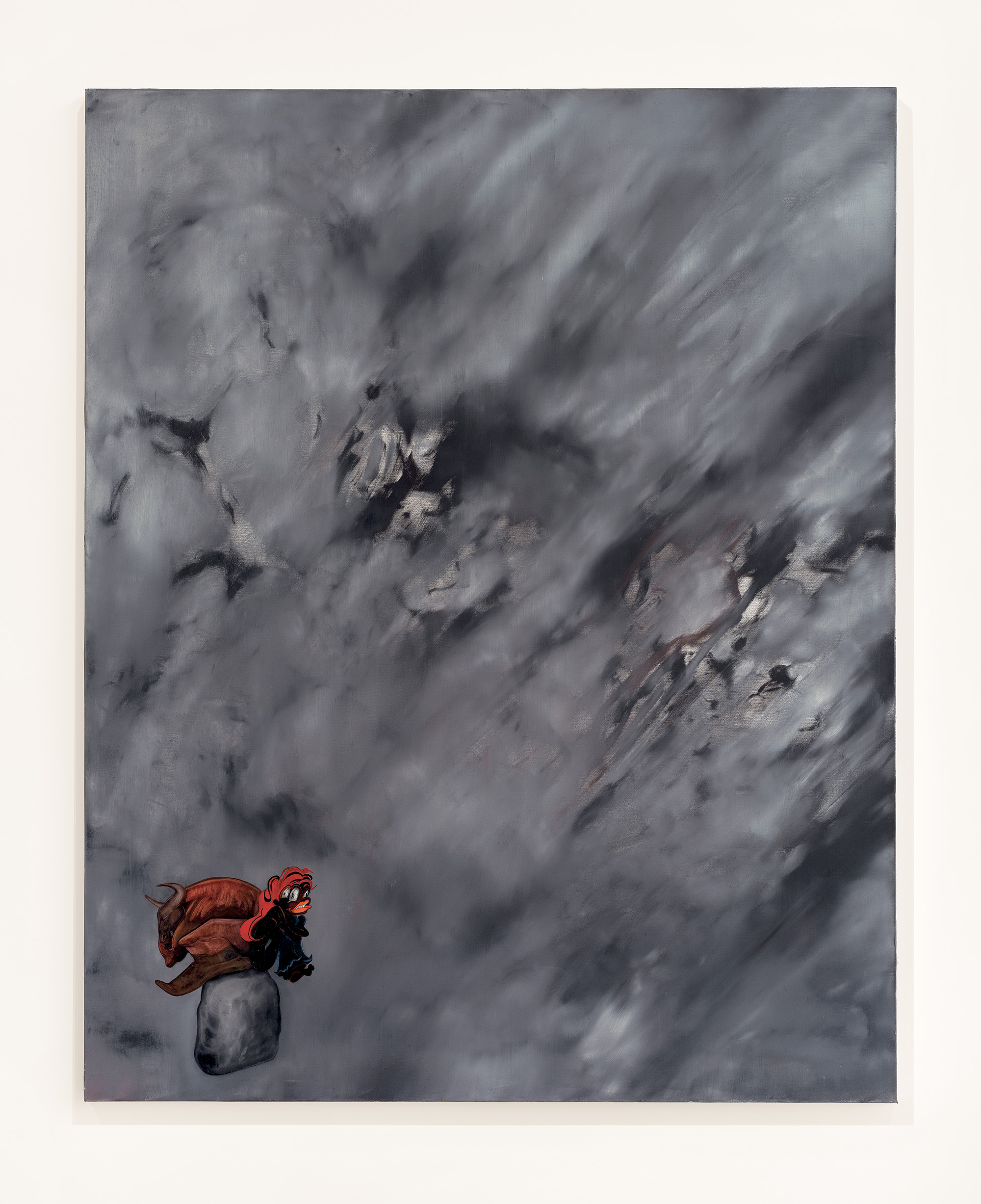
Bull Squall Bingo, 2020 Photo: Zachary Blower
Courtesy: the artist, Institute for Contemporary Art, Miami, 47 Canal, New York
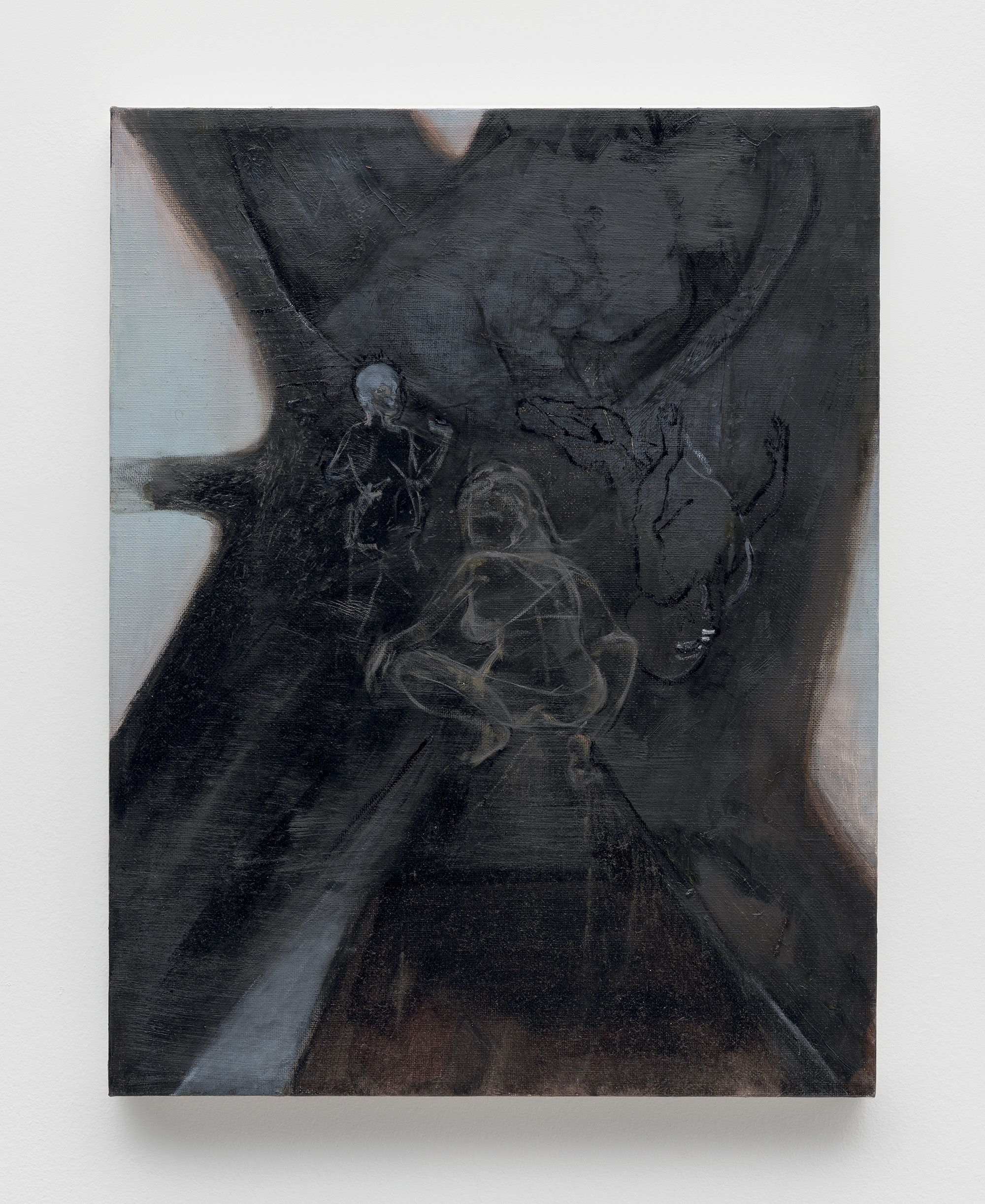
muses, 2020-2025 Photo: Joerg Lohse
Courtesy: the artist and 47 Canal, New York
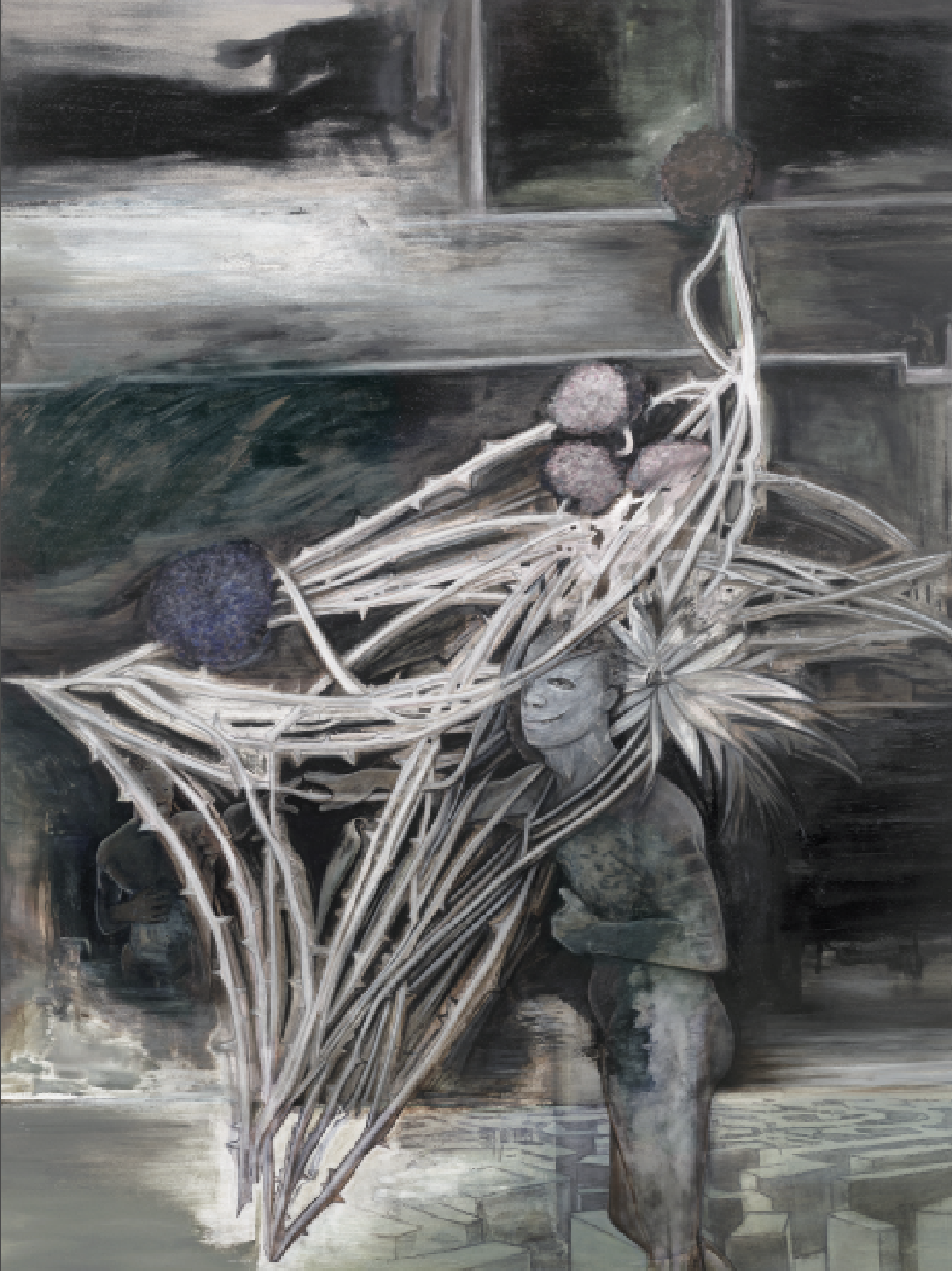
Gay Orpheus, 2023-2024 Photo: Julia Feartheringill
Courtesy: the artist and 47 Canal, New York
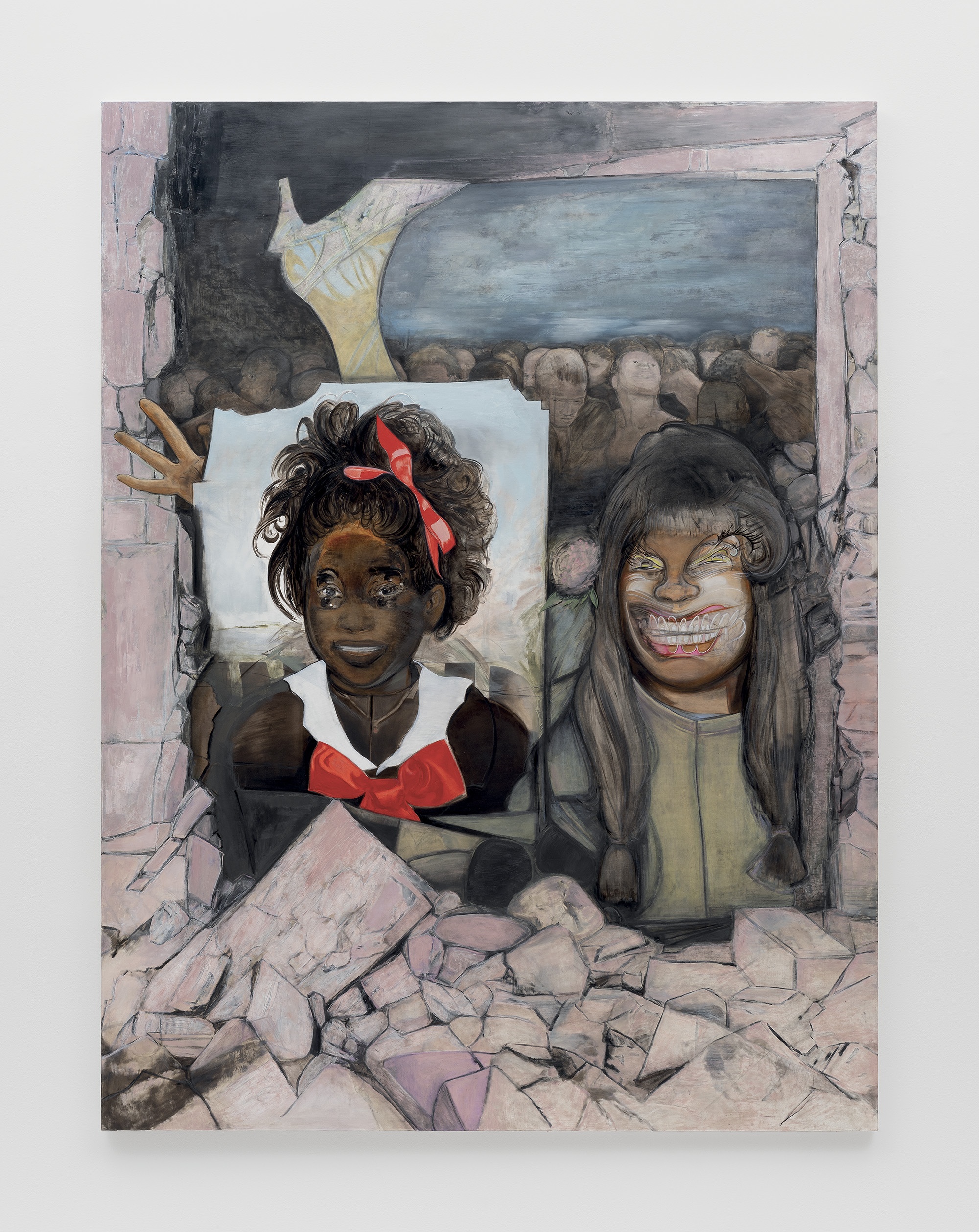
St. Williams, 2024 Photo: Joerg Lohse
Courtesy: the artist and 47 Canal, New York
And yet the works never feel purely chaotic. There is a strange coherence to them, as if all these fragments belong to the same unstable world.
This is where Ellis’s work begins to exert its particular kind of influence. The paintings do not propose alternative histories directly. Instead, they alter the visual structures through which those histories are usually imagined. By shifting the symbolic language of painting, its figures, landscapes, gestures, and myths, Ellis intervenes in the way these images continue to circulate in the present.
You leave the paintings with the sense that the story they belong to has not quite settled yet.
One painting in particular makes this feeling almost literal, though the image is not isolated within her practice. Variations of this swirling structure appear repeatedly in Ellis’s work over the past several years. The composition folds inward, spiraling toward a dense, dark center that feels less like a horizon than a collapse. At first glance it resembles a kind of vortex, a black hole pulling everything around it into motion.
But the closer you stand to it, the less cosmic the image becomes.
Along the outer rings of the painting, bodies begin to appear. They are sketched quickly, almost provisionally, suspended along the circumference as if caught in orbit. Some climb, some fall, some seem to brace themselves against the curvature of the space they occupy. None of them feels fully anchored to the ground. The surface behaves less like a landscape than a rotating field.
What initially reads as a monumental composition begins to feel more like a system collapsing under its own gravity.
The painting carries something of the structure of an allegorical image, the kind of composition that once attempted to visualize divine order or historical inevitability. But here the center refuses that role. Instead of revelation or transcendence, there is only a kind of implosion. The deeper the eye moves into the spiral, the more unstable the image becomes. Figures dissolve into brushwork, gestures blur into atmosphere, the vortex tightens.
Standing in front of it, the eye keeps circling the surface. The figures along the edge of the composition almost function like witnesses, caught at different stages of the same movement.
Everything seems pulled toward the center, yet the center itself remains opaque.
It is difficult not to think about CERN, just outside Geneva, when looking at it. There, particles are accelerated through enormous circular tunnels, colliding at extraordinary speeds in order to glimpse the fundamental structure of matter. The architecture of the collider is itself a ring, a loop through which invisible forces are measured.
Ellis’s painting carries a strangely similar structure, a circle, a center, a field of bodies pulled into relation.
But where the collider attempts to produce clarity, the brief appearance of a particle, the evidence of an underlying order, the painting refuses resolution. The deeper the eye moves into the spiral, the less certain the image becomes. Marks turn into atmosphere. Figures dissolve into movement.
The center remains resistant to explanation.
It is only later that the title returns to mind.
Geneva.
The name initially appears as a geographical reference, though Ellis has never been there. It comes from a misunderstanding she has encountered throughout her life. When people hear her name, they often respond automatically, Geneva, Switzerland. The correction comes a moment later. The assumption always arrives first.
Like the paintings themselves, the title begins with recognition before quietly displacing it.
And perhaps that is the quiet force of Ellis’s work. It allows recognition to happen, a figure, a landscape, a symbol, only to loosen its certainty. The image shifts, reorganizes itself, and what once seemed stable begins to move again.
You realize, slowly, that what you thought you understood was only the first layer of the painting.
Janiva Ellis
Text by Mohamed Almusibli
CURA. 46
Soft Power
The New Now
JANIVA ELLIS (b. 1987, Oakland, CA, US) lives and works in New York. Recent solo exhibitions include: Geneva, Kunsthalle Basel (2026); Fear Corroded Ape, Carpenter Center for the Visual Arts, Cambridge, MA (2025); StackedPlot, 47 Canal, New York (2024); Hammer Projects: Janiva Ellis, Hammer Museum, Los Angeles (2022), among others. Ellis’s work has been recently included in group exhibitions at venues including: Dallas Museum of Art (2023); Dark Light: Realism in the Age of Post Truths, Aïshti Foundation, Lebanon (2022); 2019 Whitney Biennial, New York (2019); and 2018 New Museum Triennial, New York (2018).
MOHAMED ALMUSIBLI is Director and Chief Curator of Kunsthalle Basel. Since 2026, he has been a member of the Swiss Federal Art Commission (EKK) and the Artistic Committee of Mécènes du Sud. He served as an advisor to the Hartwig Art Foundation in Amsterdam and as a lecturer at ECAL – École cantonale d’art de Lausanne. In 2019, he co-founded Cherish, an independent art space in Geneva. In 2021, he launched “Almusibli Panorama”, a year-long online video program for the Centre d’Art Contemporain Genève.