Untitled (after)
Kunsthalle Münster
December 13, 2025–March 29, 2026
Press release
With Untitled (after) the Kunsthalle Munster will present the first solo exhibition by Jelena Bulajic in a German institution, providing an overview of the work of the Serbian artist. Bulajic’s works are tools for exploring the media-mediated view of the world, speculations about dimensions of reality. They possess their own logic of showing and revealing, emerging from an intensive engagement with the pictorial, its conditions and possibilities.
The exhibition brings together various groups of works by the artist, including new pieces created especially for the presentation at the Kunsthalle and, for the first time, sculptures. The juxtaposition of the different groups of works and the interplay of figuration and abstraction reveal a concept of image-making that invites viewers to engage with perception. At a time when we are constantly surrounded by digital images and confronted with the same reception on the screen, Bulajic uses the conditions of painting and sculpture to see. In doing so, an examination of what we call images, as the artist carries it out, questioning their narrative and truth content, seems to be of particular importance, especially against the backdrop of the ubiquitous flood of images. It is about training the senses. Her play with reality requires concentration, close observation, and questioning of what we see.
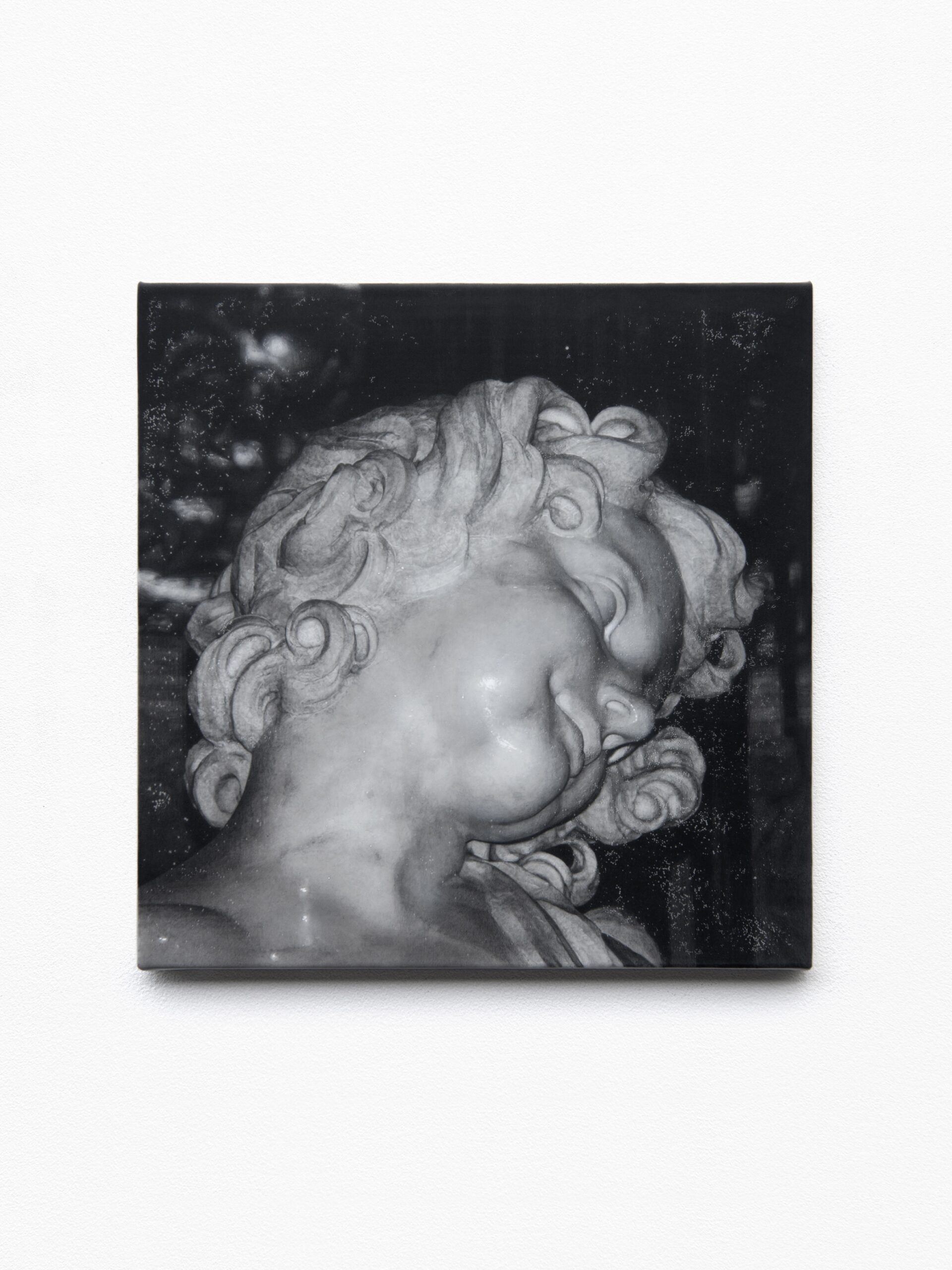
Untitled (after Bernini), 2020, Courtesy of the artist and carlier | gebauer, Berlin/Madrid. Photo: Jelena Bulajić

After Sugimoto, Alaskan Wolves, 2024, Courtesy of the artist and carlier | gebauer, Berlin/Madrid. Photo: Jelena Bulajić
Bulajic explores the medium of painting in its various facets. While it is primarily the motif that attracts the viewer’s attention at first glance, on closer inspection it is above all the tactility and surface that are significant. Painted with a mixture of marble dust, ground granite, limestone, and kaolin, the existential spirit of the works is not a contemplation of mortality, but rather a formal exploration of tactility and surface. In recent years, Bulajic has expanded traditional notions of portraiture beyond the human figure and extended her treatment of surface as a dualistic reflection of physical layers: structures of the human skin, water, rocks and the paint itself with all its physical qualities, are the “raw material” of her works and constitute their physicality, the skin of the picture. The sky, the water, and the abstract works are “mere surfaces of paint and pigment,” according to Bulajic. One sees structures in shades of gray with countless small, branching elevations and depressions. The image detail is chosen in such a way that spatial depth is not recognizable. The context of the paintings can only be deduced from their titles. For example, her paintings of the Spree depict detailed sections of the river and reproduce the texture of its surface in a photo-realistic manner. Viewers are seduced into losing themselves in it. In these works, the artist creates an abstract composition that testifies to her meticulous investigations of the structures of water.
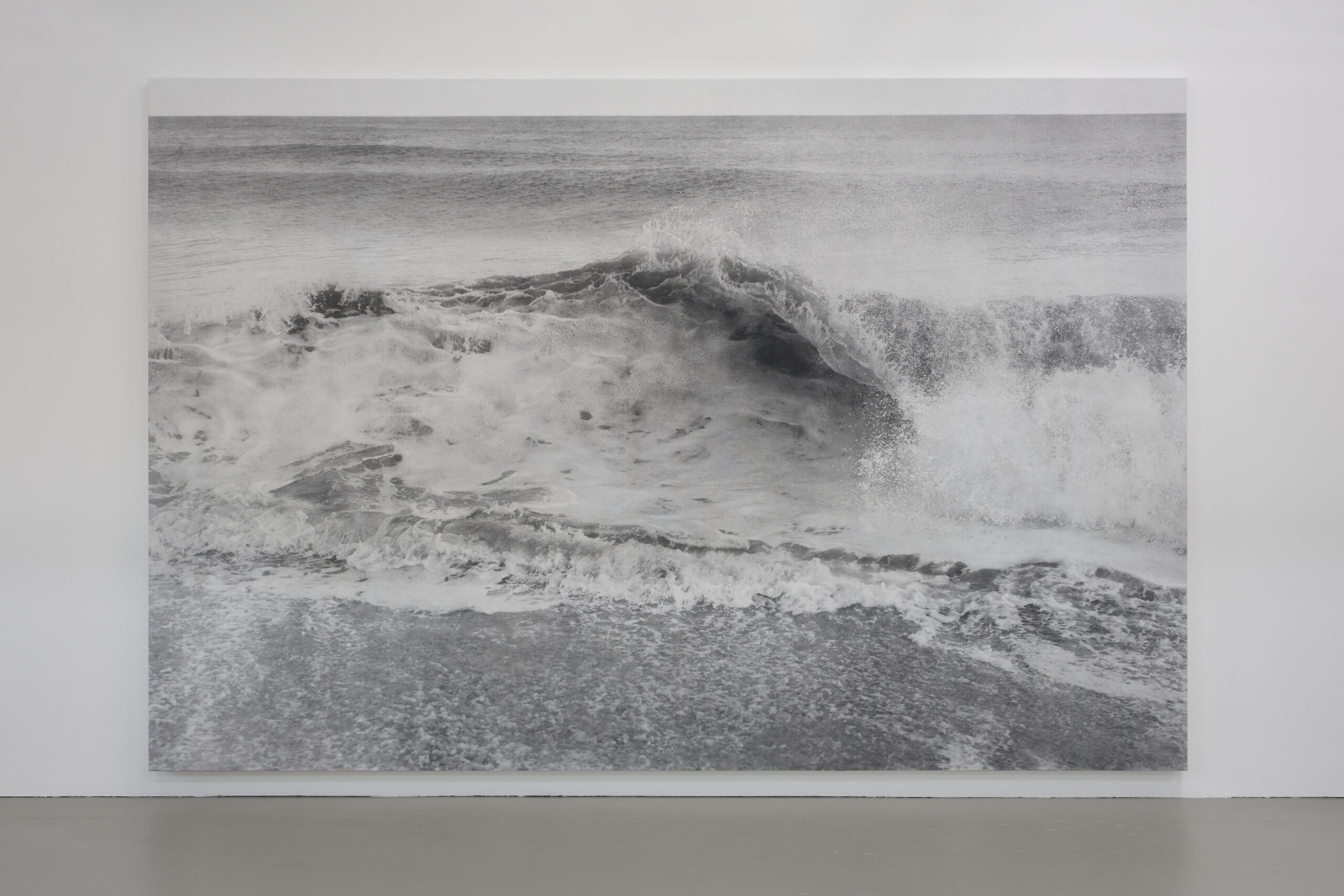
Untitled (after Tillmans, Atlantique), 2025, Courtesy of the artist. Photo: Kunsthalle Münster / Moritz Hagedorn

White on Black 1-4 (40) (detail), 2025, Courtesy of the artist. Photo: Kunsthalle Münster / Moritz Hagedorn
In her most recent paintings, Bulajic focuses on works by other artists, including Gian Lorenzo Bernini, Wolfgang Tillmans, and in her latest pieces, Hiroshi Sugimoto. This allows her to dispense with subjective expression when choosing her motifs and to penetrate directly into the levels of meaning beyond what is depicted. By working with templates, sometimes well-known motifs, she can concentrate on the craftsmanship. The surfaces-the cracks, lines, and traces of age that she deliberately causes-are the actual subject. Using painterly means, Bulajic questions the memorable power of evidence, examining perception and the role played by the artificiality and nature of images. The paint itself appears as a living material-something that a motif readily conceals. By appropriating Hiroshi Sugimoto’s Dioramas for her series After Sugimoto (since 2023), Bulajic’s representational paintings refer to a mediated reality. The iconic reference, which in Sugimoto’s case is deeply connected to the qualities and characteristics of the medium of photography, allows the artist to inscribe herself into a play of realities that begins with the diorama itself. It is about questions of presentation and representation, seeing through of deception, a raising of awareness of the fundamental relativity and inadequacy of one’s own perception. Through their repetition, symbolic repurposing, and formal, content-related, and aesthetic modification of their models, her works are part of a process of difference formation that is inherently impossible to think through to its conclusion.

After Sugimoto, Alaskan Wolves, 2024, Courtesy of the artist and carlier | gebauer, Berlin/Madrid. Photo: Jelena Bulajić
This impossibility of thinking things through to their conclusion also seems to be decisive for the group of works White on Black (since 2024)-a group of supposedly monochrome works in various formats. As the title suggests, Jelena Bulajic limits herself here to working in only two colors, creating something chromatic out of the achromatic. By applying dozens of layers of black and white lacquer to transparent Plexiglas, she creates various brilliant shades of blue. The areas of color absorb and reflect their surroundings. Nevertheless, a visibly painterly effect remains, as the works do not produce a perfect reflection or a clear naturalistic image. Despite their clear refusal to make a statement, the reflection on the glossy paint allows the works to connect with their immediate environment. It is a dynamic that draws into the passive stillness of the images. Everything in the here and now is inevitably incorporated into the works, so that they move between painting, photography, film, and tableau vivant. Bulajic creates a vivid experience of reality. Images emerge in the plural, infinite, ephemeral, and thus unstable images. When comparing or viewing her photorealistic works alongside her supposedly abstract series White on Black, one is confronted with the question of what media-mediated realism actually means. In different ways, both groups of works are declarations of faith in the medium of painting and its qualities in relation to photography. It is not representational realism, but rather a questioning of it. It is the deception that fascinates her, the disappointment with which she herself works. Her pictures reveal their artificiality.
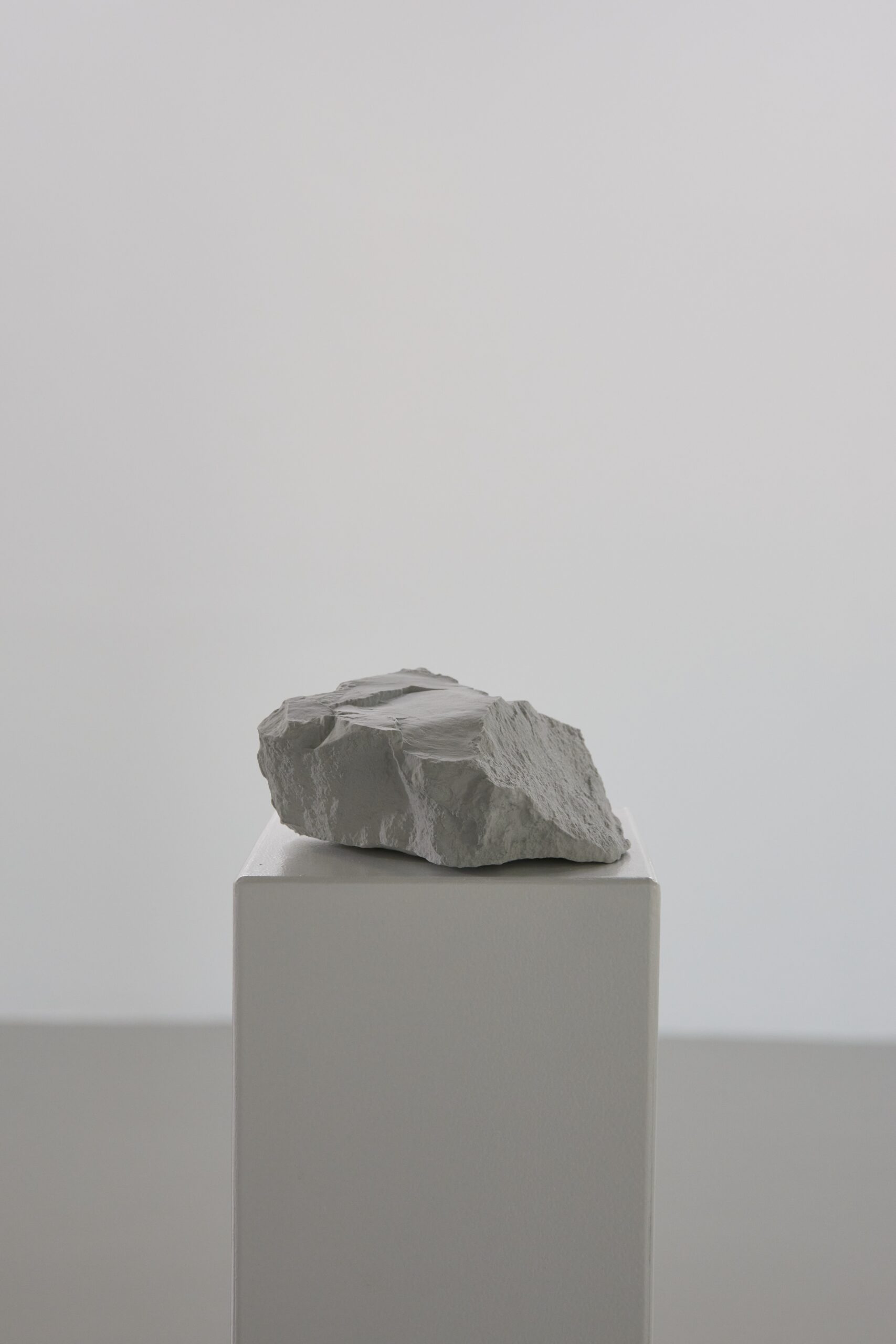
After Stone 1-1-3, 2025, Courtesy of the artist. Photo: Kunsthalle Münster / Moritz Hagedorn
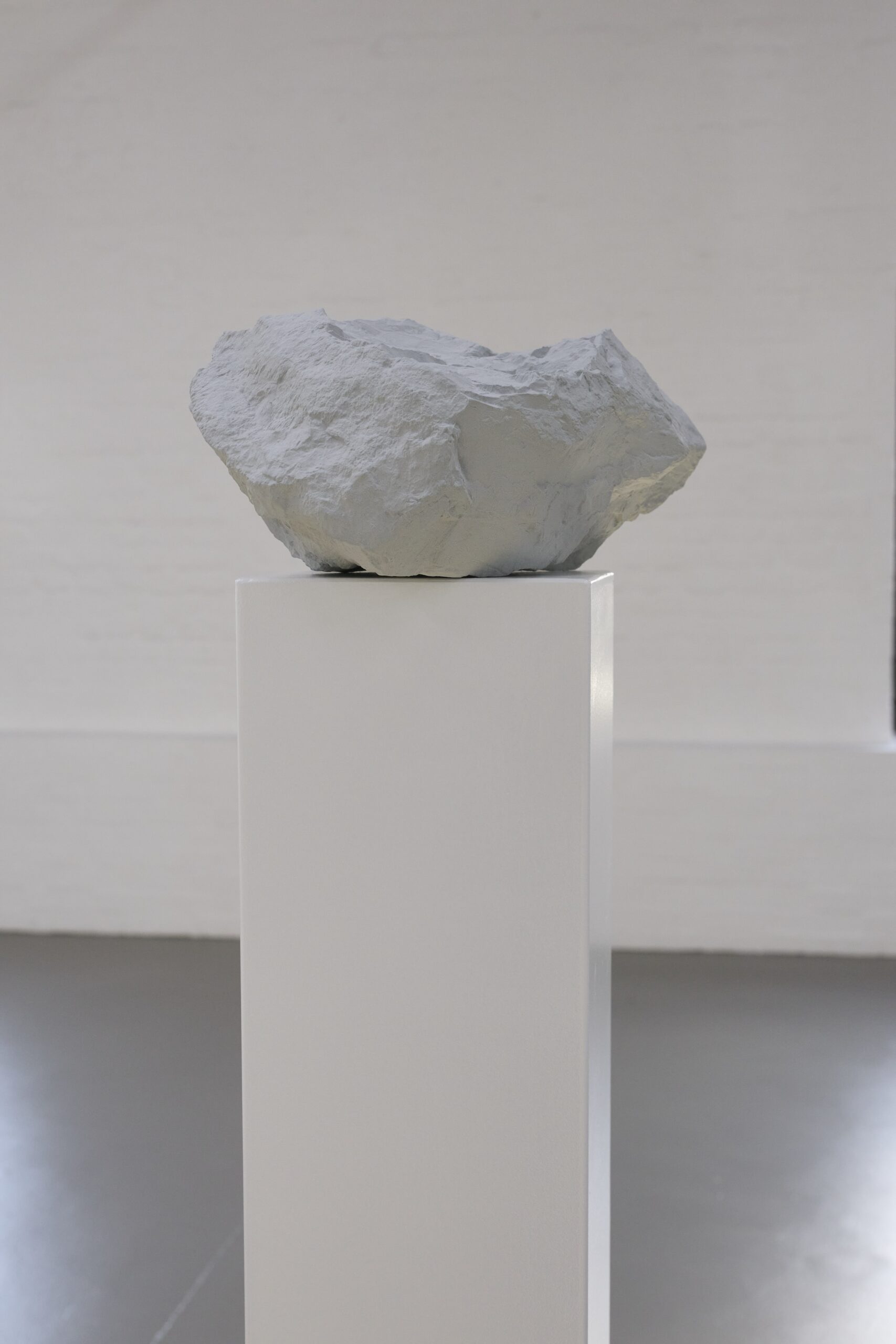
After Stone 1-2-1, 2025, Courtesy of the artist. Photo: Kunsthalle Münster / Moritz Hagedorn
Given her preoccupation with the materiality of paint and the surface of painting, Bulajic’s turn to sculpture seems like a logical next step. Her series After Stone (2025) reflects on the ambivalence of fragility and stability and explores questions of permanence and transience. Her fragile objects made of porcelain clay reproduce objects that stand for timelessness. Materiality and form drift apart and yet remain close. Created from earth and minerals, Bulajic’s stone replicas represent both a natural and an industrial landscape, yet also appear as containers, since a stone virtually contains all possible forms that can be carved out through a sculptural gesture. In their attempt to convincingly replicate nature, Jelena Bulajic’s stones are both natural and artificial at the same time.