Text by Caterina Avataneo
CURA. 44
The Generational Issue
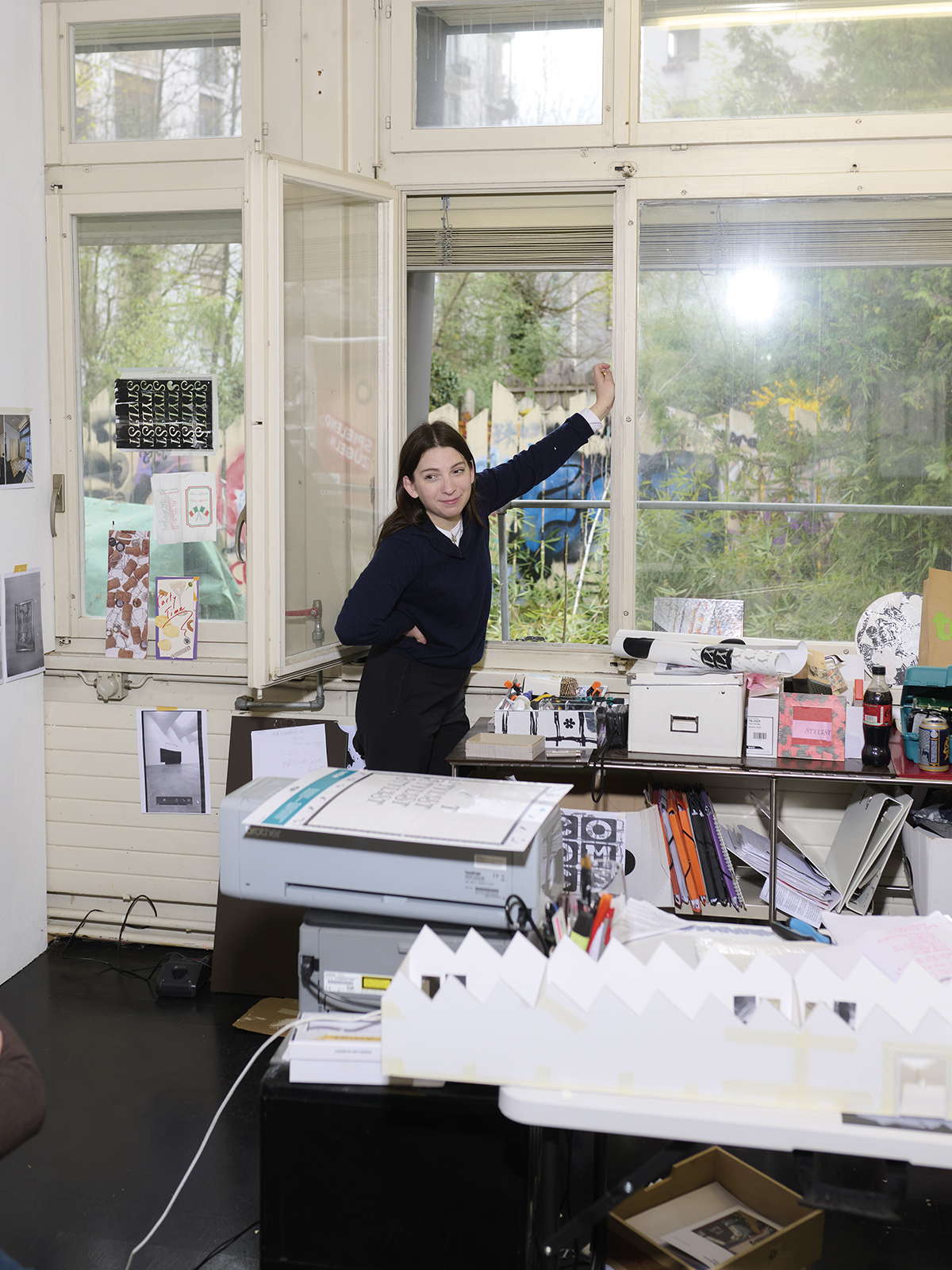
Portrait by Flavio Karrer
Let me start with a gossip. I will be opaque in my telling for privacy reasons, but the last time I video-called Lorenza Longhi I learned a fun fact so quintessentially “Longhi” that it can’t be omitted here. The artist’s new flat in Zurich must have extra gravitational forces or some sort of curse, for things keep falling. It happened with a coat rack first, then with the top of a hanger, and then, most tragically, with a piece commissioned to Longhi a few years ago, which had since become part of the artist’s private collection. It consisted of a vintage mirror with engraved text, which has now been replaced by a counterfeit DIY cheaper twin, looking quite the same.
Longhi often employs voyeuristic observation and imitation as strategies to engage with desire in consumer culture, exploring its entanglements with obsession, aspirational luxury, or unabashed abundance. She approaches the symbolic and material language of the fashion and advertising industries and pins down how prestige and desirability are constructed, displayed, and performed within Western capitalist society while also hijacking their protocols through the act of amateur making. “I am moved by a spontaneous urge. I need to know, and I know by doing,” Longhi told me during our first conversation. The core of her practice is less of a critique of post-capitalist obsolescence and its related precariousness than a personal engagement with these dynamics. A notable example is the recurrence of camellia flowers in her practice, which began in 2021 after being struck by a giant open-air Chanel pop-up store in New York. Following YouTube instructions, the artist started obsessively reproducing camellia brooches made with scraps of old found fabrics, which were turned into a series of small-scale sculptures with a spy camera as their pistil. These have since become one of the motifs of her signature silkscreen paintings and, most recently, they have also appeared in a series of large-scale photographic and serigraphic prints included in World of Yum Yum (2024), the artist’s first solo show in the US held at the at the Swiss Institute in NY.
Over the years, Longhi has patented a rather dysfunctional screen-printing technique that involves the direct application of stencils, stickers, textiles, and other solid elements of various nature on deadstock nylons, fabrics, and Tyvek. The absence of a matrix determines the uniqueness of each piece. By chance, prints are accidentally left on the surfaces, or new elements are deliberately added to mark their differences. In other words, Longhi strips the technique of its potential for modulation and seriality, adopting blunder, imperfection, and failure as appreciable standards, where spontaneity is retained in playfulness.
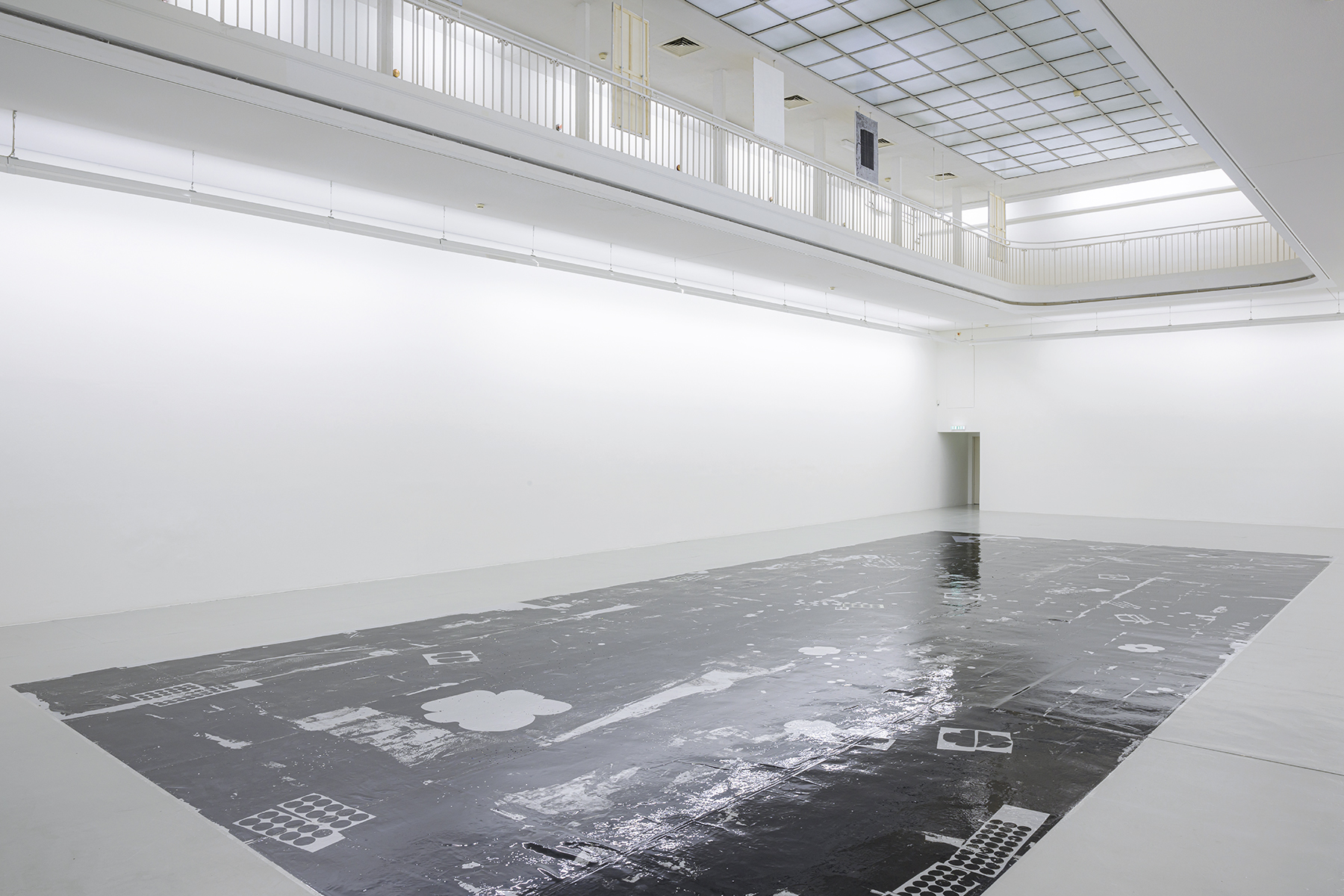
Dazzle Dazzle, installation view, Kunstverein Freiburg, 2025 Photo: Marc Doradzillo
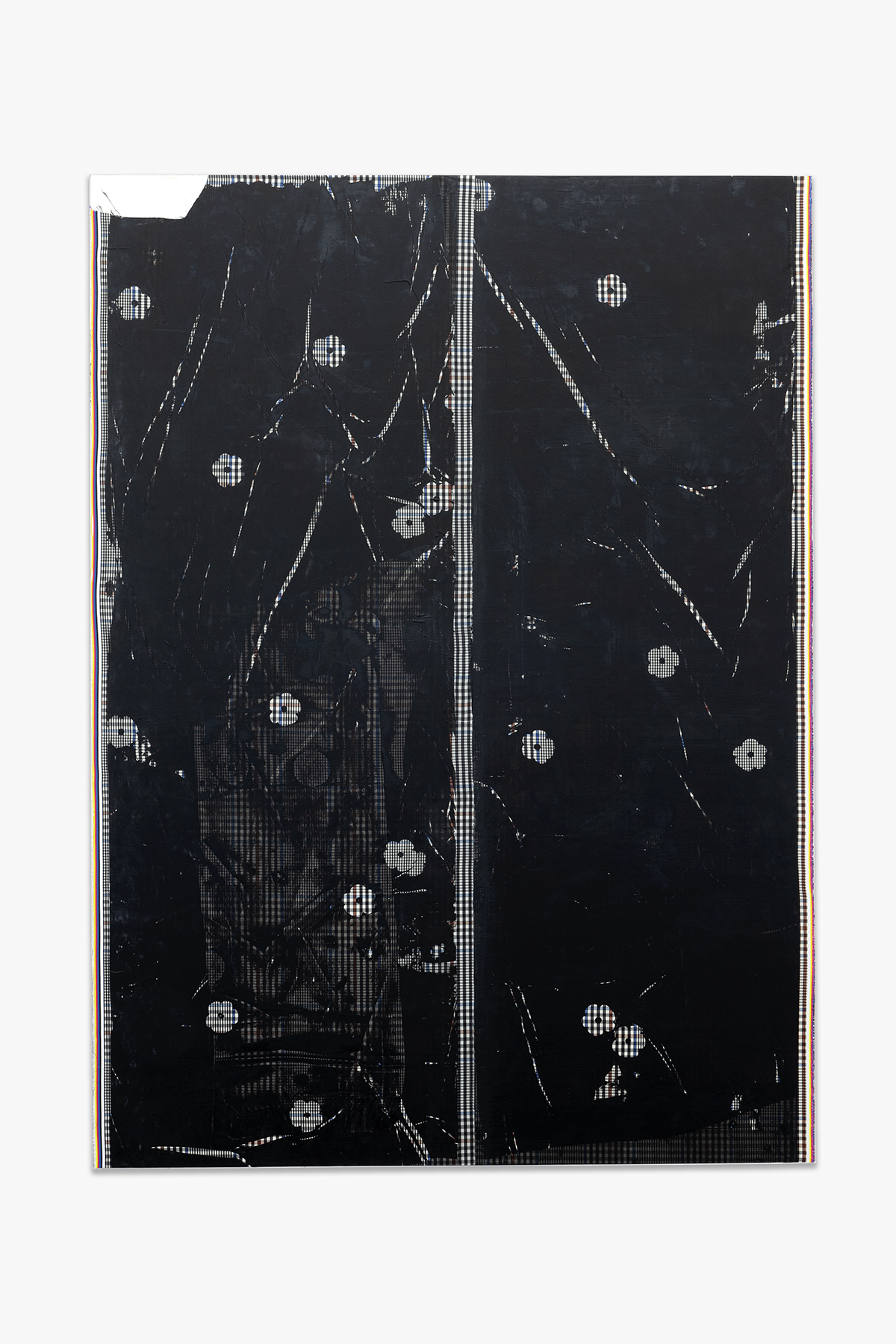
Shot Point 2, 2023 Photo: Gina Folly
Such an attitude for intercepting common protocols and altering their standards is also traceable in the fact that Longhi’s set-ups often toy with the given architecture, making the most of existing structures while also manipulating the perception of the space, be it with mirrors, movable panels, adhesive films or nylon separators. To give an example, in Fuori – Quadriennale d’Arte di Roma (2020), she added a temporary ceiling made of thick plastic film, which mimicked the skylights of 19th-century museums diffusing a cold light into the room and, most importantly, lowered this “top level” with a cheap material. Design and display also play a fundamental role in Longhi’s investigation of tastefulness, spanning from formats inspired by traditional museal systems to settings that echo the retail industry, often resulting in a trickle-down between kitschness and sobriety. In her solo show Minuet of Manners (2021) at Kunsthalle Zürich, for instance, Longhi adopted a hanging system inspired by the one developed in the ’80s by Italian architect Gae Aulenti for the Musée d’Orsay; while in The Olds (2022) at Fanta-MLN, trash-sourced mirrored panels and a series of plinths inspired by the iconic mid-century USM Haller modular furniture design gave the show an emporium vibe, emphasized by the fact that the whole space was turned into a sort of improvised system of surveillance where mirrors won their way over the (deactivated) spy cameras embedded in the small-scale camellias sculptures mentioned earlier—and featured in the show.
Polka dots and sequins are another of the artist’s obsessions. Like the camellias, these recur in her silkscreen paintings, which have recently begun to take on a circular form—allowing the pattern to assert itself over the structure. Ornament takes center stage in Longhi’s practice, jauntily reclaiming the power to strip down seemingly fixed systems and redefine notions of value and permanence. An image she sent me a while ago comes to mind: it showed a vintage evening gown belonging to the Met Costume Institute NY, whose mesh structure had been torn apart by the sheer weight of its clustered sequins. This is key to understanding both Longhi’s fascination for whatever defies infrastructural rigidity—existing ‘off the grid’—as well as her frequent references to lavish atmospheres gone bad or, more broadly, moments when glamour is inextricably tied to frivolousness in self-deprecating manners. Currently, she is working on Festive Routine, a major public commission that will see buildings and various urban elements of St. Gallen’s Marktplatz and Bohl permanently ‘dressed up’ in gowns, collars, patches, ribbons and bustiers. The project draws from the region’s textile and decorative history—and, of course, sequins could not be missed, here oversized and crafted from recycled aluminum offset printing plates sourced from local print houses.
This leads to a final consideration worth highlighting: the role of trash in Longhi’s practice, both materially, aesthetically, and conceptually, as she traces ostentation through its remnants. Engaging with debris is another of the artist’s means of understanding the codes of taste and desire and an urge to reenact these in her own way. Dazzle Dazzle (2025), her latest solo show at Kunstverein Freiburg, included a new site-specific floor piece composed of silkscreen-painted PVC and leftover materials from the exhibition’s production. The piece drew inspiration from an ancient Roman mosaic preserved at the Vatican Museums, whose decorative theme is known as asàrotos òikos or “unswept floor” and depicts food scraps left after a rich banquet. One might think this was yet again a ‘Longhiesque’ counterfeit, giving ancient unabashed abundance a rather familiar prom-like look. The artist has even started experimenting with a personalized system of documenting exhibitions with disposable cameras, making limited edition zines. No doubt a common teen kink but also very much an alternative to stiff and homologated official installation views. Clumsy or raw, Longhi’s practice at large retains an elegance dictated by its unbridled essence, where taste exists beyond the glare of pre-packed consumption.
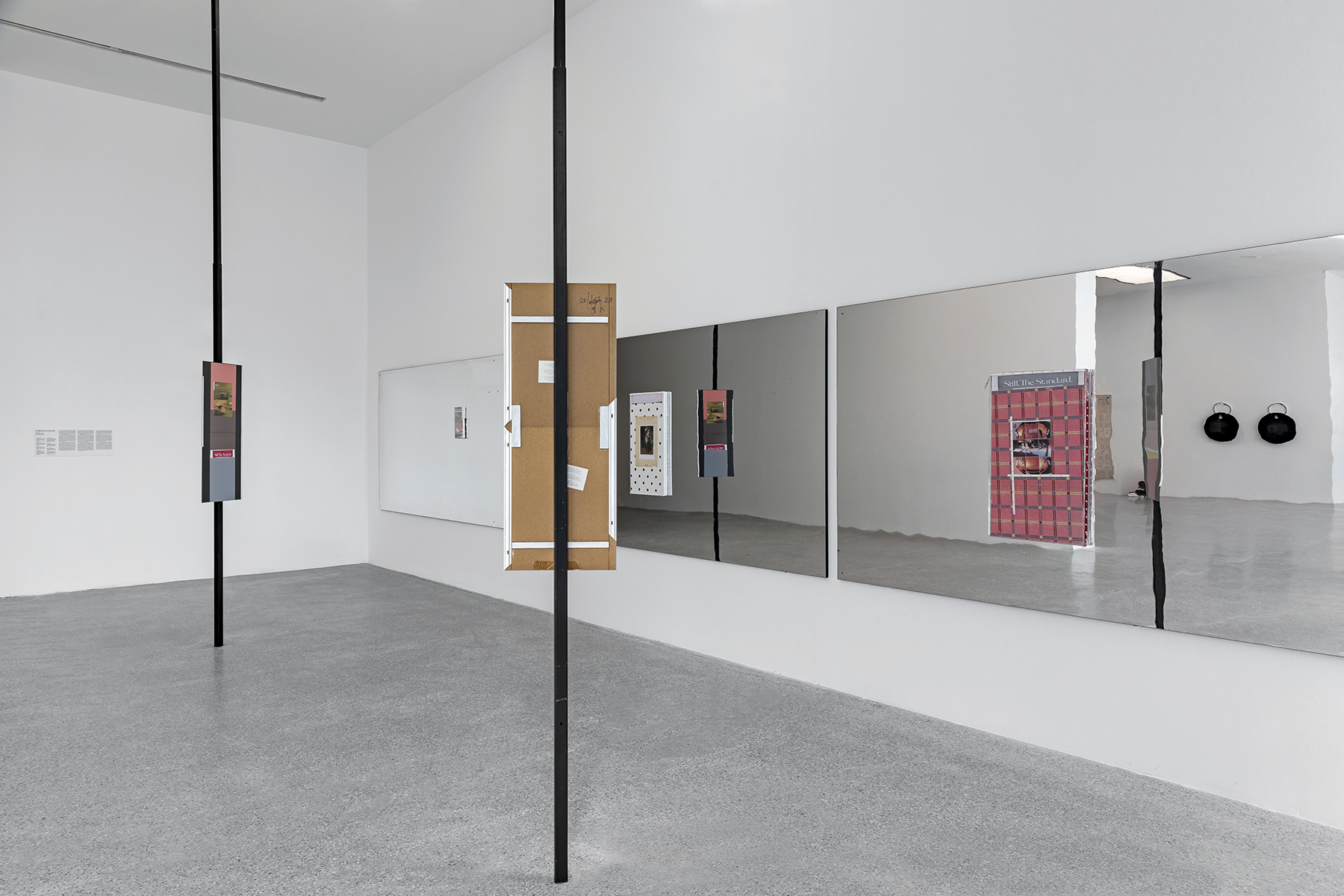
Renaissance, installation view, Museion, Bozen, 2024 Photo: Luca Guadagnini
Lorenza Longhi
Text by Caterina Avataneo
CURA.44
The Generational Issue
All images
Courtesy: the artist, Fanta-MLN, Milan and Galerie Oskar Weiss, Zurich
Lorenza Longhi (b. 1991, Lecco, Italy) lives in Zurich. She had solo shows at: Kunstverein Freiburg; Swiss Institute, New York; Kunsthalle Zürich; Fanta-MLN, Milan; Weiss Falk, Basel-Zurich; and Plymouth Rock, Zurich. Her works have been included in group exhibitions at: Museion, Bolzano; Kölnischer Kunstverein, Cologne; HALLE FÜR KUNST Steiermark, Graz; Bonner Kunstverein, Bonn; Fondazione Prada, Venice; Ordet, Milan; Kunsthalle Zürich; Quadriennale di Roma, Rome; and Fondazione Sandretto Re Rebaudengo, Turin.
Caterina Avataneo is an independent curator whose practice emphasizes creative confabulation and methodologies of intimate exchange. She is curator at Cripta747 (Turin), and co-curator of the Digital Fellowship programme for Pompeii Commitment. Archaeological Matters (online). Previous curatorial appointments and collaborations include: Almanac Inn (Turin), Arcade (London), Club GAMeC Prize (Bergamo), Pina (Wien), Rupert (Vilnius), Salzburger Kustvrerein (Salzburg), Serpentine Galleries (London), Zabludowicz Collection (London). In 2019 she was assistant curator of the Lithuanian Pavilion for the 58th Venice Biennale.


