In conversation with Fabio Cherstich
CURA. 46
Soft Power
SPOTLIGHT
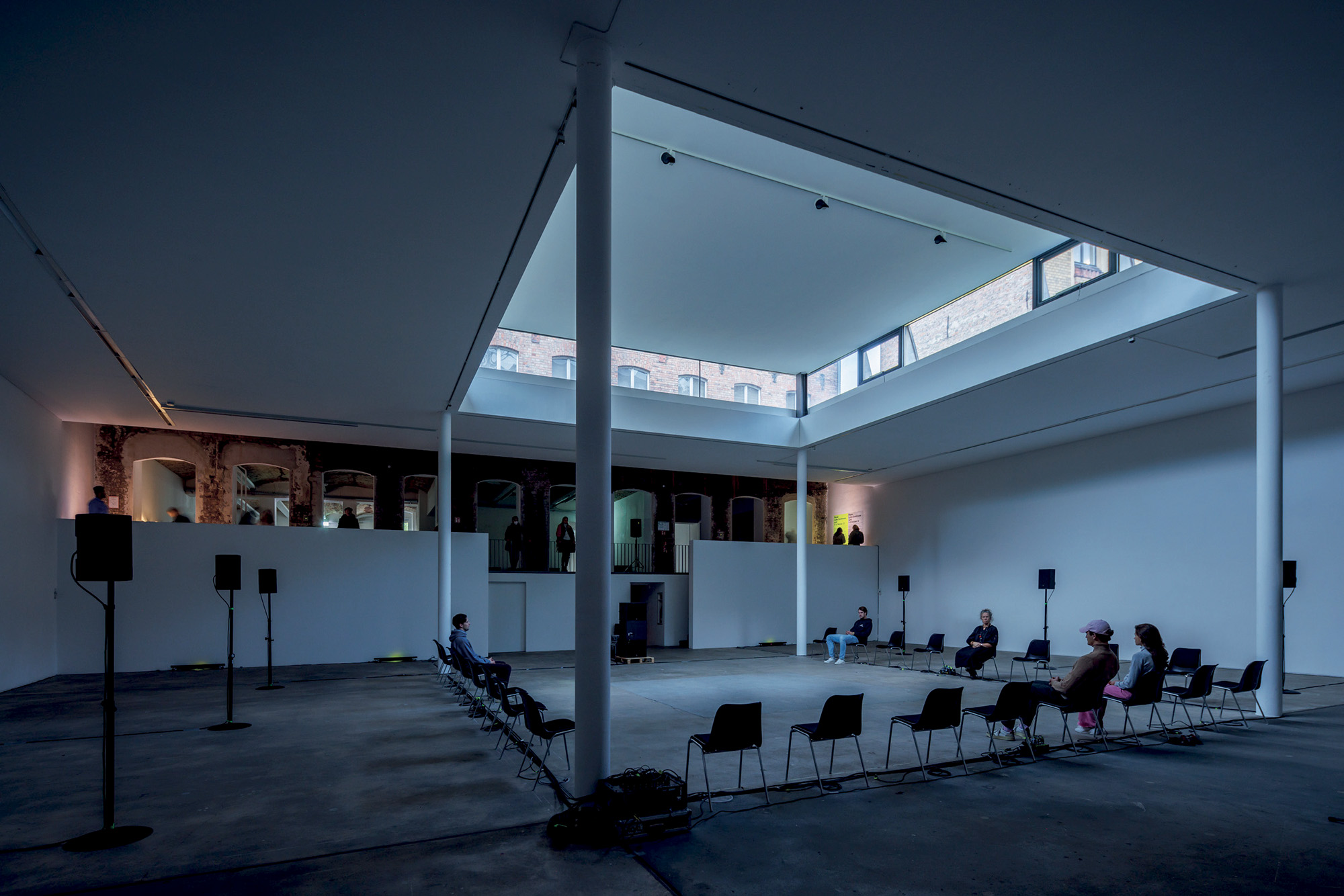
Pause: Lydia Ourahmane – sync, in collaboration with Daniel Blumberg, live sonic performance,
KW Institute for Contemporary Art, Berlin, 2022 Photo: Frank Sperling
Courtesy: the artists and KW Institute for Contemporary Art, Berlin
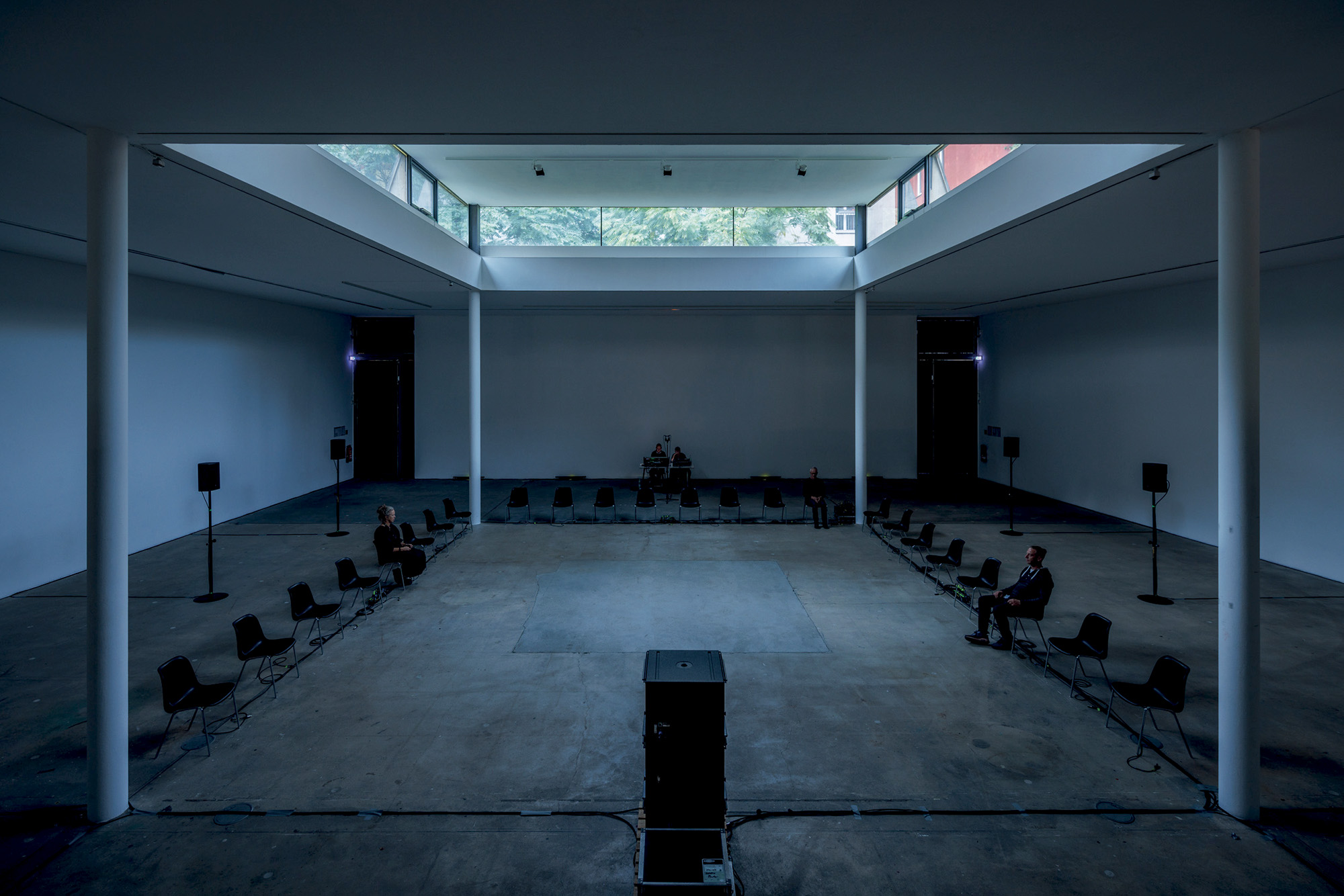
Pause: Lydia Ourahmane – sync, in collaboration with Daniel Blumberg, live sonic performance,
KW Institute for Contemporary Art, Berlin, 2022 Photo: Frank Sperling
Courtesy: the artists and KW Institute for Contemporary Art, Berlin
This conversation emerges from an invitation by CURA. to reflect on soft power through artistic practice. When asked to contribute, Lydia Ourahmane immediately came to mind. Her work has been followed for several years and made a strong impression at the 60th Venice Biennale, where it appeared as a practice operating not only at the level of form, but through systems—logistical, bureaucratic, architectural, and affective—that reorganize the conditions of experience.
In her work, soft power does not appear as a declared theme but as a method: a way of mobilizing trust, negotiation, invitation, and shared responsibility. Her projects unfold through infrastructures rather than objects, through processes rather than fixed forms, activating temporary communities and redistributing agency within institutions. What emerges is a relational approach to power, grounded in presence, duration, and participation.
This is evident in a constellation of recent works that redefine the relationship between institution, community, and authorship. At the 60th Venice Biennale in 2024, 21 Boulevard Mustapha Benboulaid (entrance) (1901–2021) presented a structure composed of doors and architectural fragments from the artist’s apartment in Algiers, reconstructed within the exhibition space. The work stems from the relocation of the apartment to sustain a sense of home across closed borders, turning a domestic threshold into a political and emotional device. Installed within the Biennale, it functioned less as a sculptural object than as an infrastructural presence, condensing bureaucratic processes, transport networks, and intimate histories into a single form.
A related understanding of power as embodied and temporal emerges in sync (2022–2024), a durational performance structured around amplified heartbeats and shared listening, where attunement replaces spectacle. Similarly, 108 Days at MACBA, Barcelona (2023–2024), transformed the museum into a space inhabited by 108 invited participants, unfolding as a durational occupation in which the work existed through encounters and presence, positioning participation as an infrastructural condition rather than a format.
This approach extends to earlier and parallel works where soft power emerges as a relational and geopolitical force. Barzakh (Kunsthalle Basel, 2021) was built around the reconstruction of the artist’s apartment in Algiers and the displacement of thousands of personal objects, forming an archive suspended between domestic intimacy and geopolitical history. Tassili (2022–2023), a film developed across multiple institutions and locations, engages with remote territories and layered temporalities of presence and absence. The Third Choir (2014–ongoing) is structured through the complex bureaucratic process required to export oil barrels from Algeria, where documentation, permits, and administrative negotiations become the core material of the work.
Across these projects, what emerges is a practice that mobilizes systems—legal, logistical, architectural, and affective—rather than simply representing them. Soft power, in this sense, appears not as a theme but as a method: an influence that moves through trust, invitation, negotiation, and shared responsibility. In Lydia Ourahmane’s work, temporary communities and infrastructures often redistribute agency within the institution, asking what it means to inhabit an artwork collectively and what forms of power are activated through such inhabitation.
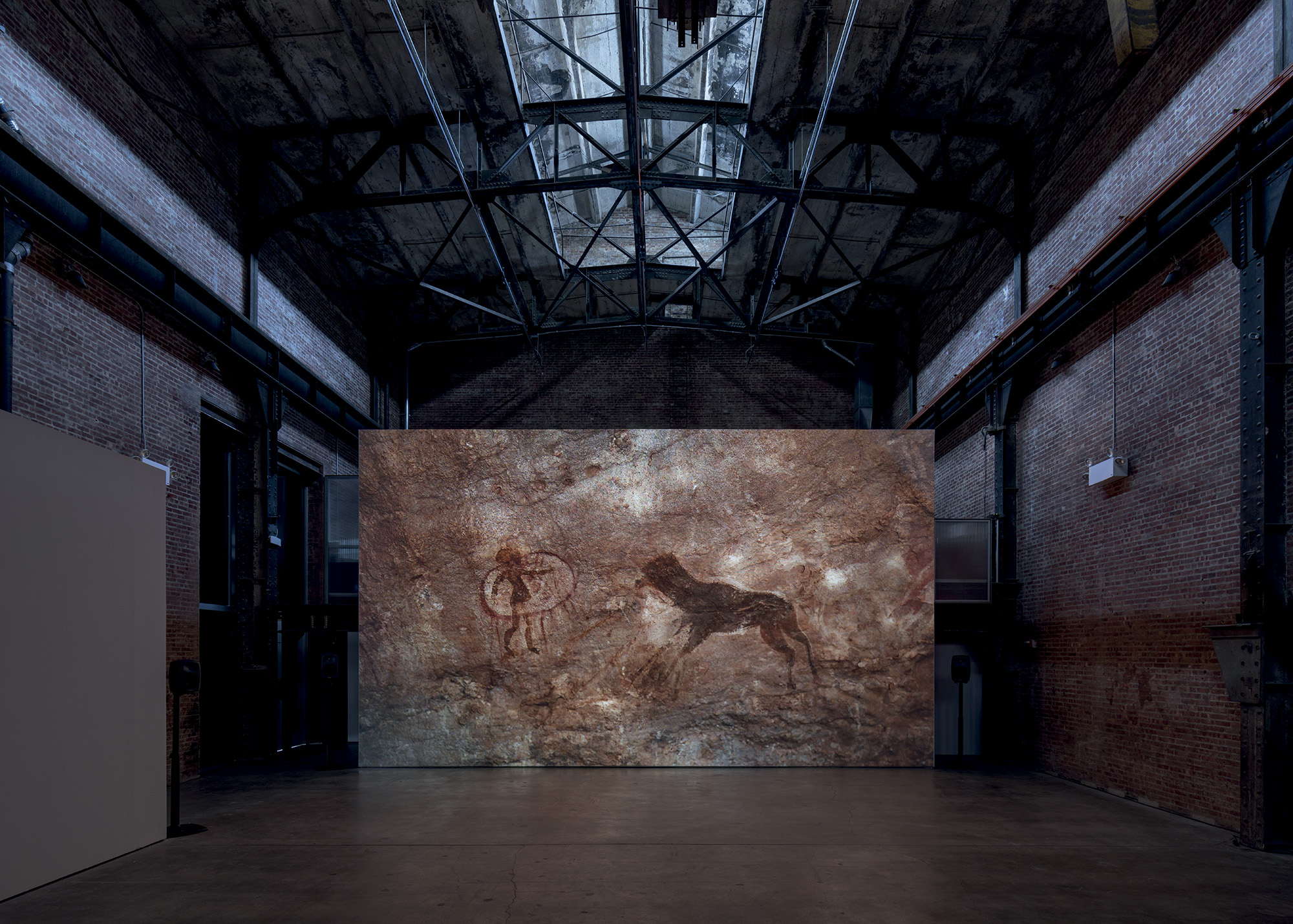
Tassili, installation views, SculptureCenter, New York, 2022
Photo: Charles Benton Courtesy: the artists
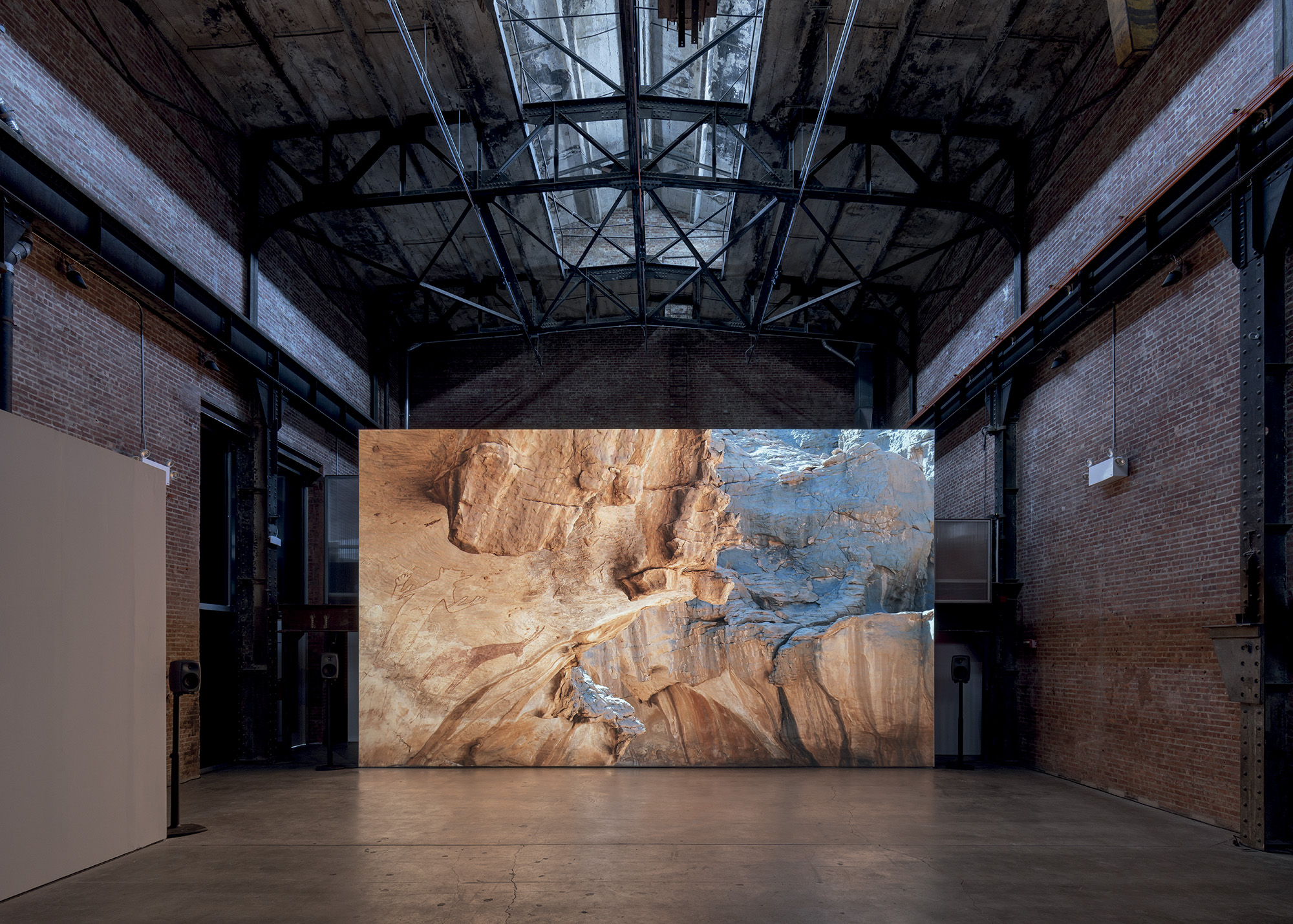
Tassili, installation views, SculptureCenter, New York, 2022
Photo: Charles Benton Courtesy: the artists
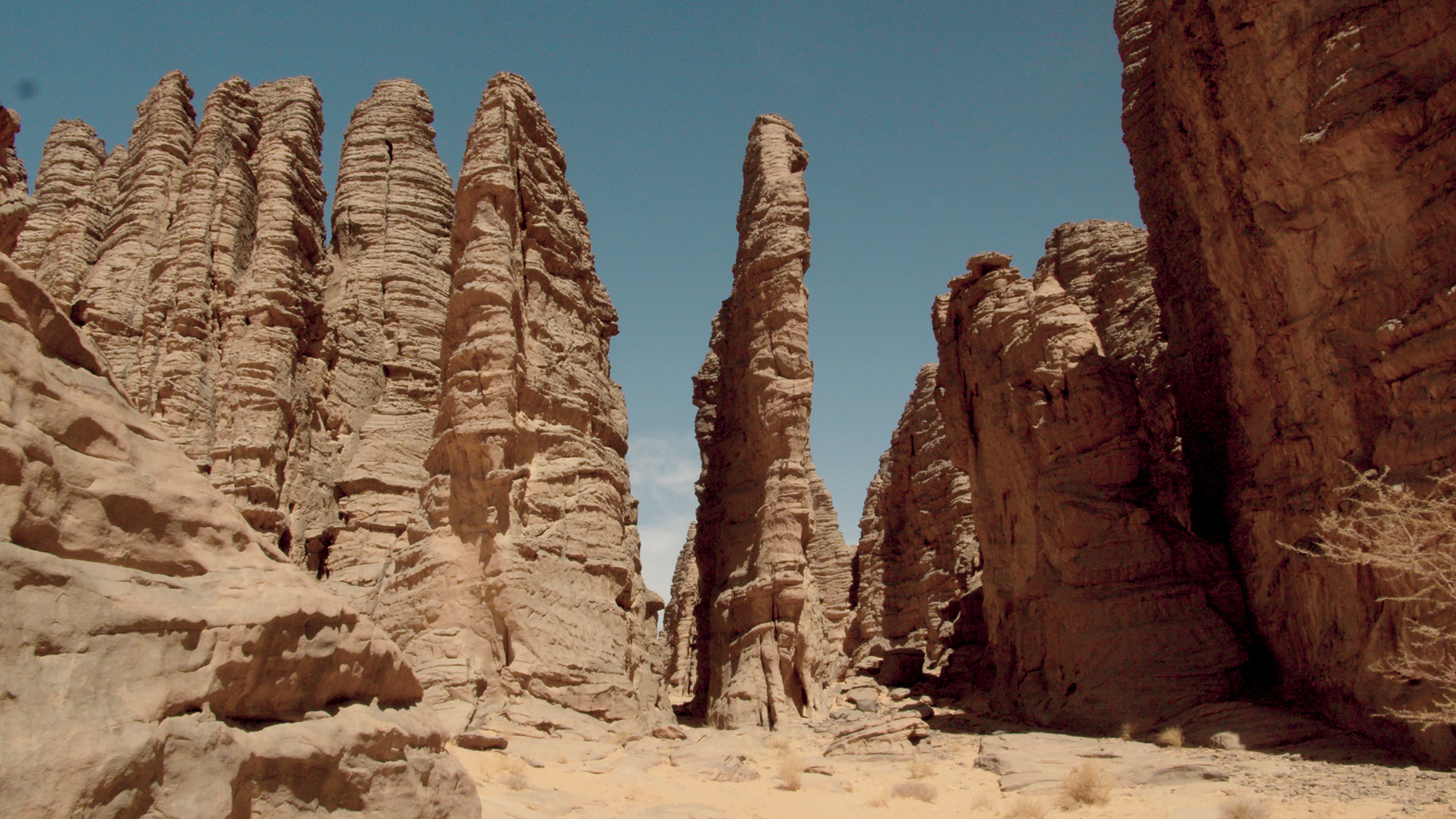
Tassili, video still, SculptureCenter, New York, 2022
Photo: Charles Benton Courtesy: the artists
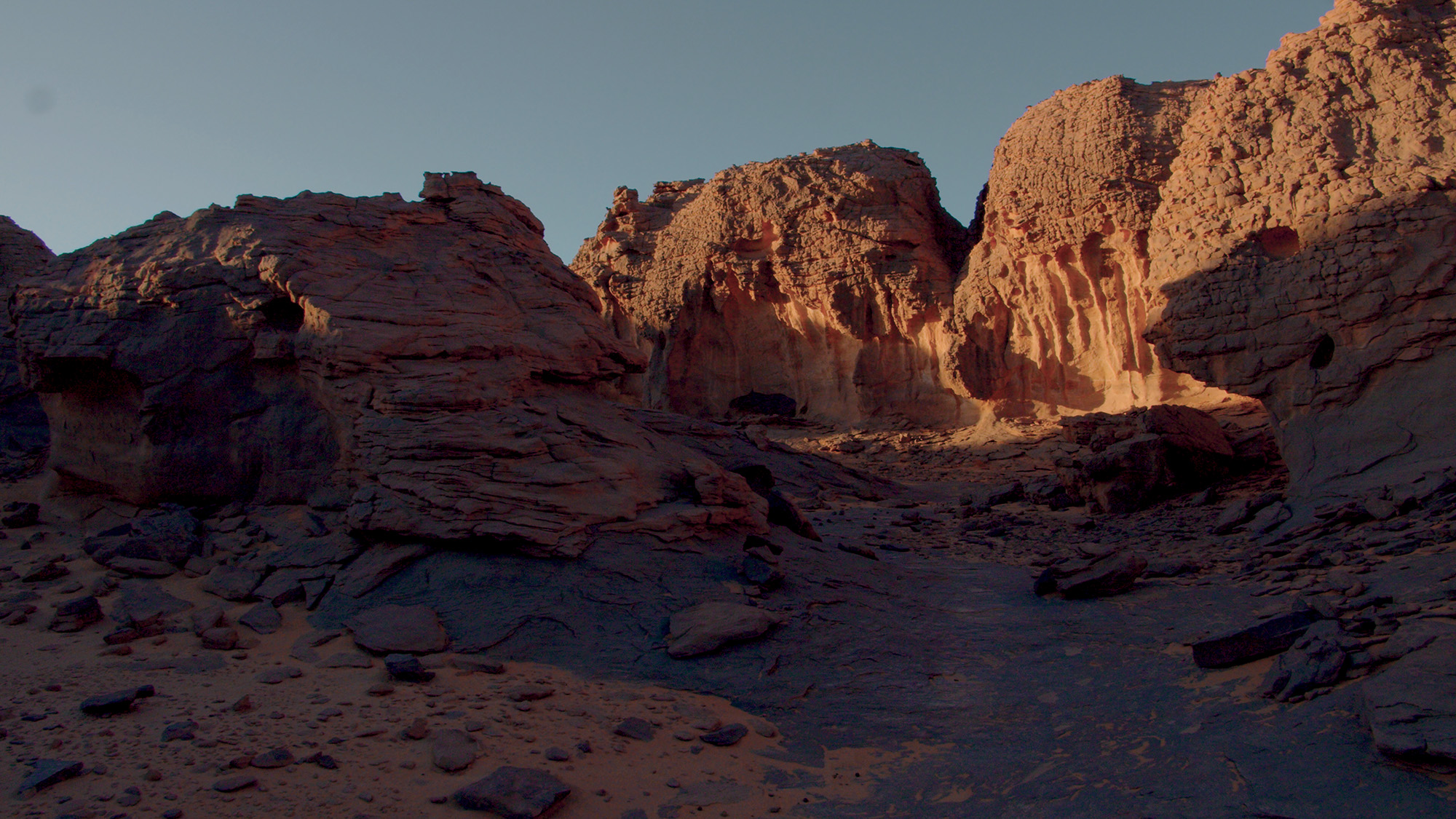
Tassili, video still, SculptureCenter, New York, 2022
Photo: Charles Benton Courtesy: the artists
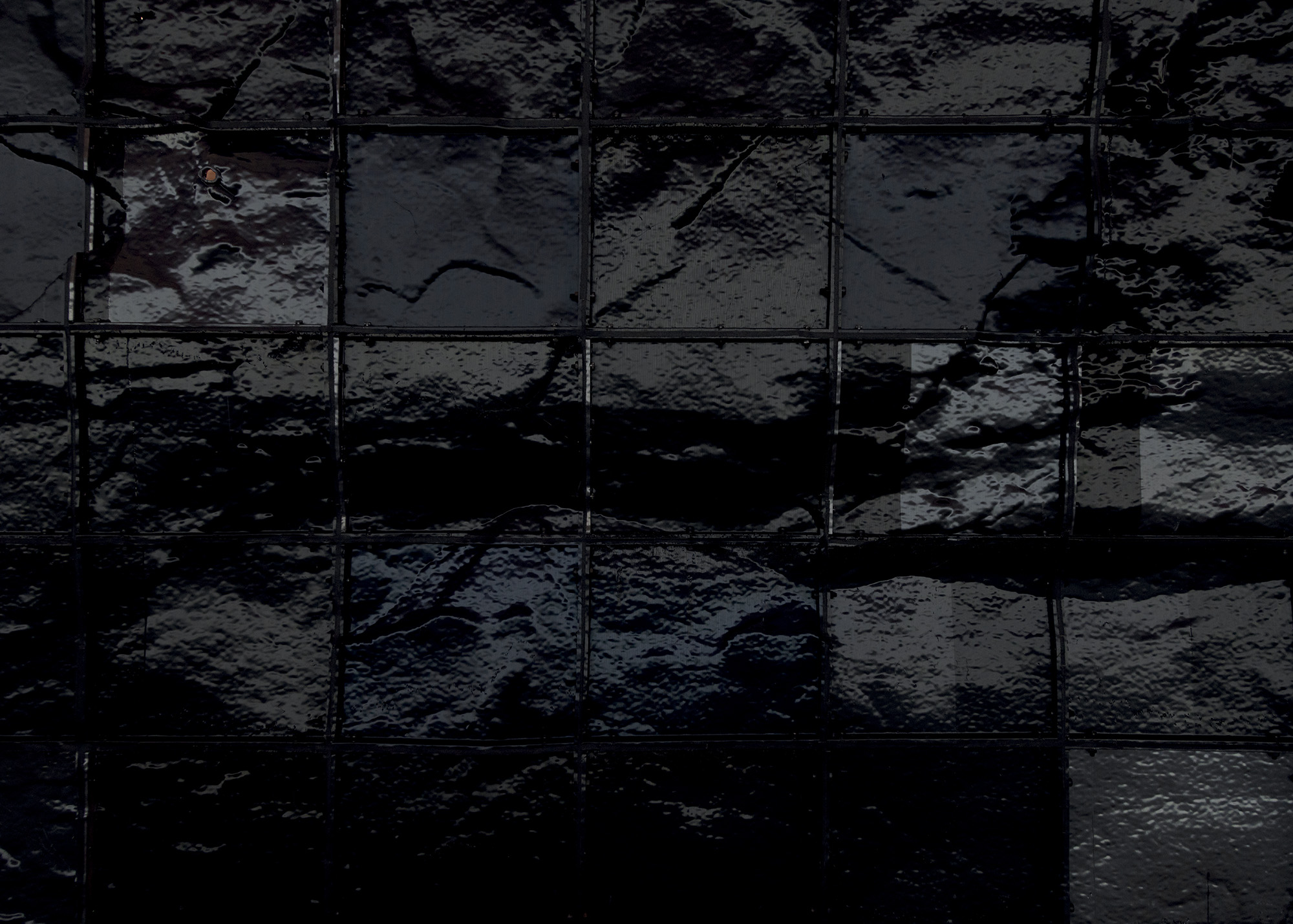
Tassili, installation views, SculptureCenter, New York, 2022
Photo: Charles Benton Courtesy: the artists
In 21 Boulevard Mustapha Benboulaid (entrance) at the Venice Biennale, the threshold of a domestic space became a geopolitical device. How did relocating and reconstructing this architecture reshape the understanding of home, permission, and mobility?
I think about situations, whether discrete or not, as interferences or insertions. The work passes through an existing infrastructure or re-routes a trajectory. I’m not necessarily interested in criticism, I’m interested in reform. Art for me is about life moving through it, where it becomes a sort of switchboard in real time to ask questions that engage with reality and seamlessly integrate it into a context. If a methodology is interactive, it becomes a collective experience. Soft power is the choreography of this parallel narrative. And the negotiation is how that situation unfolds and refolds reality into itself. We are contained by identity, where we’re born, grow up, and have our bloodlines… but then we have a cultural identity which isn’t strictly bound to location. At the same time, I think that birthplace will always hold you accountable to some desire to return, but return to what? That really made me think about return as something purely abstract. The idea of returning has more to do with investing time in a relationship with somewhere that you’re somehow disconnected from. Return becomes a way of spending time or articulating time through presence, which has nothing to do with going back. It’s about going forward. Moving to Algeria in 2018 was really steeped in this desire to remember, spending enough time to register the nuances that would otherwise be invisible. These are the layers to experience, and a domestic space was the only real locale for this thought. In 2018, I rented an apartment on 21 Boulevard Mustapha Benboulaid as a way to figure out a “home.” I think the act of embodying that question creates a powerful lapse in your own ability to discern whether that experience is genuinely lived or rather perceived. The apartment had recently been occupied by my landlady’s aunt, who passed away, the family leaving much of her quotidian residue intact. With such a density of material, I felt as though I was thoroughly investigating a life lived in a home I had just adopted. With so much identification left behind, that home became a theatre for vicarious living, through objects and orientations that belonged entirely to someone else’s experience, someone else’s choices, someone else’s way of inhabiting a space. It was fascinating. Very surreal. I would find myself making gestures influenced by different objects in that house, as if they were direct actions from the past. I started to think very seriously about how architecture, space, and objects themselves become a threshold, a conduit for experience. What is home? Where is home? COVID hit a couple of years later, and I got locked out of Algiers for eight months. It was during this period that I felt this pang to go “home,” which made me wonder what this longing was for. What did I actually miss? As part of Barzakh, the entrance to the apartment was cut out and moved along with approximately 5,000 objects and furnishings within the apartment to be reconstructed as an installation without walls at Kunsthalle Basel (later travelling to Triangle, Marseille, and SMAK, Ghent). Some objects were mine, but the majority belonged to the previous owner and her family. The work became a powerful summary of how complex layers in Algeria’s recent history are embedded in material and architecture itself. How daily contemporary life utilizes material memory and how that behaves on a metaphysical level. The door itself was made of a wooden door bolted into a brick wall in 1901 when the Haussmannian apartment was built by the French during occupation in the center of Algiers, and the second door was added in the 1990s during the Algerian civil war. Together, they held 9 locks, becoming a threshold for safety that elicited fear. They contained a century of violence that ended in the gesture of that cut. We were granted permission to move the objects during COVID, a time when people themselves were denied mobility. Objects have often had more rights than people, something a lot of my work has thought through. Barzakh invited the audience into this liminality, a temporarily suspended home, moved on a carnet ATA, which is also a temporary authorization for the movement of goods destined for eventual return. Two years later, everything except for the door returned to the apartment on 21 Boulevard Mustapha Benboulaid and was reinstalled as it was. The door stayed in Europe, a return in its own right.
Many of your projects are built through processes of invitation and shared occupation. What does participation mean when it is conceived as an infrastructure rather than a format?
I think participation is quite literally an extension of daily life. I think the fortress of systemic individualism built around the idea of integrity and national identity against-all-else is an ideology produced by these very contemporary conditions, according to which we don’t have to interact with our own use of invisible labor and resources. Communities make visible the impossibility of survival alone. So participation is material; that is very important to me. This is the case of my previous projects sync or 108 Days. I often extend the invitation to people to collaborate, participate, or fully take over an exhibition. When I think about the authorship of an idea, those lines really begin to blur through shared occupation, which puts your own desires at risk, and that’s when it gets interesting. Some collaborations merge, and in others, you have to fully trust the chaos and potential, so the work becomes a means for this truth.
108 Days at MACBA transformed the museum into a space inhabited by others over time. How did the presence of invited participants alter the distribution of authorship and responsibility within the work?
108 Days was a major participatory work that transformed the museum into a space inhabited by 108 participants to whom I had extended the invitation. When I was invited to work on an exhibition at MACBA, I was already very immersed in the local context, having recently moved to Barcelona and living 10 minutes away. I had a real quotidian engagement with the dense multiplicity of the community in Raval. Of course, I was also aware of tensions around the museum and wondered how many people in the community had actually stepped inside. And so, the question I began very consciously asking was “who is this exhibition for?” I began meeting people, hundreds of people from the local community, with the help of my project manager, Esther Fernández Cifuentes who had also lived in the area for 15 years. Together with Hiuwai Chu and Guim Camps [curators of 108 Days], we mapped out a rolodex of artists, activists, musicians, community-led initiatives, collectives, schools, street performers, scientists, spiritual groups, and so on, and invited them to activate the space in any way they deemed important, each for one day. 108 Days took over a tower on the front right side of the museum, turning the museum inside out. Each intervention became a whole universe, bringing a different momentum of subject, matter, and audience each day. We had an “unlimited” guest list that lived in a widely circulated Google Doc open on the screens of the front desk staff for people to enter the museum free of charge. I think that was what was such an important element of that exhibition. It really asked the museum to take on a very active role in the community and to question the way it operated. There were a lot of internal discussions, negotiations, and questions around accountability, of course, but I think that any kind of community-driven work is a fragile space because you’re working with individuals and groups of people who sometimes are very vulnerable. Also, working within that space requires a certain rigor and a consistent level of practice. Practicing care and supporting whatever each individual situation might require of you. My role as an artist shifted to a sort of producer, curator, organizer, technician, host, etc. 108 Days was authored by each individual and each intervention. In this sense, I think about it as a framework that anyone can activate.
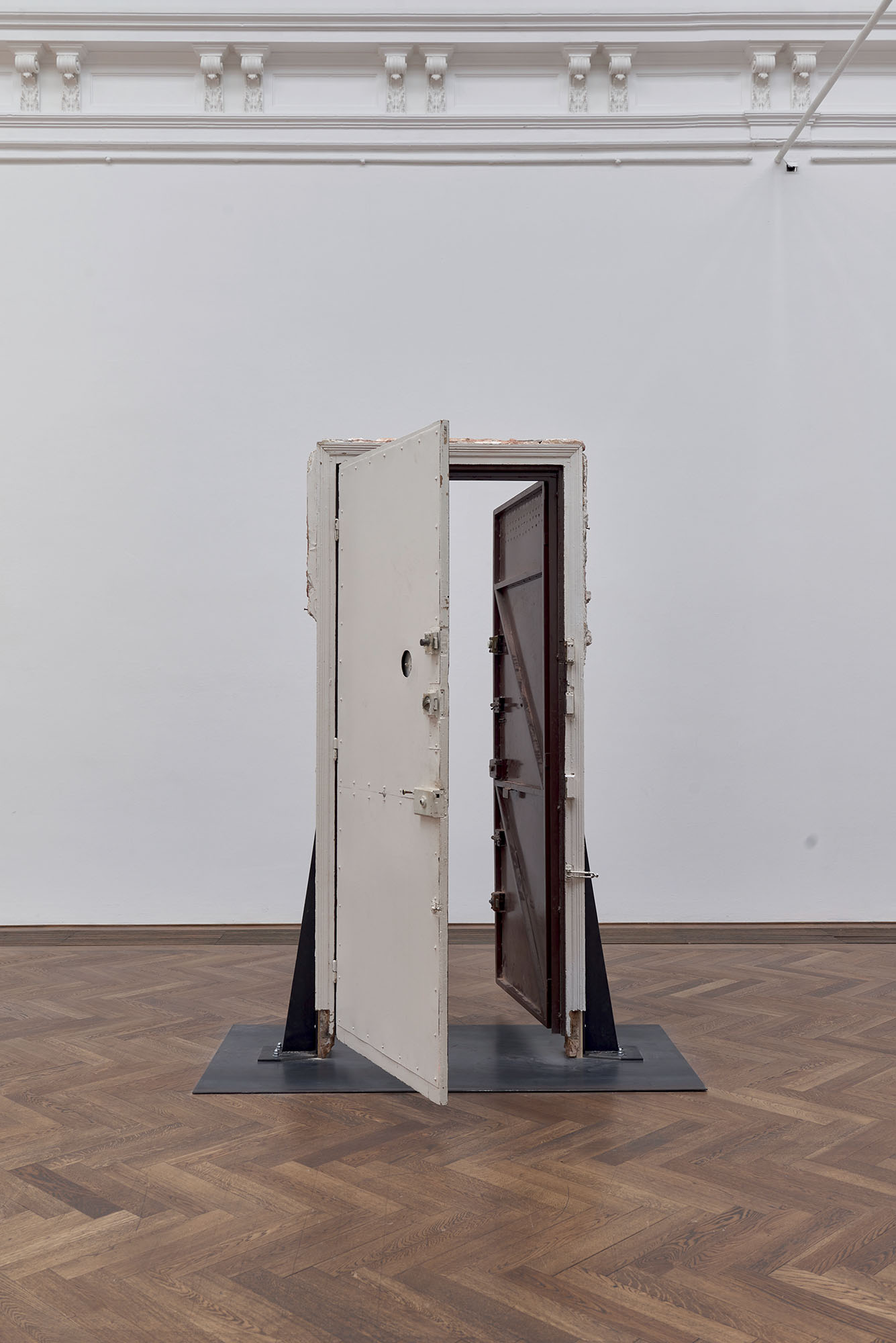
Barzakh, installation views, Kunsthalle Basel, 2021
Photo: Philipp Hänger / Kunsthalle Basel
Courtesy: the artist, Kunsthalle Basel
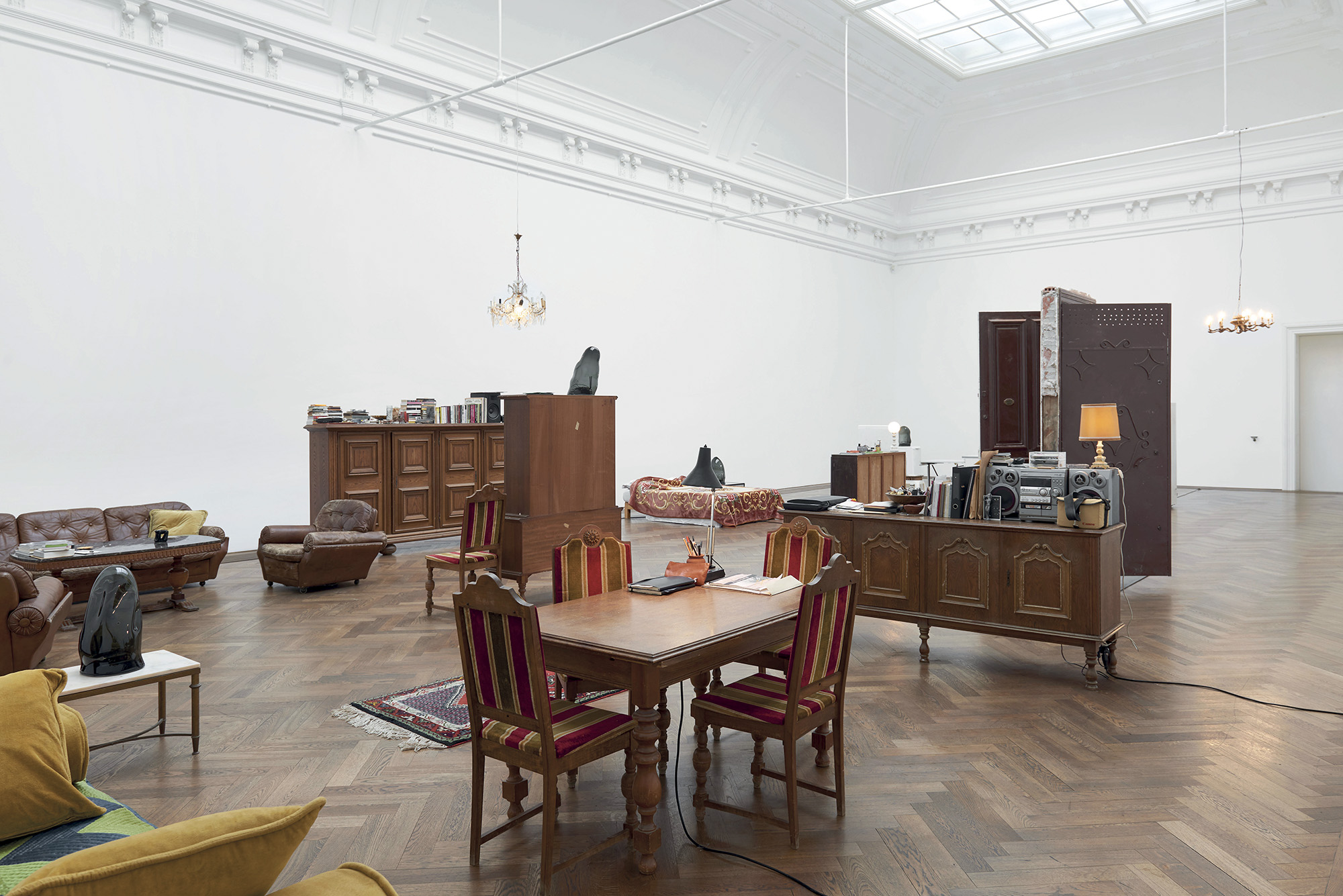
Barzakh, installation views, Kunsthalle Basel, 2021
Photo: Philipp Hänger / Kunsthalle Basel
Courtesy: the artist, Kunsthalle Basel
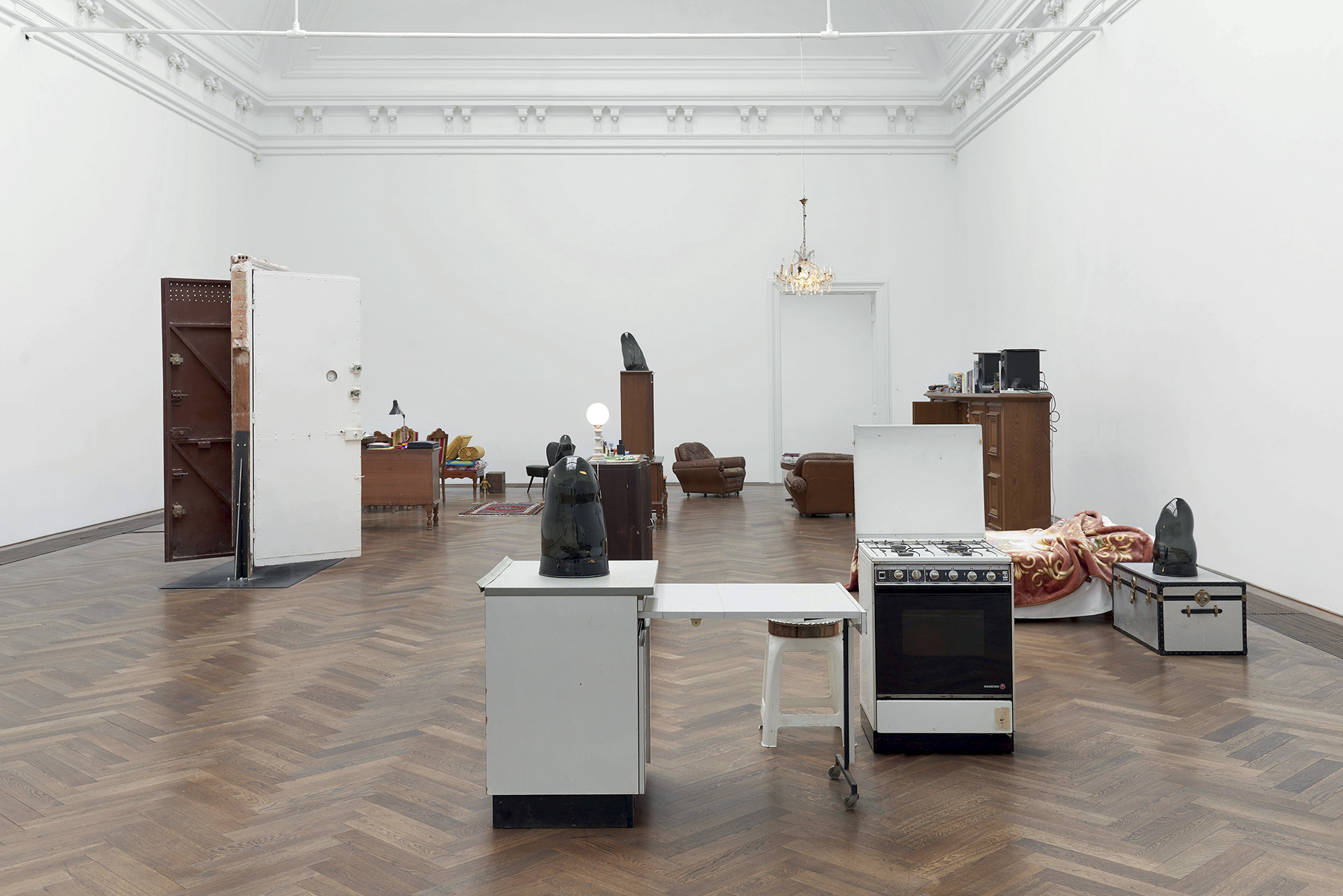
Barzakh, installation views, Kunsthalle Basel, 2021
Photo: Philipp Hänger / Kunsthalle Basel
Courtesy: the artist, Kunsthalle Basel
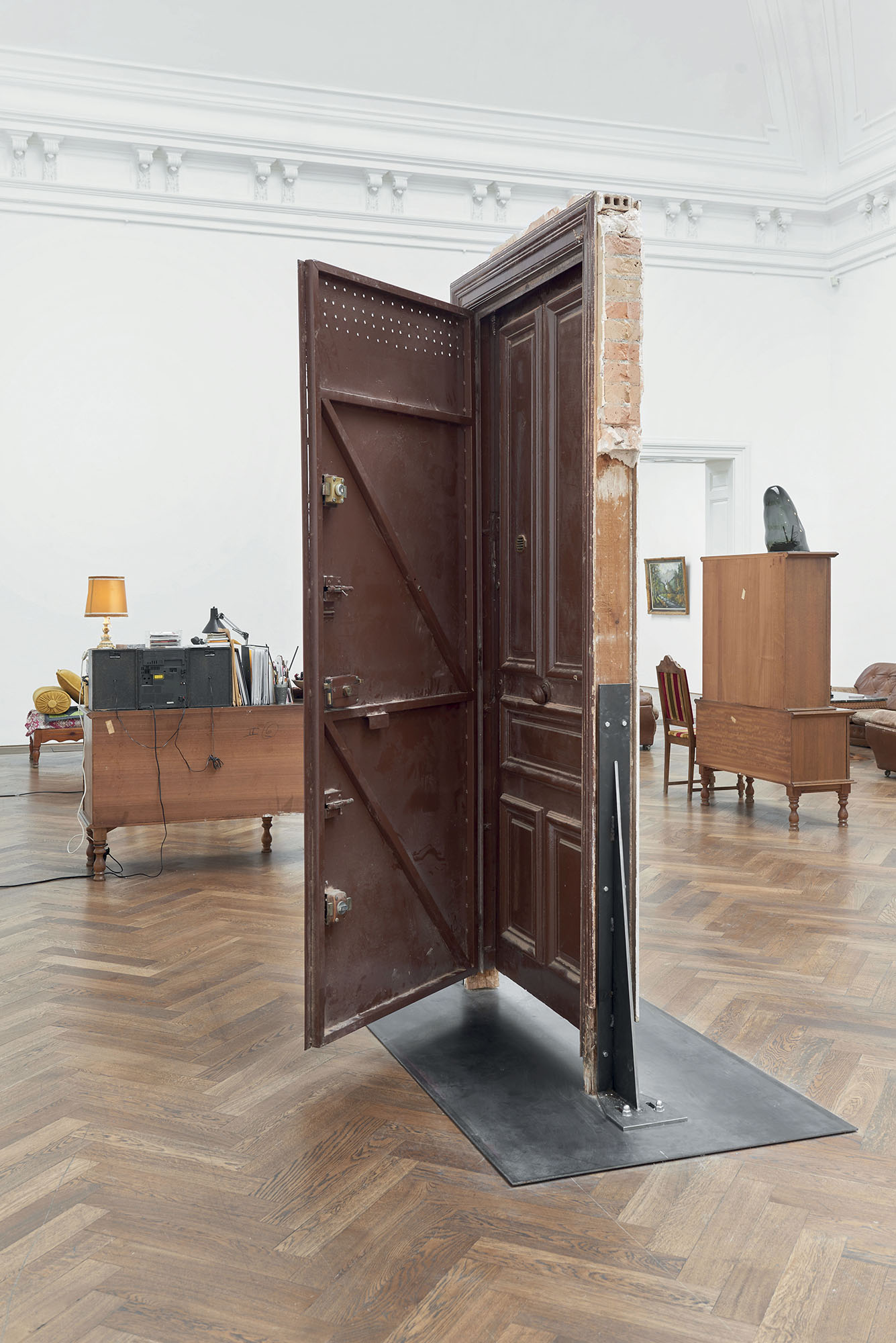
Barzakh, installation views, Kunsthalle Basel, 2021
Photo: Philipp Hänger / Kunsthalle Basel
Courtesy: the artist, Kunsthalle Basel
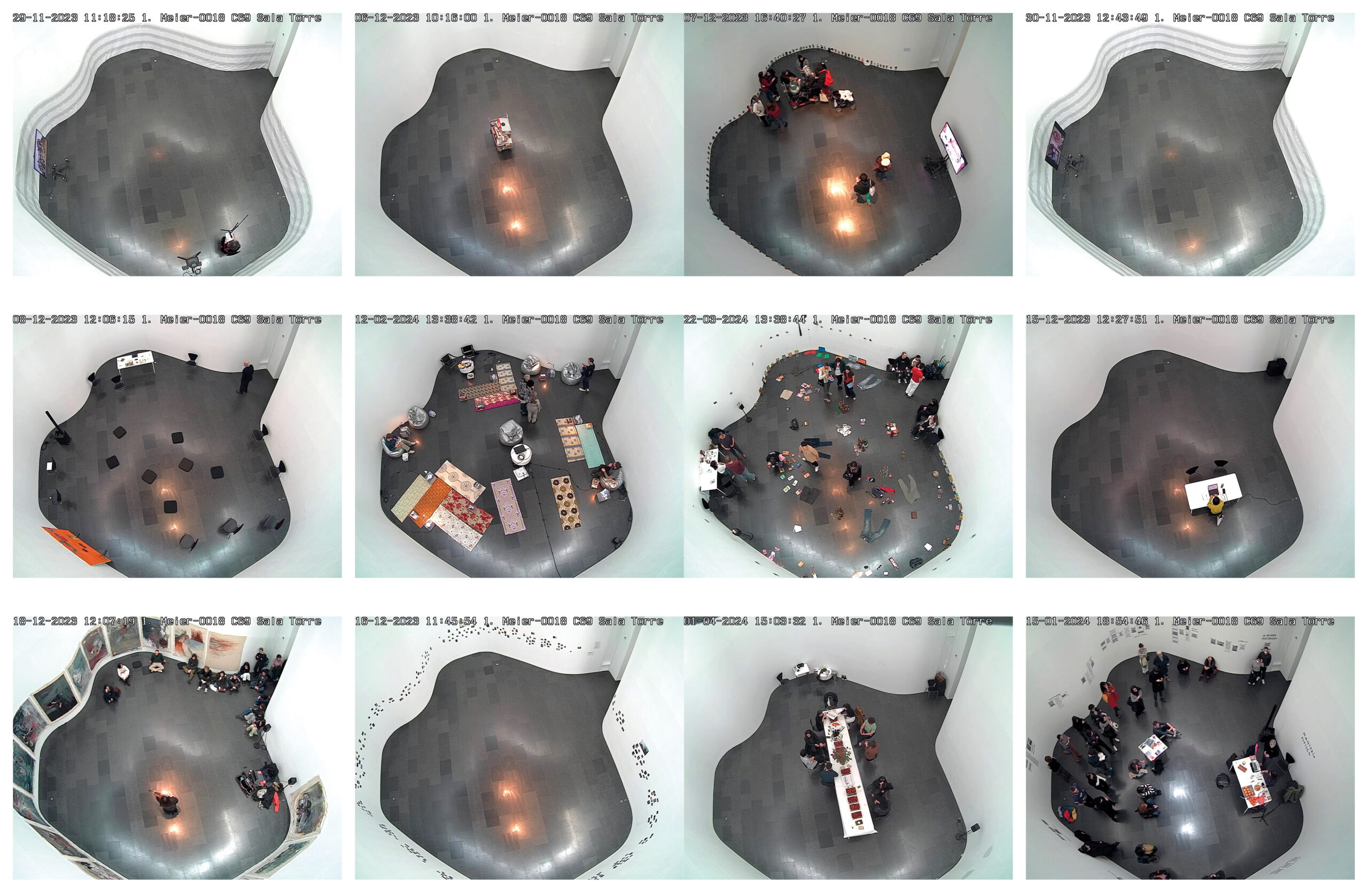
108 Days, MACBA—Museu d’Art Contemporani de Barcelona, 2023
Courtesy: the artist
Your practice frequently engages with bureaucratic and administrative processes. What kinds of agency or resistance can emerge through these systems, and how do they relate to forms of soft power?
Kyle Dancewicz had come to Barcelona to have a meeting about a show at SculptureCenter in New York. That day, cinematographer Alana Mejía González texted me saying she was in town. I was on a delayed flight back from somewhere, so we all ended up at my house talking about the film that never got made. Alana was about to fly to Algiers before COVID hit, and the borders closed in 2020; she ended up being one of the collaborators who went with me to Tassili n’Ajjer two years later. It was Kyle who insisted we try again, and later wrote that my works often begin as large, open-ended propositions that find the edges of possibility within the political, environmental, and metaphysical conditions in which I operate. I thought this was quite precise in the context of Tassili, which was really produced by these conditions. Tassili n’Ajjer hosts thousands of prehistoric engravings and cave paintings that describe the transformation of life in the Sahara. They are painted on an ancient river bed in a largely inaccessible plateau between Algeria and Libya, “discovered” by the French, and are one of the more undocumented groupings of cave paintings in the world. Tassili had been closed to foreigners for over a decade since tensions arose in the region, with only Algerian nationals allowed to visit escorted by Tuareg guides, many of whom were born on the plateau before the policy of sedentarization in the ’80s due to environmental and administrative factors. Tassili is a 45-minute film, shot in first-person as a perspective journey through the plateau. It is a wordless meandering that focuses on the route itself and the cave paintings scored in four distinct parts by Nicolas Jaar, felicita, Yawning Portal, and Sega Bodega. It is shown alongside a large sculptural “eclipse,” an almost 300-piece 3D printed cast of the landscape made in collaboration with Yuma Burgess, who spent the whole trip scanning rocks with an app on my phone. The parawork was the bureaucratic feat to bring a crew of foreigners, each with different passports, to shoot a film there. Khaled [Bouzidi] worked on the authorizations for months, eventually necessitating permissions from the Ministry of Culture, Tassili n’Ajjer National Park, and the Algerian Military in collaboration with our Tuareg guides. I later realized that the film was actually directed by these authorities, since the route was predetermined by the Tuareg guides in collaboration with the military and national park, deciding where and what we would shoot. Six months after the work was completed, we heard news that Tassili n’Ajjer was now “open to international tourism, without the need for a visa,” which is not even the case for the rest of Algeria. Khaled and I went back to Tassili this year with a group of international friends, and with Ahmed, our main guide on the film. He eventually told us it was he who used the film in his petition to reopen the plateau to tourism, a way for the Tuareg to reclaim agency over their own homeland.
In durational works such as sync, time and co-presence become central materials. How does temporality function as a political and relational force within your work?
sync is a live 24-hour composition of heartbeats amplified by contact microphones placed directly on the apex and plugged into a sound system surrounding 1–24 participants, each seated in a chair. Strangers could sit together in the room and listen to each other in continuum. What we hear is the visceral “writing” itself. Working with temporality is an offering to the present moment—you don’t know exactly how it will sound or what will happen next, and so the work gives into its conditions. I remember, during the performance at the Venice Biennale in 2024, some people would leave the room overwhelmed, or others because they couldn’t hear themselves. Daniel Blumberg, with whom I was collaborating at the time, and James Dunn engineered what was quite a densely technical and beautifully choreographic work, oscillating 8-hour shifts of invigilators and sound technicians to keep the piece live over 24 hours. I think within the work there was a confrontation in relation to co-existence between ourselves and the other. sync was about the potential of synchronization, but it also amplified the rhythm of dissonance. I was very interested in myth-making around that time, thinking about permanence as a material and what constitutes memory. Myth is an immaterial defiance to time; the potency of the story becomes an experience that is carried by each person who narrates it. And so there is a “beginning,” but there has to be a witness for the story to bind to time—and that binding is the material. If resonance is a sound enduring its own memory, sync approached the possibility of permanence where the amplified heartbeat of each participant was both its proof of life and its carrier.
The communities that form around your projects are often temporary and unstable. What remains after these collective structures dissolve?
Any shared experience or community, whether temporary, long-term, or otherwise, always remains or regenerates in some way. I think temporality can be a praxis for extreme presence, which is potent. As in: we are here for a limited time, and this is what we want to do with it. But when projects end, the debris is a rhizomatic network of relationships and connections, therefore, a means to much, much more…
Across your practice, hospitality and trust appear as recurring conditions. Can these be understood as forms of power? If so, what kind?
I grew up in a culture where hospitality and sharing were about empowering a community. My parents started a commune in the ’90s during the Algerian Civil War, which was in part a group of people who were converting to Christianity, but also a group of [hundreds of] people who survived through this community, by sharing, supporting each other, singing, dancing, praying, and eating. It’s a very long story, but the first years of my life were really spent in this utopia, parallel to the civil war. I only registered imminent threat when we had to move, first to a “safe house” in Oran and then eventually to the UK. But these early memories from my childhood rearticulate my understanding of power as resistance through hospitality, community, and the sharing of resources.
Looking ahead, how do you imagine continuing to work with participation and collective presence without allowing them to become fixed methodologies or expectations?
I realize now that my methodology is always to begin with 0. And then, where am I? Who is around? What is happening? What can we do? Because reality is so brutal, you can’t have any real expectations. That is the work to master. Right now I’m preparing an exhibition in Venice within which the work is actively participating and circulating within the local context. Working with people and community is political because it challenges any fixed position, so the work becomes a testament to the blunt force of its own lived experience, which can only generate grace.
Lydia Ourahmane
In Conversation With
Fabio Cherstich
CURA. 46
Soft Power
LYDIA OURAHMANE (b. 1992, Saϊda, Algeria) lives and works in Algiers and Barcelona. She has recently participated in: 60th Venice Biennale (2024); 15th Gwangju Biennale (2024); 34th São Paulo Biennial (2021); Manifesta 12 in Palermo (2018); and15th Istanbul Biennial (2017). Recent and upcoming solo exhibitions include: Galeria Municipal, Porto (2026); Nicoletta Fiorucci Foundation, Venice (2026); Galerie Chantal Crousel, Paris (2026); 108 Days, MACBA, Barcelona (2024); Tassili, SculptureCenter, New York; rhizome, Algiers; Fondation Louis Vuitton, Paris (2022); sync, KW Institute of Contemporary Art, Berlin (2022), among others.
FABIO CHERSTICH is a theatre and opera director and set designer. He has worked in several theatres in Italy and abroad, including the Mariinsky Theatre in St. Petersburg, Teatro Massimo in Palermo, Teatro dell’Opera di Roma, Opéra d’Avignon, Opéra de Marseille, Théâtre Maillon in Strasbourg, Teatro Argentina in Rome, and I Teatri di Reggio Emilia. His productions have been invited to major international festivals, including the Festival d’Avignon, Napoli Teatro Festival, Festival Première in Strasbourg, STUK Contemporary Art Center in Leuven, and the Festival dei Due Mondi in Spoleto. He is the creator and director of the traveling opera project Opera-Camion.