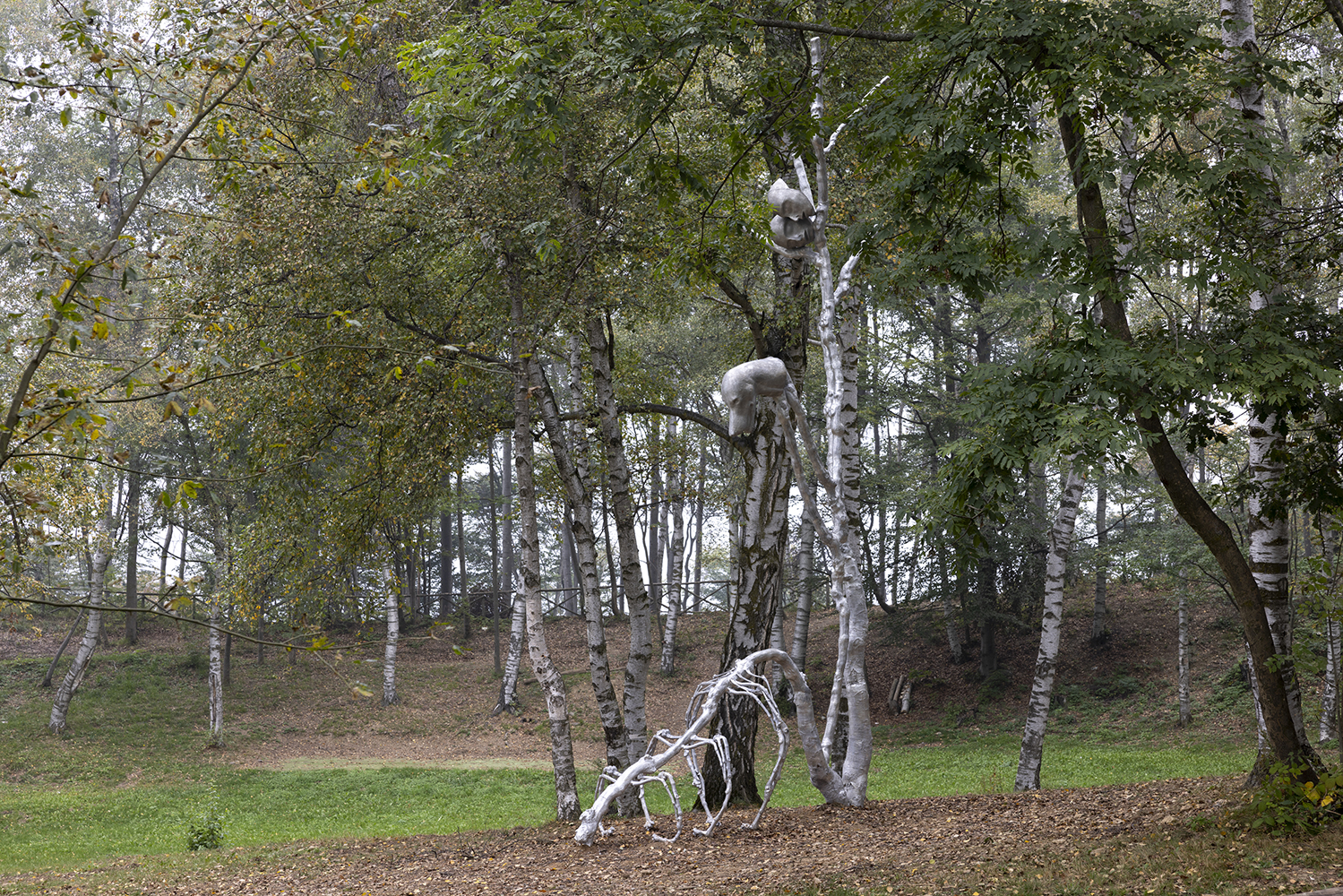
Radis #05
Special Project
Radis offers a context in which to reconsider what public art can become once it steps away from commemorative logic and its predetermined narratives. Here, artworks are not placed as finished statements but emerge slowly, through hesitation and proximity. The programme unfolds over years and across different towns, asking what local negotiations are required when an artistic gesture enters lived space.
The following “seven theses” are a distilled reflection on the processes that appear to have taken shape within Radis. Without any aim to be definitive or exhaustive, they open a space for ongoing reflection on public art as a practice rooted in specific contexts and temporalities.
These theses have been conceived within the editorial series for CURA., drawing on conversations with Giulia Cenci, Petrit Halilaj and Marta Papini.
1. Against the monument, towards permeability
Public art distances itself from upright gestures built for permanence and leans instead towards a porous condition, like a living membrane that responds to the terrain it inhabits. In Chiot Rosa, le masche never manifests as an isolated presence. It breathes alongside allochthonous birches, resonating gently with surrounding trunks and branches. Its value rests in permeability, a condition that invites crossings rather than claims territory. Meaning surfaces slowly, shaped by the layered sediment of interpretations and encounters. A public artwork flourishes when it remains open to divergent stories and temporalities, allowing them to drift through, and reshape it across seasons of reception.


2. A public artwork grafts, never imposes
Working in public space means entering existing ecologies. In Dogliani, an abandoned school and its desks persisted as a quiet infrastructure, holding decades of childhood gestures in their surfaces. A graft takes shape through shared presence, where host and newcomer subtly reshape one another. When Abetare (a day at the school) brings together drawings from desks in Runik and Dogliani, it weaves local memory with distant traces, allowing Balkan and Langhe images to inhabit the same outline of a house. An intervention unfolds through gradual attunement to stories already in motion, letting rhythms guide rather than be overridden.


3. Let the form come
Working outside the ‘white cube’ means allowing intentions to take shape through process and encounter. Le masche emerged through time spent on site, noting how figures aligned with pathways, how they surfaced or dissolved among trees, and how bodies might lean, pause, move or wander around them. Form evolved through walking and talking, exchanges with residents, and weather shifts and material constraints. Within Radis, choices arise as responses to what the site discloses and quietly asks for. Curating becomes a form of choreography, or a spatial writing that sketches possible sequences of encounters while preserving space for personal interpretation.

4. Childhood is a practice
In Radis, childhood operates as a method. The archive of desk drawings that underpins Abetare is an active grammar, distant from the idea of a fixed or concluded past. Simple motifs such as a house, a sun, or a cat shift into structural components of the sculpture, turning children’s gestures into inhabitable architectures. Working through childhood means engaging with reality through experiment rather than habit. Former pupils and the memories shared by them enter as co-authors of the work’s vocabulary, rooting it in lived experience. Childhood introduces a different tempo and reaffirms invention as a form of knowledge, opening a space where play and political imagination intersect.

5. Imagination is an archive in motion
In Radis, imagination works in concert with multiple archives, including Nuto Revelli’s oral accounts of rural life, local narratives around le masche, and traces of everyday gestures embedded in shared spaces. Le masche and Abetare engage with these materials through constellation-building. Imagination operates as a dynamic mnemonic system capable of keeping the past active while shifting its orientation. Through these speculative processes, memory evolves by reshaping and enacting space for overlooked and marginal fragments to emerge. Radis itself can be understood as a living repository, where each edition deposits material and immaterial traces that influence the next through interwoven experiences.
6. The time of public art is geological
Public space is shaped by forces and timelines that extend beyond a single human life. The birches in Chiot Rosa signal a shift from pastoral economies to ecological change. The school in Dogliani has moved from daily use to abandonment and later to a renewed role as a gathering place, centred around a drawing of a house that did not yet exist when lessons last took place. Public art can acknowledge this expanded timeline, where growth, decay, disappearance and reappearance operate as modes of coexistence. A work conceived as permanent can reveal its fragility, while an action intended as temporary may endure longer through memory than through matter. Evaluation gains significance when considered through duration, friction, use and recontextualisation. Each project in Radis contributes a slow sediment through which future works and relationships may evolve.


7. Every gesture is shared responsibility
Public art exists within a constellation of people. In Radis, responsibility passes through many hands while responsibility is a shared and continuously renewed practice. The conflicts are addressed and the trust is cultivated over time, akin to a field whose balance depends on continuous care. Every action contributes to shared responsibility, shaping the conditions for art, places and communities to keep interacting in ways that remain context-specific and alive.


Radis #05
Seven Theses for Contemporary Public Art
Text by Giulia Colletti
Fondazione Arte CRT
in collaboration with the Fondazione CRC