in conversation with Laura McLean-Ferris
CURA. 46
Soft Power
Spotlight
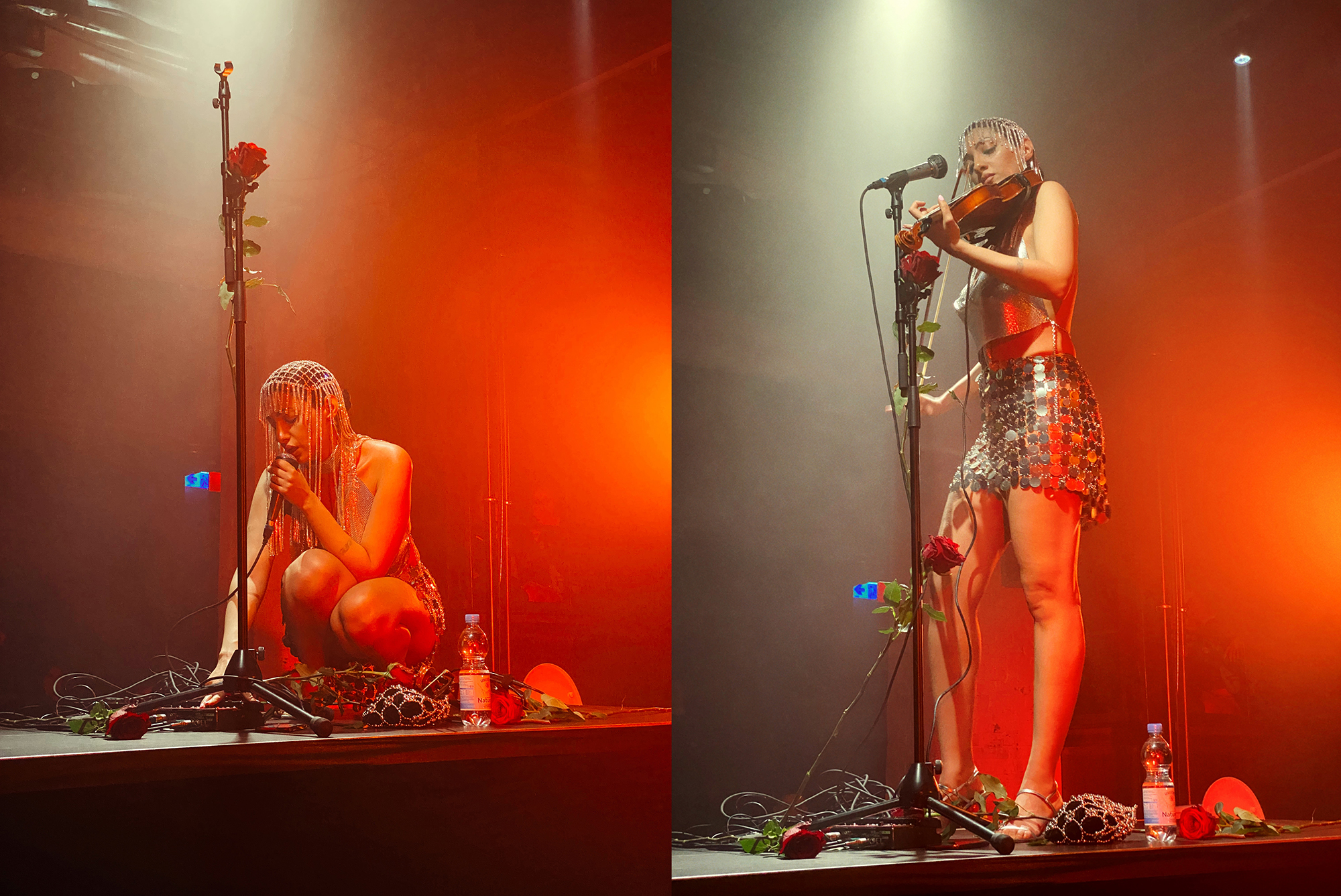
Performance at Trauma Bar Berliner, organized by Anne de Vries, 2023
Courtesy: the artist and Trauma Bar Berliner
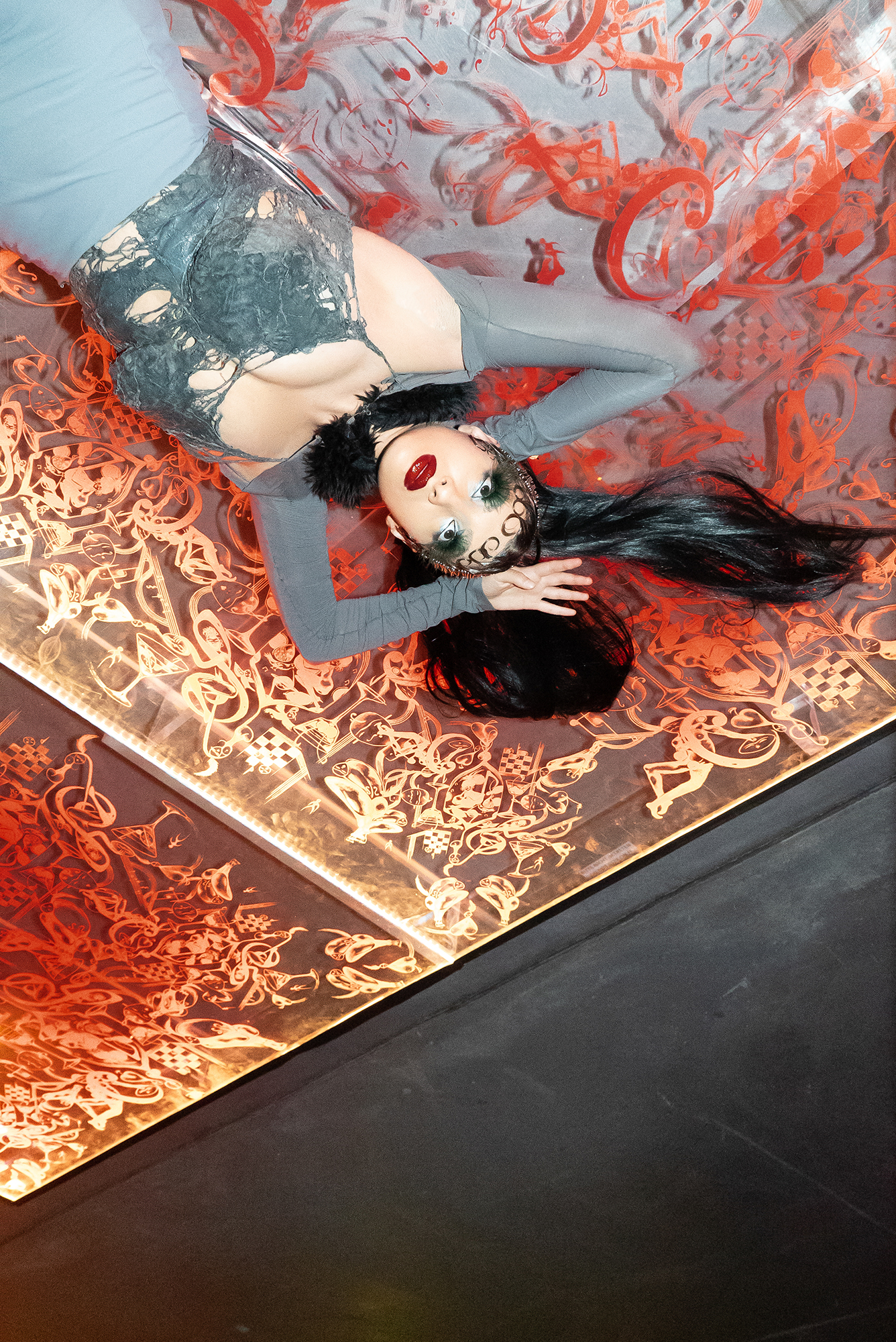
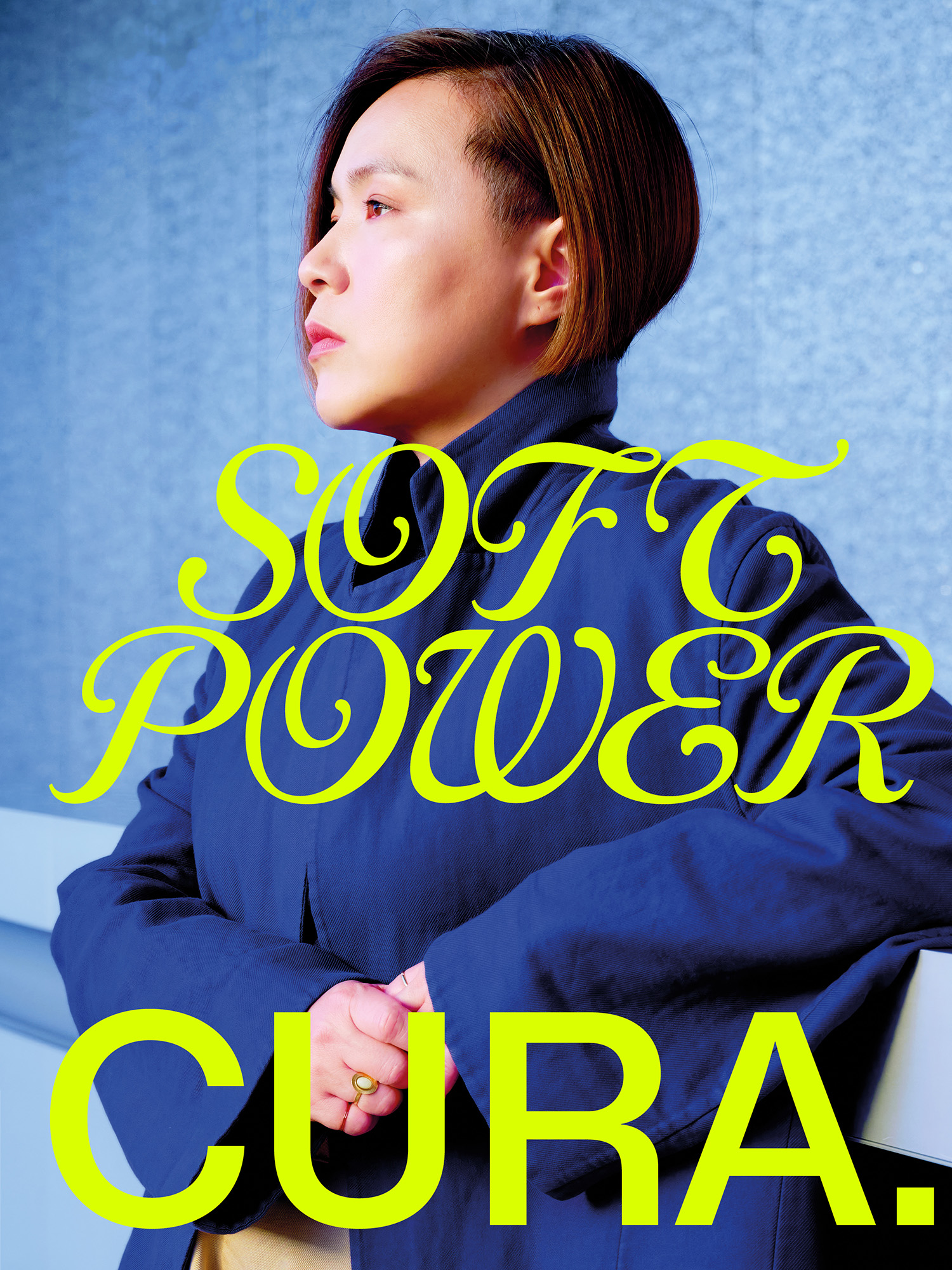
Portrait by Chanel Kah Yin Liang
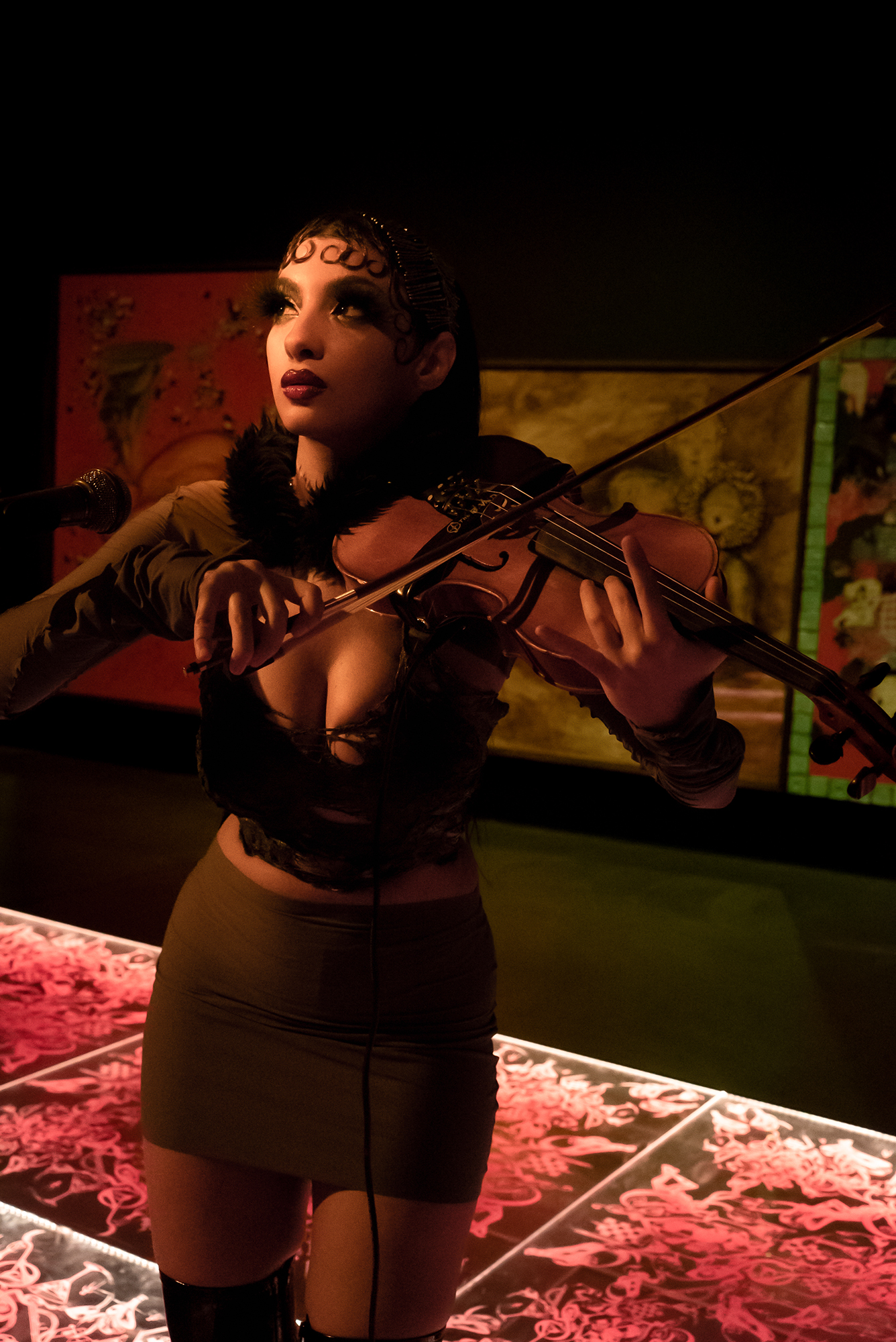
Fabula’s Score, performance, Luma Westbau, Zurich, 2022
Courtesy: the artist and Luma Westbau
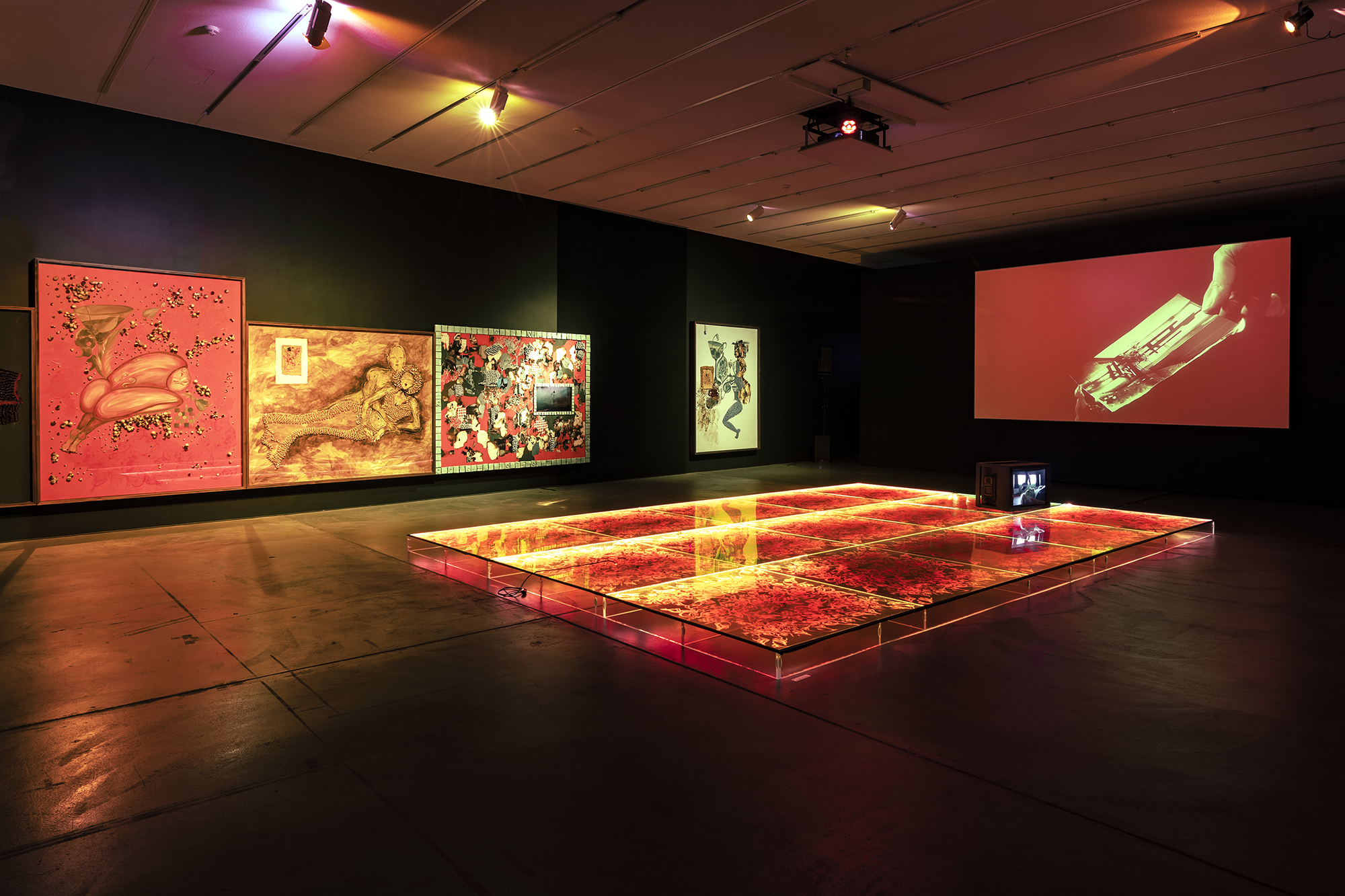
Fabula’s Score, installation views, Luma Westbau, Zurich, 2022
Courtesy: the artist and Luma Westbau
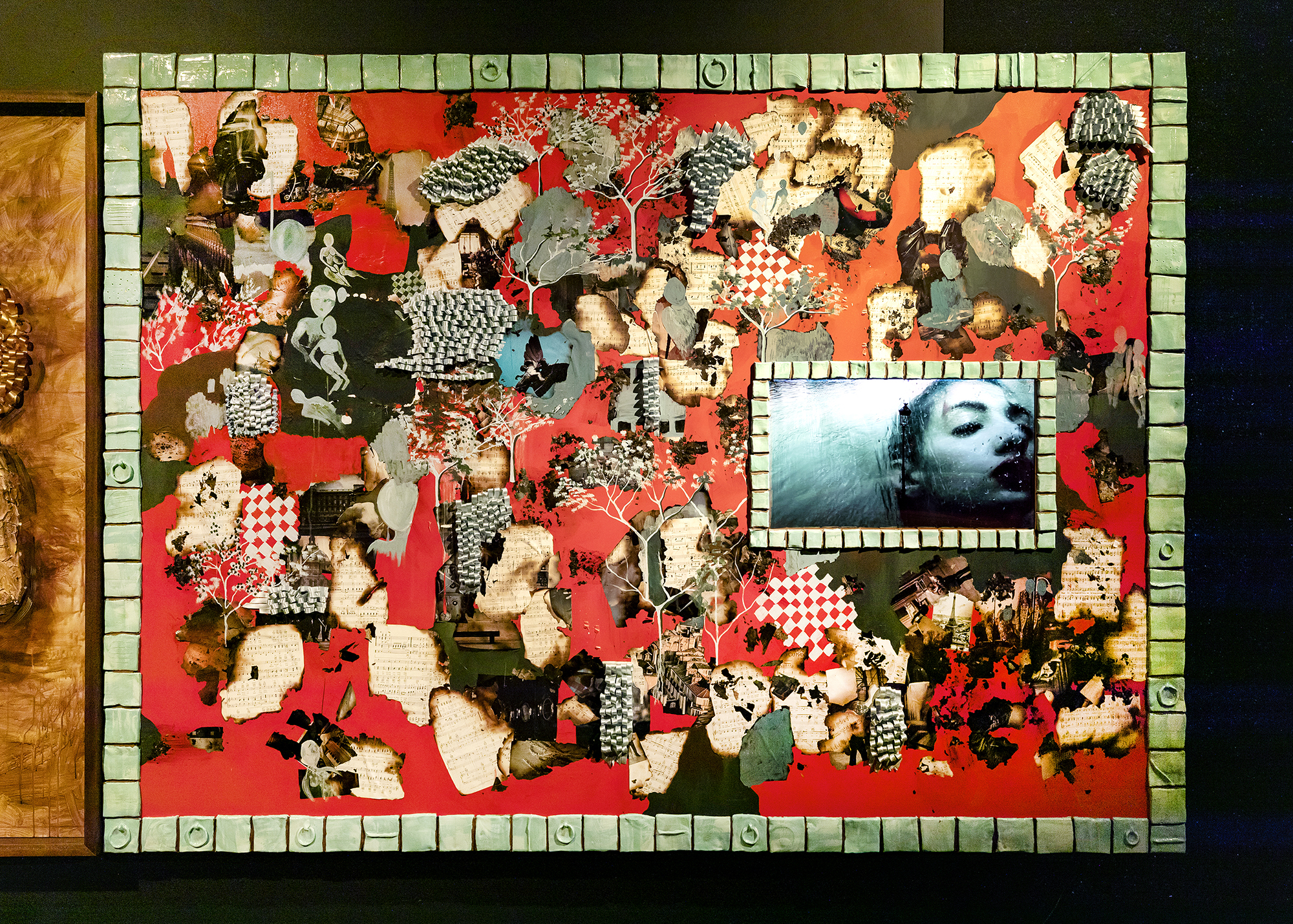
Fabula’s Score, installation views, Luma Westbau, Zurich, 2022
Courtesy: the artist and Luma Westbau
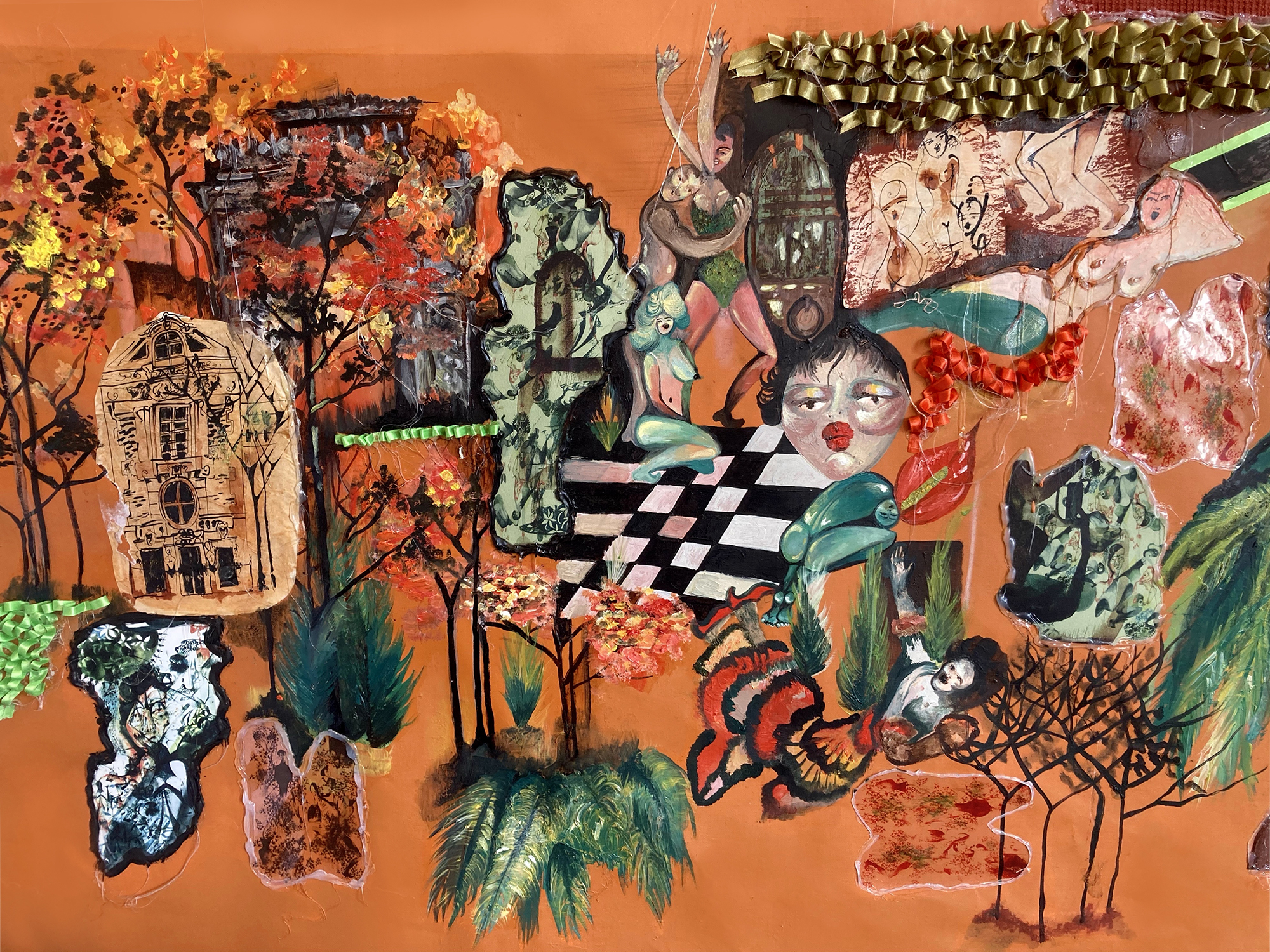
Rive Gauche/Rive Droite, 2021 Courtesy: the artist and Gaudel de Stampa
Sadaf H Nava is an artist and musician who works by layering multiple genres of art and performance, often employing aleatory and improvisatory techniques. Her recent installations have included filigree-like paintings of crowded celebratory scenes that incorporate embedded video screens; drawings of the imagined romantic lives of musical notes; and vinyl prints applied to transparent materials that create patterns out of repeated figurative drawings, disrupting spaces with shadows and color. As a musician who often works with the violin, she has performed many combative, sharp improvisations for which she has crafted elaborate costumes and sets. These performances can involve constraint methods or obstacles, such as blindfolds, spilling hair, and objects that swing around her as she performs.
LMF: I’m interested to hear about how you employ different facets of yourself as a performer and how these self-presentations intersect with your drawings and paintings.
SHN: I don’t actively try to cultivate a specific avatar or persona on stage or in the rest of my work; it’s something that happens intuitively. In terms of imagery, it could be a bricolage not limited to: television detectives, Belle Epoque absinthe hallucinations, Persian “Tahrir” (yodeling) divas, Kavkaz dances, Flamenco fashions, Punk craftiness, the glamour of old Hollywood actresses, and the sacred eroticism of Baroque acapella choirs, but these are just some things that I enjoy! What excites me about costuming is the contrast between what I tend to wear on stage and the aggressiveness of the music. I think it’s important to mess with the codes that we have become accustomed to. I grew up in the noise and punk scenes, which were heavily male-coded and where the unofficial uniform was always a black hoodie. Underground scenes can be just as predictable as anything else. I really enjoy the mismatch of a glamorous image with an abrasive sound. It’s fun because it’s false advertising. The persona in this way becomes a push back against the clichés of what someone making experimental music or contemporary art should look like. For the drawings, I draw faces the same way I did as a child. My mom taught me how to draw these faces as a toddler, and I continue the same general method. There is also a dialogue here with Iranian painting, miniature traditions; the faces of the Safavid Era look somewhat similar. When I draw or compose music, the process is always improvisation, so the content is never pre-planned. I have always been anti-rehearsal and anti-sketching in that way, so everything becomes a final product. Sometimes I don’t love it, but I have decided to live with it.
LMF: You often create environments in your work in which performance and visual elements overlap, as in your exhibition at Luma Westbau, which featured a Perspex stage that was covered in painted characters. Can you talk about how painting and performance are intertwined for you?
SHN: I often think about this Catherine Breillat quote, where she says, “I am the film. I don’t make the film.” I agree with her. I think that’s why there is a continuity between the drawings and the performances, a certain stylized self-representation. But the self itself also becomes a vehicle to express something else. I, too, in the context of a performance, become a kind of material. I have a lot of respect for film for this reason: it is a synthesis of sound, literature, light, image, and sets. I see my work as a kind of deconstructed cinema, where all of those elements are at play, just not at the same time. My exhibition at Luma was about this: how to make the performative/sound aspects come alive next to objects and paintings. The idea began with my effort to illustrate the romantic lives of musical notes. I wanted to make a musical score that included objects and physical works that were musical in their own way.
LMF: Your paintings and drawings often feature crowded scenes of figures that almost become decorative or patternlike. In describing some of the objects and installations you have made, I was tempted to use the word ‘adorned.’ I’m curious to know more about your explorations of excess in relation to historical denigrations and celebrations of ornamentation.
SHN: I definitely have a maximalist instinct, and for me it’s connected to musicality. My show at Karma International was entitled Vanity: Ornamental Madness in the Shadow of a Dionysian Mask, and it came from Nietzsche’s distinction in The Birth of Tragedy, where Apollo is aligned with sculpture, form, clarity, and Dionysus with music, madness, and a destabilized self. But Nietzsche, like many other philosophers, also associated the Dionysian with a feminine temperament, and also geographically with the East. So, there is this very problematic distinction of the Western world as logical and the East as unpredictable/unknowable. Adornment is often coded as feminine, and I’m interested in that too, both in embracing it and complicating it. I wanted to push that to its own excess to create a sort of decorative madness that loses its docility and becomes frightening. I was also thinking about Adolf Loos’s Ornament and Crime, and this push towards eliminating superfluous objects and a turn towards useful minimal interiors, which, for me, feels very rigid. In the exhibition, the broken mirror fragments reflect the viewer to themselves, but not in a Narcissus-like way. Instead, the mirror becomes a space of mimicry and projection. By inserting the viewer into the work, it multiplies the self. The mirror turns into a stage. I have always liked Florine Stettheimer’s party-scene paintings because of their storytelling and the fact that they decentralize the gaze. The paintings become passive, and the gaze of the viewer, active. In Discours/Figure, Lyotard says that “seeing is a dance” and that “a painting is not something to be read… it has to be grazed.” I find that crowded scenes lend themselves to this kind of witnessing, where each person can choose where to begin and end the story. I’m also very drawn to painters whose work feels musical, not because they depict musicians or are made by musicians, but because of the methodology itself, the repetition and gesture, brushstrokes that carry tempo. I guess the most obvious example would be Chagall.
LMF: In your exhibition Viridian Vapors, which drew on histories of intoxicating green liquids such as absinthe and chartreuse, the atmosphere was bathed in green light and mottled by shadows that came from vinyl patterns on the windows that broke up the light. Obviously, there is a rich tradition of depicting absinthe intoxication in painting and literature, but I wondered how your interests in cinema and atmosphere would play a part in a show like that.
SHN: That exhibition was influenced more directly by poetry than by cinema, particularly images and impressions from Le Spleen de Paris by Charles Baudelaire. It was also inspired by the Chartreuse monks, who produce Chartreuse, the liqueur from which the color takes its name. They say they went on strike in order to devote themselves to a different kind of spirit. Some people say their publicist encouraged the decision, since reduced production has made the prices go way up! For Baudelaire, drunkenness was sacred, much as it is within Sufi traditions. I think my approach to the theme could be seen as cinematic in terms of the exhibition’s mise-en-scène. From the installed green carpet, the light, and the viridian velvet backdrops for the drawings, I was focused on creating a cohesive environment. The works themselves were chromatically filtered, bringing to mind the stained glass of churches.
LMF: Can you tell us something about what you are working on right now?
SHN: I am currently working on a new album where I will incorporate a more traditional form of songwriting. It’s been a few years since my last release, so I’m excited to see how this one will be different from the previous albums. I’m also working on a short film treatment with a filmmaker friend of mine. In terms of paintings, I’m thinking about something gestural and textured, and experimenting with durational, performative painting. Something in sync with the strokes of a violin.
Sadaf H Nava
in conversation with
Laura McLean-Ferris
CURA.46
Soft Power
SADAF H. NAVA is an Iranian born, NYC-based visual artist and musician. Sadaf has had solo exhibitions at Karma International and Luma Foundation Westbau in Zurich, Forde in Geneva, performances and video works at MoMA PS1 Warm Up, ICA VCU, MoMA Sunday Sessions, Issue Project Room, Performa Festival, Gavin Brown Enterprises, Yale Union art space, 9th Berlin Biennale, the Museum of Fine Arts in Montreal, 3HD Festival in Berlin, and Hyperlocal Festival in London.
LAURA MCLEAN-FERRIS is a writer and curator based in Paris. Formerly, she was Chief Curator at Swiss Institute, New York, where she worked from 2015–2022. Her writing has appeared in 4Columns, Artforum, ArtReview, Bookforum, frieze, Flash Art International, and Mousse, and she has contributed essays to many monographs and exhibition catalogues.