Texts by DAN REES
and CHRISTOPHER WILLIAMS-WYNN
CURA. 46
Soft Power
COVER STORY
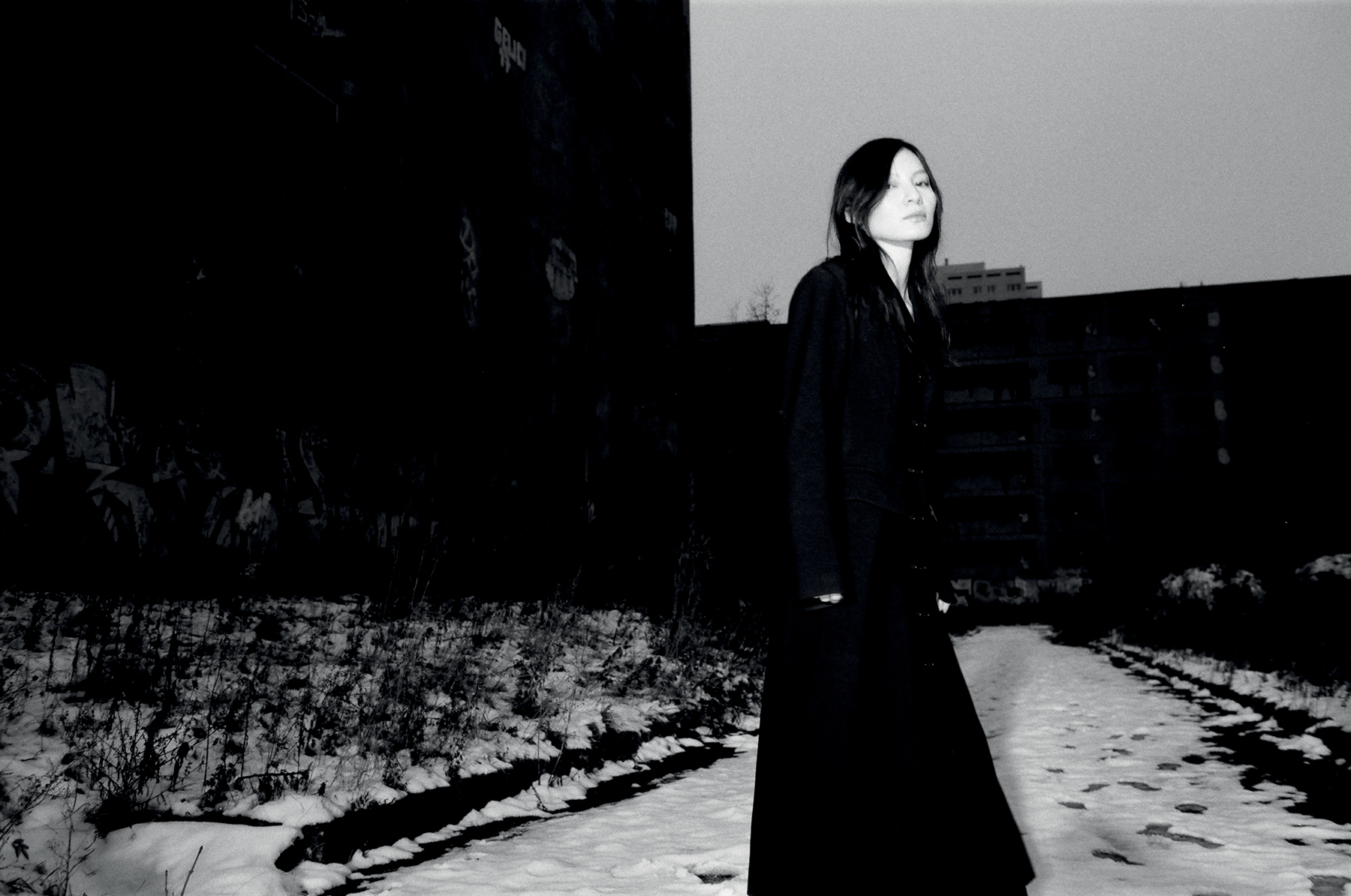
Photo: Vitali Gelwich
Sung Tieu, Human Dignity Shall Be Inviolable, 2026. Courtesy the Artist. Photo: Andrea Rossetti
Sung Tieu, Installation View, German Pavilion, 2026. Courtesy the Artist. Photo: Andrea Rossetti
Sung Tieu, Installation View, German Pavilion, 2026. Courtesy the Artist. Photo: Andrea Rossetti
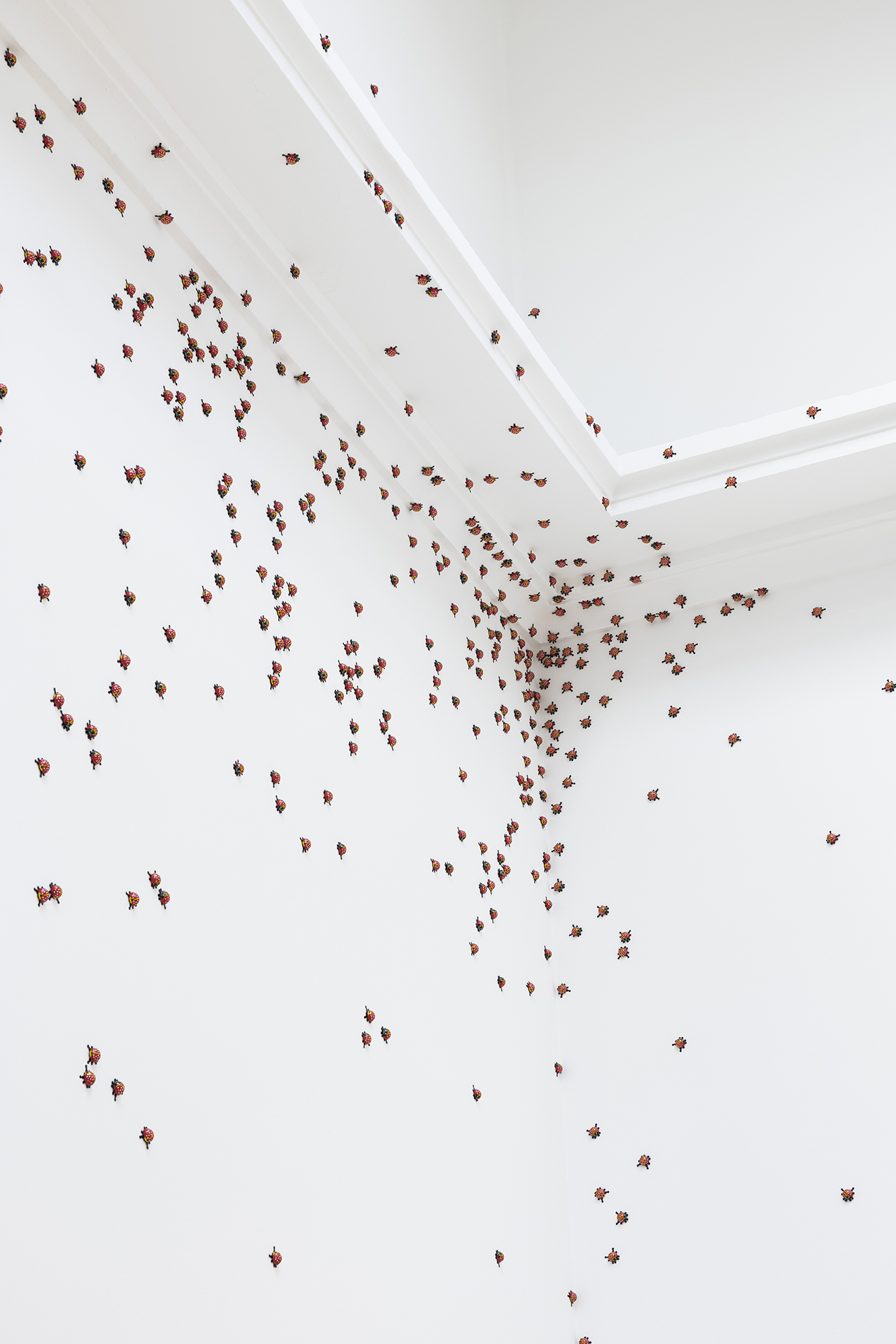
Sung Tieu, Installation View, German Pavilion, 2026. Courtesy the Artist. Photo: Andrea Rossetti
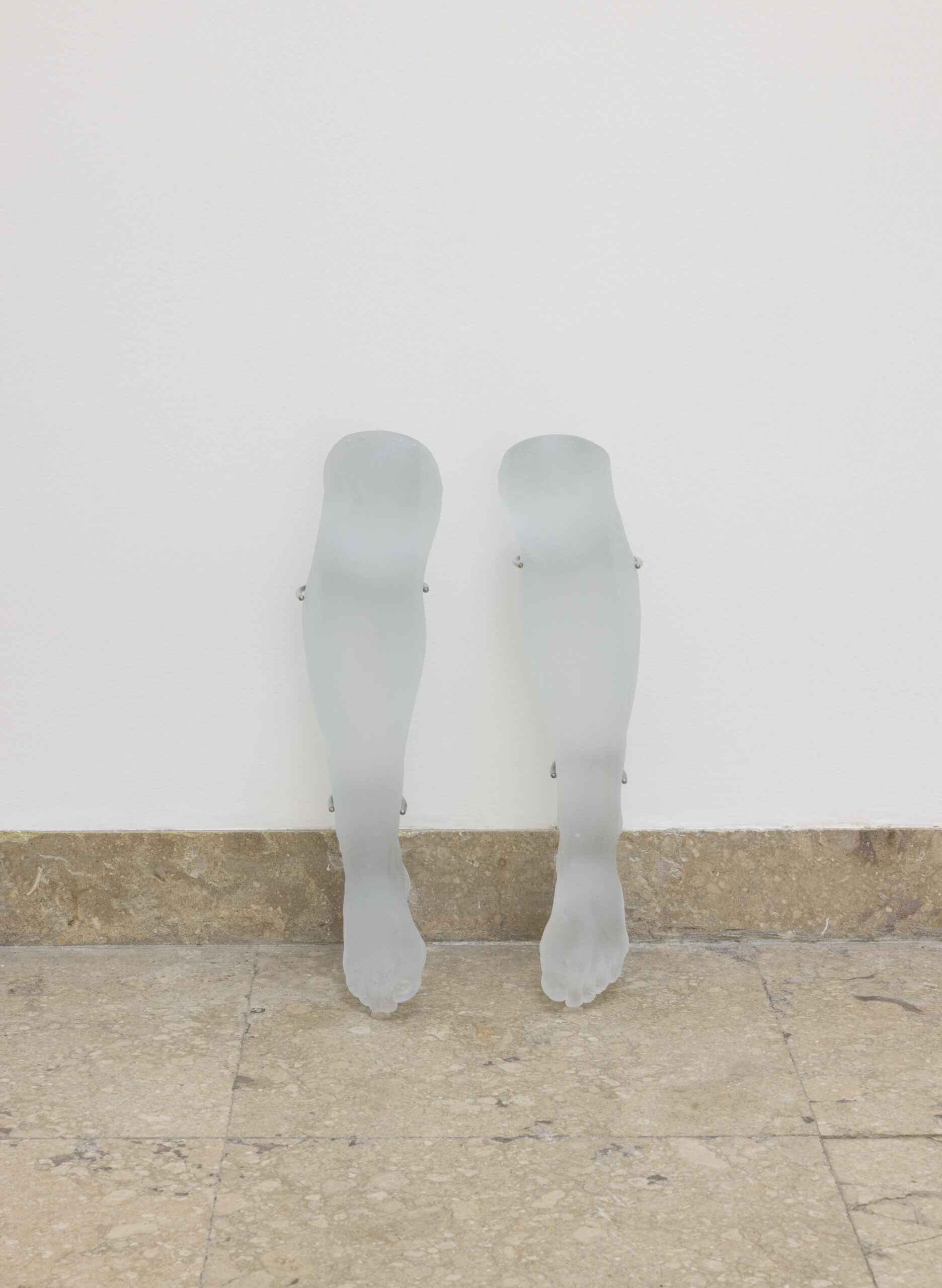
Sung Tieu, Installation View, German Pavilion, 2026. Courtesy the Artist. Photo: Andrea Rossetti
AMIDST RUINS: SUNG TIEU
AT THE 61ST VENICE BIENNALE
Text by Christopher Williams-Wynn
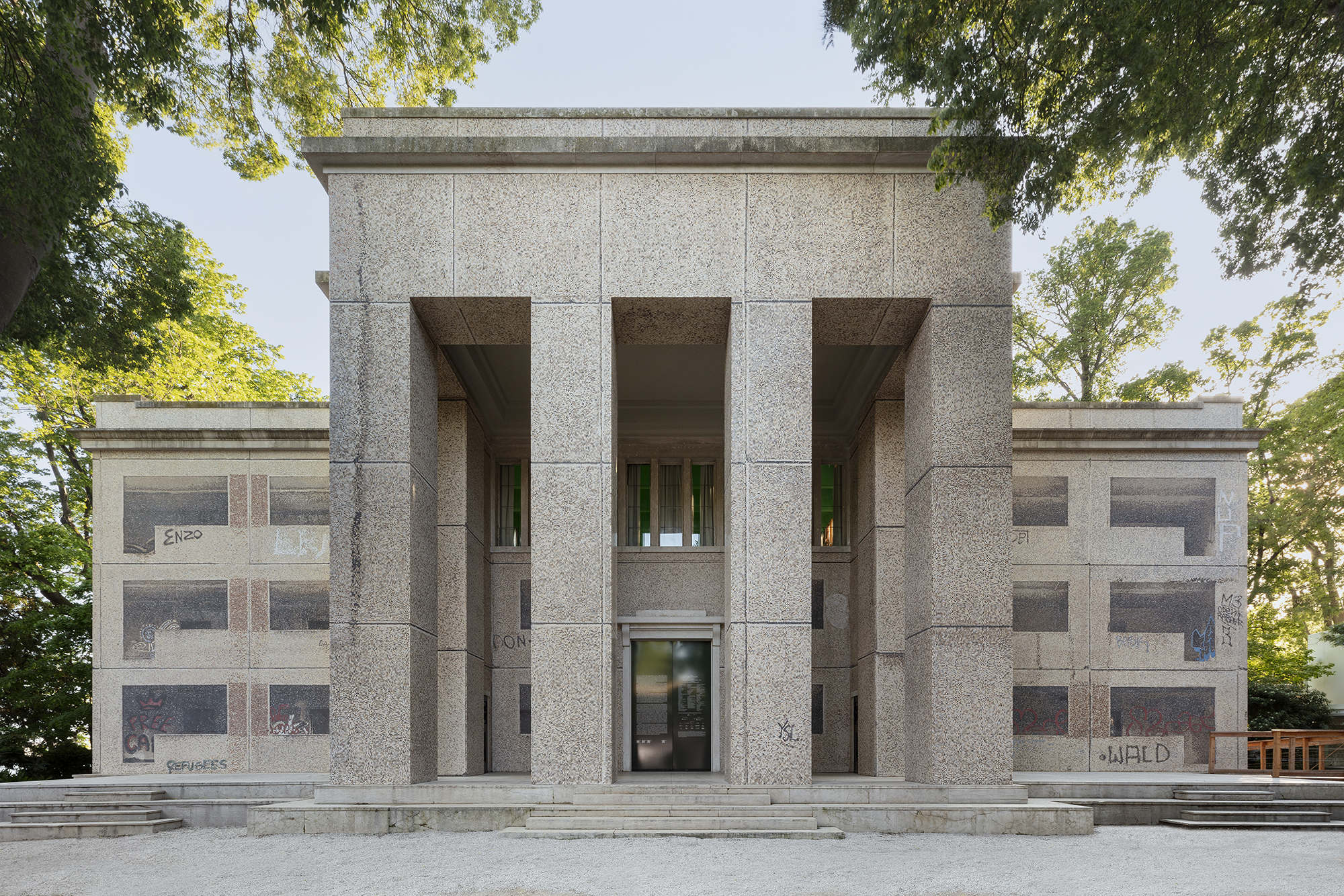
Layering histories through installations and sculptures, Sung Tieu’s project for the 61st Venice Biennale opens a new front in ongoing contests over remembrance. The porticos and infamous “Germania” inscription, which looms over the entrance of the Nazi-era edifice of the German Pavilion, are enveloped by a monumental mosaic that wraps around the building. This façade is based on a former East German housing estate in Gehrenseestrasse in Berlin well known to Tieu. During the 1980s, authorities confined so-called “contract workers” from Vietnam and a range of other countries within its walls, and it was where Tieu lived with her mother in the mid-1990s. These crumbling buildings are now being razed to enable private development. With her act of provisional, state-sanctioned concealment, Tieu forwards a Benjaminian vision of contemporary life: subordinated to speculative investment, it is a collapsing edifice erected on the remnants of authoritarian and fascist administrations.
Each side of the façade is based on a 1:1 scale image of the corresponding exterior of the Gehrenseestrasse building. Photos were taken of its current state and colors were digitally matched to marble pieces measuring 1.5 × 1.5 cm, which were then set in panels and attached to a wooden and steel substructure. Due to heritage regulations intended to preserve the pavilion’s original marble, that structure is set off from the front walls. No such safeguards have been put in place around the building in Berlin, as indicated by the graffiti on its walls. “Refugees” written on one speaks to the many inhabitants that have passed through the buildings, while “Wald” points to possible right-wing notions of the German forest as a sanctuary of the Volk. Those scrawled marks tie into the grim history of the pavilion. Dating back to 1938, the current building was designed by the architect Ernst Haiger. A member of the National Socialist German Workers’ Party since summer 1932, his architectural program—geometric order, high ceilings, marble flooring, and a towering portico—was calculated to awe visitors and foster docility. Those features have been vehicles for various interventions, most notably Hans Haacke’s demolition of the marble flooring in 1993 and Maria Eichhorn’s archaeological intervention into the walls and foundations in 2022. Opting neither to destroy nor excavate, Tieu veils. Outward signs of decrepitude counter the advertising frontages that usually mask buildings undergoing renovation and undercut the triumphant nationalism that blows through Venice.
The choice to screen implies that the pavilion is not merely an isolated repository of historical debris. It is itself encased in a present marked by far more widespread dilapidation connected to the history and aftermath of the German Democratic Republic. Founded in 1949, the state faced persistent labor shortages from the 1960s onwards and sought to address them through agreements with so-called Bruderländer, including, among others, Cuba, Mozambique, and Vietnam. Recruited workers were housed in dormitory buildings like the one constructed on Gehrenseestrasse in 1978–79. Subjected to extensive health examinations, including forced abortions in some cases, and segregated from the broader population, they had limited opportunities for education or training and were largely treated as disposable labor. The fall of the Berlin Wall on 9 November 1989 and German reunification on 3 October 1990 only increased these workers’ precarity. Economic restructuring, renewed restrictions on foreign workers, and violence by right-wing extremists shaped another phase of dangerous instability. Amid these upheavals, Tieu and her mother, Vũ Thị Hạnh, emigrated from Vietnam to Germany in 1992 to join her father, Tiêu Dũng Tiến, a contract laborer at the state-owned steel plant in Freital, near Dresden. After her parents’ relationship ended, Tieu moved into one of the buildings at Gehrenseestrasse in 1994 and lived there for three years with her mother. Privatized after German reunification, and owned by a series of investors, the buildings were finally completely vacated in 2023 to make way for urban “redevelopment.” To treat its surface as a readymade sidesteps analysis in favor of exposure, a method that risks reification to illuminate the selective recall of official memory culture.
Given the many lives of the buildings and its inhabitants, Tieu’s intervention offers a broader and more fundamental proposition about the possibility of historical recovery. At a distance, the structure appears almost real, as the mosaic gives the impression of a whole greater than its parts. Up close, the image dissolves, and only the pieces appear sharp. Against the entreaty to draw near, to grasp the real thing as some condition of understanding, the visitor is confronted with an overwhelming mass of details. Standing in front of these pieces of marble—more than three million that were inlaid by hand—invites reflection on the contrast between the material’s historical connotations of ennobled value and contemporary degradation, as well as the immense amount of labor required to plan and assemble the massive structure. Proximity guarantees anything but the possibility of totalizing knowledge. Instead, it marks the distance, always relative, at which the appearance of a whole disintegrates.
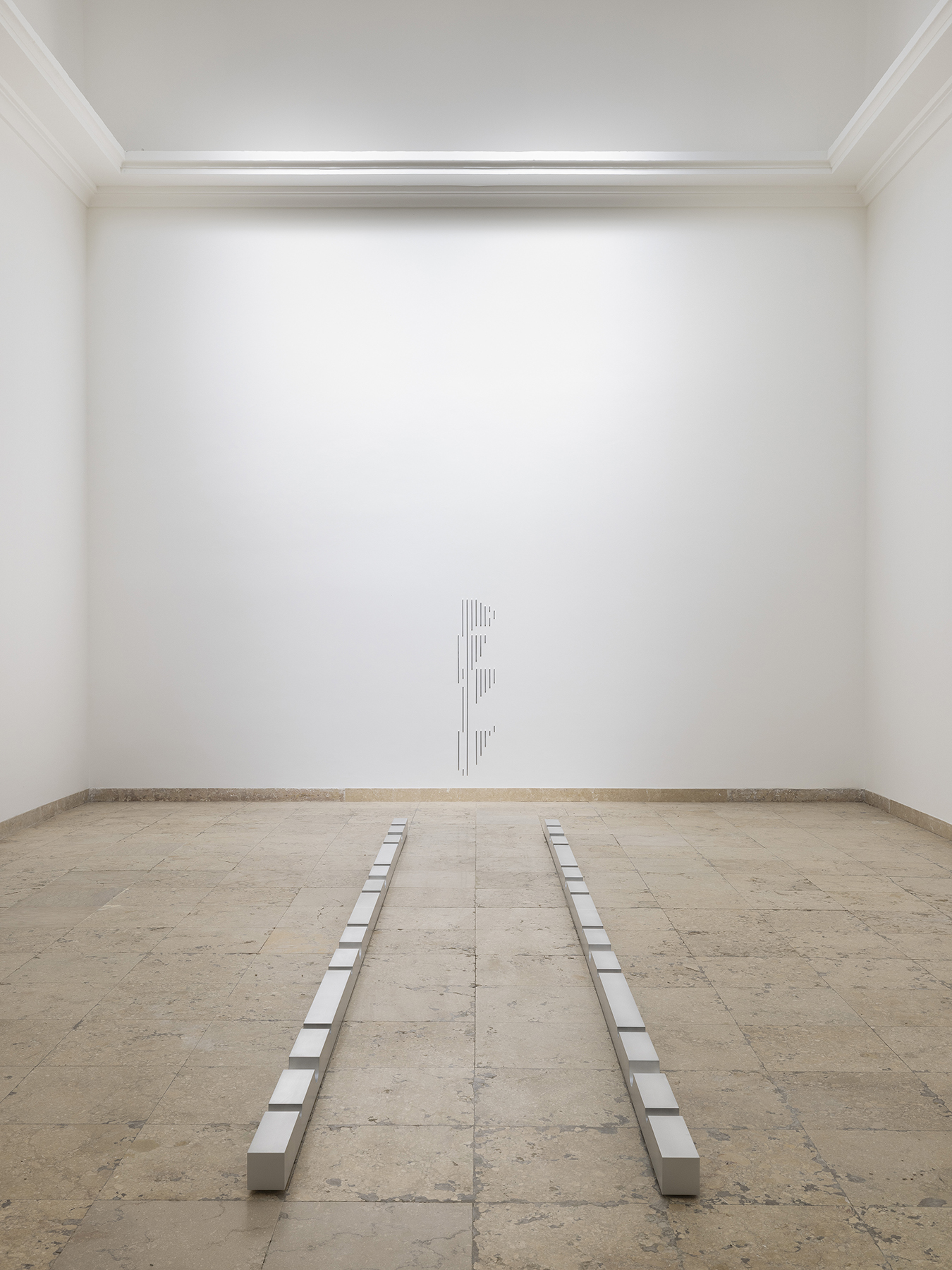
Impulses toward fragmentation continue inside, where the semblance of bodies become mosaics of mathesis. If approached side-on, a series of steel rods fastened to the wall in a vertical arrangement evoke a standing figure. As anatomical traces of Tieu’s mother, the configuration of these segments is based on techniques taken from Albrecht Dürer’s Vier Bücher von menschlicher Proportion (Four Books on Human Proportion, 1528). Almost 500 years ago this text already established a system for splitting the body into quantified units to be reassembled in pictures. Parts of the body did not matter in themselves. What counted were measurable relations: the space between the eyes, edges of the nose, shoulders, breasts, hips, and so on. Whereas Dürer’s examples depict whole figures and their measurements front-on, Tieu provides only the physical results of measurement. These rods, as manifestations of a system mediating bodies and images, show how picturing is built on the body’s concrete destitution. Broken into parts, it can only be reconstructed as a false unity and institutional fixture.
To center the fragmenting power of cultural, political, and social institutions attests, in the end, to the willfulness of ruination. There are no commemorative plaques dedicated to those that have passed through the halls on Gehrenseestrasse, and no heritage overlays in recognition of their experiences. Public authorities choose not to remember the countless individuals who were tracked through structures built to discipline and control them. Disrepair evinces disregard by a polity otherwise so insistent on brandishing its supposed capacity to reckon with the past. The gulf between privation in Berlin and protection in Venice makes clear that the pavilion is a well-maintained ruin of National Socialism. To cover the pavilion, then, is to warn of enduring values and official priorities. Demands for compliance that were so brutally enacted by past regimes have not been utterly abolished but are preserved just behind the veneer of a present order that is undergoing demolition.
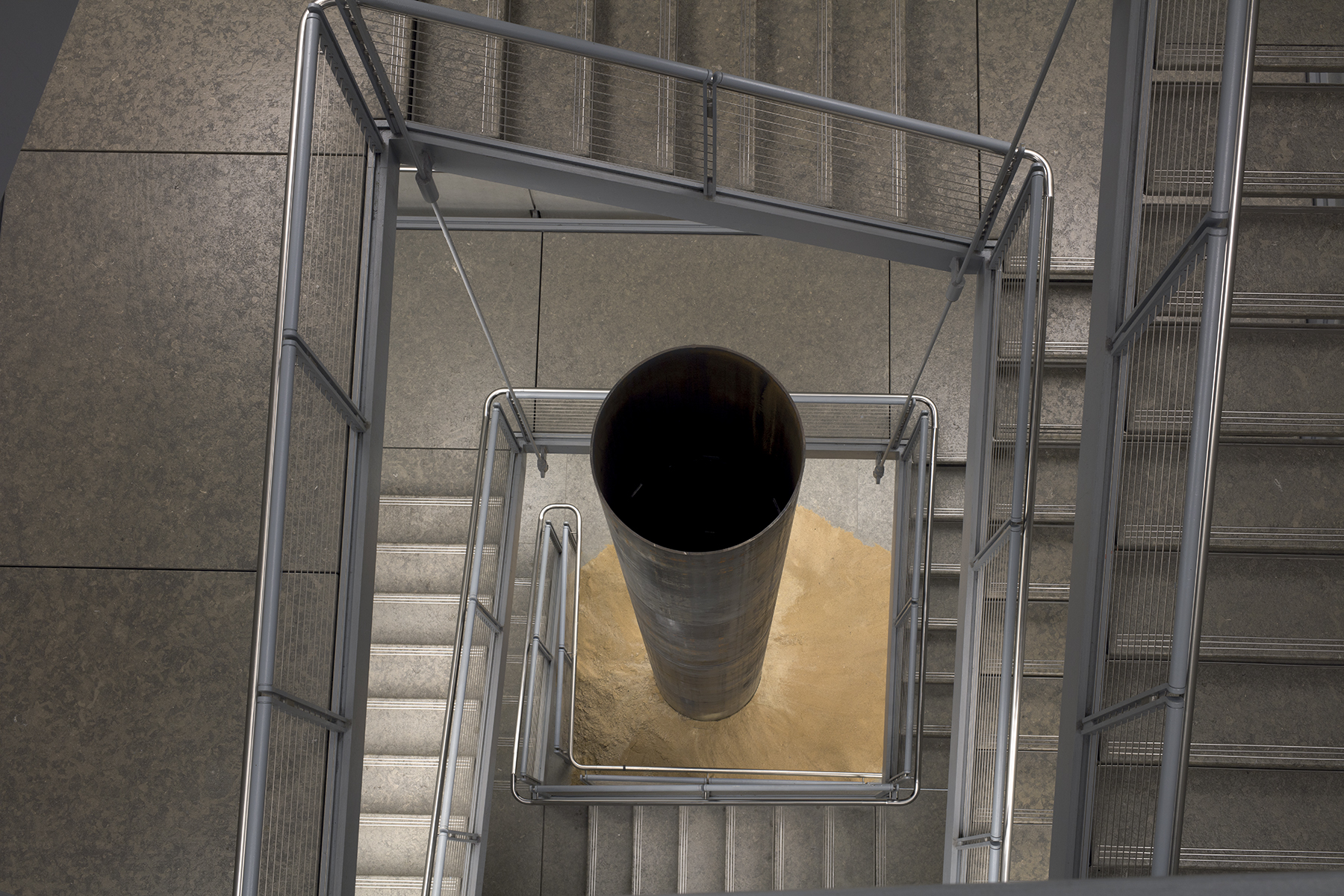
System’s Void, 2026, installation views, Whitney Biennial 2026, Whitney Museum of American Art, New York, 2026 Photo: Lance Brewer © Sung Tieu, 2026 Courtesy: the artist, Emalin, London, Galerie Sfeir Semler, Hamburg/Beirut, Trautwein Herleth, Berlin, and the Whitney Museum of American Art, New York
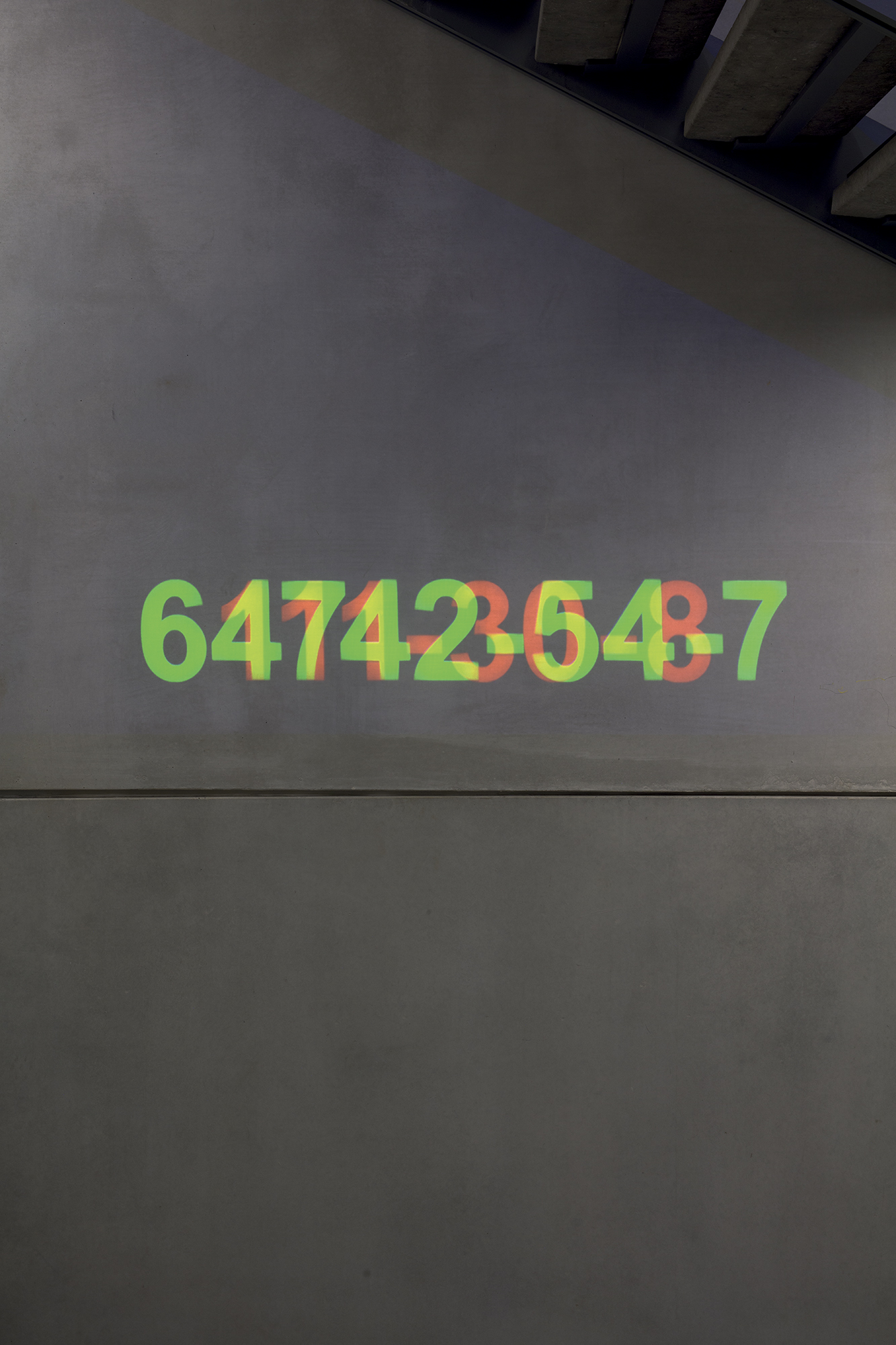
System’s Void, 2026, installation views, Whitney Biennial 2026, Whitney Museum of American Art, New York, 2026 Photo: Lance Brewer © Sung Tieu, 2026 Courtesy: the artist, Emalin, London, Galerie Sfeir Semler, Hamburg/Beirut, Trautwein Herleth, Berlin, and the Whitney Museum of American Art, New York
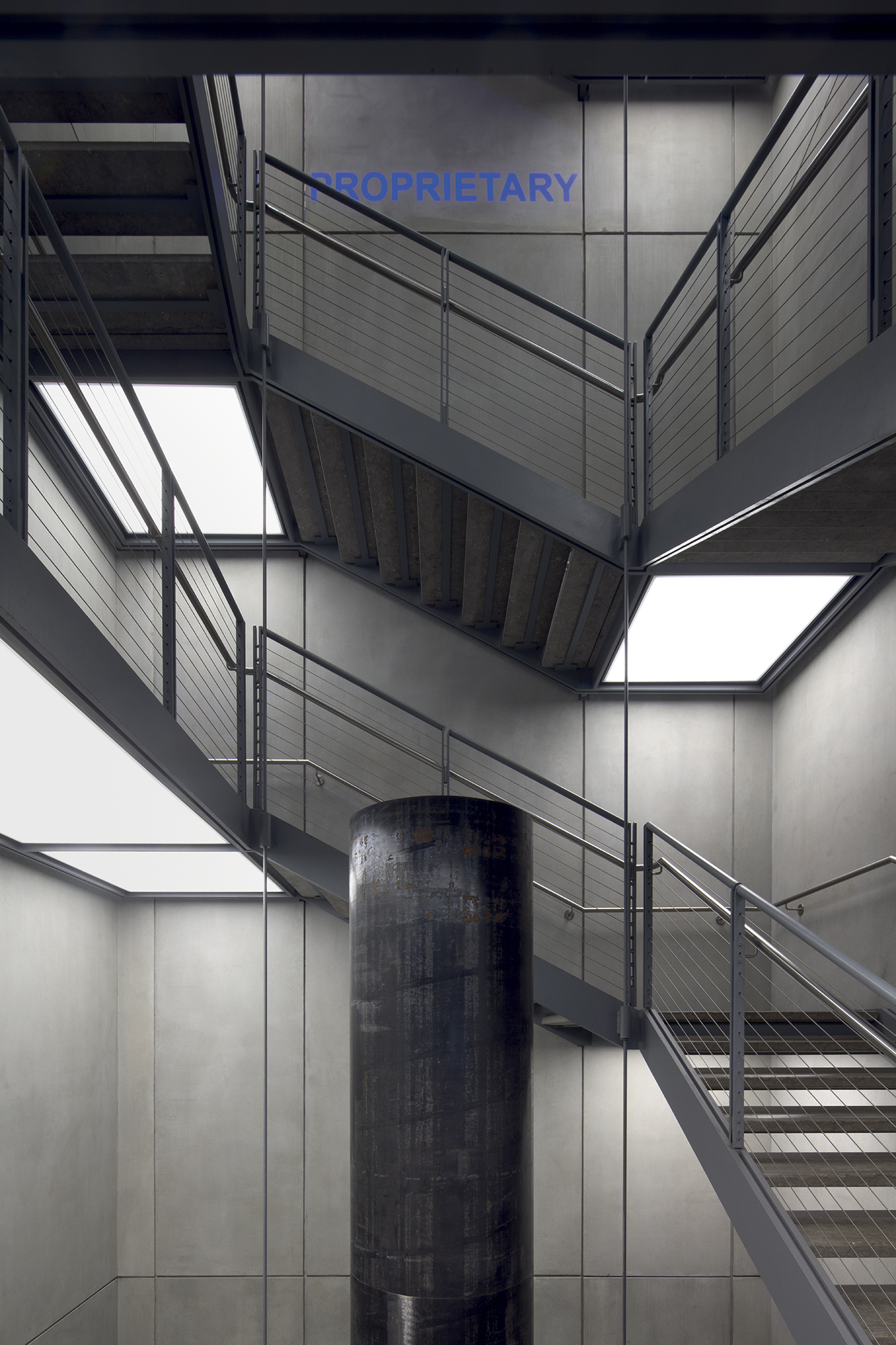
System’s Void, 2026, installation views, Whitney Biennial 2026, Whitney Museum of American Art, New York, 2026 Photo: Lance Brewer © Sung Tieu, 2026 Courtesy: the artist, Emalin, London, Galerie Sfeir Semler, Hamburg/Beirut, Trautwein Herleth, Berlin, and the Whitney Museum of American Art, New York
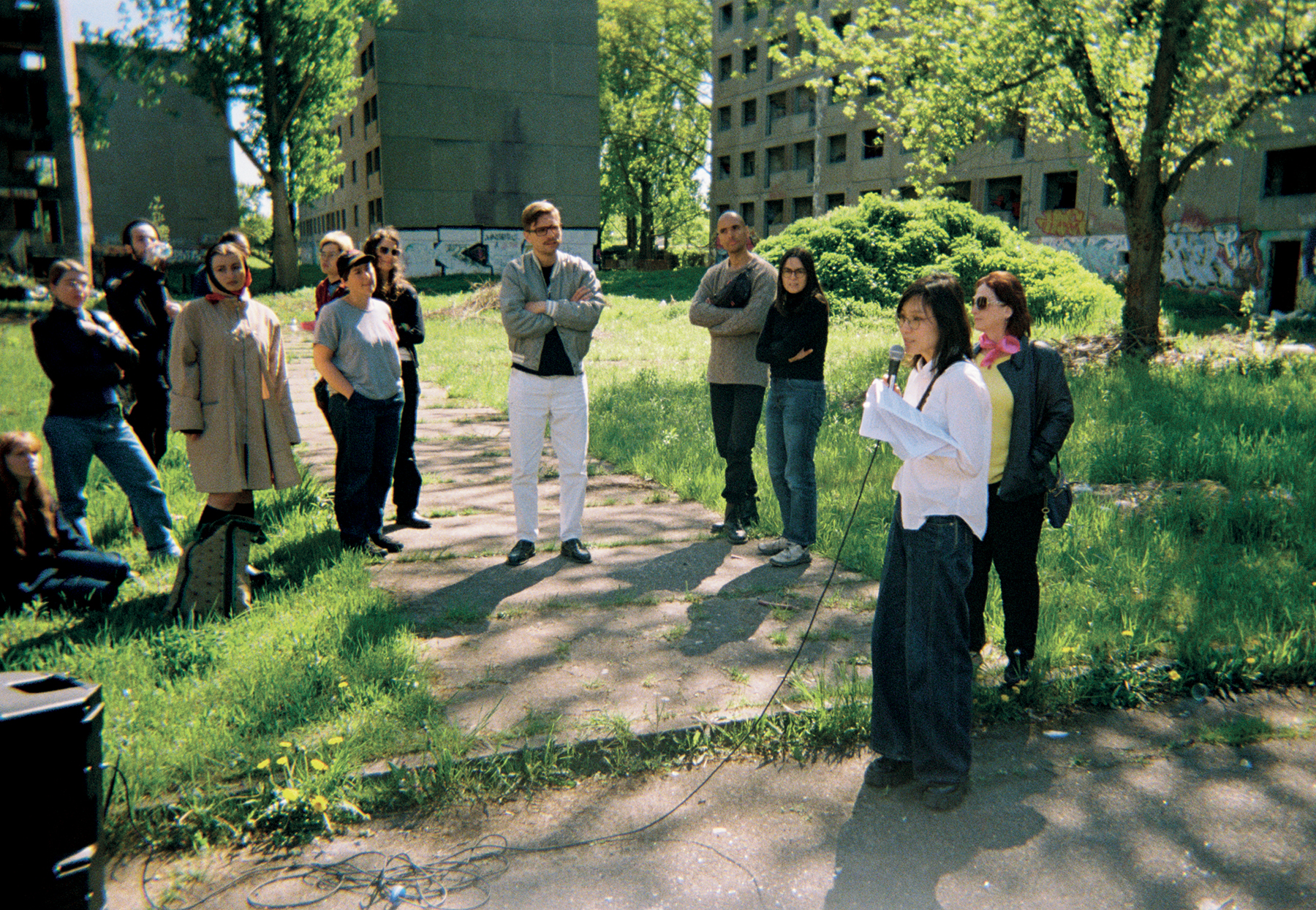
1992, 2025, Bustour, 26 April, 2025, documentation © Sung Tieu, 2026 Courtesy: the artist Photo: Sung Tieu and KW Institute for Contemporary Art, Berlin 2025

1992, 2025, Bustour, 26 April, 2025, documentation © Sung Tieu, 2026 Courtesy: the artist Photo: Sung Tieu and KW Institute for Contemporary Art, Berlin 2025
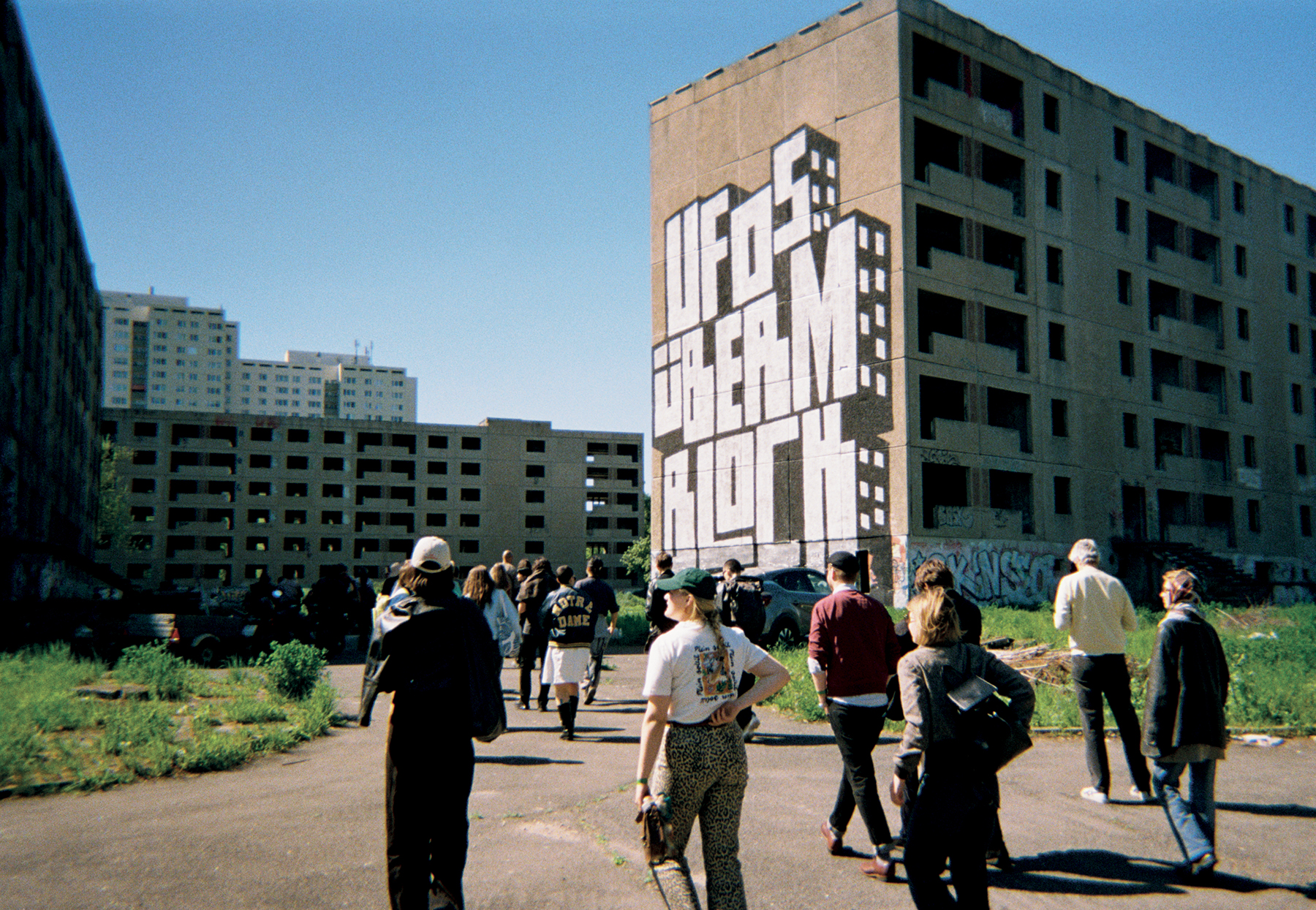
1992, 2025, Bustour, 26 April, 2025, documentation © Sung Tieu, 2026 Courtesy: the artist Photo: Sung Tieu and KW Institute for Contemporary Art, Berlin 2025
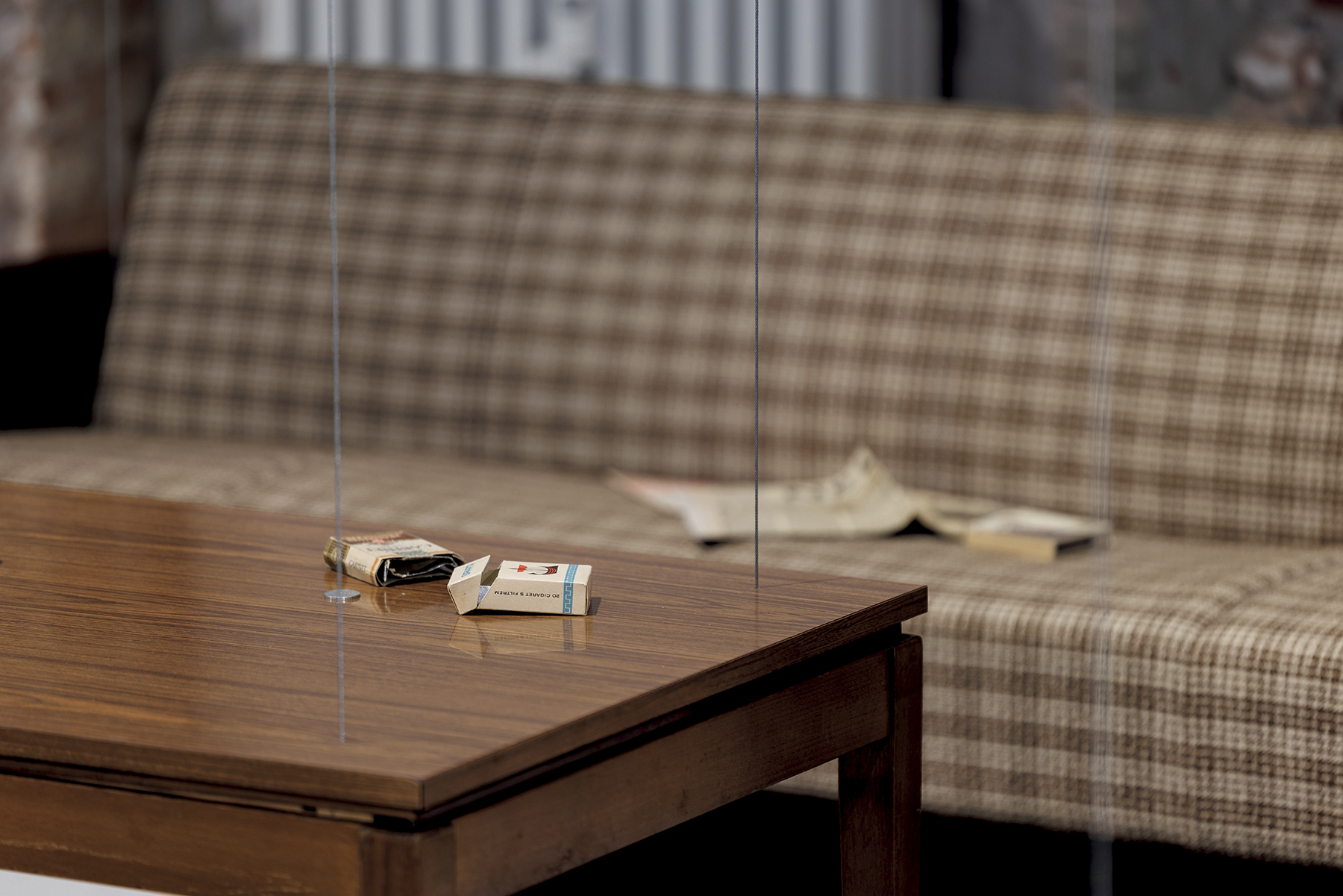
1992, 2025, installation views, Schering Stiftung Award for Artistic Research 2024, KW Institute for Contemporary Art, Berlin, 2025 Photo: Frank Sperling © Sung Tieu, 2026 Courtesy: the artist, Emalin, London, Galerie Sfeir Semler, Hamburg/Beirut, Trautwein Herleth, Berlin, and KW Institute for Contemporary Art, Berlin

1992, 2025, installation views, Schering Stiftung Award for Artistic Research 2024, KW Institute for Contemporary Art, Berlin, 2025 Photo: Frank Sperling © Sung Tieu, 2026 Courtesy: the artist, Emalin, London, Galerie Sfeir Semler, Hamburg/Beirut, Trautwein Herleth, Berlin, and KW Institute for Contemporary Art, Berlin
1992, 2025, installation views, Schering Stiftung Award for Artistic Research 2024, KW Institute for Contemporary Art, Berlin, 2025 Photo: Frank Sperling © Sung Tieu, 2026 Courtesy: the artist, Emalin, London, Galerie Sfeir Semler, Hamburg/Beirut, Trautwein Herleth, Berlin, and KW Institute for Contemporary Art, Berlin
1992, 2025, installation views, Schering Stiftung Award for Artistic Research 2024, KW Institute for Contemporary Art, Berlin, 2025 Photo: Frank Sperling © Sung Tieu, 2026 Courtesy: the artist, Emalin, London, Galerie Sfeir Semler, Hamburg/Beirut, Trautwein Herleth, Berlin, and KW Institute for Contemporary Art, Berlin
1992, 2025, installation views, Schering Stiftung Award for Artistic Research 2024, KW Institute for Contemporary Art, Berlin, 2025 Photo: Frank Sperling © Sung Tieu, 2026 Courtesy: the artist, Emalin, London, Galerie Sfeir Semler, Hamburg/Beirut, Trautwein Herleth, Berlin, and KW Institute for Contemporary Art, Berlin
The Assault of the Present on the Rest of Time, installation views, Schinkel Pavillon, Berlin, 2023 Photo: Frank Sperling © Sung Tieu, 2026 Courtesy: the artist, Emalin, London, Galerie Sfeir Semler, Hamburg/Beirut, Trautwein Herleth, Berlin, and Schinkel Pavillon, Berlin
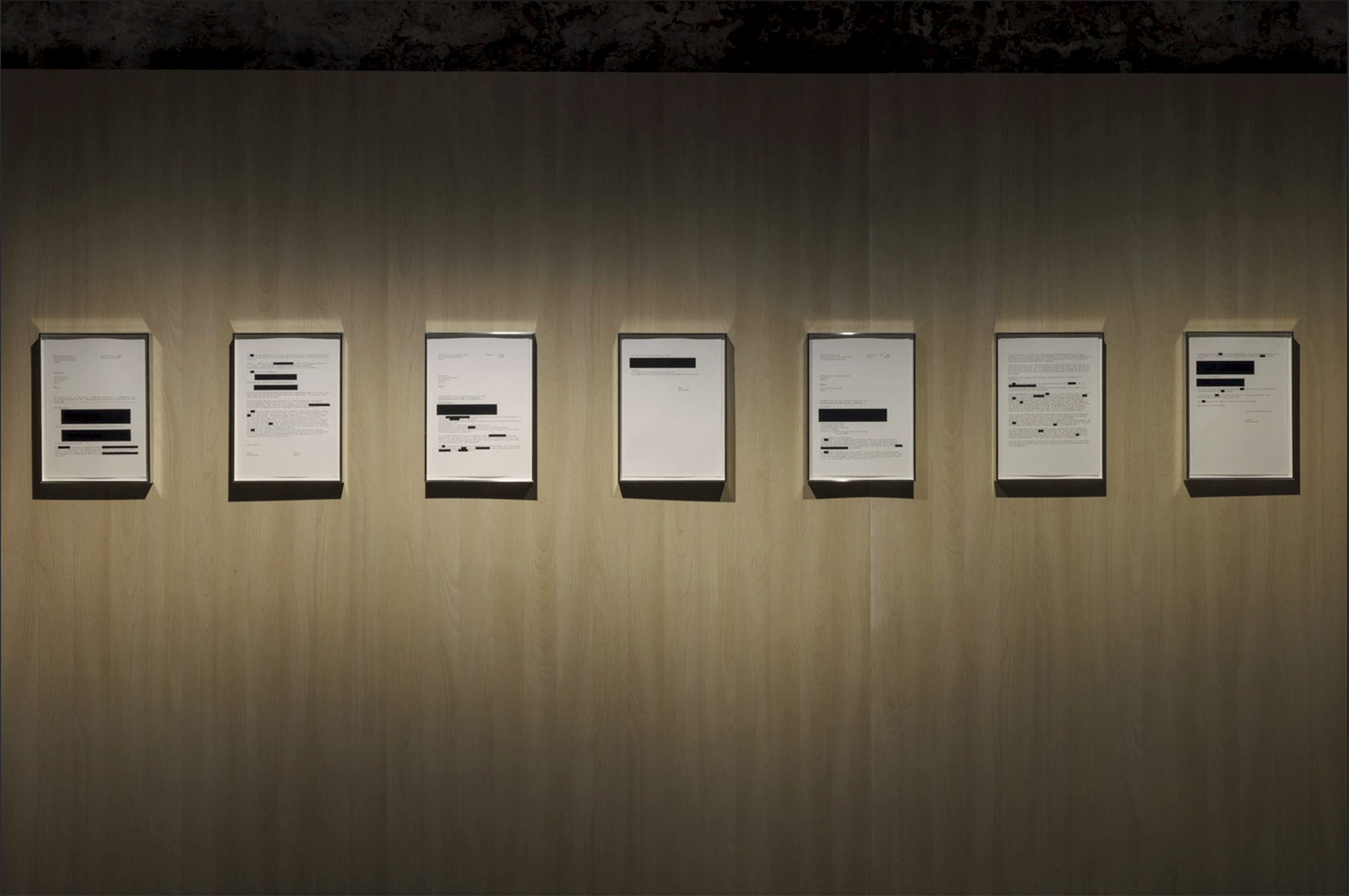
The Assault of the Present on the Rest of Time, installation views, Schinkel Pavillon, Berlin, 2023 Photo: Frank Sperling © Sung Tieu, 2026 Courtesy: the artist, Emalin, London, Galerie Sfeir Semler, Hamburg/Beirut, Trautwein Herleth, Berlin, and Schinkel Pavillon, Berlin
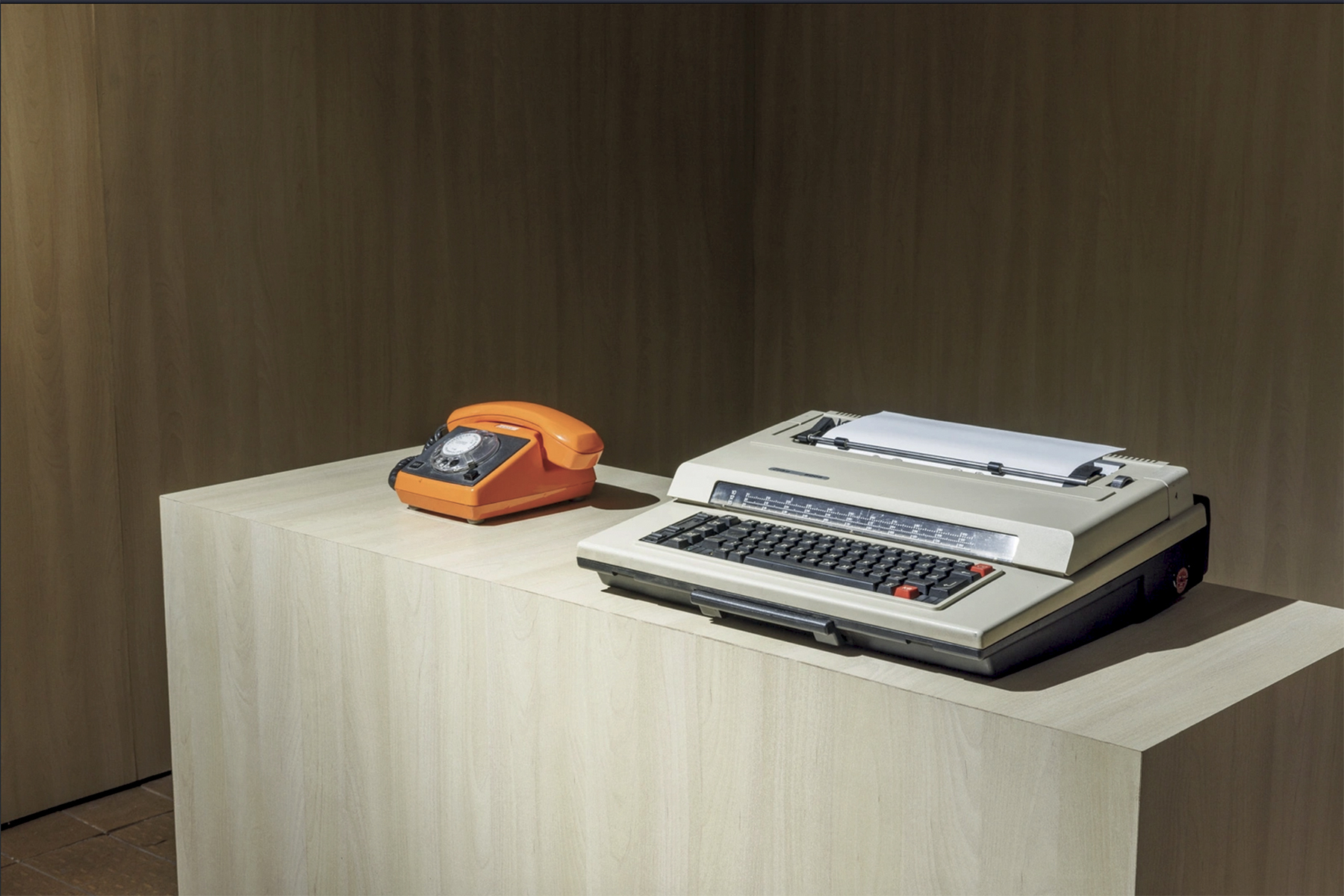
The Assault of the Present on the Rest of Time, installation views, Schinkel Pavillon, Berlin, 2023 Photo: Frank Sperling © Sung Tieu, 2026 Courtesy: the artist, Emalin, London, Galerie Sfeir Semler, Hamburg/Beirut, Trautwein Herleth, Berlin, and Schinkel Pavillon, Berlin
GREY ECONOMIES: TEMPORAL-INFRASTRUCTURAL POWER IN SUNG TIEU
Text by Dan Rees
This essay examines Sung Tieu’s engagement with historical time, focusing on its organization and spatialization under capitalism. If capitalism structures social relations through time, then time itself is not neutral but a central mechanism of domination under conditions of abstraction. Tieu’s practice is particularly suited to this analysis because it focuses on the infrastructures, such as measurement, standardization, display, and narration, through which time becomes a governing social force. Across different exhibitions, Tieu approaches these problems through distinct formal registers.
Rather than understanding culture as a form of ideological influence invested in by nation-states to exert geopolitical power, soft power will be thought of as the manner in which capital structures the logic of cultural production. From this perspective, soft power is not an alternative to hard power but the cultural and temporal framework that makes it possible in the first place.1 Culture can be understood as the medium through which this temporal logic becomes visible and naturalized. In its critical capacity, contemporary art can expose these broader contradictions within cultural production.
1992, 2025
In her exhibition 1992, 2025, at KW Institute for Contemporary Art (KW), Tieu examines how narrativity relates to meaning under capitalist social relations, where time is perceived less as a realm of possibility than as a form of governance. Historical time is immediately invoked through the two dates: 1992, marking Tieu’s arrival in Germany, and 2025, the year of the exhibition. Yet this apparent biographical chronology is interrupted by the title’s punctuation. The exhibition is titled 1992, 2025, not 1992–2025. Presenting two dates placed side by side implies a structural relation rather than continuity.
This distinction is important. A hyphen would signify duration or progression, organizing time around the human subject through a biographical arc. Such a gesture aligns with a bourgeois conception of life as a meaningful temporal whole, itself a fantasy of capitalist subjectivity. The comma refuses this humanization. Biographical time nonetheless persists throughout the exhibition, not in a simple narrative sense, but as a form of pressure exerted on its objects.
In Read Me, Wear Me, Fear Me, for example, the two mannequins—wearing clothing printed with montaged newspaper reports of right-wing attacks on immigrant communities—invoke a recognizable biographical image of mother and child. A condition of fragility is registered here that informs Tieu’s broader practice. This vulnerability marks what would be violated by the imposition of narrative continuity; the hyphen would be vulgar, insofar as it would force this biographical relation into the appearance of a coherent and reconciling life. The mythology of the narrative arc is itself a seductive form of capitalist time-consciousness. What Tieu produces instead is a mediation in which a certain form of violence becomes implicit in retrospection itself. Biography appears in 1992, 2025 only as something unable to fully integrate into abstract time.
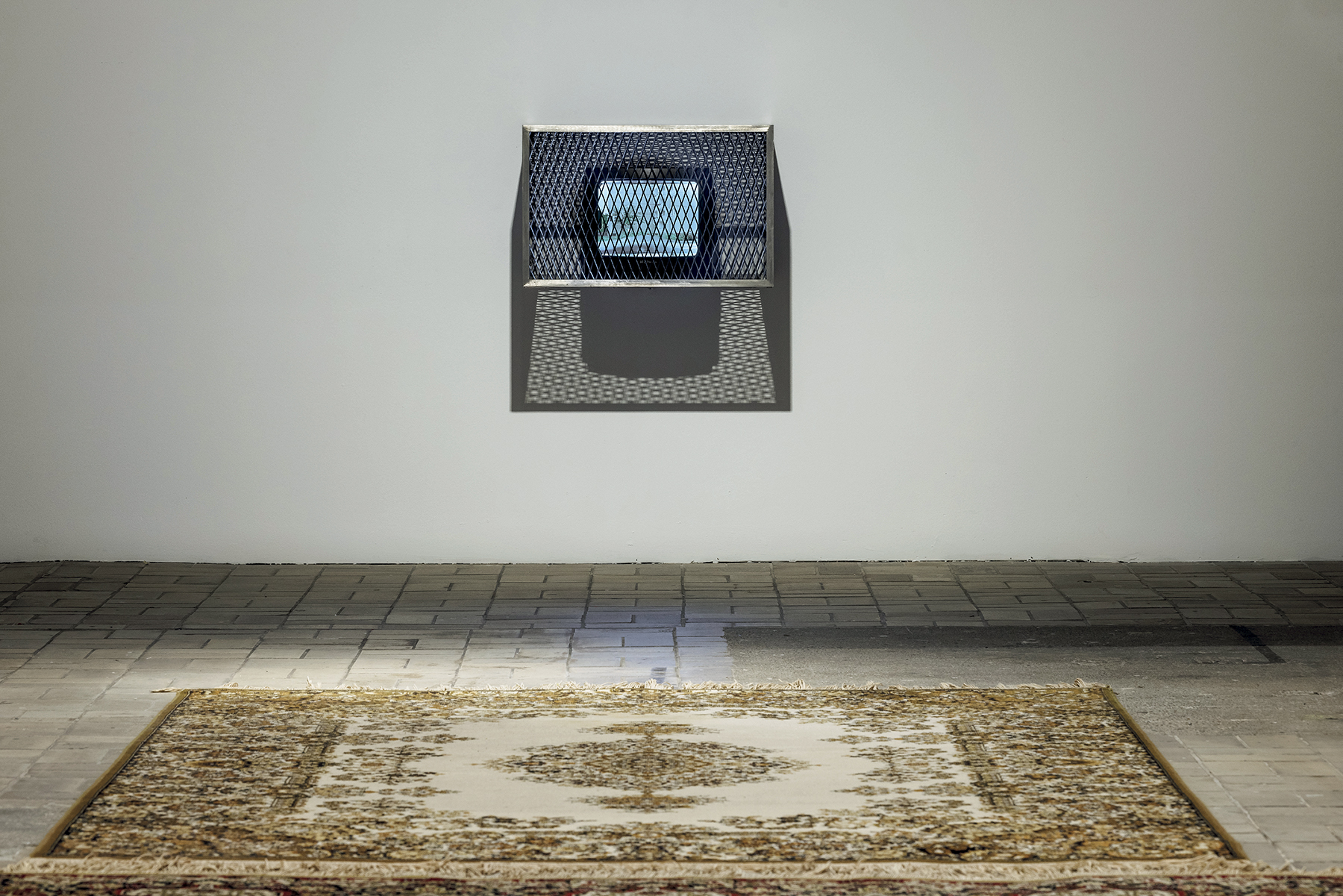
This dynamic reappears spatially within the exhibition. Metal bars protrude at right angles from architectural pillars, interrupting spatial continuity in a manner analogous to the comma’s disruption of temporal sequence. While these intrusions invite a metaphorical reading, their impact emerges through the viewer’s physical encounter with the bars as a spatial demand on the body rather than a sign to be decoded.
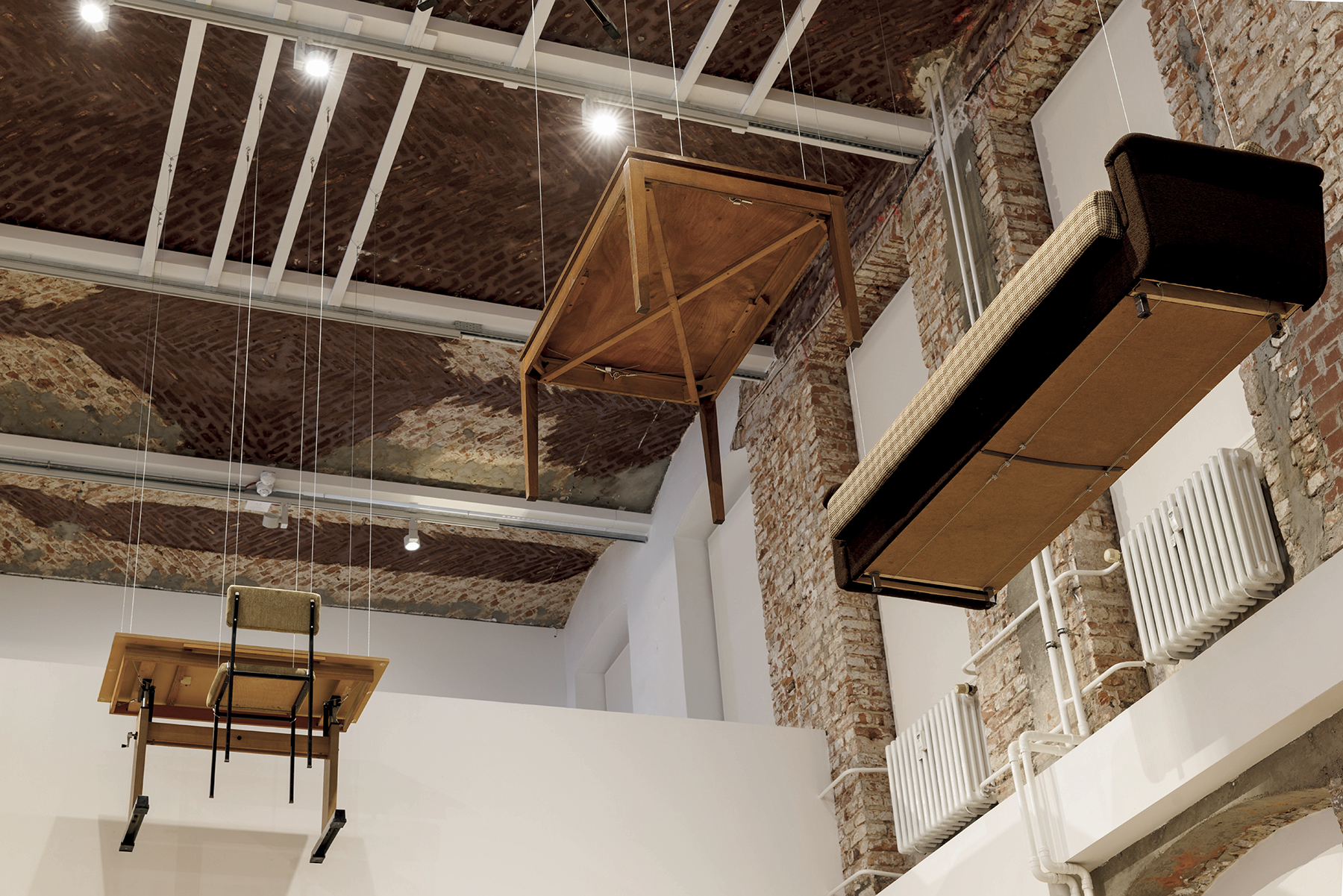
In this way, the metal bars exert a reflective pressure on the exhibition’s more overtly historical objects. What begins as physical obstruction becomes a productive blockage, a logic which is extended through the arrangement of GDR furniture in Midair (2025), where historic domestic objects hang within the negative space of the mezzanine. As one commentator observes, the risk of a hieratic effect is not incidental: the work reproduces the reification of the GDR itself as a suspended historical object.2 Just as the comma in the exhibition title suspends a sense of narrative progression, the suspension of GDR furniture renders its past as an already-expired future—what we might think of as a past future.
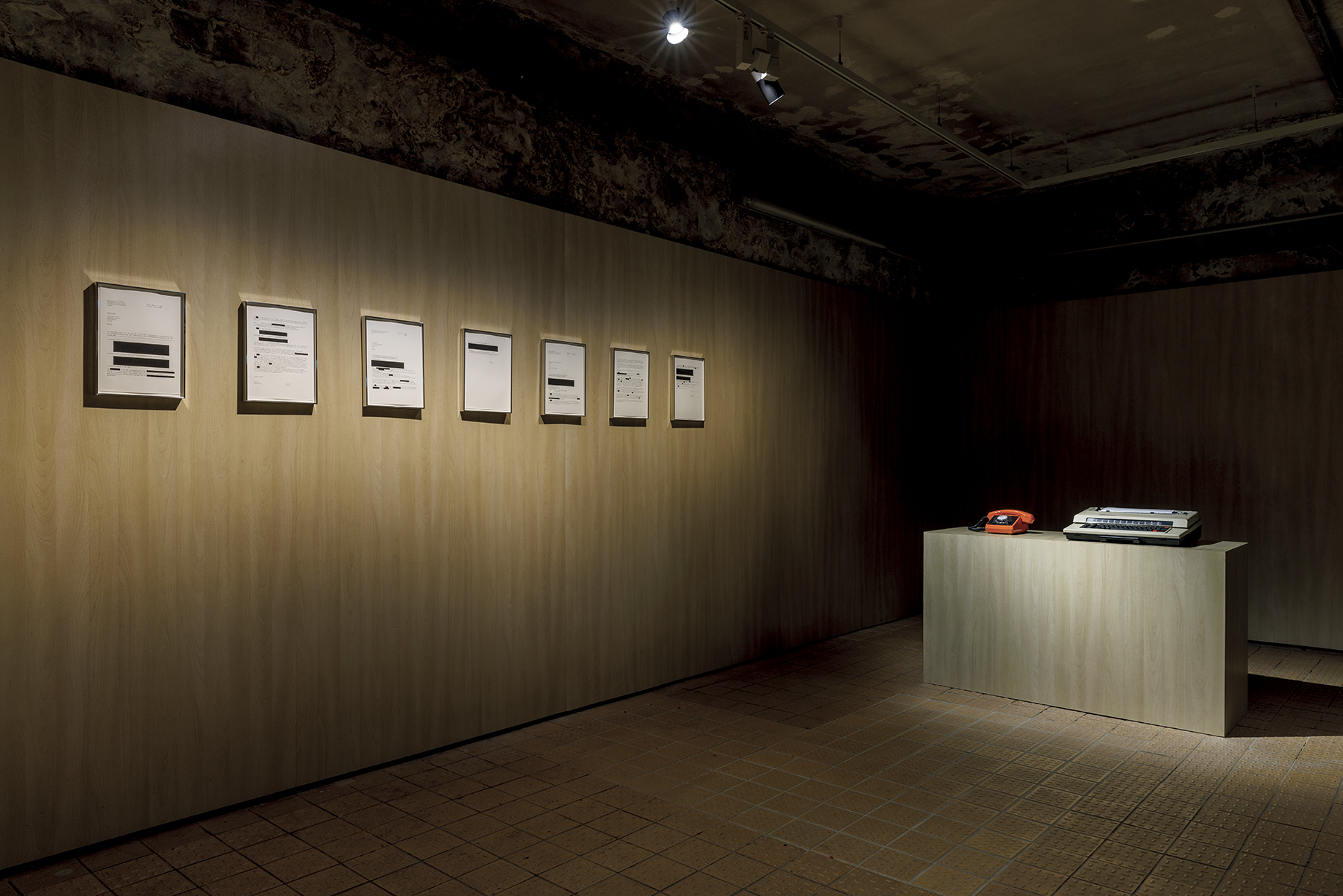
This engagement with socialist history is further mediated through the museological display of goods drawn from the Vietnamese grey economy, such as contraband cigarettes in Object of Suspicion (Politische Ökonomie des Sozialismus) (2025). These works foreground a community positioned at the margins of both state socialism and global capitalism. Rather than functioning as ethnographic detail or counter-history, Tieu’s display produces a historical remainder that cannot be integrated into either socialist historicism or capitalist abstraction.
Tieu’s practice does not offer new imaginaries or alternative futures. Rather, it refuses a form of consolation by rendering perceptible the infrastructural and temporal mechanisms through which horizons of expectation are produced. This is perhaps most acutely felt in her work Declaration of Donation (2025). The work consists of a long contract that both lays out its conceptual logic and states the conditions of its sale, with the proceeds funding a new board member at KW.3 Declaration of Donation can be understood as a productive convergence between conceptual art and infrastructural critique, such that the work’s form, as a contract, self-consciously reflects its critical aims. As the contract states, “At the heart of this work lies a fundamental question: who gets to shape the institutions that shape our cultural landscape?”
The notion of a grey economy reappears here as a structural response to institutional exclusion and the need for greater diversity. For capitalism to sustain the fantasy of a shared history, it must represent social life as a universal horizon of stable exchange relations. Cultural institutions are one of the many social mechanisms that naturalize these conditions. Tieu’s conceptual move is akin to utilizing the inventive nature of the grey economy to expose financial conditions and ‘administrative inertia’ from within. As such, Declaration of Donation functions as a critique of abstraction’s claim to universality by giving form to exclusion from a common time and space—an exclusion that is structural and racialized.
Tieu’s own institutional visibility does not redeem the histories her work registers; it stages their conditional inclusion, in which recognition itself functions as regulation. Institutional critique therefore operates less as opposition than as infrastructural diagnosis, occupying a grey zone between complicity and autonomy. It is in this sense that Tieu’s representation of Germany at the Venice Biennale is double-coded: not as simple inclusion, but as a site where the mechanisms of institutional incorporation are enacted and held in suspension.
The Ruling
If the preceding works register the administration of time’s social and political effects, The Ruling addresses an infrastructural origin of this temporal regime. Tieu’s The Ruling (Indochinese Rubber Company Groups) (2023–24) operates at the millimeter through which power is exercised, treating metrology not as a neutral instrument but as a material technology of colonial rule. Two sets of rulers—differing in unit and length, and therefore permanently out of sync—run across the gallery walls. Tieu produced one set of wooden rulers engraved with grid patterns derived from the traditional Vietnamese unit of land measurement, the xích; the other consists of 40 cm rulers etched with statistical data on French colonial administration, including figures for economic investment and Vietnamese wages.4
This measured misalignment indexes a contradiction with concrete effects. Under colonial standardization, the xích—nominally equivalent to 0.47 meters—was redefined as 0.40 meters, a contraction of 14.89 percent. This recalibration inflated measured quantities, institutionalizing systematic losses for the Vietnamese. What is standardized is therefore not only land or metrics of measurement, but by extension time itself as a medium through which value is calculated.
The rulers do not measure the walls of the gallery; if anything, the architectural surface exposes them as unstable standards. The only legible unit etched into the work is the xích; the centimeter-based rulers remain conspicuously blank. As such, the rulers retain the form of measurement while suspending its function. This reverses the usual relation in which form is subordinated to instrumental use-value. Here, the rulers’ function, their capacity to measure, is suspended and form is foregrounded. This exposes standardization of the centimeter not as a neutral process but as historically contingent. What becomes perceptible through the rulers’ misalignment is their operative role in standardization and synchronization. This altering of the metric through which value is itself measured shows how temporal coordination under capital operates prior to politics.
Tieu’s rulers produce a non-identical remainder that escapes the universal metric and its claim to commensurability. As Marx famously observed, “Time is everything, man is nothing; he is at the most the incarnation of time.”5 The Ruling gives spatial form to this temporal abstraction, in which the subject is decentered. Once labor time becomes the universal measure of value, social relations are organized through abstract equivalence, confronting subjects as autonomous, thing-like structures—what Lukács theorized as reification.6
From this perspective, the introduction of the centimeter into Vietnam is not only an act of cultural erasure or the imposition of French norms, but more fundamentally, it marks the insertion of abstract, commensurable time. This signifies a reconfiguring of social relations around labor time as the dominant unit of equivalence. The abstraction of social relations under capital is not identical with colonial violence, but proves to be one of the means by which it is reproduced in a seemingly natural manner.
The two sets of rulers stage distinct but intersecting modes of abstraction. One employs a local unit of measurement—the xích—rendered opaque and effectively abstract within Western metric systems; the other erases its unit altogether, leaving only the generalized form of measurement abstracted from use-value. Their misalignment allows the rulers to enter into a formal relation with one another. This forced commensurability of differing measuring systems produces a remainder through which the organization of time under capital becomes perceptible as infrastructure. What the work speaks to is the manner in which colonial standardization organizes abstract labor time; this in turn creates new relations to space.
On the occasions that Tieu has exhibited The Ruling, the gallery space itself becomes a concrete site upon which abstract temporality is imposed. What this makes legible is a value form that art specifically differentiates itself from, in the sense that artworks are specific objects that contain no obvious use function. Abstract time in The Ruling appears as a structuring condition of labor, a condition through which capitalism produces a historically specific time-consciousness. Colonial standardization is not a discrete historical episode but a precondition that continues under transnational capital, where different historical times are flattened into a single present.7
Biennale Form
Contemporary art is often described as a site of cultural “soft power,” a concept inherited from the Cold War, where it named the persuasive influence of nation-states exercised through cultural exports. Such an understanding is arguably no longer adequate. Under conditions of transnational, post-nation-state capital, soft power not only operates through persuasion, but also through the temporal and infrastructural coordination of social life as mediated by culture. Cultural production tends to strengthen the notion of individual agency and the more political agency is imagined as internal (creativity, imagination), the less it threatens external structures of power. This can be thought of as soft power’s self-developing loop; as an export, culture functions as a symbol of freedom, as an internalized logic, culture naturalizes capitalist relations.
The Venice Biennale, and its national pavilion system in particular, constitutes one of contemporary art’s most explicit formations of cultural soft power, both in its traditional sense and increasingly as a mode of temporal coordination.8 The wider proliferation of international biennales emblematizes the transnationalization of capital and the imaginative fiction of a shared world. At the institutional level, the biennale functions as the primary mechanism through which the art world constitutes itself as a world, following a logic of geographic expansion that mirrors capital’s own spatialization.
This says nothing about artistic intention, but speaks to the structural conditions of reception. Narrativity here does not unfold within time; it organizes time, producing history and contemporaneity through the regulation of futurity. After all, the emergence of “history” as a collective singular is itself a historically specific development—one stabilized and aestheticized through the biennale form as a shared contemporaneity.9
As Peter Osborne observes of biennales:
“They mediate exchange relations with artists via the latest cultural discourses of ‘globalization’, […] they are the Research and Development branch of the transnationalization of the culture industry. For currently, it is only capital that projects the utopian horizon of global social interconnectedness, albeit in the ultimately dystopian form of the market.”10
The ‘contemporary’ can be approached as a particular form of post-1989 modernity, shaped by the conditions of transnational capital. Contemporaneity, then, is not simply reflected by the biennale but regulated through it. The Venice Biennale emerges as a site of contradiction, in which nationalist frameworks and post-national aspirations, finitude and futurity, are held in coexistence under the fiction of frictionless global circulation.
It is within this horizon that the force of Tieu’s work becomes legible. Her practice neither claims an exterior position nor reconciles itself to inclusion. Instead, it occupies a productive neither/nor, exposing art’s own conditions of complicity without offering reconciliation. As her KW contract states, “Institutions evolve not through declarations of inclusivity but through shifts in infrastructure.” What is at stake in infrastructural critique is precisely this refusal of an aestheticized resolution. Tieu’s works operate within the same subtlety that structures the grey economy across 1992, 2025: between inclusion and exclusion, autonomy and complicity. By situating critique at the level of the infrastructural conditions of capital and the time-consciousness they produce, Tieu avoids the pitfalls of moralization and redirects critical attention toward the conditions of visibility.
1
The term “soft power” was popularized by Joseph S. Nye Jr. in Bound to Lead: The Changing Nature of American Power (1990), at a moment when the nation-state-centred cultural diplomacy it named was already being reconfigured by the transnationalization of capital.
2
Christopher Williams-Wynn, “Exploitation, Past and Present: Negotiating the Afterlives of German Reunification,” ArtMargins Online, [2025], https://artmargins.com/exploitation-past-and-present/ (accessed January 18, 2026).
3
As a result Mi You was appointed as a new member to the executive board at the KW Institute for Contemporary Art, Berlin.
4
The Ruling (Indochinese Rubber Company Groups) was exhibited at Ordet, Milan, in 2023; another version of the work was shown at Trautwein Herleth, Berlin, in 2024. The exhibition text names the pre-colonial Vietnamese land-measurement standard as điền xích / thước đo đất.
5
Karl Marx, quoted in Georg Lukács, History and Class Consciousness (London: Merlin Press, 1971), 89, originally from Marx’s The Poverty of Philosophy.
6
See Georg Lukács, History and Class Consciousness: Studies in Marxist Dialectics, trans. Rodney Livingstone (Cambridge, MA: MIT Press, 1971).
7
This dynamic recalls Peter Osborne’s formulation of the contemporary as “a disjunctive unity of co-present times.” Anywhere or Not at All: Philosophy of Contemporary Art (London: Verso, 2013), 22.
8
The obvious counterpart is the international art fair.
9
See Peter Osborne, The Politics of Time. Modernity and Avant-Garde (London: Verso, 1995), building on Reinhart Koselleck’s analysis of historical time and the emergence of “history” as a collective singular.
10
Osborne, Anywhere or Not at All, 164.

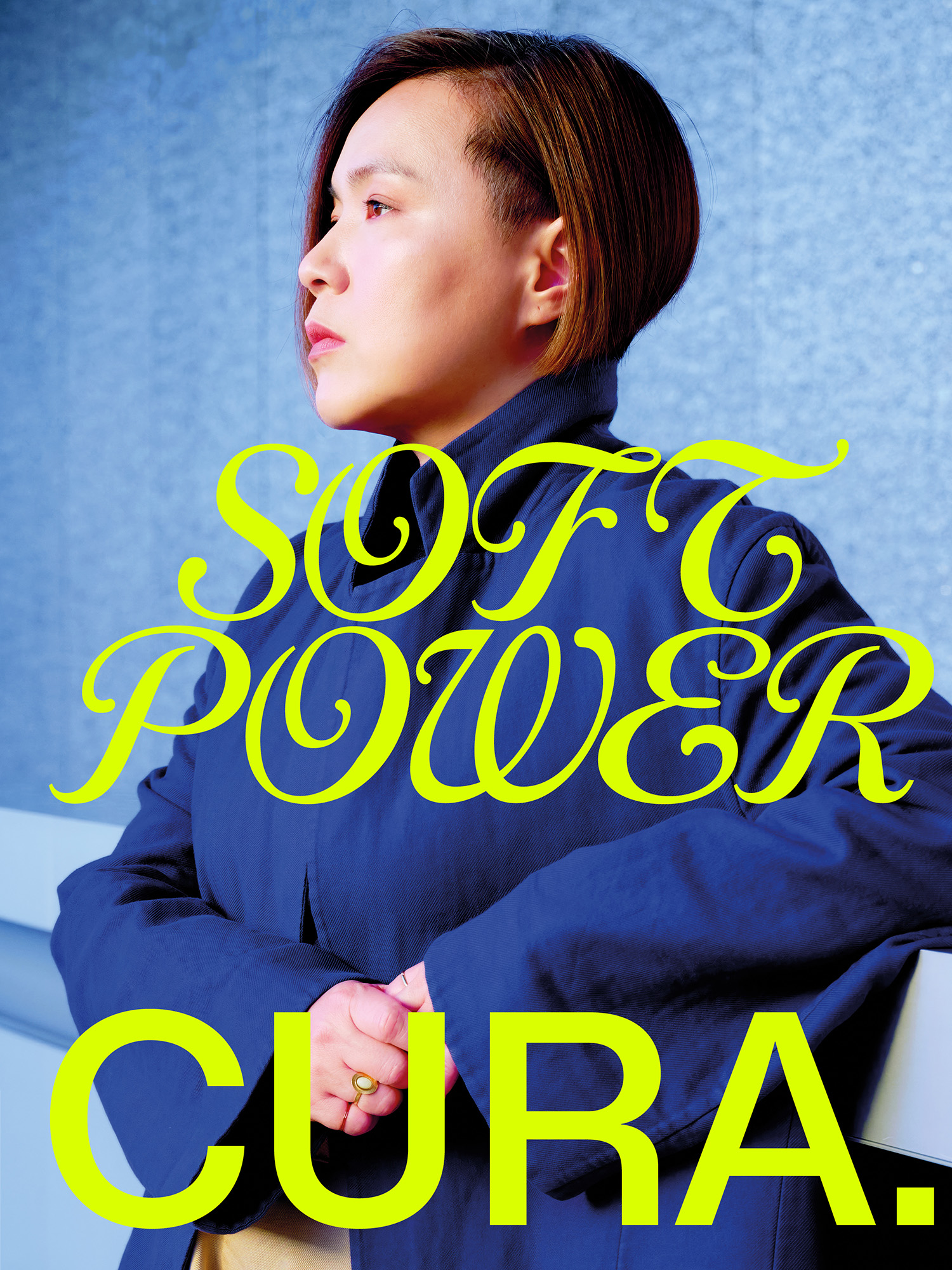
Sung Tieu
Portrait by Vitali Gelwich
Courtesy of the artist
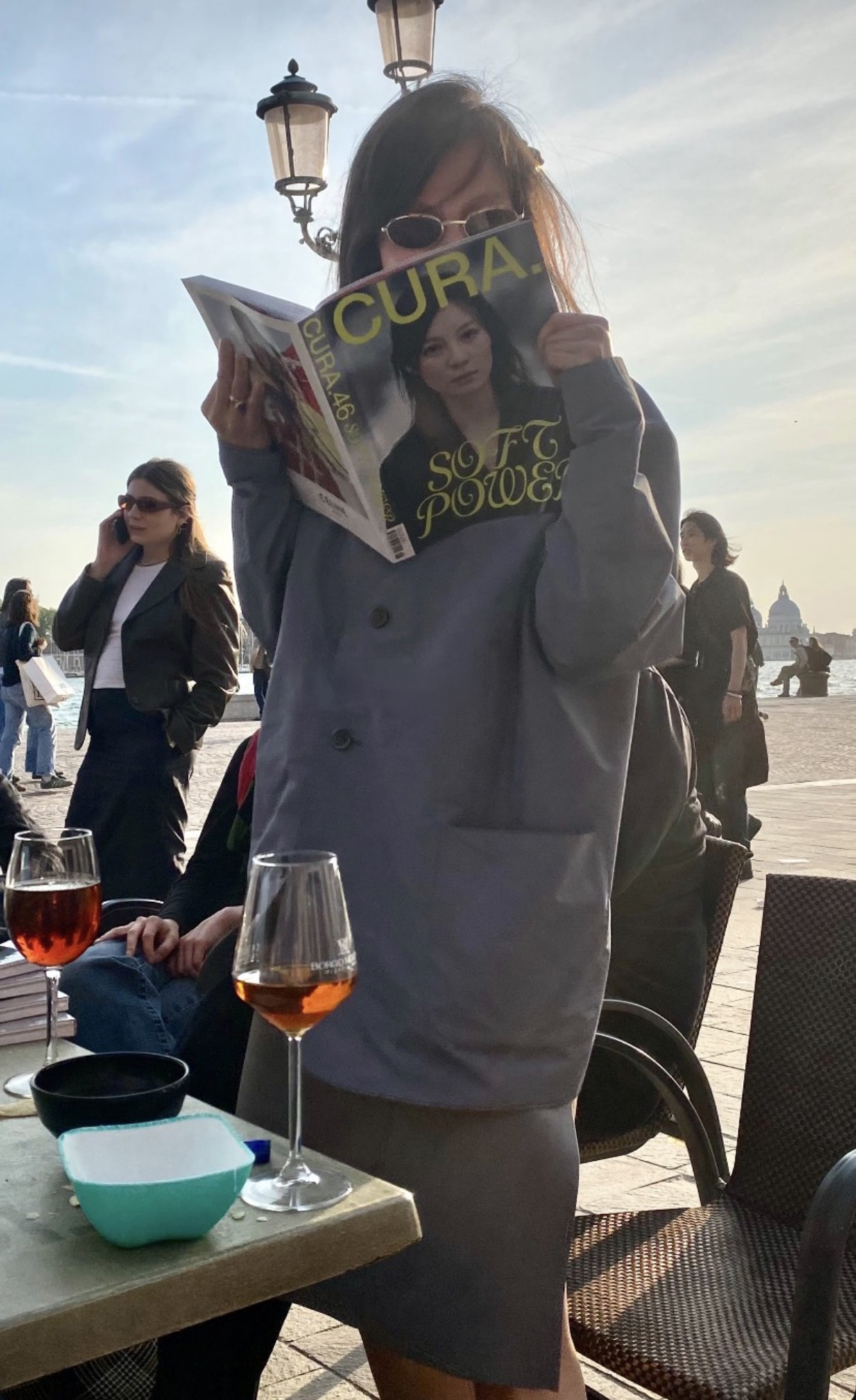
Sung in Venice, 2026
COVER STORY
SUNG TIEU
Texts by DAN REES
and CHRISTOPHER WILLIAMS-WYNN
SUNG TIEU (b. 1987, Hải Dương, Vietnam) is an artist based in Berlin. Her forthcoming solo exhibitions include: the German Pavilion at the 61st Venice Biennale, presented together with Henrike Naumann (2026); Castello di Rivoli, Turin (2026); and Emalin, London (2026). Current and forthcoming group exhibitions include the 82nd edition of the Whitney Biennial, New York; MATTA, Milan (2026); and WIELS, Brussels (2026).
DAN REES is an artist and writer based in Berlin
CHRISTOPHER WILLIAMS-WYNN is Berlin-based art historian and theorist. His first book, Arts of Control, is forthcoming from MIT Press, and his writing has appeared in Art Journal, Grey Room, The Art Bulletin, and ARTMargins Online, among other publications.