in conversation with Bart van der Heide

CURA.36 SS2021
FUTURITY

Bart van der Heide: The formal evolution of digital art has been a reoccurring topic of discussion over the last decade. Some established art critics have raised the question of why contemporary art since 1989 (when Tim Berners-Lee invented the World Wide Web) is still largely populated by pre-internet forms of media. Your installations show that digital art doesn’t need to be exclusively digital from a technological perspective. They generate expanded and interdependent circuits between the online and the offline. In the gallery space one encounters spatial installations that reference the architecture of self-organized hacker spaces or corporate flex-work environments, or even incorporate more historical forms of knowledge distribution, such as books, classification, and display. Simultaneously they are known to have an active online presence that one does not necessarily experience when visiting the exhibition in person; they generate and analyze data or even encourage digital user intervention and feedback. To those art critics that question the innovative evolution of digital art—saying that the revolution in information technology has not led to revolutionary alterations in our relationship to perception, history, language, and social relations within the context of art—what would your answer be?
Yuri Pattison: I would like to respond to this by first positing this now well-worn quote “The future is already here—it’s just not evenly distributed.”1 Ultimately the internet is about information, where anything of any value has the potential to be controlled like a packet of information in the network. For example we see this in the evolution of Amazon as a company—from the masterful streamlining of the shipping of used books, to the expansion to goods, crowdsourcing of labor, and now the control over the majority of information on the internet. For many, the company has become omnipresent, encountered daily from purchasing household goods to interaction with government web services. The work I make responds to the fabric of this reality, of living within these wider material conditions. I also consider my work to be dealing with the longer history of the information economy, and the evolution of the internet is just one part of this longer timeline. While the internet has opened up multiple new possibilities it has also accelerated many existing trends within capitalism, globalization and to some degree totalitarianism, we see ideas and power structures from the past re-emerge within the digital realm. So I don’t see the question of “digital art” being one of dichotomy, but more of subsumption. I would argue that open, easy and immediate access to information has led to artworks being made in a more polyphonic way; embodying a deeper and wider view of history/ies; utilizing a wider variety of techniques, technologies and mediums; and working across time zones, borders and languages. However, while the end results might not be so easy, or satisfying, to categorize from an art historical point of view, they certainly do mirror the wider societal changes currently occurring. Ultimately there is always the temptation to vaguely categorize art by its medium or the technology it uses rather than its content. I no longer think this is productive when discussing current cultural production and believe a more nuanced approach needs to be considered. The present is after all still a fractured reality—an increasing amount of meaningful cultural and social experience now happens entirely within the digital realm, and we are seeing an ongoing shift of power and capital to this space for that reason. The restrictions related to the pandemic have certainly pushed these changes faster into the mainstream. Other experiences are, and will continue to be, rooted in the physical, with only minor interactions with digital space. Those with true power will dominate across both realms.
BvdH: Can you elaborate on how this negotiation between both digital and physical realms is manifested within your practice?
YP: Whether centralized, or otherwise, “the digital” is bound to the physical by its infrastructure—data centers, crypto mines, cell towers, satellites, laptops, etc., and the networks that connect them. Some of my earlier works directly traced these networks through their infrastructure, exploring narratives at the points of input/output and exchange. For example outsourced views2 (2013) commissioned images and video clips of the window views closest to the workspaces of Amazon Mechanical Turk workers, constructing a landscape portrait of that labor network; or the ideal (2015)—a first person documentation of the construction of a hydroelectric powered bitcoin mine in Kangding, Tibet—which was made remotely, entirely through the mediation of the internet over several months, with the close collaboration of Eric Mu (CMO of the company) whose frank diary posts I had come across on a bitcoin forum. Funds for equipment (ordered locally via TaoBao) were sent using bitcoin, preview clips sent via the mine’s satellite internet connection and the final footage sent “IP-over-DHL” (to circumnavigate the slow upload speeds due to the Great Chinese Firewall). The edited video existed within an expanding series of sculptures, each containing a working water cooled bitcoin miner as part of their materials and through their exhibition self funded further iterations of the work. Since then I have revisited and expanded upon these strategies in broader more abstract ways—works often reveal the physical instruments of production, automation and mechanization within networks. I have frequently utilized industrial web servers as functional sculptural elements within exhibitions. These servers might locally host data accessible on the web or more recently are modified for the processing and display of video or generative content. In the exhibition user, space (Chisenhale Gallery, 2016) a server automated the functions of a speculative co-working space—controlling access to artificial and day light, altering levels of sound treatment (white noise) and also the display of live surveillance and pre-recorded embedded video content within the space. It explored the implications of a remotely managed, automated, work environment.



BvdH: Already early on you tried to address this topic. Talking about art works such as Familiarity breeds contentment (2015) in a conversation we had in 2015, you mentioned that visualizing the hidden mechanisms of the web, in all its noisy, disruptive and heavy qualities was a means of making the, let’s call it, ‘The Internet of Things’ visible and graspable, hence, prone to critical analysis. Along these same lines, we started to address the element of feedback and erosion that often crops up when your work actively circulates data and metadata between both worlds. You mentioned then that erosion seemed key to affirm the passage of time. William Gibson also suggested recently that we might be the last generation that will draw any distinction between our physical and virtual lives. How do you see this affect our sense of reality or agency over the present?
YP: I feel experiments in the field of “Mixed Reality” offer insight into the aspirations of corporations to shape and control our perception of reality. A perhaps lesser known development in this space is a novel time unit developed by Facebook, “Flicks” (2018), which aims to allow the seamlessly blending playback of all known recorded media formats (regardless of frame or sampling rate) with reality, a unit of time defined by media rather than astronomical objects. At the same time we are seeing the possibility to restore, upgrade and reformat existing recorded media using generative adversarial networks. I feel these more banal aspects of how we passively consume media, and what we consume, will slowly reshape our perceptions of history and time. We’ve already seen massive and fundamental changes to the social and political landscape through fairly rudimentary developments in our consumption such as via social media. Familiarity breeds contentment touched upon this through its implementation of very primitive AI processes to “spin” content, a technology used to plagiarize material for rogue spam websites with the results often dominating the information available for certain search terms. These new technologies will be equally messy in their feedback loops.
BvdH: In the publication Globalists: The End of Empire and the Birth of Neoliberalism, Quinn Slobodian unpacks a particular historic imaginary of the liberal world economy that was less about the freedom of the individual and more about the interdependency of the whole. The great depression had shown them that world trade was not natural, but instead depended on maintenance and the existence of a monetary system. This makes global free-trade less of an economic project, and more about global government and law; ultimately geared towards trumping absolute national sovereignty and in particular, workers unions. In short, the liberal world economy might have emerged at a time when empires collapsed, but it did not change their monetary government. I am saying this because you have talked about the colonial tendencies of the technology industry before. Your recent projects have specifically highlighted the role of time in this system. Can you elaborate on this?
YP: The temporal has been an important and reoccurring aspect of my practice, often exploring different levels of abstraction in the experience of time in networked society. For example I’ve looked at modern sunset rituals, MIThenge3 in (infinite corridor, infinite) (2016), but also phenomena such as the imposition of distant time zones via outsourced labor and telecommuting. true time master (2019-2021) was the first work to truly tackle the infrastructure and fabric of global time. The work implemented a Chip Scale Atomic Clock (CSAC)4, a technology I wanted to engage with as it links so many aspects of contemporary society. Like the internet, these miniaturized time keeping devices emerged from development by the U.S. Defense Advanced Research Projects Agency (DARPA) and they are now utilized in a diverse range of applications such as satellites, U.S. military drones, data centers, telecommunications, hydrocarbon exploration, finance, etc. Furthermore the CSAC is a cesium atomic clock, providing the most accurate time and frequency standards—the cesium standard has been used to define both the second and the meter by the General Conference on Weights and Measures since 1967. My interest in the CSAC stemmed from looking at the networks which govern our lives and their geopolitical boundaries. The internet is a network governed by time and as such it relies on accurate time keeping to function correctly and it is fed by atomic clocks via network time servers and the GPS network. The atomic master clock at the United States Naval Observatory informs much of the time on networked devices (servers, laptops, phones) in the West. With this oversight I began to view the CSAC as the descendant of the marine chronometers which enabled empires to expand their colonies through exploration. Expansionism within tech is of course on a geographical basis, we see this in projects by SpaceX or Google bringing internet to remote regions of the (often “developing”) world via miniature satellites or stratospheric balloons, but also in terms of penetration into the personal sphere. The new frontiers of the latter go way beyond the much discussed data mining and involve the reformatting and reshaping of reality through content, and as we discussed precision timing via the network will play a role in this.


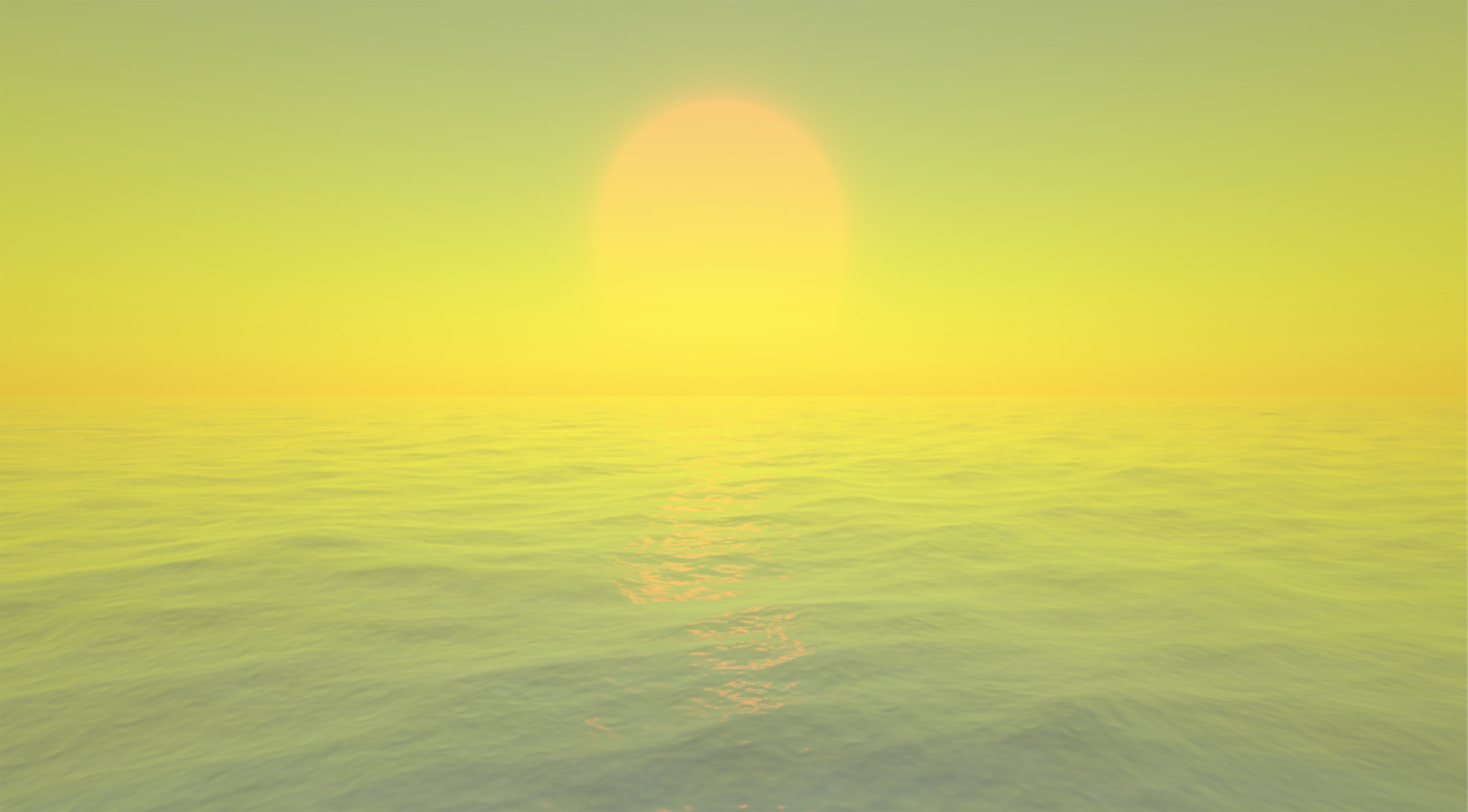
BvdH: Next I would like to go a bit deeper into the process of capturing data into an image. The liberal global economy chose the barometer metaphor to capture an economy that was inherently intangible and untraceable for a larger audience. Without this, it would have never been so widely picked up. A barometer is analytic, objective. In your recent work {sun}set, provisioning (2020-2021) you chose a sun that captures the data of an OpenGL software that measures the pollution scale.
YP: The sunset provision series used live local atmospheric data uRadmonitors, a kind of citizen science initiative aimed at open sourcing climate data online through distributed devices and averting government level coverups similar to Chernobyl, to influence the aesthetics within sunset scenes rendered by an OpenGL game engine. In part this was very much influenced by our collective awe at the spectacular, and equally artificial, sunsets we are now seeing globally due to particulates in the atmosphere from industry and other man made events. Sharing the same space as these monitors directly implicates the audience within the work, the gasses exhaled also have the potential to affect the scenes. The data is visualized within the scene in an abstracted, objectively useless, manner—an extrapolation of the overly simplistic color codings (green=good, orange=ok, red=bad) often used in the air quality apps I looked at within my research. These apps often vary greatly in their codings and presentation of data as the criteria for ‘air quality’ varies greatly from country to country, there are no global standards and the differences in standards are often quite revealing. This is one small example of the wider trend towards jargon data aesthetics where the visualization overwhelms the information it is professing to represent. These works themselves are not inherently ‘green’—they repurpose used industry standard data center servers (of the type we interact with daily) modified with gaming GPUs (the type also utilized for the mining of cryptocurrencies) to process this data and render these scenes. They participate, as we all do, in this bigger global story.

1
William Gibson, The Economist, December 4, 2003.
CURA.36
Spring Summer 2021
THE FUTURITY ISSUE
CREDITS
All images Courtesy: the artist
YURI PATTISON (b. 1986, Dublin, Ireland) lives and works in London. Solo exhibitions include: the engine, Douglas Hyde Gallery, Dublin (2020); Trusted Traveller, Kunst Halle Sankt Gallen (2017); and user, space, Chisenhale Gallery, London (2016). Current and forthcoming group exhibitions include: the 11th Seoul Mediacity Biennale; Post Capitol, MUDAM, Luxembourg; Age of You, Jameel Arts Centre, Dubai.
BART VAN DER HEIDE is an art historian and exhibition maker with an international track record in leading art institutions. He joined the Stedelijk Museum Amsterdam as Chief Curator and Head of Research in 2015, where he oversaw the museum’s extensive programming of exhibitions, collection displays and public programs. Before, he lead the Kunstverein München, which underwent ambitious growth under his directorship. From June 2020 onwards Van der Heide assumed his new role as director of Museion in Bolzano.